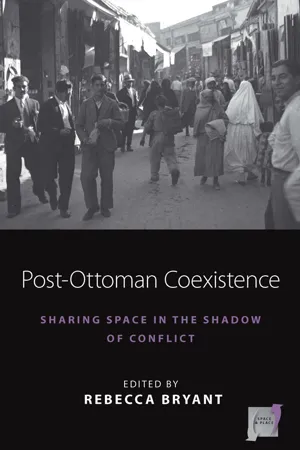
In Southeast Europe, the Balkans, and Middle East, scholars often refer to the "peaceful coexistence" of various religious and ethnic groups under the Ottoman Empire before ethnonationalist conflicts dissolved that shared space and created legacies of division. Post-Ottoman Coexistence interrogates ways of living together and asks what practices enabled centuries of cooperation and sharing, as well as how and when such sharing was disrupted. Contributors discuss both historical and contemporary practices of coexistence within the context of ethno-national conflict and its aftermath.
Considering the “Ground” for Coexistence and Conflict in Pre-modern Cyprus
IRENE DIETZEL
Cyprus is a paradigmatic post-conflict society in which “coexistence studies” abound, especially since the island’s division in 1974 into a Turkish North and a Greek South, an event that formed a tragic closure to two decades of unrest and quarrels between the communities. Peaceful coexistence of Muslims and Christians in Cyprus has been largely attributed to the dynamics of “neighborhood” (Jennings 1993, 1999; Asmussen 2001; Bryant 2004). Mixed neighborhoods, urban as well as rural, emerged during the Ottoman period (1571–1878) as a result of heterogeneous residence patterns, which at first did not follow any systematic pattern of spatial segregation.1 By the end of the Ottoman period the majority of villages (346 according to the first official census) were ethnically mixed. Although the number of mixed villages dropped drastically during the course of the twentieth century, the experience of life in mixed settlements has come to form a central part of the collective consciousness of Cypriots. The research on these shared spaces describes the texture and quality of coexistence as determined by the face-to-face-society and the rhythm of agricultural seasons. Despite a low rate of intermarriage, Cypriots forged a variety of inter-communal relations: they entertained neighborhood relations, formed friendships and cooperated in agricultural production.
This chapter contributes to this panoptic of neighborhood through an examination of the particular relationships that emerged from local forms of land use and shared concepts of property. Property relations—whether forged through inheritance practices among kin or maintained through agricultural cooperation among neighbors—were deeply woven into the fabric of neighborhood. Yet, unlike the clear-cut model of individual ownership common to contemporary Western societies, local property concepts in Ottoman Cyprus involved various degrees of ownership, rights of use, as well as an obligation for maintenance—an Ottoman distinction that in itself generated particular and highly sophisticated forms of neighborhood.
Coexistence was certainly not free of conflict. Consider the following example from the mid-twentieth century, describing a state of affairs that seemed to alienate the Cypriot modernizers of the time. The geographer and later state-appointed consolidation officer Demetrios Christodoulou writes in 1959:
Land in Cyprus is unenclosed and unfenced. This permits not only easy subdivision, but also leads to endless friction between farmer and shepherd since the latter can roam with his flocks over anybody’s property; friction, constant and costly, often exists between owners of neighboring land. (Christodoulou 1959: 84)
It is thus important to keep conflict and societal unrest between groups well within the scope of analysis. Indeed, practices of land use gave ample reason for dispute: The “constant and costly friction” described above may well be an example of what Bryant describes as “everyday diplomacy,” a constant negotiation of boundaries that distinguishes neighborliness from plain hospitality (this volume, p. 21). Yet it is worth asking why conflicts over land and resources did not tend to coincide with ethnic distinctions, mobilize on the grounds of religious identities, or reiterate religious differences. What were the underlying structures that allowed for the management of communally accessed resources as well as the distribution of property in the absence of clear-cut boundaries? Did ethno-religious differences play a part in the distribution process?
This chapter casts neighborhood in socio-ecological terms and focuses on particular strategies of Cypriot ruralists pertaining to the island’s key resources of land, forests, and water. Whether a cause for conflict or cooperation, the particular strategies are “sociogenic” (compare Lansing 1991: 128). They generate specific forms of sociality that in turn maintain the social relations necessary for the strategy to succeed. These social relations can extend far beyond the bounds of the immediate neighborhood, yet property remains a key factor. The Ottoman system of land tenure provided the island’s peasantry, both Christian and Muslim alike, with a context in which they could acquire, share, and maintain their access to land and resources. Furthermore, property was also defined by the particulars of the Mediterranean landscape. The socio-ecological perspective on Cypriot neighborhoods therefore also reflects the wider picture of the Mediterranean equation of landscape and people.
Local forms of daily coexistence did not cease with the end of Ottoman rule but survived well into the twentieth century. Nonetheless, the first half of the twentieth century witnessed a gradual dissolution of rural communities and traditional agricultural networks.2 These developments unfold prior to and along with the rise and consolidation of opposing Greek and Turkish national ideologies, the anti-colonial struggles of Greek nationalists (1955–59), as well as the violent clashes between the communities during the early years of the Republic (1963–64). The time of British colonial rule (1878–1960) therefore represents a transitional period during which the foundations for Ottoman coexistence gradually eroded. The study of coexistence in Cyprus thus inadvertently formulates a critique of colonial hegemonic practices. While the British “divide and rule” strategy has been the focus of numerous valuable studies (Constantinou 2007; Dietzel and Makrides 2009), this chapter also addresses less overt, and possibly less intentional disruptions of Ottoman coexistence, namely the British involvement in the modernization of the agricultural sector and the consequences this bore for societal dynamics between the island’s communities.
Reflections on the Ottoman System of Land Tenure
Despite the official status of most arable land as property of the state, the Ottoman Mediterranean has been described as a “sea of land proprietors,” where state land had de jure, rather than de facto character (Hadjikyriacou 2011: 49). However, the Ottoman ways of administering land and property were inherently different from those of Europe. An obvious difference lies in the absence of feudal structures in the Ottoman realm and the concomitant lack of a propertied hereditary noble class that could impose servile obligations on the peasantry. Rather, it was the “signature” of the Ottoman Empire that state control drew its legitimacy of rule from its paternalist protection of the autonomy of the peasant population. It was the priority and ideal of the central state to act as guarantor for the independence of the peasantry and the peasants’ means of subsistence, to ensure the provision of the regional markets with agricultural goods, and to prohibit the excessive accumulation of land and resources by private individuals (İslamoğlu-İnan 1991: 58).
The empire administered land and resources in a “distributive-accommodative state environment” that was inclusive of local forms of land management and that ensured the loyalty of local authorities in the provinces through the distribution of state land and tax revenues (İslamoğlu 2004: 292). The Ottoman timar state economy depended on a particular system of land distribution, whereby the state leased land to tenants for cultivation, who in turn were expected to pay a portion of their revenue as taxes. The beneficiaries of these taxes were various local rulers or pre-Ottoman ruling groups, such as the Orthodox Church, yet they exercised no jurisdiction over the peasant producers. Jurisdiction over the peasantry lay with the kadı,3 who represented Sultanic law (örf) and Shari’a. The central state thus remained the sole source of legitimation for revenue collection (İslamoğlu-İnan 1991: 59).
The Ottoman agrarian landscape was thus fashioned by the cultivation patterns of small producers. Even under increased pressures of commercial expansion following the integration of the Ottoman realm into the world market during the seventeenth century, this pattern did not change in any significant way. While market pressures would encourage the formation of large-scale commercial agriculture and single-crop plantations elsewhere in Europe, small-scale production patterns remained predominant throughout the Ottoman realm (Keyder 1990).
In Cyprus, the Ottoman conquest of 1571 brought a change to the living conditions of the local peasantry that was akin to a socio-economic revolution. By granting the peasants—hitherto serfs on the plantations of Latin feudal lords—the right to resettle and bequeath their leases on state land to their children, Ottoman rulers encouraged the emergence of subsistence agriculture as the predominant form of land use. Another important shift affected the social stratification on the island. The complex social stratification that had characterized the Latin period was replaced by a basic division of society into two major classes: a ruling class (askeri) consisting of imperial administrators, nobility, military officials, and religious clergy, and a large, tax-paying peasant class (reayah).
The emergence of a large and religiously heterogeneous peasant class, as well as the autonomy of small-scale cultivators were important factors in the development of local forms of coexistence. Until the mid-nineteenth century, taxes and tithes were exacted from the villages as a whole—this, one might argue, necessitated a certain degree of internal village solidarity and thereby discouraged social or interethnic strife that could compromise the ability to meet tax requirements.4
The legal context of Ottoman land administration offered another flexible system that could accommodate a multitude of claims. Questions pertaining to the way in which the formal category of state property (miri) blended with existing patterns of land ownership have been little explored. The legal context that emerged, however, represents the ability of the empire to respond to the cultural diversity throughout its provinces. The Ottoman Land Code reflects the complexity of the system: promulgated by Sultan Abdul Mecid in 1858 during the Ottoman reform period, the Land Code aimed at modernizing the system of land tenure, but accommodated much of the old system within it. It set down no less than five types of categorization of land:5 the large part of arable land was state property (miri) that could be rented to individuals for cultivation. The tenant would have to hold a title deed to prove his, or her,6 rights to cultivate a particular plot. The tenant could also bequeath the lease to his, or her, children. The land could revert back into exclusive state ownership if the tenant left it uncultivated over a period longer than three years. In the case of reversion, the tenant could still buy the rights back by payment of an equivalent sum. This provision, however, was rarely enforced.
A second category comprised all immovables that were full property, or freehold (mülk). Next to land and houses, also planted trees, such as orchards and vineyards, as well as water holdings would fall under this category. In the latter cases, the law envisioned a system of “multiple ownership.” A piece of land, for example, could be owned by the state and leased to a peasant, while the trees growing on this land, or the water that irrigated it could be owned by another.
The full property of religious organizations, however, was not subject to the Ottoman Land Code, but rather to Shari’a law. While religious institutions were exempt from taxes, the revenue of these lands and properties, subsumed under the term evkaf, would be dedicated to religious and charitable purposes. The category of evkaf also included state-owned land, on which the tenant paid taxes and tithes to a religious organization and not to the state.
This communal purpose further defined all land that was dedicated to the public (metruk), such as those tracts in the vicinity of settlements, which were assigned to the inhabitants of villages or towns as a whole. These lands could not be individually possessed, bought, sold, inherited, or used for any other purpose other than that for which they were distinctly assigned ab antiquo. The category comprised communal forests, village pasture lands, public roads, and places of worship.
Finally, the remaining waste or rough-land (hali) could function as state land, while permission had to be granted for its use. All rights to utilization were revoked after three years of non-cultivation.
All of the above categories were important factors in the administration of Ottoman provinces. For the fabric of neighborhood, however, the particular stipulation for forms of multiple ownership may have been especially significant, since it legally bound together several individuals as shareholders of one agricultural unit (such as irrigated orchards and multi-use fields). This kind of shareholding not only necessitated a certain level of cooperation, it also fused together the interests of shareholders in the functionality of the agricultural unit, thereby furthering a “sense of the commons”7 within the villages. To the quality of Ottoman neighborhoods, the system of land tenure added another realm of negotiation and diplomacy—perhaps analogously to the “constructive ambiguity of belonging” in Ottoman neighborhoods (this volume, p. 21ff), the Ottoman Land Code and its multiple forms of property reflect an equally constructive ambiguity of ownership.
Reflections on the Mediterranean Landscape of Production
While anthropologists have questioned the idea that an area with as much linguistic and religious diversity as the Mediterranean may represent a cultural unit (especially Herzfeld 1984; Pina-Cabral 1989), there seems to be more agreement on the Braudelian view of the Mediterranean as an ecological unit. Central works have identified the Mediterranean landscape as the fundament for a cultural distinction that nonetheless characterizes local traditions across the region (Braudel 1972; Horden and Purcell 2000; Tabak 2008). While all of these works acknowledge the landscape as a Mediterranean characteristic of longue durée, they vary in their estimation of the geo-deterministic element in Mediterranean history. Still, the history of Mediterranean localities, and with it Cypriot neighborhood, proceeds from the environmental strategies of local agriculturalists and pastoralists who have altered the Mediterranean landscape in a lasting fashion, rendering it essentially anthropogenic. Such reciprocity of environmental and human history is reflected in Horden and Purcell’s concept of “micro-region.” It includes “obvious microtopographical identifiers,” such as the location of valleys, plains, or the sides of islands, characterized by their particular hydrology, soil conditions, vegetation cover, and annual weather cycle. But it also encompasses the various human effects on the landscape, such as the intensity of labor, the number of animals, and the specific choices of productive strategies. Micro-regions are further determined by the locations they are functionally connected to, such as harbors or detached pastures (Horden and Purcell 2000: 302). Traditional agriculture in Cyprus revolved around these micro-regions and the multitude of micro-economic opportunities they afforded. It is therefore important to imagine Cypriot rural neighborhoods and the “labor of peace” they entailed as taking place within these micro-regions, rather than as confined to the residential settlements of the village.
The landscapes of production in Ottoman Cyprus resembled the “agro-sylvo-pastoral system” typical for the Mediterranean region (Blondel 2010; Schnabel 2004; Delipetrou et al. 2008; Tabak 2008). The combination of cereals, tree-crops, and small livestock that made up the core of Cypriot small-scale production bore significant socio-ecological advantages, as it helped to optimize the use of microclimatic and edaphic variations on the island. Interestingly, this polycultural strategy was shared by all peasants, irrespective of their ethno-communal affiliations. In contrast to other c...
Table of contents
Cover Page
Title Page
Copyright Page
Contents
List of Illustrations
Acknowledgments
Introduction. Everyday Coexistence in the Post-Ottoman Space
Part I. Landscapes of Coexistence and Conflict
Part II. Performing Coexistence and Difference
Part III. Negotiating Everyday Coexistence in the Shadow of Conflict
Index
Trusted by 375,005 students
Access to over 1.5 million titles for a fair monthly price.
Study more efficiently using our study tools.
Frequently asked questions
Yes, you can cancel anytime from the Subscription tab in your account settings on the Perlego website. Your subscription will stay active until the end of your current billing period. Learn how to cancel your subscription
No, books cannot be downloaded as external files, such as PDFs, for use outside of Perlego. However, you can download books within the Perlego app for offline reading on mobile or tablet. Learn how to download books offline
Perlego offers two plans: Essential and Complete
Essential is ideal for learners and professionals who enjoy exploring a wide range of subjects. Access the Essential Library with 800,000+ trusted titles and best-sellers across business, personal growth, and the humanities. Includes unlimited reading time and Standard Read Aloud voice.
Complete: Perfect for advanced learners and researchers needing full, unrestricted access. Unlock 1.5M+ books across hundreds of subjects, including academic and specialized titles. The Complete Plan also includes advanced features like Premium Read Aloud and Research Assistant.
Both plans are available with monthly, semester, or annual billing cycles.
We are an online textbook subscription service, where you can get access to an entire online library for less than the price of a single book per month. With over 1.5 million books across 990+ topics, we’ve got you covered! Learn about our mission
Look out for the read-aloud symbol on your next book to see if you can listen to it. The read-aloud tool reads text aloud for you, highlighting the text as it is being read. You can pause it, speed it up and slow it down. Learn more about Read Aloud
Yes! You can use the Perlego app on both iOS and Android devices to read anytime, anywhere — even offline. Perfect for commutes or when you’re on the go. Please note we cannot support devices running on iOS 13 and Android 7 or earlier. Learn more about using the app
Yes, you can access Post-Ottoman Coexistence by Rebecca Bryant in PDF and/or ePUB format, as well as other popular books in Social Sciences & Politics. We have over 1.5 million books available in our catalogue for you to explore.