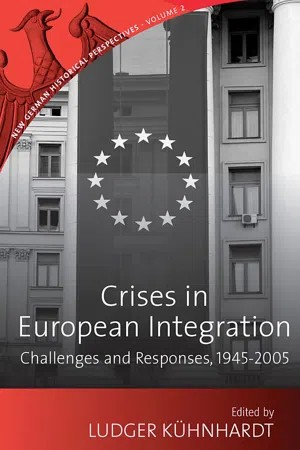
While the major trends in European integration have been well researched and constitute key elements of narratives about its value and purpose, the crises of integration and their effects have not yet attracted sufficient attention. This volume, with original contributions by leading German scholars, suggests that crises of integration should be seen as engines of progress throughout the history of European integration rather than as expressions of failure and regression, a widely held assumption. It therefore throws new light on the current crises in European integration and provides a fascinating panorama of how challenges and responses were guiding the process during its first five decades.
- 176 pages
- English
- ePUB (mobile friendly)
- Available on iOS & Android
eBook - ePub
About this book
Trusted by 375,005 students
Access to over 1.5 million titles for a fair monthly price.
Study more efficiently using our study tools.
Information
1
Sources of European Integration: The Meaning of Failed Interwar Politics and the Role of World War II
When some sixty years ago in his famous Zurich speech of September 19, 1946, Winston Churchill called for the building of “a kind of United States of Europe,” he was arguing in light of the failures of the past. As he said:
The League of Nations did not fail because of its principles or conceptions. It failed because these principles were deserted by those States who had brought it into being. It failed because the Governments of those days feared to face the facts, and act while time remained. This disaster must not be repeated. There is therefore much knowledge and material with which to build: and also bitter dear-bought experience.1
It does indeed seem that this experience was the most important driving force behind the efforts to build a European community and promote European integration in the period after World War II. In order to understand the emergence of the first institutions of this European community, I would therefore like to invite you to consider this first major cycle of crises and responses: What were the “knowledge and material” that Churchill mentioned in his speech, and how were they used to build the kind of “European family” we now know?
Experiences of War
When the failure of the Treaty of Versailles became apparent, initiatives toward the unification of Europe were given new impetus. The success of the politics of revision and the rapid march to victory by National Socialist Germany in 1939–40 made it painfully obvious to the peoples of Europe that the European nation-states were no longer in a position to guarantee the safety of their citizens. Alliances and pact systems of the conventional type no longer offered adequate protection against armed aggression. This realization gave added strength to demands for the creation of collective security structures which would do away with interstate anarchy at least in Europe. At the same time, all those nations which felt themselves threatened by the expansion of National Socialist Germany moved closer together.
In Great Britain, this development began to make itself apparent soon after the Munich Agreement of 1938. Authors such as Lord Lothian and Clarence Streit, who advocated a federation of the democratic states, gained a great deal of attention. Within a very short time, the “Federal Union” favoring this program had attracted more than ten thousand members and with the broad support of the academic and political establishment, had organized a series of conferences in 1939 and 1940, at which there was substantive discussion of the problems of a federative reorganization of Europe. In March of 1940, a Federal Union Research Institute was established at the University of Oxford and very quickly became the center of discussion.2
Churchill’s famous union offer to France has to be discussed within the framework of this movement. On June 16, 1940, the British government followed the initiative of Jean Monnet (who oversaw the French efforts of coordinating the wartime supply with Britain) and General Charles de Gaulle (deputy secretary of the French War Department who had just arrived in London) by proposing a joint declaration that was to announce joint civil rights for British and French citizens and joint bodies for the conduct of war. From Churchill’s perspective this was certainly a maneuver intended first of all to keep the French from signing a truce with the German victors. Yet there is no doubt that, had the French accepted, this proposal indeed would have led to joint war efforts; and on both sides, there were politicians and civil servants who wanted to continue institutional cooperation in peacetime.3
Subsequently, when Britain had been fighting entirely alone for more than a year against the German onslaught, the willingness of the British to enter into a permanent association with the continent had diminished perceptibly. Hopes for peace in the long term were now predominantly based around close cooperation with the US, and the country tended to see itself as growing into the role of one of the three world powers that would be called upon to safeguard peace in the future.4 Conversely, in those places where the German occupation inspired resistance, the experience of the failure of the League of Nations was deepened by that of national fragmentation and disintegration. Under these conditions, the rejection of the principle of the nation-state was formulated in a correspondingly radical fashion, and the appeal of federalist ideas became broader as soon as the defeat of the Nazis began to seem plausible. “In one point, my convictions are profound and unshakable, whatever the world may say,” wrote the French socialist leader Léon Blum in early 1941 in one of the Vichy government’s prisons. “If this war does not at last give rise to fundamentally stable international institutions, to a really effective international power, then it will not be the last war.” Like Blum, dozens of resistance writers and the overwhelming majority of resistance programs formulated what was required for this kind of effectiveness: the restriction of national sovereignties in favor of a superstate with its own institutions and leadership. “The international body must have the institutions and the powers it needs to do what it is created to do; in other words, it must be boldly and openly set up as a superstate on a level above national sovereignties.”5
The longer the struggles of the war lasted, the more the thinking of the elite within the resistance was shaped by the experience of an increasing dissolution of power vis-à-vis the new world powers as well as by the war itself and by the general collapse it caused. While Europe had largely exhausted its resources in the conflict, the United States had more than doubled its production volume. This finally allowed the yardstick of economic productivity to be extended beyond the confines of European nation-states, and fundamentally called into question the competitiveness of the countries of Europe, and therefore also their independence. Due to the key military decisions of the war, the United States at the same time rose to be the leading military power in the world, while the Soviet Union emerged as far and away the strongest military force on the European continent. This not only robbed the old states of the continent of a great deal of their previous influence over world politics, but actually placed them increasingly within the power of the war’s two main victors. Europeans came to realize that they needed to pool their resources if they were to have any hope of holding their own against the new world powers in the future.6
The readiness to find supranational solutions was further reinforced by the fact that many resistance fighters regarded totalitarian suppression by fascists as the ultimate consequence of the adoration of the principle of the nation-state’s sovereignty. In the struggle against the extreme fascist form of power politics and nationalism, they rediscovered the community of traditional European values. What drove them to resist was less the struggle against foreign domination than the revolt against the suppression of human rights. This caused them to move toward one another across philosophical, social and national divides, and to seek ways to avoid a repetition of the unleashing of the nation-state’s power. Ernesto Rossi and Altiero Spinelli addressed this in the summer of 1941 in light of long discussions with fellow inmates on the Italian prison island of Ventotene: “No longer is the ‘nation’ considered to be the historical product of the communities of man that find their state to be the most efficacious form of organizing collective life.” The nation-states’ striving for dominance, they asserted, necessarily leads to totalitarian regimes. The peoples of Europe must therefore do away with the continent’s division into sovereign nation-states in order to combat the exploiters of the old order. A “federal reorganization of Europe” was the essential prerequisite for the development of modern civilization, a process that had been completely shut down in the era of totalitarianism.7
The revolutionary dimension of this European movement became even more apparent among the representatives of the socialist left. The development of productive forces led them to conclude that a socialist revolution in Europe required a federative reorganization; at the same time, the socialist left emphasized the necessity of this radical change as a prerequisite for a European peace order. This applies to Austro-Marxists such as Oskar Pollak8 as much as to those young leaders of left-wing German socialist groups in exile such as Willi Eichler, Richard Löwenthal, and Willy Brandt,9 and the southern French resistance groups “Libérer et Fédérer” and “L’Insurgé” of Alexandre Marc and Marceau Pivert.10 They all assumed that the anti-fascist uprising offered a chance for socialist revolution. However, the engagement for a federative new order also made most of them open to pragmatic partial solutions that could be realized in a compromise with non-socialist forces. This resulted not only in the partial renewal of democratic socialism, particularly in France and in Germany, but also, as a closely connected phenomenon, in the growing commitment of these parties to a “Federation of all European Peoples.”11
The longer the war lasted and the more evident the bestiality of the National Socialist regime became, the clearer became the need for federative structures to solve the German problem as well. “Hatred cannot banish hatred, nor violence put an end to violence,” wrote Léon Blum as early as 1941. “There is only one way to resolve the contradiction, to make Germany harmless in a peaceful and stable Europe, and that is to incorporate the German nation in an international community.”12 To eliminate the social roots of German imperialism, it was essential that there be a controlled reform of German society by the victors. This tutelage, as Claude Bourdet put it in the French resistance newspaper Combat in March of 1944, “cannot be justified and will not be accepted unless it is followed by the renunciation, by all the nations of Europe, of part of their national sovereignty in favor of the European federation.” Without the prospect of development within the federative community of Europeans, the coercive measures of the victors threatened to produce only a new movement bent on revenge.13
It goes without saying that these arguments also struck a chord with those Germans who were thinking about the future of their nation after the defeat of the Third Reich. The democratic resistance could conceive of a future for Germany acceptable to all European nations only in a federative international order. As the prospects of an uprising against the National Socialist regime disappeared, its supporters tried to draw the attention of the Allies to the link between democratization and federalization. The conservative resistance around such men as Ludwig Beck, Ulrich von Hassell and Carl Goerdeler was initially oriented toward the traditional conceptions of a Central Europe dominated by Germany. Many of its supporters, however, became more modest as time passed. A good number, such as Goerdeler in particular, allowed themselves to be won over to the necessity of economic integration and controlled disarmament and in the end, they were drawn to the concept of a federated Europe “in which neither Germany nor any other power would claim predominance.”14
Taken together, the experiences of World War II brought about a broad European unification movement by 1943. Some uncertainties remained regarding the geographic borders of a united Europe and its relationship with a global peacekeeping organization. Within the movement, there were different notions of its position toward the Soviet Union and the role of the Germans within a united Europe; there were also differences on social conceptions and strategies. The supporters of the movement renounced traditional power politics and the political implementation of its ideals to different degrees, and they also varied in their pronouncements regarding the necessity of certain regional alliances. However, beyond the limits of national and philosophical outlooks, they agreed (often even using quite similar arguments) on the inadequacy and the dangers of the nation-states’ outdated system of order and on the necessity of federative solutions. This consensus was shared among the majority of the politicians in exile as well as the vast majority of the resistance fighters in the occupied countries from France to Poland, although not among a minority of conservatives or the communist resistance. Britain did not join the movement either given that trust in its own forces increased again after its having previously been drawn to federative solutions; and neither did the Nordic stat...
Table of contents
- Cover
- Title
- Copyright
- Contents
- Editorial Preface
- Introduction: European Integration: Success through Crises
- 1 Sources of European Integration: The Meaning of Failed Interwar Politics and the Role of World War II
- 2 The Failure of EDC and European Integration
- 3 The Institutional Paradox: How Crises Have Reinforced European Integration
- 4 Through Crises to EMU: Perspectives for Fiscal Union and Political Union
- 5 Opportunity or Overstretch? The Unexpected Dynamics of Deepening and Widening
- 6 Learning from Failure: The Evolution of the EU’s Foreign, Security and Defense Policy in the Course of the Yugoslav Crisis
- 7 Challenges and Opportunities: Surmounting Integration Crises in Historical Context
- 8 Frontiers and Chances for the European Union
- Select Bibliography
- Notes on Contributors
- Index
Frequently asked questions
Yes, you can cancel anytime from the Subscription tab in your account settings on the Perlego website. Your subscription will stay active until the end of your current billing period. Learn how to cancel your subscription
No, books cannot be downloaded as external files, such as PDFs, for use outside of Perlego. However, you can download books within the Perlego app for offline reading on mobile or tablet. Learn how to download books offline
Perlego offers two plans: Essential and Complete
- Essential is ideal for learners and professionals who enjoy exploring a wide range of subjects. Access the Essential Library with 800,000+ trusted titles and best-sellers across business, personal growth, and the humanities. Includes unlimited reading time and Standard Read Aloud voice.
- Complete: Perfect for advanced learners and researchers needing full, unrestricted access. Unlock 1.5M+ books across hundreds of subjects, including academic and specialized titles. The Complete Plan also includes advanced features like Premium Read Aloud and Research Assistant.
We are an online textbook subscription service, where you can get access to an entire online library for less than the price of a single book per month. With over 1.5 million books across 990+ topics, we’ve got you covered! Learn about our mission
Look out for the read-aloud symbol on your next book to see if you can listen to it. The read-aloud tool reads text aloud for you, highlighting the text as it is being read. You can pause it, speed it up and slow it down. Learn more about Read Aloud
Yes! You can use the Perlego app on both iOS and Android devices to read anytime, anywhere — even offline. Perfect for commutes or when you’re on the go.
Please note we cannot support devices running on iOS 13 and Android 7 or earlier. Learn more about using the app
Please note we cannot support devices running on iOS 13 and Android 7 or earlier. Learn more about using the app
Yes, you can access Crises in European Integration by Ludger Kühnhardt in PDF and/or ePUB format, as well as other popular books in History & European History. We have over 1.5 million books available in our catalogue for you to explore.