The period between 1917 and 1957, starting with the birth of the USSR and the American intervention in the First World War and ending with the Treaty of Rome, is of the utmost importance for contextualizing and understanding the intellectual origins of the European Community. During this time of 'crisis,' many contemporaries, especially intellectuals, felt they faced a momentous decision which could bring about a radically different future. The understanding of what Europe was and what it should be was questioned in a profound way, forcing Europeans to react. The idea of a specifically European unity finally became, at least for some, a feasible project, not only to avoid another war but to avoid the destruction of the idea of European unity. This volume reassesses the relationship between ideas of Europe and the European project and reconsiders the impact of long and short-term political transformations on assumptions about the continent's scope, nature, role and significance.
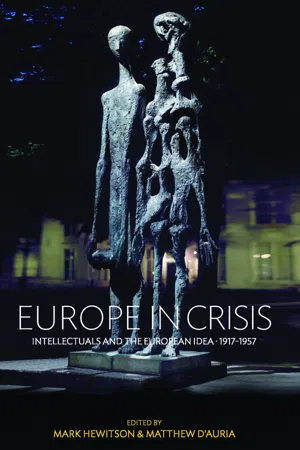
eBook - ePub
Europe in Crisis
Intellectuals and the European Idea, 1917-1957
- 360 pages
- English
- ePUB (mobile friendly)
- Available on iOS & Android
eBook - ePub
Europe in Crisis
Intellectuals and the European Idea, 1917-1957
About this book
Trusted by 375,005 students
Access to over 1.5 million titles for a fair monthly price.
Study more efficiently using our study tools.
Information
Part I
PROLOGUE

‘Europe’, claimed Simone de Beauvoir in the memoirs which she published in 1963, was a myth, used by the United States as it sought to restore the power of Germany as a counterweight to that of the USSR.1 Over the last two decades or so, historians, drawing on works from the 1960s and beyond, have investigated the European myth and the uses to which it has been put, in part to redirect attention from the ‘founding fathers’ of the European Communities to the wider cultural, intellectual, political and diplomatic context in which so-called founders lived and worked.2 Despite such studies, however, much of the literature on conceptions of Europe and on processes of European integration arguably relies too heavily on one – or more – of three propositions: first, that ideas of Europe – or a European identity – contain enduring elements and have ‘origins’ which can be identified and investigated; second, that there was an important historical shift – or a ‘zero hour’ – during or after the Second World War which made projects for Europe seem more realizable and significant, not necessarily to the exclusion of long-established ideas of Europe but at the expense of tradition ‘as a legitimizing force’; and, third, that questions of identity and culture quickly became secondary during the postwar era, displaced by planning and technocracy in practice and by neo-functionalism in theory.3 It is intended here, not to deny, but to qualify these propositions through an examination of the persistence of ideas and the relationship between ideas and policy making during the period of ‘crisis’ from 1917 to 1957.
Discussion of ideas in the public sphere affected the formulation of policy. As a comparison of the long nineteenth and short twentieth centuries makes plain, contemporaries were only likely to advocate greater cooperation between European states or, even, integration in certain spheres of state activity as a consequence of a specific set of beliefs about recent history, Europe’s place in the world, economic prosperity, nationalism and the nation-state. To most prewar Europeans, such cooperation – not to mention integration – would have been unthinkable. Nevertheless, it is equally obvious that ‘ideas’, especially those articulated by intellectuals and publicists, rarely dictated political actions. Europe was an ‘invention’, in Gerard Delanty’s formulation, in so far as it was ‘constructed in a historical process’, ‘a historically fabricated reality of ever-changing forms and dynamics’, yet it was also the product of history’s ‘divisions and frontiers, both internal and external’, ‘interpolated in concrete configurations of power and their geo-political complexes’.4 ‘Europe’, as a construction of ideas, was subject to constant contestation and transformation, as different interested parties sought to adapt it to existing or perceived conditions – or to prevent its adaptation – for their own purposes. In such circumstances, the ‘origins’ or enduring elements of a putative European idea or identity – ‘crystallisations’, in Delanty’s phrase – are less significant than shorter-term relationships between participants in public debates, politics and the making of public policy in given but changing conditions.5 Individuals’ motivations and actions are incomprehensible without reference to their assumptions, ideas and beliefs, but they are not to be understood merely as their corollary. Advocates and opponents of diverse projects for Europe appear to have had very different reasons for acting as they did as a result of varying national and political perspectives, traditions and interests, not least because any European project required the establishment of new practices and institutions, in conjunction with a shift away from existing levels and spheres of government. Actors had many motives for supporting, opposing or ignoring a particular conception of or project for Europe. Many of their motives appear to have been informed by ideas which had been debated in the public sphere. The following chapters examine the ways in which ideas, interests, motives, conditions and actions intersected. Chapters 1 and 2 show how policy-makers’ actions in the 1920s, the late 1940s and the 1950s betrayed a profound sense of the purported crisis of Europe, which helps to explain why they attempted to achieve European cooperation in both periods at the same time as evincing a frequent disregard for the precise, often confusing, diagnoses and prognoses put forward by intellectuals. As is demonstrated in Chapter 3, there was a broad sense amongst intellectuals that Europe existed and that it was being eclipsed, but there was little agreement about what Europe consisted of and how it might be ‘saved’.
Many earlier conceptions of and projects for Europe persisted after the Second World War.6 Certainly, the French intellectual Julien Benda was not alone in maintaining that ‘the war has exercised no influence either way on my ideas or on my conception as to the manner of expressing them.’7 Intellectuals like Benda, Jean-Paul Sartre, Raymond Aron, André Malraux, Lucien Febvre, Jacques Maritain, Emmanuel Mounier, André Gide, François Mauriac, José Ortega y Gasset, Altiero Spinelli, Benedetto Croce, the Mann brothers, Max Horkheimer, Otto Kirchheimer, Carl Schmitt, Ernst Jünger, Karl Jaspers, Isaiah Berlin, Karl Popper, John Maynard Keynes, Friedrich Hayek and Arnold Toynbee were all active before and after 1945, as were the different schools of European Marxism, political Catholicism, liberalism, social democracy, and orthodox and renegade conservatism. Such movements and thinkers continued to countenance and disseminate heterogeneous views about the future of Europe, some of which influenced decision makers. In keeping with the tenor of contemporary commentary, the actions of such statesmen and politicians in both the interwar and postwar eras were largely defensive, reacting to the menace of extra-European powers such as the USSR and United States, and to conflict and a crisis of confidence in Europe itself after the First World War – facts which seemed to have been confirmed by the Second World War, the onset of the Cold War, and the shocking revelation of the Holocaust. The ‘German question’ and the Franco-German axis remained central to most European policy makers in both postwar periods, with even semi-detached British observers like General Hastings Lionel Ismay – Winston Churchill’s chief military assistant in the Second World War and later Secretary General of NATO – admitting that the North Atlantic Treaty Organization was not merely designed to keep the United States in Europe and the USSR out, but also to keep Germany down.8 Many European ministers continued to combine fear and hubris with regard to the wider world, with the British Foreign Office attempting to maintain a global role until the Suez crisis of 1956, and with the Quai d’Orsay attempting to rebuild its empire – including major campaigns and loss of life in Syria, Madagascar, Indo-China and Algeria – until the late 1950s. Such uncertainty about the role of European powers was similar in some respects to that of the 1920s. It helped to produce a bewildering array of prognoses for Europe’s recovery in the late 1940s and 1950s, as in the 1920s, which often clashed with plans for the ‘rescue’ of individual nation-states and reconstruction of national economies, and which took place in tumultuous conditions, militating towards limited, predominantly economic reform on the European level rather than political or military integration.9
What is surprising, it could be held, is the precariousness of decisions for and against ‘Europe’ in the 1920s and early ’30s, and in the late 1940s and early ’50s. History, agreed the liberal, ‘positivist’ Austrian émigré Karl Popper and the ex-socialist, conservative-minded Spanish liberal José Ortega y Gasset, had no intrinsic direction.10 What would happen in and to Europe was, as historians of the Cold War have begun to acknowledge, difficult to predict.11 Chapters 1 and 2 show how nationalism, traditions of the state, globalism and the priorities of domestic politics continued to stand in the way of Europeanism, despite contemporaries’ newly articulated and strong attachment to the continent against the backdrop of a continuing European crisis. They reveal the fragility and reversibility of instances and processes of European cooperation and integration during the aftermaths of both world wars. Chapter 3 examines intellectuals’ conceptions of the crisis of Europe, as well as the flawed quest for origins and building blocks of identity on the part of historians of a ‘European idea’. This section aims to contextualize common and competing ideas of Europe by relating them to other sets of political ideas, in the domestic and international spheres (Chapter 3), and by assessing their significance in the formulation and execution of policy (Chapters 1 and 2).
Notes
1. S. de Beauvoir, La force des choses (Paris, 1963), 340.
2. Recent projects include R. Girault (ed.), Identité et conscience européenne au XXe siècle (Paris, 1994); R. Frank (ed.), Les identités européennes au XXe siècle (Paris, 2004); R. Girault and G. Bossuat (eds), Europe brisée, Europe retrouvée. Nouvelles réflexions sur l’unité européenne au XXe siècle (Paris, 1994); R. Hudemann et al. (eds), Europa im Blick der Historiker (Munich, 1995); E. du Réau (ed.), Europe des elites? Europe des peoples? La construction de l’espace européenne 1945–1960 (Paris, 1998); E. Bussière (ed.), Europa. L’idée et l’identité européennes de l’antiquité grecque au XXe siècle (Anvers, 2001); H. Kaelble, Europäer über Europa. Die Entstehung des europäischen Selbstverständnisses im 19. und 20. Jahrhundert (Frankfurt, 2001); and G. Bossuat and G. Saunier (eds), Inventer l’Europe. Histoire nouvelle des groupes d’influence et des acteurs de l’unité européenne (Brussels, 2003). Foundational works include F. Chabod, Storia dell’idea europa (Bari, 1961), J.-B. Duroselle, L’idée d’Europe dans l’histoire (Paris, 1965), G. Barraclough, European Unity in Thought and Practice (Oxford, 1963), and H. Brugmans, L’idee européenne 1920–1970, 3rd edn. (Bruges, 1970).
3. Recent investigations of origins and ‘building blocks’, some more critical than others, are H. Mikkeli, Europe as an Idea and an Identity (Basingstoke, 1998), 3–108; G. Delanty, Inventing Europe: Idea, Identity, Reality (Basingstoke, 1995), 16–129; K. Wilson and J. van der Dussen (eds), The History of the Idea of Europe (London, 1993), 13–82; A. Pagden, The Idea of Europe: From Antiquity to the European Union (Cambridge, 2002), 1–32; R. Girault, ‘Das...
Table of contents
- Cover Page
- Title Page
- Copyright Page
- Contents
- List of Maps and Figures
- Acknowledgements
- Introduction: Europe during the Forty Years’ Crisis
- PART I PROLOGUE
- PART II REIMAGINING THE PAST
- PART III MAKING SENSE OF THE PRESENT
- PART IV LOOKING TO THE FUTURE
- Conclusion: Europe between a Crisis of Culture and Political Regeneration
- Notes on Contributors
- Select Bibliography
- Index
Frequently asked questions
Yes, you can cancel anytime from the Subscription tab in your account settings on the Perlego website. Your subscription will stay active until the end of your current billing period. Learn how to cancel your subscription
No, books cannot be downloaded as external files, such as PDFs, for use outside of Perlego. However, you can download books within the Perlego app for offline reading on mobile or tablet. Learn how to download books offline
Perlego offers two plans: Essential and Complete
- Essential is ideal for learners and professionals who enjoy exploring a wide range of subjects. Access the Essential Library with 800,000+ trusted titles and best-sellers across business, personal growth, and the humanities. Includes unlimited reading time and Standard Read Aloud voice.
- Complete: Perfect for advanced learners and researchers needing full, unrestricted access. Unlock 1.5M+ books across hundreds of subjects, including academic and specialized titles. The Complete Plan also includes advanced features like Premium Read Aloud and Research Assistant.
We are an online textbook subscription service, where you can get access to an entire online library for less than the price of a single book per month. With over 1.5 million books across 990+ topics, we’ve got you covered! Learn about our mission
Look out for the read-aloud symbol on your next book to see if you can listen to it. The read-aloud tool reads text aloud for you, highlighting the text as it is being read. You can pause it, speed it up and slow it down. Learn more about Read Aloud
Yes! You can use the Perlego app on both iOS and Android devices to read anytime, anywhere — even offline. Perfect for commutes or when you’re on the go.
Please note we cannot support devices running on iOS 13 and Android 7 or earlier. Learn more about using the app
Please note we cannot support devices running on iOS 13 and Android 7 or earlier. Learn more about using the app
Yes, you can access Europe in Crisis by Mark Hewitson, Matthew D'Auria, Mark Hewitson,Matthew D'Auria,Matthew D’Auria in PDF and/or ePUB format, as well as other popular books in History & European History. We have over 1.5 million books available in our catalogue for you to explore.