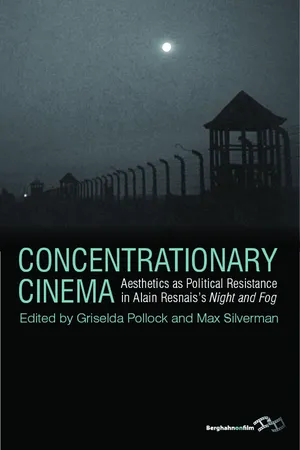
Since its completion in 1955, Alain Resnais's Night and Fog (Nuit et Brouillard) has been considered one of the most important films to confront the catastrophe and atrocities of the Nazi era. But was it a film about the Holocaust that failed to recognize the racist genocide? Or was the film not about the Holocaust as we know it today but a political and aesthetic response to what David Rousset, the French political prisoner from Buchenwald, identified on his return in 1945 as the 'concentrationary universe' which, now actualized, might release its totalitarian plague any time and anywhere? What kind of memory does the film create to warn us of the continued presence of this concentrationary universe? This international collection re-examines Resnais's benchmark film in terms of both its political and historical context of representation of the camps and of other instances of the concentrationary in contemporary cinema. Through a range of critical readings, Concentrationary Cinema explores the cinematic aesthetics of political resistance not to the Holocaust as such but to the political novelty of absolute power represented by the concentrationary system and its assault on the human condition.
eBook - ePub
Concentrationary Cinema
Aesthetics as Political Resistance in Alain Resnais's <I>Night and Fog</I>
- 358 pages
- English
- ePUB (mobile friendly)
- Available on iOS & Android
eBook - ePub
Concentrationary Cinema
Aesthetics as Political Resistance in Alain Resnais's <I>Night and Fog</I>
About this book
Trusted by 375,005 students
Access to over 1.5 million titles for a fair monthly price.
Study more efficiently using our study tools.
Information
CHAPTER 1
Night and Fog: A History of Gazes
Writing a historical analysis of the film Night and Fog presents several challenges to the film historian – developing the ideas on the fate and migration of archives which I broached in my book Clio de 5 à 7, implementing a ‘history of gazes’, and gaining a historian's understanding of the question of the work of art.1 In my book-length study of Resnais's film, published in French in 2007, I resolved these challenges through the manner in which I structured the presentation of material and through the conclusions I was able to draw from my extensive examination of the archives, documents, and visits.2 In this chapter, in which I wish to present the main lines of my model of historical film analysis, I will retrace that structure and present the key conclusions at which I arrived. What I set out to produce is not so much a monograph on Alain Resnais's documentary film as a ‘micro-history in movement’, which consists in slowly and carefully observing the film and then displacing it in space and time.3
In a stimulating text on Michelangelo Antonioni's Blow-up (1966), Jacques Revel establishes an analogy between the process of micro-history and that of the main character's investigation, which is set in motion by some seemingly insignificant photographs taken in a London park. Thus, the historian tells us, ‘is constituted a corpus that makes a story, or rather several stories, possible, since every time a photograph is printed anew, it discloses a different, hitherto invisible, reality that engenders a new plot’.4 My book is marked by these dynamics of stories generated by images being printed, re-framed and enlarged, and meanings and interpretations branching off into different directions, led by the interplay of many different gazes.
The main historical question is how did Night and Fog come into being. It is necessary to explore the mysteries of its creation and penetrate the ‘black box’ of its production. Once the film was completed, the questions to be addressed are how Night and Fog was seen, how perceptions of the film were brought into play in different national contexts, and how they have shifted with time. The film's longevity and the international scope of its distribution have made it a ‘portable lieu de mémoire’ (site of memory), in the strongest sense of the term, or, to borrow the expression of Ruth Klüger, a ‘timescape’, intersected by the many issues at stake.5
In writing a historical study of this film's production and reception, questions of writing and narrative construction I was confronted with. The study of the film evolved into a two-part portrait of the historian Olga Wormser-Migot, who served as Resnais's adviser and his inspiration in all the questions related to the history of the deportation. I followed the thread of Olga Wormser-Migot's perception of the historical events while pondering the oft-debated question of how the film was written, what historical knowledge underpinned the writing, and what issues of memory formed it. I was unable to solve what seemed puzzling to me at the time: the way the scenario fluctuated, the changes in point of view, and above all, the gap between what some of the images seemed to mean and what the commentary of the film, written by Jean Cayrol, did not say. The bird's-eye view approach of drawing up an inventory, as it were, of the body of historical knowledge existing at the time and the domination of memory did not work. So I went back to look at the problem from the inside, trying to penetrate the heart of what Michel de Certeau calls ‘the historiographical operation’.6
It was while studying Olga Wormser-Migot's personal and professional background at closer range – her first confrontations with the deportation, her discoveries and assumptions about the concentration camp system – that I began to understand. Olga Wormser-Migot's knowledge and reading had nourished Night and Fog, but her hesitations and contradictions had also filtered into the film. My initial thinking was wrong then; I had assumed that Night and Fog conformed to the principle of most historical films: as a rule, when historians are brought in to act as advisers to filmmakers, they arrive with a finished, solidly constructed work which they put at the service of the staging and construction of a filmed account. In the case of Night and Fog, however, the film was not the fruit of an accomplished work; it was actually the rough draft and first summary of a still-evolving history.
In Blow-up it is the desire and the gaze of the female partner of the couple in and on the photograph that give the investigation its momentum. The woman's need to recover the film raises a question. The point from which she observes within the photograph reveals another scene, the scene of a crime at which the photographer was present without seeing. It is because the thread of Olga Wormser-Migot's perception allowed me to see Night and Fog differently that I decided to construct my book with her portrait as its core.
Creation: the film as palimpsest
It was important to trace the creation of the film, laying particular emphasis on certain discoveries and on the archival documents that made them possible.
The plan for a film about the deportation was launched in November 1954 by Olga Wormser together with Henri Michel, secretary of the Comité d'Histoire de la Deuxième Guerre mondiale, a government commission assigned to document and study the history of the Second World War. The two historians made the announcement at the inauguration of ‘Résistance, Libération, Déportation’, an exhibition organized in Paris on the tenth anniversary of the liberation. This exhibition played an important role to the extent that it served as a documentary collection for the film Night and Fog.
My first discovery had to do with the role played in the launching of the project by an agency that remained very discreet and as a result was either unknown or ignored. The initiative behind the film was, in fact, essentially due to the Réseau du Souvenir (network of remembrance), an association of former deportees belonging to the French Resistance, founded in 1952 for the purpose of promoting the memory of the deportation. During the 1950s the Réseau was behind many initiatives: it established a national Deportation Day, made the decision to erect the Memorial to the Martyrs of the Deportation in Paris, and published Tragédie de la Déportation, an anthology of first person accounts of former deportees collected by Henri Michel and Olga Wormser.7 In 1954 the Réseau‘S priority was to reach the generation of young people who had not lived through the occupation and seemed to know nothing about it. For the members of the association, film was the ideal medium through which to reach the young, and they considered it logical to ask the state education system to participate in funding the film and to be partly responsible for distributing it.
Discovering the role of the Réseau du Souvenir gave me a better grasp of the origin and characteristics of the commissioning of the film. Three points stand out: first, the issues of history and memory were interwoven; second, the definition of the Deportation established the hegemony of the figure of the deportee-patriot-resistance fighter, as can be seen by the film's working title, Résistance et Déportation; and lastly, the association's members advocated a conception of art as monumental and commemorative that was at odds with Resnais's work.
This brings me to the point where Argos producer Anatole Dauman was contacted by Henri Michel and became involved in the project. This marked the emergence of the project as art. Dauman stressed that if the film was to reach the public it had to be sustained by a lofty formal artistic ambition. Dauman first approached Nicole Vedrès (1911–65); when she declined, he offered the film to Alain Resnais. After the ensuing negotiations, the terms of which are now well known, Resnais accepted.
Three cinematic techniques were recommended in the terms of the contract signed with the filmmaker: an iconographic part created from documents, illustrated by diagrams or items constituting authentic souvenirs from the deportation; a second part consisting of editing from shots borrowed from the French film institute or foreign film libraries; and a third part created from shots taken directly on the site of the deportation.8 The first two components refer back to a tried and tested model of the historical film. The reference to memorabilia can be explained by the desire to make use of the collection in the Resistance-Liberation-Deportation exhibition in Paris; it confirms the relic-like aspect of the work commissioned by the Réseau du Souvenir.
The shooting in situ, on the other hand, establishes the originality of the project. Resnais went even further by suggesting to Dauman that the sequences shot on location be filmed in colour, which would be more expensive. In February 1954 Henri Michel informed the members of the Réseau of the shooting locations. Shooting would be done in Struthof, Mauthausen (to which the poet Jean Cayrol had been deported), Auschwitz-Birkenau and Majdanek.9
Shooting in Auschwitz-Birkenau and Majdanek, however, required substantial financial aid from Poland. This support was acquired after lengthy negotiation. When I examined the budgets and financial documents of Argos Films, I discovered that the Poles had funded close to half of the cost. This substantial contribution went unnoticed because the co-production was disguised as an advance on the distribution rights in Eastern European countries.10 The Polish aid was absolutely decisive: contrary to the initial intentions, all the filming ended up being done in Auschwitz-Birkenau and Majdanek; in addition, the Polish central cinematography institute lent the filming team many archival documents which profoundly altered the face of the film.
Crossing over to the East: documentary research and screenplay
The process of collecting archival documents had begun in the spring of 1955 using exhibition catalogues, photograph and film collections of associations of former deportees, and the resources of the Centre de documentation juive contemporaine, the contemporary Jewish documentation centre of the Paris Holocaust memorial museum. The filmmaker and his two advisers, Michel and Wormser, then viewed the footage on the liberation of the camps that the news firm Actualités Françaises had edited in the spring of 1945. But the French military film service refused to grant them the use of the shots they had selected,11 and the Imperial War Museum of London barred them from access to its archives.12 Resnais, Michel and Wormser then went to the Netherlands Institute for War Documentation, where they found footage filmed by the British during the liberation of Bergen-Belsen. These sequences provided the bulk of the shots in the last part of the film. Their most significant find was footage shot in the Dutch transit camp of Westerbork on 19 May 1944, showing the convoy of Jews, Roma and Sinti boarding the trains and leaving for Auschwitz.13
The progressive opening up of the question of genocide can be seen more confusedly in the stages of the screenwriting, which was taking place at the same time. The first synopsis was written by the two historians starting in February 1955, even before Resnais became involved.14 This first version was copied from the table of contents of the anthology Tragédie de la Déportation. It followed the ordeal of a deportee from France step by step and put the emphasis on survivors’ accounts. In conformity with the commissioning of the film, it is the concentration camp model and the figure of the deported resistance fighter that predominate in this synopsis and the subsequent ones. In July 1955 Resnais drafted a screenplay based on these outlines, working in close collaboration with Wormser.15 The new text introduced the role of the camera and outlined the form of the future film; it also had a more pronounced historical ambition: to explain the concentration camp system and relate its history.
The successive ordeals of the deportee were now punctuated by the insertion of chronological markers about the birth and development of the concentration camp system. The screenplay begins in 1933 with the construction of the first camps in Nazi Germany; then the story's centre of gravity shifts to Auschwitz-Birkenau. Drawing from Olga Wormser's research, the script underscores the turning point of 1942 that marked a new phase in the history of the concentration camp system: using camp prisoners as slave labour in the service of the war economy. This measure also had significant consequences for the destruction of the Jews of Europe. From that point on, ‘selections’ were carried out and only those Jews who were declared fit for work entered the camps, while the majority went straight to the gas chambers. In 1942 the hitherto unconnected worlds of concentration camps and killing centres met in one place, Auschwitz-Birkenau. The combined camps were mentioned in one paragraph of the July screenplay that turns on Himmler's inspection of Auschwitz in the summer of 1942: the SS Reichsführer first toured the I G Farben factory in Monowitz and then watched the gassing of Dutch Jews in Birkenau.
The extermination of the Jews is explicitly mentioned in this passage. But this important development in the script was thwarted by Jean Cayrol's commentary, which describes this same sequence in very allusive terms, omitting any mention of the victims’ Jewish identity and blotting out the explicit reference to the Final Solution. The marginal but very real place given in the screenplay to the account of the genocide of the Jews was doubly reinforced by the stay in Poland.
Shooting in Poland: the experience of perception
The filmmaker and the two historians arrived in Warsaw in September 1955. There they researched the collection of the Jewish Historical Institute and chose some photographs, including the one from the Auschwitz Album depicting the ‘selection’ of the transport of Hungarian Jews in Birkenau (Plate 32), the now iconic photograph of the little Warsaw ghetto boy being arrested, a few shots of the camps under construction and several photographs of executions, by the Einsatzgruppen in particular.
At the Documentary Film S...
Table of contents
- Cover Page
- Title Page
- Copyright Page
- Contents
- List of Plates from Night and Fog
- List of Figures
- Foreword
- Acknowledgements
- Introduction: Concentrationary Cinema
- 1. Night and Fog: A History of Gazes
- 2. Memory of the Camps: The Rescue of an Abandoned Film
- 3. Opening the Camps, Closing the Eyes: Image, History, Readability
- 4. Resnais and the Dead
- 5. Night and Fog and the Concentrationary Gaze
- 6. Auschwitz as Allegory in Night and Fog
- 7. Night and Fog and Posttraumatic Cinema
- 8. Fearful Imagination: Night and Fog and Concentrationary Memory
- 9. Disruptive Histories: Towards a Radical Politics of Remembrance in Alain Resnais's Night and Fog
- 10. Cinema as a Slaughterbench of History: Night and Fog
- 11. Death in the Image: The Responsibility of Aesthetics in Night and Fog (1955) and Kapò (1959)
- Bibliography
- Notes on Contributors
- Index
Frequently asked questions
Yes, you can cancel anytime from the Subscription tab in your account settings on the Perlego website. Your subscription will stay active until the end of your current billing period. Learn how to cancel your subscription
No, books cannot be downloaded as external files, such as PDFs, for use outside of Perlego. However, you can download books within the Perlego app for offline reading on mobile or tablet. Learn how to download books offline
Perlego offers two plans: Essential and Complete
- Essential is ideal for learners and professionals who enjoy exploring a wide range of subjects. Access the Essential Library with 800,000+ trusted titles and best-sellers across business, personal growth, and the humanities. Includes unlimited reading time and Standard Read Aloud voice.
- Complete: Perfect for advanced learners and researchers needing full, unrestricted access. Unlock 1.5M+ books across hundreds of subjects, including academic and specialized titles. The Complete Plan also includes advanced features like Premium Read Aloud and Research Assistant.
We are an online textbook subscription service, where you can get access to an entire online library for less than the price of a single book per month. With over 1.5 million books across 990+ topics, we’ve got you covered! Learn about our mission
Look out for the read-aloud symbol on your next book to see if you can listen to it. The read-aloud tool reads text aloud for you, highlighting the text as it is being read. You can pause it, speed it up and slow it down. Learn more about Read Aloud
Yes! You can use the Perlego app on both iOS and Android devices to read anytime, anywhere — even offline. Perfect for commutes or when you’re on the go.
Please note we cannot support devices running on iOS 13 and Android 7 or earlier. Learn more about using the app
Please note we cannot support devices running on iOS 13 and Android 7 or earlier. Learn more about using the app
Yes, you can access Concentrationary Cinema by Griselda Pollock, Max Silverman, Griselda Pollock,Max Silverman in PDF and/or ePUB format, as well as other popular books in Media & Performing Arts & French Language. We have over 1.5 million books available in our catalogue for you to explore.