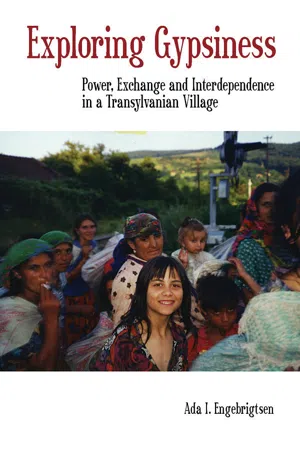
Romania has a larger Gypsy population than most other countries but little is known about the relationship between this group and the non-Gypsy Romanians around them. This book focuses on a group of Rom Gypsies living in a village in Transylvania and explores their social life and cosmology. Because Rom Gypsies are dependent on and define themselves in relation to the surrounding non-Gypsy populations, it is important to understand their day-to-day interactions with these neighbors, primarily peasants to whom they relate through extended barter. The author comes to the conclusion that, although economically and politically marginal, Rom Gypsies are central to Romanian collective identity in that they offer desirable and repulsive counter images, incorporating the uncivilized, immoral and destructive "other". This interdependence creates tensions but it also allows for some degree of cultural and political autonomy for the Roma within Romanian society.
eBook - ePub
Exploring Gypsiness
Power, Exchange and Interdependence in a Transylvanian Village
- 232 pages
- English
- ePUB (mobile friendly)
- Available on iOS & Android
eBook - ePub
Exploring Gypsiness
Power, Exchange and Interdependence in a Transylvanian Village
About this book
Trusted by 375,005 students
Access to over 1.5 million titles for a fair monthly price.
Study more efficiently using our study tools.
Information
Part I
The Rom World

Chapter 1
Roma in the Romanian Figuration
Introduction
The aim of this opening chapter is to highlight the significance of Roma as the social and ethnic category: Gypsies in the Romanian figuration. I will develop my argument by exploring the notion of ‘civilizaţie’ in the discourse of Romanianness and the theory and concept of civilization developed by the sociologist Norbert Elias (Elias, 2000). The Romanian concept of ‘civilizaţie’ is interpreted in different ways by different socioeconomic groups and ethnic groups, but I suggest that a common denominator of the colloquial use is that it refers primarily to the behaviour of people in society and especially ‘their outward bodily propriety’, bodily carriage, gestures, dress, facial expressions – in short, outward behaviour as expressions of ‘the inner self’ (Elias, 2000: 49). Civilizaţie generally also contains ideas of technical progress and certain moral virtues such as work ethic, honesty and religious piety. The most significant feature of the meaning of civilizaţie is its inseparability from the Romanian idea of naţie both in the sense of ethnic group and that of nation-state.1 The discourse of civilizaţie is common for all ethnic groups in Romania and its main focus is the gradation of different ethnic categories, naţie and nations in what is seen as a natural hierarchy (see also Berge, 1997). Thus the discourse of civilizaţie is a discourse of domination and hegemony portraying interesting aspects of the power relations of Romanian society. The hierarchy also applies to nationstates: Scandinavia and Germany are placed at the top of the civilization ladder and Turkey and the Arab countries at the bottom. It thus also mirrors the historical relations between two major empires, the Habsburg and the Ottoman, fighting for control over the area. The ‘low’ position of Romanians and Romania on the ‘civilization ladder’ points to the ambiguity of the concept, an ambiguity that is expressed quite explicitly by most Romanians, contrasting civilizaţie to ‘inner’ values and personality traits such as warmth, hospitality, vitality and cheerfulness. This ambiguity may be seen as a response to historical power relations in Romania where the ruling classes always have been made up of ‘foreigners’ to the Romanian-speaking peasantry. Thus civilizaţie has also been interpreted as an instrument of domination towards Romanian serfs by a foreign ruling ‘nation’. The concept of civilizaţie thus reflects both the inferiority complex of the Romanians as naţie in relation to other naţie in and outside Romania, as well as the resistance to a civilizing process forced upon them by their former rulers. The Romanian idea of civilization reflects the general ambiguity towards both ‘uncivilized ţigani’ and ‘civilized strangers’.
The Figurational Approach and the Civilizing Process
The Civilizing Process
Norbert Elias’ (2000) suggests analysing social formations as figurations of more or less interdependent individuals and social groups. He used dance as an analogy describing how all dancers are interdependent for their movements and how the relationships between these interdependent actors are in constant change. He saw a dance floor as a social figuration analogous to larger figurations such as those we call societies. The dance floor is like other social figurations, relatively independent of the specific individuals performing their dance, but not of individuals as such. Social figurations in Elias’s sense are to be seen as formations of interdependent actors that imply political, economic and psychological aspects. Thus a social figuration links long-term structural developments of societies with changes in people’s socially constituted personality and their social behaviour that Elias termed ‘habitus’. Elias saw emotions such as shame as socially constituted and linked to structures of society such as power relations. He thus emphasised the interdependence between changes in society and changes in the individual sentiments and moral habitus (Mennell, 1998a:15). Elias underlined that although interdependence is a trait of all social relations, a process of civilization increases this interdependence as it increases social complexity.
Elias claimed that the French concept of civilité, as the Western folk model of civilization and, I would add, the Romanian folk model of civilizaţie, are moral discourses and vehicles for the domination of one social group over others. In Elias’s words: ‘this concept expresses the self-consciousness of the West’ (Mennell, 1998a: 5). Thus the discourse of civilization in the West is one of domination whereby incorporated classes, peoples and nations are positioned in relations of dependence and relative subordination towards a certain hegemonic class and/or nation. By studying the history of manners, etiquette and the social discourse on civilité, Elias suggested that the process of political incorporation and centralisation is dependent on a process of bodily control, increased physical discipline and general drive economy that enables the relatively peaceful coexistence and interchange of groups and individuals. His argument is that the increased interdependence between social groups demands and creates a certain feeling and experience of security that again demands restraint of individual gratification. In contrast to folk models, Elias’s model of civilization does not imply an idea of inevitable progress (Mennell, 1998a). On the contrary, one of Elias’s main points is that although violence is experienced to be controlled, it continues to play a decisive part even in the most civilized, peaceful societies, but as also Foucault (1976) and others have pointed out, it becomes more hidden. Elias refers to ‘civilized conduct as an armour’ (in Mennell, 1998a: 20) that would disappear, if for instance, the levels of insecurity in society were to rise to the levels of earlier times. Elias did not see the civilizing process as a lineal evolution but as the result of political and economic relations in social figurations that are constantly changing, so that processes of decivilization counteract processes of civilization. Wars and other social breakdowns are results of decivilizing processes that temporary change the relations between parties in social figurations (Elias, 2000).
Elias’s theory of the civilizing process illuminates the central aspects of the idea of a ‘civilization ladder’ that structure the discourse on ethnicity, class and power in Romania. I am thus discussing civilization on two levels, one as a political process that influences individual habitus and identity, the other as a Romanian moral discourse of power and interethnic relations. The Romanian discourse on civilizaţie is thus treated as an instrument for the civilizing process in Elias’s sense. I have no intention of trying to trace the historical process of Romanian civilization in any detail, but to use Elias’s theory of the civilizing process and the notion of social figuration (Elias, 2000; Mennell, 1998b), together with the folk model of civilizaţie, to discuss the role of the ţigan for Romanian collective identity.
Aspects of Transylvanian History
Civilizing the ‘Vlach’
The economic, political and psychological relationship between the naţie of Romania can not be understood without some insight into the history of this region. From the early feudal times, Transylvania had a relatively free position under the Ottoman Empire and came under Hungarian rule and later that of the Habsburg Empire in the late seventeenth century, while Wallachia and Moldovia were vassal states under the Ottoman Empire until the late nineteenth century. The ethnic, political and economic figuration of Transylvania was slightly different from that of Wallachia and Moldovia, but had many similarities (Achim, 2004). The peasant serfs, called Vlach were predominantly Romanian-speaking in both regions, and the ţigani were in both regions itinerant craftsmen, serfs and slaves. Until the late nineteenth century, then, the feudal states of Transylvania, Wallachia and Moldova were composed of interdependent but ethnically, culturally, politically and economically different categories of people. Lord was synonymous with Hungarian, Saxon or Greek, peasant and serf with Vlach, and slave or artisan serf with ţigan. A naţio was the nomination of a group associated with a territory, its members holding a particular legal status as citizens. Contrary to subjects, members of a naţio were considered noble (Verdery, 1983: 83).
The Catholic and Calvinist Magyar, the Szekler and the Lutheran Saxon made up the three naţie of Transylavania. Romanian-speaking people, although a numerical majority, were not considered a naţio and were thus not citizens. Vlachs and ţigani were positioned as social groups, not as ‘nations’, and social mobility meant ethnic assimilation. To acquire an education, a position and citizenship, wealthy Vlachs changed their ‘nationality’ and their religion and turned German or Magyar. This is parallel to how ţigani still become Romanian, Magyar or German to better their social position in society (Seim, 1998; Verdery, 1983).
From the eighteenth century the Hapsburg regents Maria Thereza and Josef II started a process of centralisation and homogenisation of the vast empire to strengthen, control and increase its tax revenues (Verdery, 1983). I will here only point to the civilizing strategies applied by the Habsburg Empire in terms of religious, linguistic and cultural cohesion in Transylvania, and to the resistance and compliance by the Romanians serfs.2 According to Verdery (1983) the economic and political strategies for controlling Transylvania were primarily felt as an obstruction by the gentry, while the serfs in many instances experienced them as a protection against exploitation. When the serfs opposed the strategies for cultural integration it was primarily questions of religion. The Uniate Church, a hybrid of the Roman Catholic and Orthodox faiths, was introduced by the Habsburg Government to ease the transition to Catholicism, and represented a means for Vlachs and other non-nations to acquire certain privileges and possibilities to rise to noble status. Although this strategy had some success in the beginning, the serfs soon left and rejected the Uniate Church in great numbers supported by their Magyar masters who had no reason to rejoice in the transformation of Vlach serfs into nobles. This religious opposition was paired with an increased awareness among the Magyar nobles of the empire’s effort towards the Germanisation of state bureaucracy. To counteract this effort, an emerging nationalist awareness among Magyar nobles developed, followed by strategies of Magyarisation of Transylvania that culminated in the revolution of 1848 and the proclamation of a Hungarian state including Transylvania in 1867. In this process ‘naţio’ was confirmed as a concept of group affiliation based on ethnicity and class, and this meaning was appropriated and kept by large also by the non-naţie populations of Transylvania (Verdery, 1983). Only Magyars would be part of the new nation that embraced a territory with almost 50 percent non-Magyar population. This again prompted a rising Romanian nationalism, based on the same logic of creating a nation of Romanians. The Uniate Church created by the Habsburg Empire as a state-building strategy was now becoming an important element in developing the Romanian nation. The clergy’s access to higher education and their knowledge of ...
Table of contents
- Cover
- Title
- Copyright
- Contents
- Preface
- Acknowledgements
- Transcriptions, Pronunciations and Vocabulary
- Introduction
- PART I THE ROM WORLD
- PART II ROMA AS VILLAGERS
- Epilogue
- Bibliography
- Index
Frequently asked questions
Yes, you can cancel anytime from the Subscription tab in your account settings on the Perlego website. Your subscription will stay active until the end of your current billing period. Learn how to cancel your subscription
No, books cannot be downloaded as external files, such as PDFs, for use outside of Perlego. However, you can download books within the Perlego app for offline reading on mobile or tablet. Learn how to download books offline
Perlego offers two plans: Essential and Complete
- Essential is ideal for learners and professionals who enjoy exploring a wide range of subjects. Access the Essential Library with 800,000+ trusted titles and best-sellers across business, personal growth, and the humanities. Includes unlimited reading time and Standard Read Aloud voice.
- Complete: Perfect for advanced learners and researchers needing full, unrestricted access. Unlock 1.5M+ books across hundreds of subjects, including academic and specialized titles. The Complete Plan also includes advanced features like Premium Read Aloud and Research Assistant.
We are an online textbook subscription service, where you can get access to an entire online library for less than the price of a single book per month. With over 1.5 million books across 990+ topics, we’ve got you covered! Learn about our mission
Look out for the read-aloud symbol on your next book to see if you can listen to it. The read-aloud tool reads text aloud for you, highlighting the text as it is being read. You can pause it, speed it up and slow it down. Learn more about Read Aloud
Yes! You can use the Perlego app on both iOS and Android devices to read anytime, anywhere — even offline. Perfect for commutes or when you’re on the go.
Please note we cannot support devices running on iOS 13 and Android 7 or earlier. Learn more about using the app
Please note we cannot support devices running on iOS 13 and Android 7 or earlier. Learn more about using the app
Yes, you can access Exploring Gypsiness by Ada I. Engebrigtsen in PDF and/or ePUB format, as well as other popular books in Social Sciences & Cultural & Social Anthropology. We have over 1.5 million books available in our catalogue for you to explore.