- English
- ePUB (mobile friendly)
- Available on iOS & Android
eBook - ePub
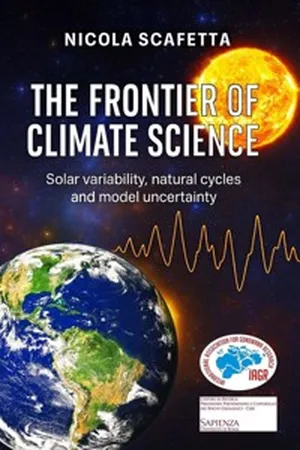
The Frontier of Climate Science (Color Edition)
About this book
(Color Edition) The Frontier of Climate Science explores climate dynamics through physics, complex systems, and astronomy, synthesizing several decades of peer?reviewed research. The book critically reviews the scientific foundations of modern climate theory, the evolution of IPCC assessments, and the limits of global climate models (GCMs) when confronted with observations. It investigates natural variability across multiple timescales, including oceanic oscillations, solar variability, and astronomical cycles driving both solar and climate variability, integrating satellite data, paleoclimate reconstructions, and empirical modeling approaches. From this evidence emerges a balanced view of climate risk, favoring pragmatic adaptation over narrowly defined policy pathways such as Net Zero. Rich in insights and analytical approaches, the book helps readers understand climate variability, assess risks, think critically, and explore key open questions in climate science. Endorsed by the International Association for Gondwana Research (IAGR) and by CERI - Sapienza University of Rome. Forewords by M. Santosh, A. Prestininzi and J. Curry.
Information
Subtopic
Essays on ScienceIndex
Biological SciencesTable of contents
- Title
- Synopsis
- Contents
- Foreword by Prof. M. Santosh
- Foreword by Prof. Alberto Prestininzi
- Foreword by Prof. Judith Curry
- Introduction
- Part 1 — Climate Science According to the “Scientific Consensus”
- Chapter 1. Understanding climate change in order to act
- Chapter 2. The climate issue as a global challenge
- Chapter 3. The IPCC and the Global Climate Models
- Chapter 4. Earth’s energy balance and the greenhouse effect
- Chapter 5. Evolution of the IPCC reports from 1990 to 2023
- Chapter 6. Results of the Global Climate Models
- Chapter 7. Concluding remarks on IPCC attribution frameworks
- Part 2 — Critical Perspectives on the Anthropogenic Global Warming Theory
- Chapter 8. Science and pseudo-science: preserving the boundary
- Chapter 9. The rhetoric of scientific “consensus” in the climate debate
- Chapter 10. The impossibility of validating the primary GCM prediction
- Chapter 11. The “hot model” problem
- Chapter 12. The 50–70-year oscillation and its implications
- Chapter 13. The “Roman Optimum” and the “Medieval Warm Period”
- Chapter 14. The Holocene and Phanerozoic temperature–CO₂ conundrum
- Chapter 15. Assessment of GCMs and the social cost of carbon
- Part 3 — New Perspectives for Quantifying Climate Change
- Chapter 16. Uncertainty in global surface temperature records
- Chapter 17. The “urban heat island” (UHI) effect
- Chapter 18. Dendrochronological, satellite and instrumental data
- Chapter 19. Contamination in homogenizing meteorological data
- Chapter 20. Nighttime temperatures rising faster than daytime
- Chapter 21. The 2000–2014 temperature “pause” controversy
- Chapter 22. Assessing non-climatic systematic biases in global warming
- Part 4 — Rethinking Climate Attribution: The Solar Perspective
- Chapter 23. The changing Sun and Earth’s climate
- Chapter 24. TSI satellite composites: a controversy spanning four decades
- Chapter 25. TSI proxy models: between uncertainty and revision
- Chapter 26. Particle-driven climate forcing modulated by solar variability
- Part 5 — Modeling Climate Change with Empirical Models
- Chapter 27. From reductionist models to empirical–holistic frameworks
- Chapter 28. Climate attribution using multilinear regression
- Chapter 29. Model selection and empirical optimization
- Chapter 30. Modeling climate with astronomical harmonics
- Chapter 31. An energy balance–regression climate model
- Part 6 — Spectral Coherence Between Planetary Harmonics and Solar–Climate Cycles
- Chapter 32. Cosmic timing and Earth’s climate cycles
- Chapter 33. Orbital synchronization and planetary cycles
- Chapter 34. Solar cycles shorter than the Schwabe 11–year cycle
- Chapter 35. The Schwabe solar cycle and the Venus–Earth–Jupiter model
- Chapter 36. The Jupiter–Saturn model and long-term solar variability
- Chapter 37. The stable harmonics of the Solar System
- Chapter 38. How the planets could influence the Sun
- Chapter 39. Heliospheric oscillations in climate records
- Chapter 40. A two-millennial climate reconstruction based on astronomical rhythms
- Part 7 — Toward a New Paradigm
- Chapter 41. Science as a process, not dogma
- Chapter 42. Toward the planetary hypothesis
- Bibliography
- Acknowledgments
- The author
Trusted by 375,005 students
Access to over 1.5 million titles for a fair monthly price.
Study more efficiently using our study tools.
Frequently asked questions
Yes, you can cancel anytime from the Subscription tab in your account settings on the Perlego website. Your subscription will stay active until the end of your current billing period. Learn how to cancel your subscription
No, books cannot be downloaded as external files, such as PDFs, for use outside of Perlego. However, you can download books within the Perlego app for offline reading on mobile or tablet. Learn how to download books offline
Perlego offers two plans: Essential and Complete
- Essential is ideal for learners and professionals who enjoy exploring a wide range of subjects. Access the Essential Library with 800,000+ trusted titles and best-sellers across business, personal growth, and the humanities. Includes unlimited reading time and Standard Read Aloud voice.
- Complete: Perfect for advanced learners and researchers needing full, unrestricted access. Unlock 1.5M+ books across hundreds of subjects, including academic and specialized titles. The Complete Plan also includes advanced features like Premium Read Aloud and Research Assistant.
We are an online textbook subscription service, where you can get access to an entire online library for less than the price of a single book per month. With over 1.5 million books across 990+ topics, we’ve got you covered! Learn about our mission
Look out for the read-aloud symbol on your next book to see if you can listen to it. The read-aloud tool reads text aloud for you, highlighting the text as it is being read. You can pause it, speed it up and slow it down. Learn more about Read Aloud
Yes! You can use the Perlego app on both iOS and Android devices to read anytime, anywhere — even offline. Perfect for commutes or when you’re on the go.
Please note we cannot support devices running on iOS 13 and Android 7 or earlier. Learn more about using the app
Please note we cannot support devices running on iOS 13 and Android 7 or earlier. Learn more about using the app
Yes, you can access The Frontier of Climate Science (Color Edition) by Nicola Scafetta in PDF and/or ePUB format, as well as other popular books in Biological Sciences & Essays on Science. We have over 1.5 million books available in our catalogue for you to explore.