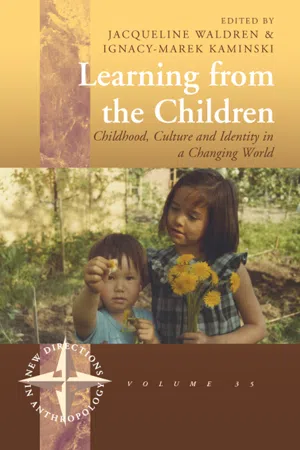
Children and youth, regardless of their ethnic backgrounds, are experiencing lifestyle choices their parents never imagined and contributing to the transformation of ideals, traditions, education and adult–child power dynamics. As a result of the advances in technology and media as well as the effects of globalization, the transmission of social and cultural practices from parents to children is changing. Based on a number of qualitative studies, this book offers insights into the lives of children and youth in Britain, Japan, Spain, Israel/Palestine, and Pakistan. Attention is focused on the child's perspective within the social-power dynamics involved in adult–child relations, which reveals the dilemmas of policy, planning and parenting in a changing world.
eBook - ePub
Learning From the Children
Childhood, Culture and Identity in a Changing World
- 204 pages
- English
- ePUB (mobile friendly)
- Available on iOS & Android
eBook - ePub
Learning From the Children
Childhood, Culture and Identity in a Changing World
About this book
Trusted by 375,005 students
Access to over 1.5 million titles for a fair monthly price.
Study more efficiently using our study tools.
Information
Part I
CHANGING NORMS

Chapter 1
INVISIBLE ROUTES, INVISIBLE LIVES:
THE MULTIPLE WORLDS OF RUNAWAY AND MISSING WOMEN AND GIRLS IN UPPER SINDH, PAKISTAN
Introduction
This case study of runaway women and girls in Upper Sindh1 has a twofold objective: first, to examine what role gender, or being a female, plays in the social making of the girls and by that premise, what roles notions of childhood and adulthood play in women’s identity.2 This is also primarily the reason why both girls and women are the subject of this case study. I propose to examine how notions of adulthood and childhood are gendered by seeing how women and children are constructed jointly as minors.3 Here I look at systems of marriage and concepts of honour which both make women and girls as cultural children in relation to men, or even boys.
A second objective is to understand these notions especially with respect to runaway girls and women.4 This study helps me to look at women and girls as agents, who are able to effect social transformations by changing structural forms of marriage. The act of running away constructs women and girls as social actors, capable of transforming their future, thereby reversing their roles as ‘cultural minors’ in the custody of men.
My work shifts away from looking at these acts as aberrations that lead to delinquency, prostitution and crime. Runaway action is an assertion of women and girls challenging the dominant forms of marriage and possibly a strategy to social mobility and change. The closest anthropological discussions are in the field of bride capture as a form of marriage (Barnes 1999). However, bride capture is studied in a structural model and women’s own agency; their choices of life paths are rarely considered in these studies. In the following, runaway action is shown as positive action towards social mobility, where women, otherwise considered children, become momentary ‘adults’.
This study is informed by my experience as a native woman, but also as someone in an official position. As a Syed woman from Upper Sindh, I belong to a status group that is revered and respected, as Syeds are considered to be genealogically linked with the Prophet Mohammad. In addition, in 2001, I was elected as the Nazim, a mayor, in my home district Khairpur, which is part of Upper Sindh. My involvement both as a Syed woman and as a woman in power involved me in such a way that I can say that I am my own informant. Both these positions made me a nucleus of my own fieldwork, and its subject as well, and the problem solving, especially concerning women and girls, became routine. My home served as a meeting place, where women from the district would bring applications, requesting mundane provisions, food, clothing, shelter, but also sometimes for resolution of marital disputes, custody, or protection against violence. ‘We have heard that you listen to women’, they would come and tell me. Where women’s direct access to political space is restricted, my access to women was considered empowering, so much so that during my period in office, men would come and tell me that the women of their family warned them that they now have a female representative to turn to, should they not behave with them, and some even threatened to have them locked up behind bars using my office.
Upper Sindh: The Field Area
Upper Sindh is geographically located in the south of Pakistan, bordering three provinces: Sindh, Balochistan and the Punjab, with a combined population of eight million people. This area is marked as one of the most violent regions in Pakistan, reporting not only a high crime rate as reported by the police but also cultural forms of violence such as killings in the name of honour, and group feuds.
Upper Sindh represents the confluence of three groups of peoples – the western Baloch, eastern Rajput-based groups, and the northern Jats.5 Historically, it is influenced by the Balochi tribal system, and social rules are based on the normative honour values. Apart from territorial identities there is also a caste-like social stratification with many identity formations based on divisions of labour, especially in towns where there are many different groups of people. For instance, there are rank identities mimicking Hindu caste structures like the Syeds, considered to be descendants of the Prophet, as the highest and the Sheikh, low-caste Hindu converts at the lowest, and profession-based identities like the artisan communities. Numerous migrations of nomadic pastoral, camel and sheep herders from Afghanistan have meant a constant turnover of the population and frequent invasions have brought to this region Pashtoon, Afghan, Turkic and Mongol groups as well. The languages spoken are largely Sindhi, Seraiki, but Balochi and to a lesser extent Brahui are also spoken.
Economically, Upper Sindh is an agricultural area, growing cash crops like wheat, rice and cotton, and seasonal fruits. The perennial canals from the Indus have brought new settlements. Farming in Upper Sindh is a mixed set of social practices and social relations. On the lowest scale are the landless cultivators called hari, who are also sharecroppers farming for bigger landlords. These are followed by small farmers, whose farm sizes are so small that they have to supplement their own farm income by working on other farms as well, so they are both hari and owner cultivators. Medium-sized farms tend to be exclusively owner operated, and the larger farms may be cultivated by wage labour, hari operated farms or both. Then there are tenant farmers, who contract land from one season to the next on fixed rates and finally there are the absentee landlords, who lease out their lands in any of the ways described above.
Farming settlements are organized into villages, which are largely uniform groups of people organized around common landholdings with shared values and intermarriages. Village size can range from a single household to hundreds of households. There are several names for groups used in everyday relations – qaum, for large group identities, raje is another general word for the people, and birathar is used more as groups of interrelated lineages with a common identity.
The territorially organized group identities all seem to use honour ideologies to protect and shape their identity, resources and boundaries. Power, both political and social, is vested in heads of tribes, called Sardar, landed elite, called wadera, and various manners of religious heads, called Pir, who hold lineages that link them to the Prophet. Upper Sindh has historically had a strong local mediation system, and the Sardar, Pir and wadera reinforce their political power by participating in mediations over various conflicts. State power is largely based on the former colonial structure with a powerful bureaucracy and local elite given indirect powers.6 The area is divided into districts and each district has its administrative machinery headed by a district officer and law and order managed by a police officer. Increasingly today, the state representatives assist the strong informal networks, and the chiefs and mediators strongly influence state institutions as they are part of the political power.
In the following discussion, I will use the local notions of honour as the context within which gender relations are shaped. The people of Upper Sindh follow Islam, and symbols of Islam such as the Quran are widely used in social relations. Here I may be questioned on how Islam constructs the local notions of honour. Some anthropologists like Rosen (2000) say that customary norms and values and religion are not really far apart but a continuum. However, the notion of honour rarely uses the rhetoric of Islam. Marriage practices also contradict official Islam, which emphasizes will and agency of two people, men and women who enter into contract. But going into details of whether customs are Islamic or not or how Islam has shaped custom and how custom is shaped by Islam is in itself a circular debate. If the society in Upper Sindh follows Islam, by that logic, all practices are subsumed under religion. But if the Quran is to be taken as a fixed form of Islamic injunctions then many practices find no basis in religious texts. And to reverse this argument, many practices mentioned in religious texts are not found in Upper Sindh. Here it is enough to say that in the local discourse, the laws of God, the laws of the state and the laws of the people, or qaum, are set out as distinct by people and all three are important, and the contradictions between all three result in conflicts all the time. Although there are resonances between the three and one can be set up as the other, in the community they are set up as distinct discourses. All three are used and applied in differing contexts, and why custom is a complicated category is because it undergoes changes over time, depending on how laws of the state, laws of God and laws of tribe interact.
Women and Girls as ‘Children’ in the Honour Value System
The social and political relations of Upper Sindh are based chiefly on the local honour values of izzat and ghairat. The anthropology of honour is a large body of material concerned with defining what honour is, but also recognizes that it is an elusive term.7 My experience in the field is that honour is a relational term, used differently by men, women and by people across hierarchies in the same society. I am oversimplifying but, for basic context, izzat refers more to material honour, and ghairat is reactive honour, especially used as a self-help instrument, with respect to women. The honour value system involves much more than these two words. There is a whole repertoire of social behaviour, of modesty codes, of hierarchies within and across sexes and ages and manifests itself differently in different hierarchical settings.8
In Upper Sindh, one is simultaneously struck by the brutal forms of honour-related violence against men and women, and girls and boys, in the customary shape of Karo kari (a compound word meaning black man, black woman), when women and men are accused of sexual transgressions,9 on the one hand, and the frequency with which women and girls run away from their homes and villages every day and contract marriages of love, challenging social control of women’s movements, on the other. Both these worlds present a contradictory tension, one in which women or girls and boys are victims, and the other where they take control of their lives, one where the honour value system is articulated in self-help notions, and the other where it is challenged actively.
When women are suspected of sexual transgressions, it is the ghairat in men that provides the moral basis of violence against women. So much value is placed on women’s status, especially with respect to marriage, if there is a violation, as in the case of women in relationships, women are accused as black, along with the men who are suspected with them. This practice, called Karo Kari, perhaps aims at marital rights and gender roles. Black men and women, and even girls and boys, are usually evicted from the community, and black men/boys fined to compensate for the women lost in the process. But many times, women and girls accused of being black are killed too, as are the men.
Men are considered women’s natural guardians and protectors in the honour value system. Even though ghairat is considered to be a male reaction to violation of honour, women actively engage with the politics of ghairat. And older women in the hierarchy, such as mothers and mothers-in-law, may also be guardians of ghairat. For instance, I have met two mothers who defended the death of their daughters as black women, saying that there was no regret in such an action as it was about izzat and ghairat.
Like women, the fate of girls in Upper Sindh is linked to their productive and reproductive role. Very early on, the girl child is involved in domestic labour, as an assistant to the mother, especially to look after the younger siblings. Her role is to collect fuel wood, to run errands, to help their mothers in weeding, cleaning, washing and cooking. Further, teenage girls are likely to be punished in the same way as older women for violation of honour. Physically, girls also embody sacred honour with power to heal relations. This can be observed in the girl’s capacity to resolve disputes. Girls are referred to as niani, which is a sacred term, denoting virginity and purity. As niani, a girl and sometimes an unmarried woman, who is a girl even at 40 if she is not married, can resolve disputes. In blood feuds women and girls can go to an aggrieved side, in a ceremony called niani mairh, and this method is sure to resolve disputes.
In the honour value system then, women of reproductive age are in the custody of men, and therefore cultural ‘minors’. With respect to men, all such women are children. Husbands refer to their wife and children collectively as ‘bare’, a Sindhi word meaning ‘children’. They would never speak of wife in the singular as a person, but in the plural inclusive in the term ‘bare’. Women of reproductive age would, generally speaking, not go into public spaces alone. In most cases they are accompanied by a male, even if the male is a child. Young women are often chaperoned by brothers or nephews half their age. Married women would take their sons to the market with them; middle-aged women would be chaperoned by teenage students. In other words, a male child is a protector of an adult woman because he is a male, even when he is a child. Mentally too, women are considered minors, and women rarely speak in front of men in the presence of guests or other male members of the family. This permanent childhood conferred on women with respect to men erases boundaries between girlhood and womanhood. Women are girls and girls are women, and both are children with respect to males, who even as children have custodial and protection rights over them. This configuration reconstitutes notions of childhood and adulthood as gendered entities: children are primarily those who ar...
Table of contents
- Cover
- Title
- Copyright
- Contents
- List of Illustrations
- Acknowledgements
- Preface
- Introduction
- Part I. Changing Norms
- Part II. Listening and Learning
- Part III. Cross-Cultural Mobility
- Notes on Contributors
- Index
Frequently asked questions
Yes, you can cancel anytime from the Subscription tab in your account settings on the Perlego website. Your subscription will stay active until the end of your current billing period. Learn how to cancel your subscription
No, books cannot be downloaded as external files, such as PDFs, for use outside of Perlego. However, you can download books within the Perlego app for offline reading on mobile or tablet. Learn how to download books offline
Perlego offers two plans: Essential and Complete
- Essential is ideal for learners and professionals who enjoy exploring a wide range of subjects. Access the Essential Library with 800,000+ trusted titles and best-sellers across business, personal growth, and the humanities. Includes unlimited reading time and Standard Read Aloud voice.
- Complete: Perfect for advanced learners and researchers needing full, unrestricted access. Unlock 1.5M+ books across hundreds of subjects, including academic and specialized titles. The Complete Plan also includes advanced features like Premium Read Aloud and Research Assistant.
We are an online textbook subscription service, where you can get access to an entire online library for less than the price of a single book per month. With over 1.5 million books across 990+ topics, we’ve got you covered! Learn about our mission
Look out for the read-aloud symbol on your next book to see if you can listen to it. The read-aloud tool reads text aloud for you, highlighting the text as it is being read. You can pause it, speed it up and slow it down. Learn more about Read Aloud
Yes! You can use the Perlego app on both iOS and Android devices to read anytime, anywhere — even offline. Perfect for commutes or when you’re on the go.
Please note we cannot support devices running on iOS 13 and Android 7 or earlier. Learn more about using the app
Please note we cannot support devices running on iOS 13 and Android 7 or earlier. Learn more about using the app
Yes, you can access Learning From the Children by Jacqueline Waldren, Ignacy-Marek Kaminski, Jacqueline Waldren,Ignacy-Marek Kaminski in PDF and/or ePUB format, as well as other popular books in Social Sciences & Cultural & Social Anthropology. We have over 1.5 million books available in our catalogue for you to explore.