What was distinctive—and distinctively "modern"—about German society and politics in the age of Kaiser Wilhelm II? In addressing this question, these essays assemble cutting-edge research by fourteen international scholars. Based on evidence of an explicit and self-confidently "bourgeois" formation in German public culture, the contributors suggest new ways of interpreting its reformist potential and advance alternative readings of German political history before 1914. While proposing a more measured understanding of Wilhelmine Germany's extraordinarily dynamic society, they also grapple with the ambivalent, cross-cutting nature of German "modernities" and reassess their impact on long-term developments running through the Wilhelmine age.
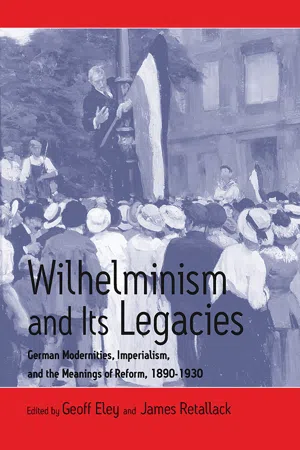
eBook - ePub
Wilhelminism and Its Legacies
German Modernities, Imperialism, and the Meanings of Reform, 1890-1930
- 280 pages
- English
- ePUB (mobile friendly)
- Available on iOS & Android
eBook - ePub
Wilhelminism and Its Legacies
German Modernities, Imperialism, and the Meanings of Reform, 1890-1930
About this book
Trusted by 375,005 students
Access to over 1.5 million titles for a fair monthly price.
Study more efficiently using our study tools.
Information
Table of contents
- Cover Page
- Title Page
- Copyright Page
- Contents
- Foreword
- Acknowledgments
- Introduction
- 1. Making a Place in the Nation: Meanings of “Citizenship” in Wilhelmine Germany
- 2. Membership, Organization, and Wilhelmine Modernism: Constructing Economic Democracy through Cooperation
- 3. “Few better Farmers in Europe”? Productivity, Change, and Modernization in East-Elbian Agriculture, 1870-1913
- 4. The Wilhelmine Regime and the Problem of Reform: German Debates about Modern Nation-States
- 5. Lebensreform: A Middle-Class Antidote to Wilhelminism?
- 6. Imperialist Socialism of the Chair: Gustav Schmoller and German Weltpolitik, 1897-1905
- 7. “Our Natural Ally”: Anglo-German Relations and the Contradictory Agendas of Wilhelmine Socialism, 1897-1900
- 8. The “Malet Incident,” October 1895: A Prelude to the Kaiser's “Krüger Telegram” in the Context of the Anglo-German Imperialist Rivalry
- 9. Colonial Agitation and the Bismarckian State: The Case of Carl Peters
- 10. The Law and the Colonial State: Legal Codification versus Practice in a German Colony
- 11. Max Warburg and German Politics: The Limits of Financial Power in Wilhelmine Germany
- 12. Continuity and Change in Post-Wilhelmine Germany: From the 1918 Revolution to the Ruhr Crisis
- 13. A Wilhelmine Legacy? Coudenhove-Kalergi's Pan-Europe and the Crisis of European Modernity, 1922-1932
- 14. Ideas into Politics: Meanings of “Stasis” in Wilhelmine Germany
- Notes on Contributors
- List of Publications by Hartmut Pogge Von Strandmann
- Index
Frequently asked questions
Yes, you can cancel anytime from the Subscription tab in your account settings on the Perlego website. Your subscription will stay active until the end of your current billing period. Learn how to cancel your subscription
No, books cannot be downloaded as external files, such as PDFs, for use outside of Perlego. However, you can download books within the Perlego app for offline reading on mobile or tablet. Learn how to download books offline
Perlego offers two plans: Essential and Complete
- Essential is ideal for learners and professionals who enjoy exploring a wide range of subjects. Access the Essential Library with 800,000+ trusted titles and best-sellers across business, personal growth, and the humanities. Includes unlimited reading time and Standard Read Aloud voice.
- Complete: Perfect for advanced learners and researchers needing full, unrestricted access. Unlock 1.5M+ books across hundreds of subjects, including academic and specialized titles. The Complete Plan also includes advanced features like Premium Read Aloud and Research Assistant.
We are an online textbook subscription service, where you can get access to an entire online library for less than the price of a single book per month. With over 1.5 million books across 990+ topics, we’ve got you covered! Learn about our mission
Look out for the read-aloud symbol on your next book to see if you can listen to it. The read-aloud tool reads text aloud for you, highlighting the text as it is being read. You can pause it, speed it up and slow it down. Learn more about Read Aloud
Yes! You can use the Perlego app on both iOS and Android devices to read anytime, anywhere — even offline. Perfect for commutes or when you’re on the go.
Please note we cannot support devices running on iOS 13 and Android 7 or earlier. Learn more about using the app
Please note we cannot support devices running on iOS 13 and Android 7 or earlier. Learn more about using the app
Yes, you can access Wilhelminism and Its Legacies by Geoff Eley, James Retallack, Geoff Eley,James Retallack in PDF and/or ePUB format, as well as other popular books in History & 19th Century History. We have over 1.5 million books available in our catalogue for you to explore.