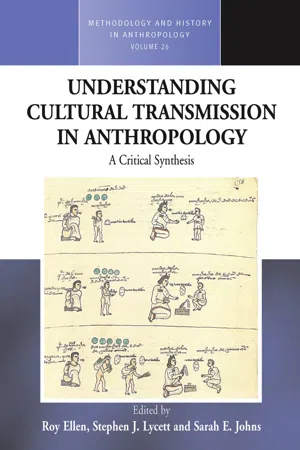
The concept of "cultural transmission" is central to much contemporary anthropological theory, since successful human reproduction through social systems is essential for effective survival and for enhancing the adaptiveness of individual humans and local populations. Yet, what is understood by the phrase and how it might best be studied is highly contested. This book brings together contributions that reflect the current diversity of approaches - from the fields of biology, primatology, palaeoanthropology, psychology, social anthropology, ethnobiology, and archaeology - to examine social and cultural transmission from a range of perspectives and at different scales of generalization. The comprehensive introduction explores some of the problems and connections. Overall, the book provides a timely synthesis of current accounts of cultural transmission in relation to cognitive process, practical action, and local socio-ecological context, while linking these with explanations of longer-term evolutionary trajectories.
eBook - ePub
Understanding Cultural Transmission in Anthropology
A Critical Synthesis
- 392 pages
- English
- ePUB (mobile friendly)
- Available on iOS & Android
eBook - ePub
Understanding Cultural Transmission in Anthropology
A Critical Synthesis
About this book
Trusted by 375,005 students
Access to over 1.5 million titles for a fair monthly price.
Study more efficiently using our study tools.
Information
Chapter 1

WHAT ANIMALS OTHER THAN PRIMATES CAN TELL US ABOUT HUMAN CULTURAL TRANSMISSION
Introduction
To most social scientists, human culture is unique, and bears no comparison to the behavioural traditions observed in other animals. To a large extent this position is justified, since our species alone has created technologies that endlessly bring forth new innovations, allowing it to transform environments to unprecedented levels and thereby dominate the planet; not to mention humanity’s extraordinary achievements in the sciences, arts, music and literature. Our success as a species is widely attributed to this capability for culture, through which we share adaptive knowledge, and fashion solutions to life’s challenges (Boyd and Richerson 1985; Plotkin 1997). Yet the observation that a wide range of other animals are also capable of innovation and social learning (Heyes and Galef 1996; Laland and Galef 2009), albeit to a lesser degree, begs the question of exactly what it is that is special about the cultural capabilities of humans.
It is here that a comparative perspective can be of utility. Careful analyses of the cognitive capabilities and social behaviour of humans and other animals potentially allows researchers to characterize the truly unique aspects of human culture. This is no trivial matter, since history is littered with examples of claims along the lines of ‘humans uniquely do X, or possess Y’ (e.g. use tools, teach, imitate, exhibit referential communication, possess episodic memory) that have subsequently fallen by the wayside when established in another species. Such comparisons of course also isolate features that humans share with other animals, which can be equally insightful, since they pave the way to studying animals as model systems that can illuminate human behaviour. Moreover, comparisons between humans and other animals help us to reconstruct the past, and determine how, and from where, human cultural capability evolved.
Before meaningful comparisons between the ‘cultures’ of humans and other animals can be made, we need to specify precisely what we mean by the term culture. Once again, this is no trivial matter, since it has proven extremely difficult for social scientists to derive a satisfactory consensual definition, or to find means to operationalize culture (Kroeber and Kluckholm 1952; Durham 1991). The definition that we adopt follows Laland and Hoppitt (2003): Cultures are those group-typical behaviour patterns shared by members of a community that rely on socially learned and transmitted information. This broad definition is designed to encourage relevant comparative data to be collected, providing a framework with which to investigate the evolutionary roots of culture. In our view, a narrower definition, for instance, one that automatically restricted culture to humans, would not prove particularly useful, at least not to researchers interested in a comparative perspective. This is not only because the answer to the question of whether or not animals have culture would be a fait accompli; by definition, they would not. But in addition, this denotation would act as a barrier to understanding the evolutionary roots of culture. No light would be shed on how culture came into existence, nor on humans’ place in nature. Premature, over-exacting distinctions potentially jeopardize our ability to see relationships between culture-like phenomena in diverse taxa.
Interestingly, when a broad definition is adopted, it transpires that some of the strongest evidence for culture in non-human animals comes not from our nearest relatives, the primates, but from a handful of distantly related and disparate animals – a few birds, whales and fish species (Laland and Hoppitt 2003). For instance, the claims of culture in chimpanzees are hotly contested (Humle and Newton-Fisher, this volume), not least because it is unclear whether the observed behavioural variation, labelled ‘culture’ (Whiten et al. 1999), results from differential social learning, or from differences in ecology or genetics (Laland and Janik 2006). However, we describe below experimental studies on natural populations of fish and birds that clearly demonstrate that the species concerned exhibit behavioural traditions reliant on social learning, and where population differences cannot be attributed to confounding genetic or ecological factors (Warner 1988; Slagsvold and Wiebe 2007). Likewise, arguably the best evidence for animal teaching is in meerkats (Thornton and McAuliffe 2006); for animal innovation, mental time-travel and cumulative culture, it is in birds (Clayton and Dickinson 1998; Hunt and Gray 2003; Emery and Clayton 2004; Lefebvre et al. 2004); and for vocal learning, it is in cetaceans (Rendeli and Whitehead 2001). These observations become significant once we recognize the full gamut of tools offered by the comparative method.
Comparative analyses between species can allow inferences to be made about the attributes of species ancestral to humans, and allow us to understand the evolutionary history of the traits seen in modern man. In simple terms, this approach is reliant on detecting homologies that humans and closely related animals share. Naturally, the first points of comparison that spring to mind are with non-human primates, particularly the apes. Researchers are interested in our closest relatives because these species potentially exhibit homologous traits to humans, due to shared ancestry, or may perhaps exhibit precursors of unique human characteristics, such as language. Unfortunately, advocates of this approach sometimes pin too much weight on the chimpanzee–human comparison (or to a lesser extent, the other apes–human comparison) in the name of homology, reasoning that since the chimpanzee shares more genes with humans than do other species, such comparisons are likely to be especially insightful. In fact, a single comparison, such as human–chimpanzee, contributes a solitary datum to any attempt to identify reliable relationships between selective environments and adaptations. By and large, the comparative method has moved on since the 1950s, when such pairwise comparisons were pioneered by ethologists, such as Niko Tinbergen and Konrad Lorenz, to shed light on behavioural adaptations; famously, comparisons between black-headed gulls and kittiwakes suggested numerous differences, related to nest construction and chick and parental behaviour, that could be understood as adaptations to the differential risk of predation in ground- and cliff-nesting gulls (Cullen 1957; Tinbergen et al. 1962; Tinbergen 1963). At best, such comparisons serve to generate an evolutionary hypothesis: at worst, they are nothing more than a source of uninformed speculation. In the case of the gulls, further comparisons amongst closely related birds exposed to similar selection regimes were necessary to confirm the evolutionary relationships (Clutton-Brock and Harvey 1984). So it is with chimpanzee–human comparisons, which must be complemented by further comparisons in order to yield meaningful information.
Moreover, a single comparison is uninformative as to which characters are ancestral and which are derived. In principle, all of the differences between humans and chimpanzees could have evolved in the chimpanzee lineage since divergence from the common ancestor. The assumption that all the relevant evolutionary change took place in the hominin lineage has been a constant source of error in theories of human evolution. Consider, for example, the recent work on Ardipithecus, which suggests that the common ancestor of humans and chimpanzees may not have been a knuckle-walker, and that researchers have been misled by a chimpanzee model (Lovejoy 2009). Researchers that fail to consider ancestral and derived traits are vulnerable to making errors. More generally, if researchers restrict themselves to a narrow comparison involving a very small number of species closely related to humans, they risk telling apparently plausible ‘just-so stories’ about human evolution.
Of course, just how wide a comparison across taxa is useful will depend very much on the question in hand. Comparative analyses of animal abilities suggest that some human behavioural and psychological traits have a long history. For instance, a capacity for associative learning may even have evolved in our invertebrate ancestors; an understanding of causal relationships may be common to both mammals and birds; much social behaviour, such as forming stable social bonds, developing dominance hierarchies, and an understanding of third-party social relationships, probably evolved in our pre-hominid primate ancestors; while a capacity for true imitation probably evolved in pre-hominid apes. The important point here is that the appropriate taxonomic group for comparative analysis is not inevitably restricted to primates.
In this chapter we concentrate on two further ways in which a wider taxonomic net allows light to be shed on human cultural transmission. First, animals can be used as model systems to better understand behavioural and cognitive processes shared with humans. In this case, non-primates frequently provide an opportunity for more rigorous investigation of cultural transmission as they can be more easily manipulated in an experimental setting. For instance, much of the experimental work on animal social learning carried out in our laboratory involves studies of fish and birds. That is because these animals offer practical advantages over many other vertebrates for the study of social learning. After all, the diffusion of innovations and animal traditions are group-level phenomena, and if they are to be studied reliably, researchers require not just replicate animals but replicate populations of animals. While it would be economically and practically challenging (not to mention ethically questionable) to set up large numbers of replicate populations of chimpanzees or Japanese macaques, it is extremely straightforward and cheap to set up large numbers of populations of small fish in the laboratory, and subject them to experimentation. Similarly, we have been able to set up small experimental populations of birds in which to carry out diffusion studies. These practical advantages allow for multiple conditions and good statistical power, bringing experimental rigour to any social learning investigation. Of course, such practical advantages would be worthless if birds and fish were hopeless at social learning, or never innovated, but below we provide evidence that this is not the case. On the contrary, we will describe examples of learning strategies proposed by anthropologists, psychologists and economists as rules that humans deploy that we also observe in birds and fish.
The second means of using the comparative method is to seek to identify ecological, social or life-history characters that co-vary with cognitive and behavioural traits shared by humans and animals. While the mechanisms underlying learning across species are frequently non-homologous, there are parallels at a functional level, and these are potentially informative with respect to the ecological and social factors that favour the evolution of the attribute concerned. This allows inferences to be made about the ancestral function of, and selective environment favouring, human capabilities. This method is reliant on detecting analogous processes amongst humans and distantly related animal species. Analogy is at least as powerful a comparative tool as homology (Harvey and Pagel 1991). Evolutionary hypotheses are well supported when independently derived data repeatedly suggest that a particular selection pressure consistently favours a specific character. For instance, Dunbar’s (1995) observed relationship between neocortex size and group size in primates is rendered all the more compelling by the observation that convergent evolution has generated the same patterns in carnivores and ungulates (Dunbar and Bever 1998; Shultz and Dunbar 2006). Researchers who restrict themselves to homology fail to utilize a valid and powerful source of comparative data. Below we describe how comparative analyses using non-human taxa can shed light on the ecological factors that promote reliance on culture, and the capabilities that underpin it.
In summary, researchers wishing to draw inferences about human evolution based on comparisons with other species would be well advised not to focus solely on the common chimpanzee, the apes, or even the primates; nor should they pick and choose a comparator species from any single taxon. Rather, we recommend that they utilize the full power of the modern comparative method, complete with its sophisticated statistical tools (Harvey and Pagel 1991), harnessing both homology and analogy to maximal effect. In this chapter we endeavour to illustrate each of these approaches, focusing on studies of social learning and cultural transmission in animals. We suggest that non-primates can make, and indeed have made, a valid contribution using both of these approaches.
Use of Model Species
The Concept of ‘Model Species’
Model organisms are species that are studied by scientists hoping to further understanding of wider biological phenomena relevant to a range of species, including humans. Of course, different model organisms are used to answer different biological questions, but most have some features in common. These include ready availability and short generation times (to enable scientists to make use of large sample sizes and experimental replication), along with being relatively easy to maintain and manipulate in a controlled experimental setting.
The use of model organisms in such fields as medicine, developmental biology and genetics is well established. For instance, the African clawed frog (Xenopus laevis), which produces large embryos with a high tolerance for physical and pharmacological manipulation, has proven to be a useful study species for addressing questions about vertebrate development (Jones 2005); while the single-celled yeast (Saccharomyces cerevisiae) is frequently used as a tool for investigating the genetic control of cellular processes (Fields and Johnston 2005).
Just as these species have thrown light on human cell functioning and embryological development, so may the study of behaviour in selected animal species (including rats, pigeons and sticklebacks) provide us with insights into cultural transmission. We can use them, for instance, to illuminate our understanding of how information flows through populations, as well as to investigate the occurrence of various ‘types’ of social learning, and social learning ‘strategies’. Of course, if human social learning was completely different from that of other animals, any insights that model species could offer would be limited. However, as evidence suggests that this is far from the case, model species may well be of considerable use.
The Problem with Primates
When seeking to understand the evolutionary history of the processes involved in human cultural transmission – and what, if anything, makes us ‘unique’ – researchers can look not only at humans, but at other animals. Primates, being our closest relatives, may be the obvious choice. However, studying them – and obtaining firm evidence of their capacity for social information transfer – is often not easy. Different populations of wild chimpanzees, for example, are known to exhibit differences in their behavioural repertoires, the best-known of which is perhaps the distinct tool-using patterns seen in different groups (Whiten et al. 1999; Boesch 2003; Whiten et al. 2003). Some or all of these maybe socially learnt: chimpanzees are undoubtedly capable of social learning (Whiten and Custance 1996), and experiments with captive populations have shown that, when different groups are ‘seeded’ with a demonstrator trained to solve a foraging task using a particular method, other members of the group acquire and maintain the same method of solving it as that of their ...
Table of contents
- Cover
- Half title
- Title
- Copyright
- Contents
- List of Figures
- List of Tables
- Preface
- Introduction: On the Concept of Cultural Transmission
- 1. What Animals other than Primates can tell us about Human Cultural Transmission
- 2. Culture in Non-human Primates: Definitions and Evidence
- 3. Cultural Transmission Theory and Fossil Hominin Behaviour: A Discussion of Epistemological and Methodological Strengths
- 4. Studying Cultural Transmission within an Interdisciplinary Cultural Evolutionary Framework
- 5. Do Transmission Isolating Mechanisms (TRIMS) Influence Cultural Evolution? Evidence from Patterns of Textile Diversity within and between Iranian Tribal Groups
- 6. Co-evolution between Bentwood Box Traditions and Languages on the Pacific Northwest Coast
- 7. The Transmission of Ethnobotanical Knowledge and Skills among Tsimane’ in the Bolivian Amazon
- 8. Processual Perspectives on Traditional Environmental Knowledge: Continuity, Erosion, Transformation, Innovation
- 9. Transmitting Penan Basketry Knowledge and Practice
- 10. Plant Exchange and Social Performance: Implications for Knowledge Transfer in British Allotments
- 11. Thinking Like a Cheese: Towards an Ecological Understanding of the Reproduction of Knowledge in Contemporary Artisan Cheese Making
- 12. Lineages of Cultural Transmission
- Notes on Contributors
- Index
Frequently asked questions
Yes, you can cancel anytime from the Subscription tab in your account settings on the Perlego website. Your subscription will stay active until the end of your current billing period. Learn how to cancel your subscription
No, books cannot be downloaded as external files, such as PDFs, for use outside of Perlego. However, you can download books within the Perlego app for offline reading on mobile or tablet. Learn how to download books offline
Perlego offers two plans: Essential and Complete
- Essential is ideal for learners and professionals who enjoy exploring a wide range of subjects. Access the Essential Library with 800,000+ trusted titles and best-sellers across business, personal growth, and the humanities. Includes unlimited reading time and Standard Read Aloud voice.
- Complete: Perfect for advanced learners and researchers needing full, unrestricted access. Unlock 1.5M+ books across hundreds of subjects, including academic and specialized titles. The Complete Plan also includes advanced features like Premium Read Aloud and Research Assistant.
We are an online textbook subscription service, where you can get access to an entire online library for less than the price of a single book per month. With over 1.5 million books across 990+ topics, we’ve got you covered! Learn about our mission
Look out for the read-aloud symbol on your next book to see if you can listen to it. The read-aloud tool reads text aloud for you, highlighting the text as it is being read. You can pause it, speed it up and slow it down. Learn more about Read Aloud
Yes! You can use the Perlego app on both iOS and Android devices to read anytime, anywhere — even offline. Perfect for commutes or when you’re on the go.
Please note we cannot support devices running on iOS 13 and Android 7 or earlier. Learn more about using the app
Please note we cannot support devices running on iOS 13 and Android 7 or earlier. Learn more about using the app
Yes, you can access Understanding Cultural Transmission in Anthropology by Roy Ellen, Stephen J. Lycett, Sarah E. Johns, Roy Ellen,Stephen J. Lycett,Sarah E. Johns in PDF and/or ePUB format, as well as other popular books in Social Sciences & Anthropology. We have over 1.5 million books available in our catalogue for you to explore.