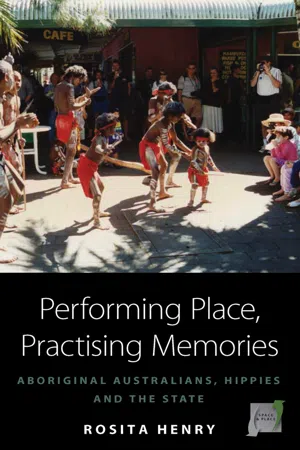
During the 1970s a wave of 'counter-culture' people moved into rural communities in many parts of Australia. This study focuses in particular on the town of Kuranda in North Queensland and the relationship between the settlers and the local Aboriginal population, concentrating on a number of linked social dramas that portrayed the use of both public and private space. Through their public performances and in their everyday spatial encounters, these people resisted the bureaucratic state but, in the process, they also contributed to the cultivation and propagation of state effects.
Trusted by 375,005 students
Access to over 1.5 million titles for a fair monthly price.
Memory is usually thought of as having to do with the temporality of mind (Halbwachs 1992; Douglas 1995) rather than with the materiality and corporeality of place. Yet as Casey argues:
[Memory] is the stabilizing persistence of place as a container of experiences that contributes so powerfully to its intrinsic memorability. An alert and alive memory connects spontaneously with place, finding in it features that favour and parallel its own activities. We might even say that memory is naturally place-oriented or at least place-supported … Unlike site and time, memory does not thrive on the indifferently dispersed. It thrives, rather, on the persistent particularities of what is properly in place: held fast there and made one’s own (Casey 1987: 186).
The link between memory and place is realised through the agency of the lived body (Casey 1987). Places are constituted and animated by the social and political engagement of human beings with one another. However, people make place within social processes and structures that have already been moulded and that continue to be shaped by others. It is in this sense that place is already ‘pregnant with the past’ (Ingold 1993: 153), pregnant with practices of power and domination. However, as we store our memories in places, we store places in memories (Casey 1987). Thus, removing people from places does not necessarily mean forever losing the memory of the places themselves. Lost places may be commemorated, and people may feel homesick or nostalgic for ancestral places they have never actually inhabited. Such memories may even be transmitted to later generations. Nevertheless, to remove a people from a place means to deny them the embodiment of those memories that are triggered and cultivated through actual social engagement and corporeal experience with that place. This can result in a profoundly disorienting mutilation of memory.
Paths and Pockets: The Colonisation of Aboriginal Places
Before European colonisation of North Queensland, the Aboriginal people of the rainforest region around Kuranda made ‘systematic and sustained’ use of clearings in the rainforest that were connected by a network of pathways (Loos 1982: 89). Evidence for this can be found in the journals of early explorers and prospectors such as Christie Palmerston, who made an expedition from Herberton to the Barron Falls in December 1884 and January 1885,1 and James Venture Mulligan, who made an expedition through the area in 1875 (Loos 1982: 89). The explorers provide fascinating accounts of the intensive occupation of the North Queensland rainforest2 region by Aboriginal people prior to European settlement:
Traversed this creek only one mile seeing a great number of native tracks, also a number of shields painted and laid along its banks to dry … we could hear the aborigines talking on both sides of the creek, and passed through several camps from which they had scampered away leaving everything on seeing us: native blankets in dozens, bushels of red berries cooked and uncooked; I believe there was a hundredweight of newly crushed meal heaped up on their greasy looking blankets. Long ungainly swords and shields scattered about in all directions; scores of small fishing nets … (Palmerston in Woolston & Colliver 1968: 28).
At the end of the creek on which we are camped struck a blackfellows’ track or road; we followed it for over two miles round to the west end of the scrub. The track is well beaten, and runs between the hills and the scrub … A splendid track, the best native track I ever saw anywhere. There are roads off the main track to each of their townships, which consist of well thatched gunyahs, big enough to hold five or six darkies. We counted eleven such townships since we came to the edge of the scrub, and we have only travelled four miles along it. At certain seasons this must be a crowded place with blacks, which seem to live principally on nuts, for there are barrowfuls of nutshells at their camps (Mulligan 1877: 6).
A descendant of one of the early settler families told me that when the settlers rode through ‘the scrub’ down to the coast before the range road was built, they would picnic and/or camp overnight in ‘pockets’ in the scrub that he thought Aboriginal people had made. He named a number of such pockets: McKenzie’s Pocket, Christmas Pocket, Cedar Pocket, Read’s Pocket, Dinner Pocket, and Welcome Pocket (Maurie Veivers, pers. comm. 16 January 1996). The names indicate their importance in the European settlement of the rainforest area, and it is clear that the settlers recognised them not only as landmarks but also as havens in what was to them a broad expanse of endless and unwelcoming scrub. These pockets were not only obvious places to camp, but also sites from which to begin settlement of the area. Loos (1982: 89) notes that all the pockets in the rainforest discovered by explorers and made use of by early settlers ‘were probably Aboriginal camp or ceremonial sites’. The following account by Christie Palmerston could be taken as evidence of this:3
I continued my journey along this large path, making great progress … and also through many native camps, saw many paths leading from and junctioning with this one. In two miles it led me to a small pocket or open space of about an acre or less. … This corroboree ground presented a clean orderly appearance, the smallest shrub even having been plucked out by the roots, to all appearances the preceding day. … Large paths, similar to the one followed by me, branch from this pocket in all directions (Woolston & Colliver 1968: 29).
About thirty years later, naturalist Erik Mjöberg (1918: 168) wrote of the rainforest peoples: ‘They often cut out a large circle in the rainforest, before they put up their humpies, partly to get some sunshine and partly to avoid the old branches falling down on them.’
It is important to note that Europeans did not simply move into the rainforest country, but that they actually appropriated Aboriginal pathways through the forest and chose to occupy specific sites that Aboriginal people had cleared. This is significant and shows the immediate and traumatic impact that European settlement must have had on the Aboriginal population of the rainforest. Aboriginal oral history corroborates this occupation of their home sites by the settlers. Some of these pockets were associated with particular family groups, while others were places where different family groups met for socialising, for ceremonial activity and for exchange. The Djabugay name for these places is bulmba, a term that can be qualified to refer to particular types of places, such as grounds for fighting or for ceremonial corroboree meetings, as well as to refer to people of the same place. In other words, the term bulmba refers not simply to a bounded place, but also to the general concept of home or homeland, and it may be extended to mean ‘the world, land, sea, sky and even time itself’ (Banning & Quinn 1989: 73). In the process of her linguistic study of Djabugay, for example, Cassells recorded the following (my emphasis):
Gulu bulmba ngandji binangunday yaluguli
camp/home 1pl. listen today
Today we listen to the people at home
Bamulu bulmba djurawala ngundaying
person-ERG home wrong-now see
and we see people doing wrong now
…
gulu ngandjin bulmba nyiwul yiringan
1p. home one belong
This is our only home here, this land
Bulmba ngandji binangundalum
camp, home, land pl. listen-PURP
Let’s listen to the old people
gadjagadjar ngandjinda bulmba djanang burmu wala
spirits-REDUP-WITH 1pl.DAT home stand still now
Everything is standing still now
…
gulay bulmba guragura wala
home, people great grandfathers, ancestors now
All the old people are gone now
…
gulaywu bulmbawu bibunbaywu
these – ALL camp – ALL child, young – ALL
For all these young ones
bulmba ngandji yiringanu wanggaruwanggaru nguru
home 1pl. belong east – ALL
This is our home, stretching all the way east, right up
ngunbaywu ngunbaywu wanggaru nguru guwulu wuru
Kuranda – ALL-REDUP Speewah
To Kuranda, and right back to Speewah,
yalngiri wuru guyangga wuruwu wubulu wuru
Crystal Cascades PLACE NAME PLACE NAME
and Crystal Cascades; up to guyangga and down to wubulu,
djulanuwu wuru gulu guludu wuru djulanu
PLACE–ALL Dove Creek PLACE NAME
and right on to djulanu and Dove Creek,
marandjaru wuru garadjuruwu wuru gudjay bulmba
Bebo Mountain PLACE–ALL those places
Bebo Mountain, and garadjuru
…
bulmba: guragurawu wala mayngalawu wala
old people last of the line now nothing-ALL now
We, the old people, are the last ones left, we are going soon (Cassells 1977).
This text, from which I have only selected small sections, describes not just the extent of the land that the informant considered home, but also the informant’s sense of ‘home’ as a relationship with others through shared place.
The European settlers first moved into the very heart of Aboriginal rainforest country. In other words, colonisation was not simply a case of settlement of the Aboriginal people’s general territory, but of occupation of their actual dwelling places, their homes, their hearths and their network of paths (or ‘pads’ as they are locally known). Thus began the mutilation of place memory.
It can be inferred that townships like Kuranda and other smaller settlements in the area, such as Kowrowa and Mantaka, began and grew from these pockets – that is, from the hearth lands of Aboriginal country.4 Mantaka and Kowrowa were known to the early settlers as ‘Welcome Pocket’ and ‘Dinner Pocket’ respectively. Djabugay people told me that there were camps at many places like these along the banks of the Barron River and its tributaries, some of which they continued to use after European settlement of the area:
You see my grandparents used to work in Kuranda, and that’s when I was about three or four. I used to walk from the mission [to] the camp where we stayed. They used to walk with me and we used to pad down the riverside right down to past that bridge there, Kuranda Heights. Go past there. And we had a little camp just further down there, down the quick side, Barron River. In the thirties, camp at the thing; and we had a little track going up to the railway and just had a little gate we can go through. And we used to go up in town then; and they be working for the Veivers [original settler family] (Esther Snider, pers. comm. 18 June 1996).
Particularly well remembered are the camps on the river at Kuranda Heights, at Oak Forest and near the Kuranda Railway Station.5 The concentration of population along the river and its importance in terms of identity is evidenced by the name ‘the Barron River Tribe’, which was given to the people in the early literature and which became the name they used themselves between European settlement and the 1980s, at which point Djabugay and other tribal or clan names began to take on political precedence.
Although Aboriginal people on the coast had begun to experience the devastating affects of the beche de mer fishing industry as early as the 1860s,6 the first Europeans to move into the rainforest region were timber gatherers during the 1870s. Prospectors, miners and selectors soon followed, creating an impact upon the rainforest peoples from all directions.7 As Loos (1982: 93) writes: ‘While timber-getters and selectors were encroaching upon the rainforest Aborigines from the east, denying them the rivers and river flats of the Daintree, Barron, Mulgrave, and the Johnstone, miners and newly-established small cattle stations on the west were restricting their access to hunting grounds and freshwater fishing.’
The first of the cattle stations to be established close to Kuranda was ‘Emerald End’ on the Barron River, which was owned by John Atherton. However, direct contact between Aboriginal people and the settlers intensified during the main construction phase of the railway line and the roads through the range. Settler communities of railway workers and farmers sprang up along the railway sidings as more and more land was made available for selection.8 Many of the selectors found it difficult to make a living from farming alone and supplemented their income by working in the timber industry, on the railways, or through prospecting and mining.
According to Loos (1982: 3), European encroachment on the land reduced Aboriginal access to traditional food sources to the point that the tribes were actually starving. In his annual report (Queensland, Parliament 1900: 2), Northern Protector of Aborigines W. E. Roth, provided support for this:
As each new block of country becomes taken up, the blacks are forcibly hunted off their water supplies and hunting grounds both in it and in its immediate neighbourhood. According to their own laws of trespass they are prevented from seeking fresh pastures, except at the cost of fighting …9
However, the rainforest was a formidable enough barrier to the settlers to provide some Aboriginal people with a relatively safe haven from which to mount a campaign of resistance, as well as to supplement their diet with settler cattle. According to Bolton:
The dense forests between the Atherton Tableland and the coast hid the comings and goings of cattle-killers only too well. John Atherton estimated his average loss as a bullock a day for five years, and once or twice a spear was aimed at him (Bolton 1963: 94).
Bolton does not mention any retaliation on the part of Atherton. Yet according to Aboriginal oral history, he ordered and participated in a massacre of Aboriginal people who had stolen one of his horses in lieu of payment of the bullock he had promised them for showing him a way across the range to the coast.10
Loos (1982: 93) argues that resistance to European settlement from rainforest Aboriginal people ‘was so effective that it led to the evolution of a completely new government policy’ to ‘pacify the Aborigines’ by providing food rations. This policy, which was initiated and supported by some of the settlers themselves, replaced the earlier policy of violent ‘dispersal’ of Aboriginal groups using the native police force. According to Loos (1982), the native police force had proved to be ineffective in the face of the large-scale resistance of rainforest peoples. Rationing meant that Aboriginal ...
Table of contents
Cover Page
Title Page
Copyright Page
Contents
List of Figures and Maps
Preface
Acknowledgements
Introducing Place: Fieldwork and Framework
Chapter 1 Colonising Place: The Mutilation of Memory
Chapter 2 Countering Place: Hippies, Hairies and ‘Enacted Utopia’
Chapter 3 Performing Place: Amphitheater Dramas
Chapter 4 Commodifying Place: The Metamorphosis of the Markets
Chapter 5 Planning Place: Main Street Blues
Chapter 6 Dancing Place: Cultural Renaissance and Tjapukai Theatre
Chapter 7 Protesting Place: Environmentalists, Aboriginal People and the Skyrail
Chapter 8 Creating Place: The Production of a Space for Difference
References
Index
Frequently asked questions
Yes, you can cancel anytime from the Subscription tab in your account settings on the Perlego website. Your subscription will stay active until the end of your current billing period. Learn how to cancel your subscription
No, books cannot be downloaded as external files, such as PDFs, for use outside of Perlego. However, you can download books within the Perlego app for offline reading on mobile or tablet. Learn how to download books offline
Perlego offers two plans: Essential and Complete
Essential is ideal for learners and professionals who enjoy exploring a wide range of subjects. Access the Essential Library with 800,000+ trusted titles and best-sellers across business, personal growth, and the humanities. Includes unlimited reading time and Standard Read Aloud voice.
Complete: Perfect for advanced learners and researchers needing full, unrestricted access. Unlock 1.5M+ books across hundreds of subjects, including academic and specialized titles. The Complete Plan also includes advanced features like Premium Read Aloud and Research Assistant.
Both plans are available with monthly, semester, or annual billing cycles.
We are an online textbook subscription service, where you can get access to an entire online library for less than the price of a single book per month. With over 1.5 million books across 990+ topics, we’ve got you covered! Learn about our mission
Look out for the read-aloud symbol on your next book to see if you can listen to it. The read-aloud tool reads text aloud for you, highlighting the text as it is being read. You can pause it, speed it up and slow it down. Learn more about Read Aloud
Yes! You can use the Perlego app on both iOS and Android devices to read anytime, anywhere — even offline. Perfect for commutes or when you’re on the go. Please note we cannot support devices running on iOS 13 and Android 7 or earlier. Learn more about using the app
Yes, you can access Performing Place, Practising Memories by Rosita Henry in PDF and/or ePUB format, as well as other popular books in Social Sciences & Performing Arts. We have over 1.5 million books available in our catalogue for you to explore.