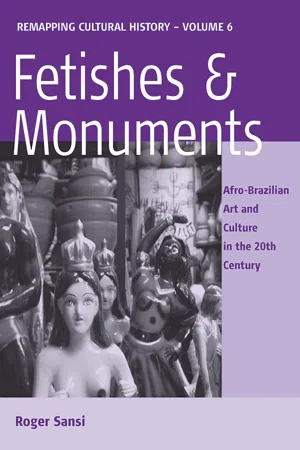
One hundred years ago in Brazil the rituals of Candomblé were feared as sorcery and persecuted as crime. Its cult objects were fearsome fetishes. Nowadays, they are Afro-Brazilian cultural works of art, objects of museum display and public monuments. Focusing on the particular histories of objects, images, spaces and persons who embodied it, this book portrays the historical journey from weapons of sorcery looted by the police, to hidden living stones, to public works of art attacked by religious fanatics that see them as images of the Devil, former sorcerers who have become artists, writers, and philosophers. Addressing this history as a journey of objectification and appropriation, the author offers a fresh, unconventional, and illuminating look at questions of syncretism, hybridity and cultural resistance in Brazil and in the Black Atlantic in general.
eBook - ePub
Fetishes and Monuments
Afro-Brazilian Art and Culture in the 20<SUP>th</SUP> Century
- 224 pages
- English
- ePUB (mobile friendly)
- Available on iOS & Android
eBook - ePub
About this book
Trusted by 375,005 students
Access to over 1.5 million titles for a fair monthly price.
Study more efficiently using our study tools.
Information
Chapter 1
‘Making the Saint’: Spirits,
Shrines and Syncretism
in Candomblé
Shrines and Syncretism
in Candomblé
In 1983, Mãe Stella, head of the Candomblé house Ilê Axé Opô Afonjá, forbade ‘syncretistic’ spirits, like the Caboclo or Indian spirit, and all Catholic practices in her house, and retired all Catholic images from the shrines. This ‘revolution’ in values is the result of the influence of an intellectual tradition, Afro-Brazilianism, which has insisted on the Africanness of Candomblé, and the movement of ‘re-Africanisation’ that followed it, which seeks to eliminate all traces of syncretism from Candomblé practice.
The following chapters will discuss more extensively this Afro-Brazilianist tradition and the re-Africanisation movement. But first, it is important to reflect on ‘syncretism’, and what is so terrible about it. Purifiers of the Candomblé tradition like Mãe Stella (Azevedo Santos 1995) have defined syncretism as a disguise, a false construction, a façade under which real, authentic African cultural and religious traditions were preserved. This is a very partial view that denies the complex process of historical construction of Candomblé, in which the give and take between Brazilian society and its public religion, Catholicism, cannot be so easily dismissed. Candomblé has a history, and this history is not just the continuous connection between the African ‘then’ and the Brazilian ‘now’, but a complex process in constant transformation. ‘Syncretism’ is probably a rather clumsy and problematic way of understanding this historical change, but, still, this change cannot be denied. The purpose of this chapter is not to defend the ‘syncretism’ of Candomblé, but to explain its historicity: how its ritual practice constantly incorporates new images, spirits, objects and values from its social and historical context.
One way of introducing this practice of incorporation is to focus on the ritual processes of ‘making the saint’. Bruno Latour (1996) has mentioned the Candomblé expression ‘fazer o santo’, ‘making the saint’, as an example of the spontaneity with which other cultures ‘construct’ their social agents. For Latour, hearing about ‘fazer o santo’ was a sort of profane revelation that helped him in rethinking how science also ‘makes’ its objects, and how these objects are not just artifices but become autonomous beings, ‘agents’. His argument is directed against the limits of social constructivism, which sees social events as predetermined representations, objects of ideology and fiction that never acquire a true autonomy. Against this rigidity, Latour proposes to open our eyes to the historicity of events, their capacity to generate new values that cannot be reduced to the list of elements that make a part of the event before it happens. Through the event, the social actors involved ‘gagnent en definition’, in Latour's words (2001: 131); they are modified and more defined in their relation.
For Latour, ‘making the saint’ is a revealing metaphor for the question of historicity: how historical events produce an unprecedented redefinition of its constitutive elements. Latour does not know much about Candomblé, but his intuition is basically correct. In fact, Candomblé people ‘construct’ their saints as autonomous agents, at the same time that they build themselves as persons. ‘Making the saint’ is a dialectical process of continuously constructing the person, in relation to the spirits that she embodies and to the ‘other body’ of these spirits, the shrines.
Following the distinction proposed by Boyer (1996), Candomblé people relate with spirits in two ways: one is by means of the ‘gift’, the innate capacity of the person to embody and ‘find’ spirits. The other is through ‘initiation’, the ritual process through which the priest (‘mãe do santo’), as an initiator, ‘puts her hand on the head’ of the person, teaches the secrets and gives the elements necessary for the person to ‘seat’ (assentar) the ‘saints’. The ‘gift’ of mediums, on the one hand, is the means through which Candomblé practitioners introduce ritual innovations, new spirits and new elements to altars and houses. Initiation, on the other hand, is the means through which rituals are reproduced, according to a ‘tradition’.
The ‘initiation’/’gift’ distinction could be superimposed on the more traditional dichotomy of ‘magic’ and ‘religion’:1 the practices based on the ‘gift’ of mediums have been rejected as forms of magic, as sorcery, while other practices, based on initiation, have been identified with ‘religion’, and from there with ‘Afro-Brazilian culture’, as we will see in later chapters. However, this apparent contradiction of syncretistic ‘magic’ and African ‘culture’ hides a deeper truth: they are related in a ‘deeper dialectic of ritual reversal and mediation’ (Apter 2002: 251). We could say that in Candomblé, what initiation cults lose by decay, forgetfulness, conflicts over value and the impossibility of fully reproducing ritual knowledge, is then substituted by the inspiration of mediums who establish through their gift a direct connection with Orixás and spirits. In these terms, the contraposition of initiation and gift generates a historical dialectic of production of value, in which new spirits, objects and values are incorporated.
In what follows, I first introduce the discourse on ‘initiation’, as it is conventionally described in the Afro-Brazilianist literature. Initiation rituals have for a long time been the central interest of the Afro-Brazilianist literature. The ethnographic discourse of initiation and tradition is mainly based on the practices of an elite group of houses in Salvador, including Ilê Axé Opô Afonjá, which have become hegemonic in Candomblé since the 1930s. These houses follow the tradition of the ‘Ketu nation’ (after the city of Ketu in Yorubaland). The Afro-Brazilianist literature (from Carneiro 1981 [1936] to Nicolau 2006) has often insisted on the presence of other ‘nations’ (‘nações’) or traditions besides ‘Ketu’, like ‘Jeje’ and ‘Angola’, but nowadays the hegemony of ‘Ketu’ tradition in the religious field is unquestionable. However, more than defending other ritual traditions, in this chapter I wish to question the common notion defended by the Afro-Brazilianist literature that ‘tradition’ and ‘initiation’ are everything in Candomblé, by showing how ‘gift’, in Boyer's terms (1996), or innovation in general, are also central for its reproduction.
For that purpose, I concentrate on the particular case of a priestess whose practice is more based on ‘gift’ than ‘initiation’. In my conclusions I will return to the question of gift and initiation in the construction of value. I describe the dialectic between these two terms as a historical process that transcends a static opposition of ‘purity’ and ‘syncretism’. The objective of this chapter is to show how some supposedly ‘syncretistic’ practices within Candomblé are in fact transpositions of personal stories and local collective histories, incorporated and read from the perspective of Candomblé. Syncretism is in fact personal and collective history.
Initiation, Bodies and Shrines
Many initiates in Candomblé do not join the cult out of choice, but because a spiritual entity, the Orixá or santo (saint), forced them to. The santo will cause physical, mental and social afflictions if the initiates do not fulfil their duties (obrigação) and pay them worship. The people obliged to pay worship to the Orixá may be described as ‘patients’, using Alfred Gell's terminology (1998): people without agency over themselves. The agents, on the other hand, would be the santos. The process of initiation in Candomblé can be described as an attempt by the initiate to regain agency over her own body and her own life. But to achieve that, the patient has to start by recognising her subordination to the santos.
To appease the Orixá, the patient may start by offering a bori, described by Mãe Stella as a ‘pre-initiation’ (Azevedo Santos 1995), a ritual of ‘giving food to the head’.2 The head is the receptacle of spiritual power, and ‘feeding the head’ makes it strong, protecting it from spells. But it is also the signature of an alliance with the Orixá, because the head, ori, is precisely the place where the Orixás seize power over their acolytes. In the bori ceremony the mãe do santo makes offerings to the ‘head’ of the person and to the Orixá that owns this head.3
The bori creates a link between the Candomblé house and the patient. The pot where the bits and pieces of the ritual have been deposited is left in the altar for the Orixá. There it becomes an assento, a ‘seat’, the house of the santo. Then it is said that the santo has been ‘seated’ or ‘settled down’ (‘santo assentado’). Joining the assentos of the other initiates, the initiate and her assento become a part of the Candomblé house; the mãe do santo has ‘put her hand on the head’ of the new initiate (‘por a mão na cabeça’). After that, the patient belongs to the axé, to the house, which also means that he is now ‘obliged’, in debt to the Orixá and to the house: he is at the bottom of a hierarchical structure, led by the mãe do santo. He must now periodically come to the ritual washing (ossé) of his assento.4
A Candomblé altar is composed of a central pot or assento (the assento of the house), surrounded by the pots of the initiates (their particular assentos), which extend and reproduce the main assento (the axé of the house). Thus, the assento reproduces materially the hierarchy of people in the Candomblé house. In the rituals of possession the santo is first summoned to the room of the assentos with sacrifices and offerings; these offerings, together with the ritual chants and the drumming, enable the transference of spiritual power from assento to the head, Ori,5 from the object to the person, in the ritual of spirit possession.
What Mãe Stella calls ‘initiation’ proper (Azevedo Santos 1995) is the process during which the person learns to incorporate the Orixá, becoming a filha do santo. Most people with santo assentado never get initiated: only people with the gift to incorporate Orixás do. The central objective of initiation is to ‘tame’ the body, making it accustomed to incorporating the Orixá. At the beginning, the Orixá can take the body of the filha at any time, very violently. Through initiation, the body gets used to possession and learns to control and focus it. After a long period of reclusion and intimacy with the assentos, learning the secrets in the quarto do santo (the room of the assentos), in the Abá Baxé ritual, the initiate's head is shaved (raspada) by the mãe do santo, and a little cut is made in the top of her head, where the blood of sacrifices and other elements of axé are shed. Then her head is painted with the motifs of the Orixá, and the initiate comes out, in a public ritual (saida do santo, ‘coming out of the saint’). She becomes possessed, and the ‘santo’ cries her initiation name out loud. Then the santo is ‘done’: this ritual process is called ‘feitura do santo’, ‘making of the saint’.
‘Making the saint’ is a very concrete, material process: it is not exactly a religious revelation or conversion, nor a schooling in the myths, songs and prayers, but it consists of learning to deal with the santo, to understand its requirements and to fulfil them satisfactorily. To that end, the initiate has to learn a number of ritual techniques, including essential body techniques for the incorporation of the santo, making offerings and building shrines. This is a dialectical process of objectification and appropriation, in which the santo is built, made concrete in the shrine and in the body.
We could say that through initiation the santo is built not only in the body and the shrine but also in the person of the filha do santo. Initiation lasts many years, in an exchange in which person and saint help build each other, because making the saint, in fact, is also making oneself. When the filha do santo has had seven years of initiation, and she has followed her ritual obligations, she becomes an ebomi, an elder. At that point, she has developed an extremely close and harmonious relationship with the Orixá, the rituals, the secret, deep knowledge (Apter 1992), the axé of the house. Then she may open her own house, if her mai do santo gives her the Deca. The Deca is the ritual that gives the power to open her own house of Candomblé. It can also be called ‘dar a navalha’, ‘give the razor’, because it bestows the capacity of ‘raspar cabeça’, ‘shaving head’, that is, the power to initiate people, to ‘assentar’ and ‘fazer o santo’, ‘seating’ and making the saints. However, the axé of the new house will always remain connected to the original axé of the house where the new mãe do santo was made; it is said that, in truth, it is the same axé.
The process of initiation transfers agency from the santo to the initiate. In the initial moment the person is just a ‘patient’, in Gell's terms (1998), an object of the agency of the santo, who wants to seize her body. Through initiation, the ‘patient’ starts acquiring some agency over her own body, and progressively she masters her relationship with the santo, and is able to help others.
In this sense, the process of initiation can be seen as a process of construction of the person. After Goldman (1985), we could look at Candomblé as a dynamic system that builds persons. It not only tries to classify people through archetypes or reflect a repressed ego, as psychological interpretations of possession have often postulated, but its ritual practices also produce new social persons. If we see the person as an open process, we could say that the santos are active elements that collaborate precisely in the construction of a person who is always in the making.
However, the person is not built only in the body, but also in the shrine. The altars and shrines of Candomblé are the assentos. As we have seen, assento means ‘seat’;6 it refers to the act of ‘sitting down’, fixing the saint in a thing, transforming the ephemeral event of initiation into an enduring object. The general structure7 of the assento consists of a dais full of pots. The pots are made of clay, porcelain or wood, depending on the santo.8 They are wrapped with cloth and closed in rooms (quarto do santo), hidden from the curiosity of strangers. These pots contain the fundamentos, the foundations that embody the saints of the initiates. These objects were identified as fetiches by the researchers on Afro-Brazilian religions, who were influenced by the literature on the ‘fetishist cults’ of West Africa.9 The fundamentos can be different things10 but stones (otã) are one of the more common elements. Each Orixá has particular otã and fundamentos. The assentos of Oxum and Iemanjá, for example, are shells and stones found in the waters, since these are the elements of these Orixás, river and sea, and they have a colour corresponding to the colours of these Orixás (yellow or gold for Oxum, white or silver for Iemanjá). The stones of Xangô are supposed to have fallen from the sky, since Xangô i...
Table of contents
- Cover Page
- Title Page
- Copyright Page
- Contents
- List of Illustrations
- Acknowledgements
- Introduction: Culture and Objectification in the Black Rome
- 1: ‘Making the Saint’: Spirits, Shrines and Syncretism in Candomblé
- 2: From Sorcery to Civilisation: The Objectification of Afro-Brazilian Culture
- 3: From Informants to Scholars: Appropriating Afro-Brazilian Culture
- 4: From Weapons of Crime to Jewels of the Crown: Candomblé in Museums
- 5: From the Shanties to the Mansions: Candomblé as National Heritage
- 6: Modern Art and Afro-Brazilian Culture in Bahia
- 7: Authenticity and Commodification in Afro-Brazilian Art
- 8: Candomblé as Public Art: The Orixás of Tororó
- 9: Re-appropriations of Afro-Brazilian Culture
- Bibliography
- Index
Frequently asked questions
Yes, you can cancel anytime from the Subscription tab in your account settings on the Perlego website. Your subscription will stay active until the end of your current billing period. Learn how to cancel your subscription
No, books cannot be downloaded as external files, such as PDFs, for use outside of Perlego. However, you can download books within the Perlego app for offline reading on mobile or tablet. Learn how to download books offline
Perlego offers two plans: Essential and Complete
- Essential is ideal for learners and professionals who enjoy exploring a wide range of subjects. Access the Essential Library with 800,000+ trusted titles and best-sellers across business, personal growth, and the humanities. Includes unlimited reading time and Standard Read Aloud voice.
- Complete: Perfect for advanced learners and researchers needing full, unrestricted access. Unlock 1.5M+ books across hundreds of subjects, including academic and specialized titles. The Complete Plan also includes advanced features like Premium Read Aloud and Research Assistant.
We are an online textbook subscription service, where you can get access to an entire online library for less than the price of a single book per month. With over 1.5 million books across 990+ topics, we’ve got you covered! Learn about our mission
Look out for the read-aloud symbol on your next book to see if you can listen to it. The read-aloud tool reads text aloud for you, highlighting the text as it is being read. You can pause it, speed it up and slow it down. Learn more about Read Aloud
Yes! You can use the Perlego app on both iOS and Android devices to read anytime, anywhere — even offline. Perfect for commutes or when you’re on the go.
Please note we cannot support devices running on iOS 13 and Android 7 or earlier. Learn more about using the app
Please note we cannot support devices running on iOS 13 and Android 7 or earlier. Learn more about using the app
Yes, you can access Fetishes and Monuments by Roger Sansi in PDF and/or ePUB format, as well as other popular books in Arte & Studi museali. We have over 1.5 million books available in our catalogue for you to explore.