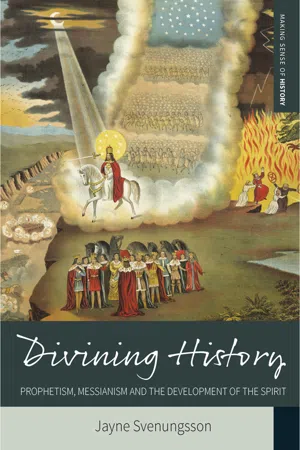
For millennia, messianic visions of redemption have inspired men and women to turn against unjust and oppressive orders. Yet these very same traditions are regularly decried as antecedents to the violent and authoritarian ideologies of modernity. Informed in equal parts by theology and historical theory, this book offers a provocative exploration of this double-edged legacy. Author Jayne Svenungsson rigorously pursues a middle path between utopian arrogance and an enervated postmodernism, assessing the impact of Jewish and Christian theologies of history on subsequent thinkers, and in the process identifying a web of spiritual and intellectual motifs extending from ancient Jewish prophets to contemporary radicals such as Giorgio Agamben and Slavoj Zizek.
eBook - ePub
Divining History
Prophetism, Messianism and the Development of the Spirit
- 240 pages
- English
- ePUB (mobile friendly)
- Available on iOS & Android
eBook - ePub
About this book
Trusted by 375,005 students
Access to over 1.5 million titles for a fair monthly price.
Study more efficiently using our study tools.
Information
CHAPTER 1
The God of History

Notes for this section begin on page 32.
‘Christianity is not one of the great things of history: it is history which is one of the great things of Christianity.’1 This grand assertion appeared in a posthumously circulated aphorism by the French cardinal Henri de Lubac, an influential voice in twentieth-century debates over the relationship between the West’s view of history and the Christian legacy. The assertion needs modification and nuancing, but de Lubac was onto something. When Christianity emerged during the first centuries of the first millennium, history writing played a central role. The early church relied to a significant degree upon theological readings of history in order to constitute itself as a tradition and to specify its relationship to the Jewish-rabbinical tradition from which it would successively distance itself.
These ‘theologies of history’ were supported by a series of components that regulated both the early church’s rupture and its continuity with the Jewish tradition. One such was the prophetic promise of deliverance, whose theological roots go back to Exodus – the story of how God liberates his people from Egyptian captivity. The early Christian movement incorporated this central motif within Judaism into its own reading of history, which holds that the promised redemption was set in motion by Jesus’s death and resurrection. Complete liberation, however, is yet to come. Only with the return of the resurrected Jesus, that is to say, at the end of history, will salvation be fully realized. Until then, humanity participates in a historical drama in which it is called upon to make a choice with respect to the offer of redemption manifested in Jesus of Nazareth.
This claim is nothing less than that the very goal and purpose of history have assumed new meaning because of Jesus’s death and resurrection. According to this view, it is equally clear that Jesus cannot be considered as merely the latest in a line of prophets promising redemption. He is the redemption, God’s anointed servant as promised by the prophets. Here another essential component of the early Christian reading of history comes into view: the messianic event. And it is perhaps here that both the break and continuity with the Jewish tradition appear most clearly. Announcing that the messianic period had been ushered in by Jesus’s resurrection, the fledgling Christian movement went on to successively distance itself from the majority of Jews, who did not acknowledge Jesus of Nazareth as their Messiah. At the same time, the very claim that Jesus was the promised Messiah clearly indicated that the movement saw itself as in a relation of continuity with the Jewish messianic tradition. For anyone wishing to grasp this issue properly, it is essential to understand that the embryo of what was eventually to develop into Christianity remained for a long time a movement within Judaism.2
In the texts of the New Testament this need to register continuity with the messianic tradition is everywhere in evidence. What is more, a third key component of the emergent theologies of history, the spirit, makes its appearance here. Particularly in Luke–Acts (the composite work of the Gospel of Luke and the Acts of the Apostles), the spirit appears as a guarantor of the continuity between the established tradition of spiritually anointed prophets and Jesus, who is accordingly seen as the fulfilment of that tradition. An illustrative example is offered by Luke’s account of Jesus’s visit to the Nazareth synagogue, in which the author has Jesus, speaking of himself, recite from the Book of Isaiah, ‘The Spirit of the Lord is upon me, because he has anointed me to bring good news to the poor’ (Luke 4:18; cf. Isa. 61:1).3 The implication is that the spirit which inspired the prophets is now upon Jesus, and, moreover, that he is God’s chosen Messiah.
However, the spirit is not invoked solely as a marker of continuity between Jesus’s activities and the older messianic tradition but is also taken to guarantee continuity between Jesus himself and his followers – that is, what would become the Christian church. This notion receives its most forceful expression in the depiction of the descent of the spirit at Pentecost in the second chapter of the Acts of the Apostles. The author here makes clear that the spirit which descends upon the apostles is not merely that foretold by the prophet Joel (Joel 2:28), but also identical with that conferred upon Jesus by God at his baptism. The significance which this notion held for early Christian theologies of history – and, indirectly, for later philosophies of history – can hardly be overstated: the spirit as a marker of God’s continuous presence and influence in human history.
With this in mind, let us return to de Lubac’s aphorism. While there is an important grain of truth in de Lubac’s yoking of Christianity and history – as the latter has been conceptualized in the West – the background outlined here clearly illustrates why his claim requires slight modification. The Christian concept of history did not appear from nowhere as a given part of Christianity’s own development. On the contrary, a number of its constituent elements already existed in the prophetic traditions of Jewish antiquity, even if they underwent fundamental changes by being incorporated into a Christian theological framework. In order to find the roots of the three historico-theological motifs that are the focus of the present study I will therefore be relying primarily upon the prophetic literature in the Hebrew Bible.
An additional clarification with regard to de Lubac’s aphorism is warranted. The statement that Christianity gave birth to the Western conception of history should not be equated with the claim that the narrating of history per se is, in the final instance, a Christian invention. Those familiar with the classics will be well aware that the culture of ancient Greece in particular could boast a distinguished tradition of historical narrative. Indeed, it is in ancient Greece that we find those figures customarily held up as the very first historians: Herodotus (c. 484–425 BC), ‘the Father of History’, and Thucydides (c. 460–400 BC). In other words, the Jewish and (by extension) Christian traditions gave birth not to history writing as such, but to the specific form of theology of history that has been of decisive importance for the West’s conception of history.
God as the Lord of History
‘Prophecy’ is often associated with augury or prediction of the future. The term is also used in this sense within certain forms of Christianity, notably charismatic forms of modern Protestantism. While the prophecy of Jewish antiquity encompasses such variants, it is not in this sense that the notion is primarily of interest from a historico-theological perspective. Rather, it is a question of a specific understanding of history that emerges in the prophetic literature of the Hebrew Bible. Several distinctive features of this perspective on history have been examined in the modern era by an array of Jewish biblical scholars and philosophers, including the aforementioned Martin Buber, Abraham Heschel and Yehezkel Kaufmann. These twentieth-century thinkers made a substantial contribution towards revitalizing and opening up new perspectives on modern biblical scholarship (which to a large degree had been shaped by Christian theology).
The founding of historical-critical analysis as a textual methodology in the nineteenth century unquestionably resulted in a major shift in perceptions of the prophetic literature. Where previous generations of Christian theologians had primarily studied the prophets in light of Christ – considered as the realization of the prophets’ promises – subsequent scholars were instead to turn their attention to the prophets themselves. Among nineteenth-century Protestant biblical scholars, the prophets came to be seen as the culmination of a religious-historical development. Briefly, this development described the displacement of a primitive Israelite tribal religion by an ethically superior monotheism, to which the prophetic literature bore witness. In the years following their Babylonian exile, the Israelites’ divine worship relapsed into a narrowly legalistic and nationalistic religion in the form of rabbinic Judaism. In contrast to this ‘late Judaism’ (Spätjudentum), Christianity – particularly the morality-focused liberal Protestantism to which these biblical scholars generally belonged – was presented as the true heir of the universal and ethical religion founded by the prophets.4
During the twentieth century this more or less explicitly anti-Jewish interpretation has been successively dismantled. In particular, a deepened understanding of Second Temple Judaism (c. 515 BC–70 AD) has had the effect of undermining the dogmatizing efforts to counterpose the prophets to law and cultic life. Indeed, such efforts have often revealed more about the advocates of Protestantism than they do about the prophets themselves. A similar challenge has been mounted to the view that the prophets heralded a dramatically new era in Judaism. Several of the Jewish textual scholars already mentioned have played a central role here. Both Kaufmann and Heschel emphasize that the prophets rely to a great extent upon an ethics whose core features had already emerged by the time (eighth century BC) the earliest so-called literary prophets (i.e., the biblical figures who wrote down their prophecies and are represented by books in the Bible) made their appearance.5
Kaufmann perhaps goes furthest in emphasizing the continuity within the ancient Jewish religion. It is also in this context that he foregrounds those defining characteristics of the view of history to which prophetism gives expression. In his magisterial study The Religion of Israel, written over twenty years, Kaufmann argues that the religion of the Bible is, as such, based upon a claim to historical continuity.6 This continuity goes beyond the fact that the prophets essentially share and presuppose the same conception of God held by the older religion with its popular roots. In the case of Judaism, the continuity also derives from the way in which the religion itself finds support in arguments taken from history. Accordingly, when the prophets make the case for God, they do so without the aid of sophisticated philosophical reasoning. Instead, they turn to historical legends from deep within the popular imaginary: the story of the Exodus, of God’s revelation of the Tablets of Law on Mount Sinai, of the occupation of the land of Canaan, and so on.7
In the eyes of the prophets, it is these historical events that make the God of Israel worthy of faith and trust. In corresponding fashion, the divine prohibition against other gods articulated by the First Commandment rests upon a historical claim about God’s role as deliverer of his people: ‘I am the Lord your God, who brought you out of the land of Egypt, out of the house of slavery; you shall have no other gods before me’ (Exod. 20:2–3). And this motif from Exodus is repeatedly invoked by the prophets as a basis for their pronouncement of judgement. Thus Amos declares:
Thus says the Lord:
For three transgressions of Israel,
and for four, I will not revoke the punishment;
because they sell the righteous for silver.
and the needy for a pair of sandals –
they who trample the head of the poor into the dust of the earth,
and for four, I will not revoke the punishment;
because they sell the righteous for silver.
and the needy for a pair of sandals –
they who trample the head of the poor into the dust of the earth,
and push the afflicted out of the way;
father and son go to the same girl,
so that my holy name is profaned;
they lay themselves down beside every altar
on garments taken in pledge;
and in the house of their God they drink
wine bought with fines they imposed.
Yet I destroyed the Amorite before them,
whose height was like the height of cedars,
and who was as strong as oaks;
I destroyed his fruit above,
and his roots beneath.
Also I brought you up out of the land of Egypt,
and led you for forty years in the wilderness,
to possess the land of the Amorite.
(Amos 2:6–10)
The very fact that God came to the rescue of his people at an earlier point in history is here presented as sufficient grounds for Israel to show its faith in God – in this instance, as manifested in justice – in the present moment also. Yet the prophets do not advance this historical claim solely in order to pronounce judgement. As frequently, Exodus and similar motifs are invoked by the prophets when announcing the promise of futu...
Table of contents
- Cover Page
- Title Page
- Copyright Page
- Contents
- Preface
- Chapter 1. The God of History
- Chapter 2. The Ages of History
- Chapter 3. Romantic History
- Chapter 4. History after God
- Chapter 5. The Politics of History
- Postscript. A Theopolitical Vision
- Bibliography
- Index
Frequently asked questions
Yes, you can cancel anytime from the Subscription tab in your account settings on the Perlego website. Your subscription will stay active until the end of your current billing period. Learn how to cancel your subscription
No, books cannot be downloaded as external files, such as PDFs, for use outside of Perlego. However, you can download books within the Perlego app for offline reading on mobile or tablet. Learn how to download books offline
Perlego offers two plans: Essential and Complete
- Essential is ideal for learners and professionals who enjoy exploring a wide range of subjects. Access the Essential Library with 800,000+ trusted titles and best-sellers across business, personal growth, and the humanities. Includes unlimited reading time and Standard Read Aloud voice.
- Complete: Perfect for advanced learners and researchers needing full, unrestricted access. Unlock 1.5M+ books across hundreds of subjects, including academic and specialized titles. The Complete Plan also includes advanced features like Premium Read Aloud and Research Assistant.
We are an online textbook subscription service, where you can get access to an entire online library for less than the price of a single book per month. With over 1.5 million books across 990+ topics, we’ve got you covered! Learn about our mission
Look out for the read-aloud symbol on your next book to see if you can listen to it. The read-aloud tool reads text aloud for you, highlighting the text as it is being read. You can pause it, speed it up and slow it down. Learn more about Read Aloud
Yes! You can use the Perlego app on both iOS and Android devices to read anytime, anywhere — even offline. Perfect for commutes or when you’re on the go.
Please note we cannot support devices running on iOS 13 and Android 7 or earlier. Learn more about using the app
Please note we cannot support devices running on iOS 13 and Android 7 or earlier. Learn more about using the app
Yes, you can access Divining History by Jayne Svenungsson in PDF and/or ePUB format, as well as other popular books in Theology & Religion & Historiography. We have over 1.5 million books available in our catalogue for you to explore.