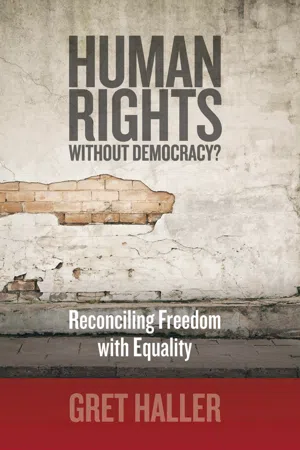
Do Human Rights truly serve the people? Should citizens themselves decide democratically of what those rights consist? Or is it a decision for experts and the courts? Gret Haller argues that Human Rights must be established democratically. Drawing on the works of political philosophers from John Locke to Immanuel Kant, she explains why, from a philosophical point of view, liberty and equality need not be mutually exclusive. She outlines the history of the concept of Human Rights, shedding light on the historical development of factual rights, and compares how Human Rights are understood in the United States in contrast to Great Britain and Continental Europe, uncovering vast differences. The end of the Cold War presented a challenge to reexamine equality as being constitutive of freedom, yet the West has not seized this opportunity and instead allows so-called experts to define Human Rights based on individual cases. Ultimately, the highest courts revise political decisions and thereby discourage participation in the democratic shaping of political will.
- 198 pages
- English
- PDF
- Available on iOS & Android
eBook - PDF
About this book
Information
Table of contents
- Contents
- Preface
- Part I — The Notion of Human Rights Prior to 1789
- Chapter 1 — The Prehistory and the Context of Human Rights
- Chapter 2 — First Concepts of Human Rights
- Chapter 3 — Human Rights, Morals, and Law
- Part II — Human Rights from 1789 to 1989
- Chapter 4 — From Human Rights to Positive Law
- Chapter 5 — Human Rights, the State, and Democracy
- Chapter 6 — Politics and Law
- Part III — The Crisis in Human Rights Since 1989
- Chapter 7 — The Cold War
- Chapter 8 — Moralizing Human Rights
- Chapter 9 — Natural Right and Imposed Concepts of Man
- Part IV — Outlook
- Chapter 10 — Perspectives for Democratic Legitimacy
- Chapter 11 — Universality and Regionalization
- Chapter 12 — Repercussions from the Cold War
- Bibliography
- Index
Trusted by 375,005 students
Access to over 1.5 million titles for a fair monthly price.
Study more efficiently using our study tools.
Frequently asked questions
Yes, you can cancel anytime from the Subscription tab in your account settings on the Perlego website. Your subscription will stay active until the end of your current billing period. Learn how to cancel your subscription
No, books cannot be downloaded as external files, such as PDFs, for use outside of Perlego. However, you can download books within the Perlego app for offline reading on mobile or tablet. Learn how to download books offline
Perlego offers two plans: Essential and Complete
- Essential is ideal for learners and professionals who enjoy exploring a wide range of subjects. Access the Essential Library with 800,000+ trusted titles and best-sellers across business, personal growth, and the humanities. Includes unlimited reading time and Standard Read Aloud voice.
- Complete: Perfect for advanced learners and researchers needing full, unrestricted access. Unlock 1.5M+ books across hundreds of subjects, including academic and specialized titles. The Complete Plan also includes advanced features like Premium Read Aloud and Research Assistant.
We are an online textbook subscription service, where you can get access to an entire online library for less than the price of a single book per month. With over 1.5 million books across 990+ topics, we’ve got you covered! Learn about our mission
Look out for the read-aloud symbol on your next book to see if you can listen to it. The read-aloud tool reads text aloud for you, highlighting the text as it is being read. You can pause it, speed it up and slow it down. Learn more about Read Aloud
Yes! You can use the Perlego app on both iOS and Android devices to read anytime, anywhere — even offline. Perfect for commutes or when you’re on the go.
Please note we cannot support devices running on iOS 13 and Android 7 or earlier. Learn more about using the app
Please note we cannot support devices running on iOS 13 and Android 7 or earlier. Learn more about using the app
Yes, you can access Human Rights Without Democracy? by Gret Haller in PDF and/or ePUB format, as well as other popular books in Politics & International Relations & Law Theory & Practice. We have over 1.5 million books available in our catalogue for you to explore.