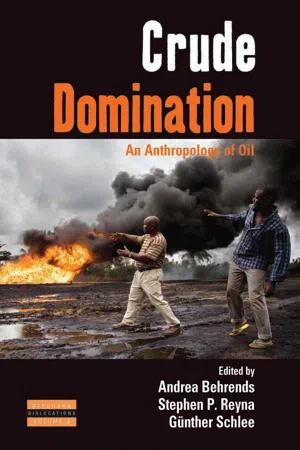
Crude Domination is an innovative and important book about a critical topic – oil. While there have been numerous works about petroleum from 'experience-far' perspectives, there have been relatively few that have turned the 'experience-near' ethnographic gaze of anthropology on the topic. Crude Domination does just this among more peoples and more places than any other volume. Its chapters investigate nuances of culture, politics and economics in Africa, Latin America, and Eurasia as they pertain to petroleum. They wrestle with the key questions vexing scholars and practitioners alike: problems of the economic blight of the resource curse, underdevelopment, democracy, violence and war. Additionally they address topics that may initially appear insignificant – such as child witches and lionmen, fighting for oil when there is no oil, reindeer nomadism, community TV – but which turn out on closer scrutiny to be vital for explaining conflict and transformation in petro-states. Based upon these rich, new worlds of information, the text formulates a novel, domination approach to the social analysis of oil.
eBook - ePub
Crude Domination
An Anthropology of Oil
- 334 pages
- English
- ePUB (mobile friendly)
- Available on iOS & Android
eBook - ePub
Crude Domination
An Anthropology of Oil
About this book
Trusted by 375,005 students
Access to over 1.5 million titles for a fair monthly price.
Study more efficiently using our study tools.
Information
PART I

GENERALITIES
— Chapter 1 —
THE CRAZY CURSE AND CRUDE DOMINATION
Towards an Anthroplogy of Oil
The oil price is very high, it's crazy. There is no additional supply.
—Pumomo Yusgiantoro, OPEC President (The Economist, 2004)
Immanuel Wallerstein wrote of a ‘systemic crisis’ that he believes within twenty-five to fifty years would produce ‘disintegration of our existing historical social system’ (1997: 1256). Strong rhetoric from a person dedicated to painstaking investigation of the longue durée of the modern world system, and not to histrionics. It might be objected that Wallerstein is to the Left and besides that he is an intellectual and so not a practical person of the world. Consider the practical world of government and journalism. Alan Greenspan, ex-Chairman of the US Federal Reserve, respected elder statesman of US finance and an architect of neo-liberal globalism, has written The Age of Turbulence: Adventures in a New World (2007). Here he suggests that it is now a time of instability, a world of turbulence. Naomi Klein, a journalist covering global calamities, has written The Shock Doctrine: The Rise of Disaster Capitalism (2007) in which she strips away neo-liberal cloaking rhetoric to reveal contemporary capitalism in shockingly complicit bondage with disaster. So there you have it. Recently, on the Left and Right, academics, statesmen and journalists have been talking of ‘systemic crises’ in a world of ‘turbulence’ characterised by ‘disaster capitalism’. Why?
Responding to this question brings us to oil. Oil is the key scarce, strategic resource needed for almost all capitalist enterprise (Homer-Dixon 2001; Klare 2002). It is not renewable. One concern of those studying oil has been how to conceptualise its supply. M. King Hubbert suggested in the 1950s that it might be imagined as a bell curve. This meant it would have an ascending slope as output increased; a highest point before decrease set in; and a descending slope, as output decreased. The high point has come to be known as ‘Hubbert's Peak’. Hubbert's work allowed yearly projections of what the oil supply bell curve would look like. In 1956 he predicted US oil production would peak around 1970 and decline thereafter. The prediction of production decline after the peak was correct. His simulation methods have been improved and found to be reliable (Deffeyes 2006). Thus, the approach helps answer the question: what years will be those of Hubbert's Peak, after which production subsides? Available evidence suggests that Hubbard's Peak is fast approaching. There are ninety-eight oil-producing countries in the world; sixty-four of these are believed to have passed their geologically imposed production peak; and of those, sixty are in terminal production decline (Strahan 2007). Oil prospecting has turned sour. In 2010 oil production declined by 1,2 million barrels per day, or 1,7 %, the largest decline since 1982 (BP 2010). Peak oil specialists predicted that Hubbert's Peak had occurred, or would occur between 2000 and 2010 (Kunstler 2006). Indeed, Deffeyes has asserted it occurred in 2005 (in Green Car Congress 2006). Consumption of oil, on the other hand, has been predicted to rise 60 per cent between 2003 and 2025 (IAGS 2003). So, oil production declines, very soon, under conditions of rising demand. Its replacement is theoretically possible, though not currently economically or technically feasible.
What will the loss of oil mean? There is a general concurrence that there will be severe and lengthy worldwide depression resultant from shrunken economic activity, high inflation, and rising transportation costs. Furthermore, reduction of petroleum supplies will compromise food production, threatening mass human starvation, because contemporary industrial agriculture is dependent on cheap oil (for fertiliser, herbicides, pesticides and machinery fuel). Additionally, the carbon dioxide released into the atmosphere by the utilisation of fossil fuels is a major cause of global warming. This means that global warming will accompany consumption of the remaining oil supplies ‘during the 21st century’ and ‘could lead to a relatively abrupt lowering of the ocean’ temperature due to melting icepacks, which, in turn, could lead to ‘harsher winter weather…, sharply reduced soil moisture and more intense winds’, leading finally to reduction in ‘the human carrying capacity of the Earth's environment’ (Schwartz and Randall 2003: 1). It should be noted that the preceding judgement does not come from ‘radical’ ecologists. Schwartz and Randall work for the US Department of Defense. Under such conditions, according to one observer, ‘If the US controls the sources of energy of its rivals – Europe, Japan, China and other nations aspiring to be more independent – they win’ (Dayaneni and Wing 2002: 2). Thus, there is a gathering ‘turbulence’, due to ‘systemic crisis’ because, as the head of OPEC put it in 2004, there is ‘no additional supply’ of oil – ‘it's crazy’.
One point to draw from the preceding is that in some sense the future of the world depends upon oil and how humans use it. As the past and the present are the only predictors of the future, this means to some extent that the fate of humanity depends upon inquiries into how oil affects the dynamics of human social forms. As we shall see below, anthropological inquiry into oil is limited, while that of other social sciences is richer. So the goal of this introduction is to propose a research strategy for anthropological analysis of oil. It will do so by interrogating findings of existing oil literatures, discussing the research implications of the articles that compose the offerings of this book, and finally sketching on the basis of these analyses an anthropology of oil in a turbulent world. This sketch, offered in the third section, will propose a ‘crude domination’ approach, whose goal is explanation of oil's crazy curse.
The Crazy ‘Curse': Current Approaches
The oil literature to be discussed is that in economics, political science and anthropology starting in the 1970s, because it was at this time that the current turbulence began. The turbulence began on a high note. Oil prices boomed in the years following the early 1970s, bringing, according to one oil minister, ‘More money than we ever in our wildest dreams thought possible’ (in Karl 1997: 3). ‘Petro-states’, as understood here, are capital-intensive oil exporters with high ratios of oil to total exports; petroleum industry enclaves; and enormous rents or royalties (from oil sales), which accrue directly to the central government. ‘Social development’ is any sequence of events that leads to beneficent, sustainable economic, social and political change for all segments of a population. The 1970s boom meant that oil rents became enormous. Petro-dollars, people dreamed, would buy petro-states’ development. Dream and reality marched down different paths.
Oil turned out to be a development ‘curse’ (Auty 1993; Ross 1999). Most petro-states found their economic performance worsened in the 1990s (Attiga 1981; Gelb 1988; Karl 1997, 1999). Some ‘oil rich’ petro-states found themselves ‘dirt poor’ in the sense that their poor became poorer (Gary and Karl 2003). Michael Ross (2001) found democracy unlikely and authoritarian regimes likely in petro-states. Worse, oil is ‘black gold’ over which social pirates fiercely compete. So, oil-exporting countries have found themselves operating under conditions of intense internal and external conflict (Kaldor, Karl and Said 2007; Klare 2002). Some of this has been non-violent, involving competition for oil-derived benefits. Much has been violent. There has been international (Peluso and Watts 2001; Vallette et al. 2003) and intra-state warfare (Ross 2002). ‘Oil's curse’, as understood here, is the triple conjuncture in petro-states of stagnating social development and poverty; high conflict, often violent; and a tendency towards authoritarian regimes.
The preceding suggests a paradox: if money is a condition of development, and it surely is, why do petro-dollars buy petro-curse rather than petro-utopia? Because this paradox is so puzzling – what is supposed to create prosperity makes the reverse – let us recognise that oil producers suffer from a crazy curse. Crazy phenomena have an important effect on human welfare, therefore they beg for solution. Accordingly, investigation of oil's crazy curse is the research object of this anthropology of oil. Some major contributions to this literature are considered next.
Resource Curse, Dutch Disease and Greed
Economics, often labelled the dismal science, strengthens this reputation with its handling of oil's crazy curse. Classical economists in the eighteenth and nineteenth centuries first formulated theory relevant to the curse. They observed that Spain and England had marched down vastly different developmental paths – Spain to decline, England to growth. Adam Smith explained this with a theory of resources, which warned of the perils of natural resource rents. ‘Rents’ or ‘royalties’ are payments to owners of land for using its various raw materials in the production of goods and services. Economies based on renting natural resources motivate rent-seeking behaviour and not profits from productive activity (Smith 1776). Further, raw material rents were exhaustible and, thus, experienced diminishing returns (Mill 1851). Thus classical theory predicted that economies based upon rent of their raw materials were flawed. Their logic was: rent a lot, and then less and less. It was as if they suffered a ‘resource curse’.
The Dutch Disease, based upon studies of contemporary resource booms, seemed to amplify classical theory of rentier economies (Auty 1993). This ‘disease’ is a body of generalisations concerning ‘the sectorial reallocation of productive factors’ during a raw material boom’ (Gelb 1988: 22). Specifically,
if the income derived from this is spent rather than saved abroad, the sum of the consequences includes a resource movement effect which draws factors of production out of other activities and into the booming sector, and a spending effect which draws factors of production out of activities producing traded commodities (to be substituted by imports) and into non traded sectors. (ibid.)
‘Traded sectors’ are those selling export goods. They are usually in industry and agriculture. They suffer. ‘Non-traded sectors’ are those not involved in export trade, and include services and transportation. These prosper. Oil is a particular resource, so oil's curse is a specific instance of the Dutch Disease in petroleum-based resource booms.
Sachs and Warner believed that the evidence showed the curse to be ‘solid fact’ (2001: 828). Recently, however, ‘solid fact’ has appeared less so. Some find the Dutch Disease ‘less common’ than originally believed (Ross 1999: 305). David and Wright (1997) provided evidence that some resource-based economies actually do well, while others do not. Thus economic evidence suggests: sometimes economic development was hampered by the curse and sometimes it is not.
Recently in economics, stimulated by the work of two economists associated with the World Bank, Paul Collier and Anke Hoeffler, there has come to be an economic explanation of why oil's curse involves so much warfare. Collier's and Hoeffler's approach emphasises greed, asserting on the basis of statistical data from seventy-eight civil conflicts from 1960 up to and including 1999, that ‘opportunities are more important in explaining conflict than are motives’ (Collier and Hoeffler 2001: 2). Further, abundant resources play a major role in providing opportunities, and greed to control these resources – legally or illegally – provokes and/or maintains wars, most of which are civil strife. This approach to the association of warfare and oil is discussed and critiqued in Andrea Behrends’ contribution to this book. Suffice it to say that it has become a major position in the literature of oil and violence attracting support, modification and scepticism (Ballentine and Sherman 2003; Marchal and Messiant 2002; Reno 2004). Let us now turn to political science.
Rent Seeking, Institutional and Patrimonial Theory
Two political science approaches have been significant in the study of oil's curse. The first offers an explanation of petro-states’ development difficulties under conditions of rent seeking. The second is more specific to African conditions and emphasises patrimonialism. Karl's seminal investigation of oil booms, The Paradox of Plenty, emphasises ‘political institutions’ (1997: xvi). Her central claim is ‘that prior interactions of structure and agency create the institutional legacy that constrains choice down the road’ (1997: 10). These legacies are path dependencies. In petro-states high oil rents multiply ‘the opportunities for both public authorities and private interests to engage in rent seeking’ (1997: 15). ‘Rent seeking’ occurs when an individual, organisation or firm seeks money by manipulating the political and/or economic environment, rather than by making a profit through either trade or productive enterprise (Krueger 1974). US agriculture is rent seeking when its agents seek subsidies and tariffs to protect its revenues. Rent seeking, according to Karl, in petro-states ‘leads to a…marriage between entrepreneurs seeking to link up with the state and public officials seeking to intervene further in the market'; with the unfortunate economic consequence that the state's oil rents go to those adept at manipulating officials and not ‘to those engaged in less remunerative but more productive activities’ (1997: 57). This is a rent seeking/institutional hypothesis because transformations that lead down the path of development difficulties result from actors altering economic and political institutions to facilitate rent seeking. Oil ministries and companies become institutions that distribute oil rents. Private enterprises become institutions less involved in productive or distributive business than in seeking rents.
African oil is becoming increasingly important to the global economy. Further, African petro-states, as documented by Behrends, Ekholm-Friedman, Reyna and Watts in their contributions to this book, have been especially and violently burdened by oil's curse. A type of patrimonialism, called neo-patrimonialism, may explain this situation (Bayart 1993). Weber (1978) developed the concept of patrimonial states for ancient and medieval polities where the state was regarded as some form of ‘private’ property of a kin group. Certain political scientists, importantly J.-F. Médard (1992), proposed that a ‘neo-patrimonialism’ explains post-colonial African states’ development woes. This is because institutions of ‘public authority’ in African states were ‘made an object of appropriation by the formal officeholders, functionaries, politicians and military personnel’, who based their ‘individual ascendancy or family ascendancy on a private usage of the res publica’ (ibid.: 167). This is a neo-patrimonialism because ‘patrimons’, officials with the capacity to allocate public assets, act as if the state were their patrimony, even though in contemporary times this is not the case. Patrimons allocate public assets from public institutions to maintain or create loyalty among their rent-seeking clients, kin or friends. Oil rents are public assets. Their vastness in petro-states raises the potential of corruption to new levels. This can produce two possible, not mutually exclusive outcomes. A first outcome is that client enterprises perform poorly because clients lack the qualifications to manage the enterprises. This is well documented for Gabon (Yates 1996). A second outcome is that conflict turns violent, because the patrimon's favouritism to certain rent seekers inflames antagonism among the disfavoured. Let us now consider literature on the anthropology of oil.
The Anthropology of Oil
Roy Rappaport, when President of the American Anthropological Association (1987–1989), urged the discipline to contribute to the formulation of public policy, particularly that concerning the drilling of oil and gas. But to many anthropologists at the time such a concern seemed peripheral. Why do applied anthropology, when there were other, tastier fish to fry; such as those in Writing Culture (Clifford and Marcus, 1986) and other fishy, postmodern delicacies? Consequently, today the New York Times does not announce triumph after triumph in the anthropological analysis of oil, rather it publicises Pentagon programmes to embed anthropologists in the US Army to support the USA's colonial oil wars in Iraq and Afghanistan (Rohde 2007).
Scrutiny of the literature that does exist reveals some fine studies, informed by anthropology, by those in other disciplines, such as Robert's Vitalis’ work on Saudi Arabia (2006). Some applied anthropology did follow Rappaport's suggestion and sought to document the effect of oil on local communities in oil- or gas-producing regions. There have been impact studies, for example, concerning New Guinea (Sagir 2004), Nigeria (Fentiman 1996), the US Gulf coast (McGuire and Gardner 2003), throughout the Arctic north (Degteva 2006; Picou et. al 1992), and Latin America (Pearce 2004; Rival 1997). There are articles where discussion of oil is a detail in a broader canvas; for example, James Ferguson's insightful critique of James Scott's Seeing Like a State (Ferguson 2005). Finally, and promising for a richer future, there is research by younger anthropologists who make oil the core of their intellectual practice. However, there are three mature works concerning the anthropology of oil including Suzana Sawyer's Crude Chronicles: Indigenous Politics, Multinational Oil, and Neoliberalism in Ecuador (2004), Andrew Apter's The Pan-African Nation: Oil and the Spectacle of Culture in Nigeria (2005) and Fernando Coronil's The Magical State: Nature, Money, and Modernity in Venezuela (1997). Let us look more closely at these texts, beginning with Sawyer's book.
Ecuador's Amazon jungle is a major supplier of crude oil to the United States. Consequently, the Ecuadorian Amazon has endured the economic, political and environmental consequences of a growing US thirst for petroleum and the policies of neo-liberalism designed to satisfy that thirst. Crude Chronicles tells the story of the rise of an organised indigenous movement during the 1990s and its struggles against a US oil company and Ecuadorian neo-liberal policies. Crude Chronicles documents the growing sophistication of indigenous politics – utilising marches, demonstrations, occupations and negotiations – as Indians fenced with, undermined and, occasionally, yielded to US Big Oil. Equally, Sawyer follows the complex strategies and discourses that the multinational corporations and the Ecuadorian state deployed as they sought to brook no opposition from their indigenous opponents. Against mounting government attempts to privatise and liberalise the national economy, Suzana Sawyer shows how Ecuadorian neo-liberal reforms led to a crisis of governance, accountability and representation that fuelled one of twentieth-century Latin America's strongest indigenous movements and which ultimately led to the more leftist government that currently governs Ecuador. Crudely put, the heart of Sawyer's analysis is who is going to ...
Table of contents
- Cover Page
- Title Page
- Copyright Page
- Contents
- List of Figures
- Part I | Generalities
- Part II | Africa
- Part III | Latin America
- Part IV | Post-Socialist Russia
- Afterword - Suggestions for a Second Reading: An Alternative Perspective on Contested Resources as an Explanation for Conflict
- Notes on Contributors
- Index
Frequently asked questions
Yes, you can cancel anytime from the Subscription tab in your account settings on the Perlego website. Your subscription will stay active until the end of your current billing period. Learn how to cancel your subscription
No, books cannot be downloaded as external files, such as PDFs, for use outside of Perlego. However, you can download books within the Perlego app for offline reading on mobile or tablet. Learn how to download books offline
Perlego offers two plans: Essential and Complete
- Essential is ideal for learners and professionals who enjoy exploring a wide range of subjects. Access the Essential Library with 800,000+ trusted titles and best-sellers across business, personal growth, and the humanities. Includes unlimited reading time and Standard Read Aloud voice.
- Complete: Perfect for advanced learners and researchers needing full, unrestricted access. Unlock 1.5M+ books across hundreds of subjects, including academic and specialized titles. The Complete Plan also includes advanced features like Premium Read Aloud and Research Assistant.
We are an online textbook subscription service, where you can get access to an entire online library for less than the price of a single book per month. With over 1.5 million books across 990+ topics, we’ve got you covered! Learn about our mission
Look out for the read-aloud symbol on your next book to see if you can listen to it. The read-aloud tool reads text aloud for you, highlighting the text as it is being read. You can pause it, speed it up and slow it down. Learn more about Read Aloud
Yes! You can use the Perlego app on both iOS and Android devices to read anytime, anywhere — even offline. Perfect for commutes or when you’re on the go.
Please note we cannot support devices running on iOS 13 and Android 7 or earlier. Learn more about using the app
Please note we cannot support devices running on iOS 13 and Android 7 or earlier. Learn more about using the app
Yes, you can access Crude Domination by Andrea Behrends, Stephen Reyna, Günther Schlee, Andrea Behrends,Stephen Reyna,Günther Schlee in PDF and/or ePUB format, as well as other popular books in Social Sciences & Business General. We have over 1.5 million books available in our catalogue for you to explore.