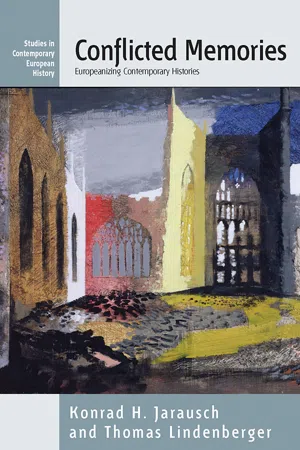
Despite the growing interest in general European history, the European dimension is surprisingly absent from the writing of contemporary history. In most countries, the historiography on the 20th century continues to be dominated by national perspectives. Although there is cross-national work on specific topics such as occupation or resistance, transnational conceptions and narratives of contemporary European history have yet to be worked out. This volume focuses on the development of a shared conception of recent European history that will be required as an underpinning for further economic and political integration so as to make lasting cooperation on the old continent possible. It tries to overcome the traditional national framing that ironically persists just at a time when organized efforts to transform Europe from an object of debate to an actual subject have some chance of succeeding in making it into a polity in its own right.
eBook - ePub
Conflicted Memories
Europeanizing Contemporary Histories
- 304 pages
- English
- ePUB (mobile friendly)
- Available on iOS & Android
eBook - ePub
Conflicted Memories
Europeanizing Contemporary Histories
About this book
Trusted by 375,005 students
Access to over 1.5 million titles for a fair monthly price.
Study more efficiently using our study tools.
Information
Part 1
CONTESTED MEMORIES

Chapter 1
HISTORY OF MEMORY,
POLICIES OF THE PAST: WHAT FOR?
POLICIES OF THE PAST: WHAT FOR?
According to common sense both within and beyond the boundaries of Europe, we more or less take for granted the existence of a European ‘culture' or ‘civilization.' In spite of geopolitical uncertainties, divergent points of view, and ideological discrepancies, this topos is firmly anchored in the collective imagination, even though it frequently gives rise to misunderstandings. Even the most chauvinistic of historians subscribe to this idea, out of either conviction or convenience. Moreover, several works have been written in recent years about the history of European institutions or organizations, and about the economic, social, and cultural history of European countries from a comparative perspective or on a transnational scale.1 These works are themselves the product of European networks that have mobilized resources within the framework of what may be called the ‘Europeanization' of research and the increased movement of researchers and students. They have been so consistently supported—with varying degrees of discernment—by European research policies that it would be presumptuous to claim to be breaking new ground with this topic. Nevertheless, there are at least two reasons why it makes sense to rethink the premises on which the ‘Europeanization' of present and future historiography is based.
The first reason is that, until recently, European history was conceived in terms of a given political, geographical, and economic entity, and that our task was to shed light on its foundations, structures, and inherent characteristics. From this perspective, Europe was simultaneously the main object of research, the source of privileged financing, and sometimes also the beneficiary of results presented with a view to improving European public policies.2 Moreover, this Europe was still primarily ‘Western.' However, the political, cultural, and even historiographical upheavals that took place in the wake of the fall of the Berlin Wall, and especially the integration of countries that once formed the eastern border of Europe, give rise to other perspectives and other questions, even retrospectively. Mark Mazower's recent book Dark Continent gives an idea of the direction European historiography will probably take in the future.3 A history of Europe in the twentieth century that is in keeping with its times can no longer merely praise the merits of postwar growth, the miracle of Franco-German reconciliation, and the benefits of stable borders and political institutions. Two aspects of future European historiography are of particular significance. First, such a history must, in the future, take account of the heritage and memory of communism, a topic that is still controversial and even today has hardly been accommodated within ‘Western' public consciousness. In some countries, in particular France and, to a lesser extent, Southern Europe, a considerable number of intellectuals and scholars have difficulty accepting the fact that this heritage harbours very negative connotations for tens of millions of Europeans whose experiences contrast starkly with their comparably lenient assessments of the large Western communist parties.4
In the same vein, other little-known or underestimated topics should be taken into account in the future, such as the significance of the compulsory migration of millions of people throughout Central and Eastern Europe after 1945, as well as ongoing ethnic tensions in some regions during the postwar years. The full extent of these tensions was not acknowledged in the West because it had been concealed during Soviet domination.5 In short, this alternative history of Europe entails the risk of being less optimistic, but is in sum more sensitive to historical gravity, the slow rhythms of change, and even the possible dead end that confounded progressive ideas characteristic of the early European construction process. At the same time, this would by no means imply a revaluation of the role played by national history.
The second reason why we need to reexamine the history of Europe is that scientific steps forward in this field have largely been made within the framework of specialized university degree courses formally defined as the ‘History of Europe' or ‘European History.' These have not yet become so commonplace or widespread that they have had a lasting impact on the dominant historiographical tradition, nor have they changed the analytical framework of other areas of historiography. One can easily observe to what extent contemporary history, unlike medieval or modern history—a distinction that in itself requires careful thought—is still underpinned by a national narrative that emphasizes the idea of historical singularity. The persistent discussions about the ‘German special path' (Sonderweg) are an example of this. A similar case is the continuing presence of the traditional topic of the ‘French exception' in historiography, which is almost never put to the test of historical comparison since it appears to be firmly rooted in a specific political historical tradition.6 In most European countries, the majority of works written by historians specializing in the nineteenth and twentieth centuries are therefore largely confined to a national framework, even when they claim to deal with transnational phenomena like the history of the two world wars or the period of National Socialism and Fascism.
These examples are not chosen by chance. These two topics make up a large portion of recent research on contemporary history. They have attracted much attention, been at the centre of public discussion, and contributed a great deal to the renewal of contemporary historiography in general, which, over the last twenty years, has become one of the major fields of historical study.7 However, they are all too often dealt with from a strictly national perspective because they come within the scope of debates about the redefinition of national identities in some European countries. Examples of this phenomenon include the ‘Historians' Dispute' that took place in Germany in the mid 1980s, the controversies about the First World War or about the memory of the Vichy regime in France, or even the debates about the heritage of Fascism and antifascism in Italy.
It is therefore not merely a question of writing an ‘alternative' history of Europe, but of reflecting on the possibility (or impossibility) of approaching certain problems from a perspective that is not national—problems that can only be understood if they are considered in isolation from the specific framework of one country or another. One could conceive of a global history that is receptive to the multiple dimensions and interconnections arising from the various questions raised. The ‘Europeanization' of questions should not therefore conform to political or ideological objectives, however praiseworthy they may be (such as ‘constructing Europe’), but rather adopt a heuristic approach, allowing historians to choose the most appropriate focal length in which to surpass or else explain in different terms a specific phenomenon, including the national phenomenon.8
The field of study devoted to collective memory offers a good standpoint from which to approach these questions. Over the last fifteen years, such studies have focused largely on the aftermath of wars, revolutions, dictatorships, and major massacres, as if bad memories were of top-priority interest to historians and to the human and social sciences in general. The same goes for the public policies of the past or even the policies of memory, which over recent years have invested a lot of energy in ‘managing' tragic episodes of recent history and attempting to ‘repair' them, sometimes decades after the events took place. Moreover, these two phenomena are interrelated, either because the historical writings preceded the policies or because they followed them and even reinforced their effect.
How and why does memory, in particular the memory of traumatic events, continue to be an object of political and historiographical interest in a Europe where peace, stability, and economic prosperity are the prime values, and in a context in which war is almost of no consequence (even though it has not been completely eradicated)? Some historians go a step further: Has the considerable interest taken in the murderous events of this century, above all in the Holocaust, not led to a biased and even distorted vision of the history of Europe after 1945?
Much energy…has recently been devoted to exploring the complex ways in which the populations and states of postwar Europe remembered and forgot about different aspects of the war years. This analysis of Europe's ‘undigested past'…does, however, tend to privilege the particularly ‘postwar' character of the subsequent decades, as if the history of western Europe after 1945 was little more than the after-shocks of the cataclysm which had preceded it. This is no more than a partial truth, and we also need to recognise that the contested struggle for postwar memory was often a mechanism by which the political forces of Europe in the 1950s and the 1960s competed for the present and the future by instrumentalising an increasingly distant past.9
This commentary is clearly aimed at historians of memory, and aptly reflects the disproportionate place accorded to the memory of the Second World War in the imagination of several European countries. It can serve as a starting point for two corollary questions:
1. What are the consequences of recent studies on memory? Have they emerged within a national context, or do they adopt a European perspective, and are these models all interchangeable with one another?
2. Why has the memory of the Holocaust acquired a central status over the last twenty years? And why has it become the object of new political initiatives on the European level?
Is the History of Memory National History?
In general, and assuming that it is possible to take account of the huge number of works published on this subject, one can discern three major tendencies in the relatively new field of research known as the history of memory.
The first and probably the oldest of these tendencies derives from the extensive work done in the field of oral history and from the attention accorded to eyewitness accounts in all areas of contemporary history: memoires, diaries, war notebooks, interviews, etc. This historiographical genre has been very successful because it appears to offer insight into the history of ‘ordinary people,' those forgotten by history, a category that until recently had not been given recognition in mainstream history writing. This field of history has had a lasting impact on the history of women and gender, on the history of cultural and ethnic minorities, on the renewal of the history of social movements, and on the history of everyday life (Alltagsgeschichte). By definition, this form of history surpasses (or ought to surpass) any particular national framework: it is not possible to write an oral history of the French or the Germans; on the other hand, there are numerous oral histories of French workers or German women at a specific period in the history of the twentieth century.
Oral history is dominated by sociological and anthropological approaches and appears at first glance to be an appropriate way of ‘Europeanizing' contemporary history. This phenomenon becomes apparent in studies about the war, based on the social experience of individuals and prioritizing witness reports by soldiers, prisoners, and victims among the civilian population, that adopt a comparative or transnational perspective from the start. It is also apparent in some writings on the Holocaust that focus on the utterances of survivors and use witness accounts while marginalizing the national dimension. In these examples, it is necessary to make distinctions with respect to the common experiences of certain populations or social categories throughout Europe: between the fate of Jews and other victims of National Socialism on the one hand, and more or less universal experiences that are not confined to Europe on the other; or between the experience of imprisonment and of the concentration camp system on the one hand, and the violence of war on the other. The scope of observation and analysis depends very much on the initial question posed.
The second tendency arose in the wake of studies of what the historian Pierre Nora calls ‘sites of memory' (lieux de mémoire), a notion that has since been given equal attention in Germany and Italy, where projects have been carried out that closely resemble the original.10 These projects strive to understand the way in which a society goes about reading its own past, and how it keeps the past alive, or commemorates or forgets episodes of its history. They are based on the relatively new idea that our relation to the past evolves over time, and that it is governed by a specific type of historicity that needs to be explained. This basic premise is shared by all historians of memory today. In the meantime, these projects have resulted in a sort of inventory of national traditions, which was doubtlessly part of the initial aim. In some cases, certain traditions have been invented by listing phenomena that, a priori, had no obvious memorial function or else offered no basis upon which to interpret the past. The essays contained in Les Lieux de mémoire include studies of ‘vectors of memory' that convey an explicit and socially demanded representation of the past (monuments, museums, major historical works, etc.) as well as cultural, political, and social processes (language, sites of power, and the spatial division of territory, for example). These essays' authors claim that they convey implicit representations of the past and, moreover, that they are signs by which we can identify the common elements of the national imagination shared by French people.
This type of approach presupposes that there exists a very strong sense of national identity, as in France, Germany, or Italy. It also presupposes that political leaders play a significant role in the writing of history. It has often been said that the notion of ‘sites of memory' cannot be applied to each and every nation: it encounters obstacles in the Netherlands, for example, where history does not play such a central role in assuring social cohesion,11 and in the United Kingdom, where there is no ‘historical consciousness' in the sense of an ‘official version of the past approved by the state.'12
Pierre Nora himself has insisted that the notion of ‘site of memory' is specific to France, although the expression comes from the Latin locus memoriae, and is therefore part of the European linguistic heritage. He traces the specificity of this term back to the 1970s in France and the beginning of a crisis of French national identity, ‘where it has become apparent that a huge stock of collective memory, of historical memory acquired in the fervour of tradition, via the questioning of customs, disappeared into thin air, only to return by means of the scientific and reconstructive writing of history.'13 This ‘sense of loss' was one of the motives underlying the project for Les Lieux de mémoire, whose specifically French dimension was underscored retrospectively in order to challenge any form of uncoordinated export of the concept, especially on a European scale:
What counts [for all aspects of the history of memory] are not the objects, which are merely signs and traces of the past, but the kind of relation one has to the past and the manner in which the present uses and reconstructs it; as it happens, France, an archetypal nation-state, has been marked by consider...
Table of contents
- Cover Page
- Title Page
- Copyright Page
- Contents
- Acknowledgments
- List of Acronymns
- Introduction - Contours of a Critical History of Contemporary Europe: A Transnational Agenda
- Part 1: Contested Memories
- Part 2: Multiple Conflicts
- Part 3: Transnational Interactions
- Part 4: Unfinished Political Processes
- Selected Bibliography
- List of Contributors
Frequently asked questions
Yes, you can cancel anytime from the Subscription tab in your account settings on the Perlego website. Your subscription will stay active until the end of your current billing period. Learn how to cancel your subscription
No, books cannot be downloaded as external files, such as PDFs, for use outside of Perlego. However, you can download books within the Perlego app for offline reading on mobile or tablet. Learn how to download books offline
Perlego offers two plans: Essential and Complete
- Essential is ideal for learners and professionals who enjoy exploring a wide range of subjects. Access the Essential Library with 800,000+ trusted titles and best-sellers across business, personal growth, and the humanities. Includes unlimited reading time and Standard Read Aloud voice.
- Complete: Perfect for advanced learners and researchers needing full, unrestricted access. Unlock 1.5M+ books across hundreds of subjects, including academic and specialized titles. The Complete Plan also includes advanced features like Premium Read Aloud and Research Assistant.
We are an online textbook subscription service, where you can get access to an entire online library for less than the price of a single book per month. With over 1.5 million books across 990+ topics, we’ve got you covered! Learn about our mission
Look out for the read-aloud symbol on your next book to see if you can listen to it. The read-aloud tool reads text aloud for you, highlighting the text as it is being read. You can pause it, speed it up and slow it down. Learn more about Read Aloud
Yes! You can use the Perlego app on both iOS and Android devices to read anytime, anywhere — even offline. Perfect for commutes or when you’re on the go.
Please note we cannot support devices running on iOS 13 and Android 7 or earlier. Learn more about using the app
Please note we cannot support devices running on iOS 13 and Android 7 or earlier. Learn more about using the app
Yes, you can access Conflicted Memories by Konrad H. Jarausch, Thomas Lindenberger, Konrad H. Jarausch,Thomas Lindenberger in PDF and/or ePUB format, as well as other popular books in History & 20th Century History. We have over 1.5 million books available in our catalogue for you to explore.