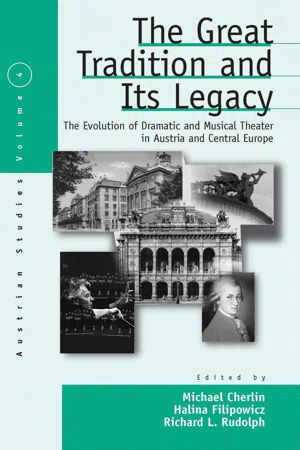
Both dramatic and musical theater are part of the tradition that has made Austria - especially Vienna - and the old Habsburg lands synonymous with high culture in Central Europe. Many works, often controversial originally but now considered as classics, are still performed regularly in Vienna, Prague, Budapest, or Krakow. This volume not only offers an excellent overview of the theatrical history of the region, it is also an innovative, cross-disciplinary attempt to analyse the inner workings and dynamics of theater through a discussion of the interplay between society, the audience, and performing artists.
eBook - ePub
The Great Tradition and Its Legacy
The Evolution of Dramatic and Musical Theater in Austria and Central Europe
- 290 pages
- English
- ePUB (mobile friendly)
- Available on iOS & Android
eBook - ePub
The Great Tradition and Its Legacy
The Evolution of Dramatic and Musical Theater in Austria and Central Europe
About this book
Trusted by 375,005 students
Access to over 1.5 million titles for a fair monthly price.
Study more efficiently using our study tools.
Information
CONTRIBUTORS

Eva Badura-Skoda has been professor of music at the University of Wisconsin-Madison and guest professor at the Mozarteum, Boston University, Queens University, McGill University, and the Universität Göttingen. She has published scholarly books and numerous articles in various languages, mainly about performance practice problems and the Viennese classical period composers. In 1986 she was decorated with the Austrian Honorary Cross Literis et Arbitus.
Evan Baker is a researcher, writer, and lecturer in Los Angeles. His research focuses on the history of opera staging, production, and theater architecture. His most recent publication (as coeditor with James Deaville) was Wagner in Rehearsal, 1875–1876: The Diaries of Richard Fricke (1998). He is presently writing a history of opera production for Yale University Press.
Hans-Peter Bayerdörfer is professor at the Institute of Theater Research at the Ludwig-Maximilians-University of Munich. Jewish-German theater and literature relationships in Austria and Germany are primary areas of his research interests.
Michael Cherlin is professor of music theory at the School of Music, University of Minnesota. His research focuses on relations between music and text and on the Second Viennese School. Recent papers include “Memory and Rhetorical Trope in Schoenberg’s String Trio,” published in the Journal of the American Musicological Society (fall 1998), and “Motive and Memory in Schoenberg’s First String Quartet,” included in a festschrift for David Lewin, Music of My Future: The Schoenberg Quartets and Trio, published by Harvard University Press (2001).
Sibylle Dahms is associate professor at the Institute of Musicology of the University of Salzburg, where she is also curator of the significant dance collection, Derra de Moroda Dance Archives. Her research focuses on opera and dance history, particularly from the sixteenth to the nineteenth centuries.
Halina Filipowicz is professor of Slavic literatures at the University of Wisconsin-Madison. Her interdisciplinary research spans the intersection of drama, performance, gender, and cultural mythology, with particular emphasis on taboo topics in Polish and Polish-Jewish cultural studies. Her publications include A Laboratory of Impure Forms: The Plays of Tadeusz Różewicz (1991; Polish translation, 2000), several special issues, and numerous book chapters and articles. She is currently working on a monograph entitled Democracy at the Theatre: Drama, Transgression, and Polish Cultural Mythology, 1786–1989.
Christine Kiebuzinska is professor in the Department of English at Virginia Tech. She is the author of Revolutionaries in the Theater: Meyerhold, Brecht, and Witkiewicz (1988) and Intertextual Loops in Modern Drama (2001). She has authored numerous articles and reviews on modern drama, including ones on Elfriede Jelinek and Thomas Bernhard, that have appeared in Modern Drama, Theatre Journal, Comparative Literature, and Modern Language Studies.
Jeanette R. Malkin is senior lecturer at the Department of Theatre Studies, Hebrew University, Jerusalem. She has published widely on contemporary German and American theater, including works on Heiner Müller, Thomas Bernhard, and Sam Shepard. She is currently coediting a book, Jews and the Emergence of Modern German Theater, for the Wisconsin University Press. Her most recent book is Memory-Theater and Postmodern Drama (University of Michigan Press, 1999).
Michael Patterson is professor of theater in the Department of Performing Arts at De Montfort University, Leicester, England. He has published several books on German-language theater, including a comprehensive bibliography. His book on British political theater, Strategies of Political Theatre: Post-War British Play-wrights, was published by Cambridge University Press in 2003, and he is now working on The Oxford Dictionary of Plays.
Alfred Pfabigan is professor in the Institute of Philosophy at the University of Vienna. He recently published Thomas Bernhard—Ein österreichisches Weltexperiment (1999) and Die Enttäuschung der Moderne (2000).
Peter Revers is professor of music history at the University of Music and Dramatic Arts in Graz. His research focuses on eighteenth- to twentieth-century music and the reception of Far Eastern music in Europe around 1900. Recently he published Das Fremde und das Vertraute: Studien zur musiktheoretischen und musikdramatischen Ostasienrezeption (The Foreign and the Familiar: Studies on the Reception of Far Eastern Music in Music Theory and Music Drama) (1997), and Mahlers Lieder (Mahler’s Songs) (2000).
Richard L. Rudolph is professor of history, emeritus, of the University of Minnesota and is the former director of the Center for Austrian Studies at that university. He has written on various aspects of the social and economic history of Central and Eastern Europe.
Harold B. Segel is professor emeritus of Slavic and comparative literature at Columbia University. His more recent books include The Vienna Coffeehouse Wits, 1890–1938 (1993), Pinocchio’s Progeny: Puppets, Marionettes, Automatons and Robots in Modernist and Avant-garde Drama (1995), Stranger in Our Midst: Images of the Jew in Polish Literature (1996), Egon Erwin Kisch: The Raging Reporter (1997), Body Ascendant: Modernism and the Physical Imperative (1998), Political Thought in Renaissance Poland (2003), and The Columbia Guide to the Literature of Eastern Europe since 1945 (2003).
Ernst Wangermann is professor emeritus of Austrian history in the Institute of History at the University of Salzburg. His research focuses on the Austrian Enlightenment and on enlightened reform and the impact of the French Revolution in the Habsburg Empire. He has coedited Genie und Alltag (1994), which explores the social and intellectual context of Mozart’s compositions, and contributed an essay on the eighteenth century to Das Millennium: Essays zu tausend Jahre Österreich (1996). Most recently, he has contributed the entries on the Austrian Enlightenment and Joseph II to the new Encyclopedia of the Enlightenment.
Carl Weber, professor of directing and dramaturgy in the Drama Department at Stanford University, has been a collaborator of Bertolt Brecht and has directed widely in both Europe and North America. He has published numerous essays, and has edited and translated several volumes of writings by Heiner Müller and the anthology Drama Contemporary: Germany. His research focuses on German-language drama and performance. Most recently, he was the editor, commentator, and translator for A Heiner Müller Reader (2001).
Gretchen Wheelock is associate professor of musicology at the University of Rochester’s Eastman School of Music. She is the author of Haydn’s Ingenious Jesting with Art (1992) and has published essays on issues of gender in Mozart’s opera in Musicology and Difference (1993) and Siren Songs: Representations of Gender and Sexuality in Opera (2000).
DRAMATIC THEATER
INTRODUCTION
Rethinking Drama and Theater in Austria and Central Europe

Halina Filipowicz
Most people, when they think of the performing arts in Austria, remember the Great Tradition: Mozart, Haydn, Mahler. But what of Johann Nepomuk Nestroy, Karl Goldmark, Elfriede Jelinek? What of Thomas Bernhard’s “scandalous” plays, which have delighted some critics and terrified others? Can we now come at the Great Tradition differently? It is to redress the balance in creative, interdisciplinary ways and to explore the remarkably innovative achievement of what is known as the Great Tradition that we offer this volume. It brings together new readings of a rich juxtaposition of major and minor works, the relation of these works to cultural, intellectual, and political history, and the questions they raise for problems of critical theory. Though widely divergent in their thematic preoccupations and methodological approaches, the essays do not attempt, of course, to cover fully this broad and diverse area. The spotlight is on Austria, with excursions into Germany and Poland that extend the scope of inquiry, offering new insights into the culture of two of Austria’s Others.
The chapters on drama and theater open up a debate that continues throughout the volume and considers these questions among others: what are the ethical gains and shortcomings of a cultural solidarity through the aesthetic? Does a “fetishization” of the aesthetic merely reinforce the status quo? These questions are not new, but they have gained new resonance in literary and cultural studies since the late 1980s.1 What emerges most persistently from the debate in this volume is a sense that the situation of the performing arts in Austria and Central Europe does not fit snugly into established theoretical frameworks, precisely because of the vexed political questions that hover over the recent history of this region. Here, the artist’s obligation to transmute historical chaos to imaginative order has always seemed to be at once more urgent, more fragile, and more burdensome, even stifling, than elsewhere in Europe. In “Theses on the Philosophy of History,” Walter Benjamin encapsulates this conundrum through the image of a Klee drawing, Angelus Novus: “His face is turned toward the past. Where we perceive a chain of events, he sees only one single catastrophe which keeps piling wreckage upon wreckage and hurls it in front of his feet. The angel would like to stay, awaken the dead, and make whole what has been smashed. But a storm is blowing from Paradise; it has got caught in his wings with such violence that the angel can no longer close them. This storm irresistibly propels him into the future to which his back is turned, while the pile of debris before him grows skyward. This storm is what we call progress.”2 This powerful passage, however, leaves thoroughly and disturbingly open-ended the question about the identity of “we” and about the relation between what “we” see and what “we” want to see. One way to grapple with this issue is to turn to the representational paradoxes of drama and theater.
The essays on drama and theater, chronologically as well as conceptually, straddle two epochs: the Enlightenment and the “new beginning.” By the “new beginning” I mean the artistic reforms, liberties, and audacities that, between the late 1880s and the outbreak of World War I, changed European drama and theater almost beyond recognition. That passionate revisionist project was far from articulating a comprehensive and uniform program. Instead, it included realistic, naturalistic, symbolist, and ritualistic strands. If there was one element that the revisionist project had in common, it was a radical shift away from a theater that had been commodified for consumption by “cultured,” middle-class audiences. That shift was predicated on a belief—quite far-ranging in its implications—in the autonomous nature of theater or, more precisely, on a belief in the autonomous nature of the art of theater. In other words, the thrust of the reformist vision was to insist that theater is a fully independent art form rather than either entertainment or a vehicle for dramatic literature.
Today, in our era of packaged, distant, “cool” culture, the need for live theater as an art form, indeed for any kind of live (and hence “warm”) theater, is ever more problematic. And no wonder. In the technophilia world of total absorption by simulacra, where everything has always already been mediated, reproduced, or represented by technologies, live theater seems passé. And yet, paradoxically (unpostmodernistically?), live performance still manages to hold out an irresistible promise of what is often called, archaically, “theater magic.” How does live theater produce so strong a mechanism for “magic” recognition? Can the appeal, indeed the mystery, of live theater be seen as originating in its contradictions and aporias rather than in its unequivocal groundedness in the real?
It seems almost a banality to say that live theater is the most communal of all the arts: it depends on public performance and collective viewing. Much of what we like to call the magic of live theater relies on the give-and-take between an individual perspective and an experience shared with others in the same space. It seems almost another banality to declare that live theater can work its magic outside the instrumental capacity of simulation technologies. On bare ground, without any technological advantages, an actor can create a world that is more intense and real than the world most of us know. The craft of acting is laid bare without the attendant “mysteries” of character, sets, costumes, props, and music. Through the magic of performative transformation, this theater degree zero can be the site of revelation but not necessarily of communication—or at least not of communication in any instrumental or functional sense.
It seems still another banality—yet one that we, as participants in the twentieth century’s “rampantly visualist culture,” or, more precisely, in the twentieth century’s surrender to the monocular imagery of the photograph, cinema, and television, can tend to lose sight of—to point out that live theater is differently visual.3 In the epistemological sense, of course, theater subscribes to a kind of visual abs...
Table of contents
- Cover
- Title
- Copyright
- Contents
- List of Illustrations
- Preface
- Notes on Contributors
- Musical Theater
- References
- Index
Frequently asked questions
Yes, you can cancel anytime from the Subscription tab in your account settings on the Perlego website. Your subscription will stay active until the end of your current billing period. Learn how to cancel your subscription
No, books cannot be downloaded as external files, such as PDFs, for use outside of Perlego. However, you can download books within the Perlego app for offline reading on mobile or tablet. Learn how to download books offline
Perlego offers two plans: Essential and Complete
- Essential is ideal for learners and professionals who enjoy exploring a wide range of subjects. Access the Essential Library with 800,000+ trusted titles and best-sellers across business, personal growth, and the humanities. Includes unlimited reading time and Standard Read Aloud voice.
- Complete: Perfect for advanced learners and researchers needing full, unrestricted access. Unlock 1.5M+ books across hundreds of subjects, including academic and specialized titles. The Complete Plan also includes advanced features like Premium Read Aloud and Research Assistant.
We are an online textbook subscription service, where you can get access to an entire online library for less than the price of a single book per month. With over 1.5 million books across 990+ topics, we’ve got you covered! Learn about our mission
Look out for the read-aloud symbol on your next book to see if you can listen to it. The read-aloud tool reads text aloud for you, highlighting the text as it is being read. You can pause it, speed it up and slow it down. Learn more about Read Aloud
Yes! You can use the Perlego app on both iOS and Android devices to read anytime, anywhere — even offline. Perfect for commutes or when you’re on the go.
Please note we cannot support devices running on iOS 13 and Android 7 or earlier. Learn more about using the app
Please note we cannot support devices running on iOS 13 and Android 7 or earlier. Learn more about using the app
Yes, you can access The Great Tradition and Its Legacy by Michael Cherlin, Halina Filipowicz, Richard L. Rudolph, Michael Cherlin,Halina Filipowicz,Richard L. Rudolph in PDF and/or ePUB format, as well as other popular books in History & European History. We have over 1.5 million books available in our catalogue for you to explore.