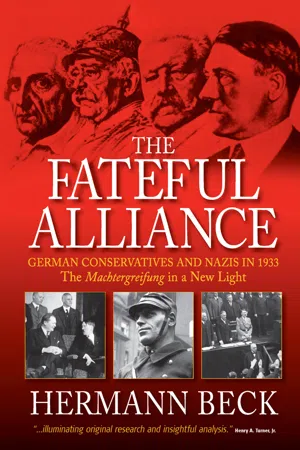
On 30 January 1933, Alfred Hugenberg's conservative German National People's Party (DNVP) formed a coalition government with the Nazi Party, thus enabling Hitler to accede to the chancellorship. This book analyzes in detail the complicated relationship between Conservatives and Nazis and offers a re-interpretation of the Nazi seizure of power - the decisive months between 30 January and 14 July 1933. The Machtergreifung is characterized here as a period of all-pervasive violence and lawlessness with incessant conflicts between Nazis and German Nationals and Nazi attacks on the conservative Bürgertum, a far cry from the traditional depiction of the takeover as a relatively bloodless, virtually sterile assumption of power by one vast impersonal apparatus wresting control from another. The author scrutinizes the revolutionary character of the Nazi seizure of power, the Nazis' attacks on the conservative Bürgertum and its values, and National Socialism's co-optation of conservative symbols of state power to serve radically new goals, while addressing the issue of why the DNVP was complicit in this and paradoxically participated in eroding the foundations of its very own principles and bases of support.
eBook - ePub
The Fateful Alliance
German Conservatives and Nazis in 1933: The <I>Machtergreifung</I> in a New Light
- 372 pages
- English
- ePUB (mobile friendly)
- Available on iOS & Android
eBook - ePub
The Fateful Alliance
German Conservatives and Nazis in 1933: The <I>Machtergreifung</I> in a New Light
About this book
Trusted by 375,005 students
Access to over 1.5 million titles for a fair monthly price.
Study more efficiently using our study tools.
Information
Chapter I
PRAGMATISTS VERSUS FUNDAMENTALISTS
The DNVP in the Weimar Republic, 1918–1933
From its inception, the German National People's Party was divided between principled opposition to the Weimar Republic, on the one hand, and the desire for practical cooperation and participation in governmental coalitions, on the other—a conflict that was never overcome until Hugenberg became party chairman in 1928. Three phases in the relationship between the DNVP and the Weimar Republic can be distinguished: (I) uncompromising opposition and hope for the demise of the Republic before 1924, with tentative signs of a reluctant readiness for cooperation; (II) participation in coalition governments and political cooperation despite ongoing opposition to Gustav Stresemann's foreign policy during Weimar's “good years” between 1924 and 1928, the DNVP's politically most successful period; (III) increasing hostility toward the Republic with the accession of Alfred Hugenberg to the chairmanship of the party in October 1928. The rejection of all that Weimar represented became all-pervasive; this weakened the party and divided it further, while strengthening the radical forces within it.
In the first years after its formation in 1918, the DNVP was dominated by conservatives who had served in the ministerial bureaucracy of the Empire. Despite their principled opposition to the Weimar Republic, their experience in government administration had led them to pursue practical solutions to political problems. Given their personalities and life experiences, none of these men could remain intransigent in their opposition to the Republic; they thus proved willing to participate in the Weimar political system until a better solution could be found. The initial leadership group of the DNVP, despite harboring deep animosity toward the principles on which Weimar was based, was nonetheless moderate in orientation, though at times deceptively so. By contrast, the members of the former Deutsch-Konservative Partei (German Conservative Party or DKP) who had joined the DNVP, such as the party's former parliamentary faction leader Kuno Graf von Westarp, or those close to the Pan-German Association, such as Alfred Hugenberg, stubbornly emphasized their disdain for the Republic and were less willing to compromise their principles for the sake of practical politics. Initially, they remained in the background because they had become too discredited by their exaggerated annexationist demands during the war. During wartime their views had been considered to be a commendable reflection of national sentiment. Now, in the wake of defeat, they had become an embarrassing mortgage of a past best forgotten. In the shadow of wartime defeat and less burdened by the baggage of past annexationist claims, former Free Conservatives and Christian Socials thus initially exercised greater influence within the party than their relative strength warranted, especially in Weimar's constituent National Assembly and in the formulation of the DNVP's political program. The leadership team in this first phase, which determined the party's course in the immediate postwar period, consisted mainly of Imperial civil servants such as Oskar Hergt (1869–1967), former Prussian Finance Minister and, since December 1918, the first chairman of the DNVP; Clemens von Delbrück (1856–1921), former Free Conservative Lord Mayor of Danzig, Prussian Minister of Industry and Commerce, and later Undersecretary of State (Staatssekretär) of the Interior from 1909 to 1916, who became one of the major exponents of the DNVP in the National Assembly until his death in December 1921;1 Arthur Graf von Posadowsky-Wehner (1845–1932), DNVP parliamentary faction leader in the National Assembly and one of Delbrück's predecessors as Undersecretary of State of the Interior from 1897 to 1907, who had made a name for himself as a social reformer during the Empire (he left the DNVP after the Kapp Putsch in 1920);2 and Karl Helfferich (1872–1924), another high-ranking bureaucrat, financial expert and banker, Undersecretary of State in the Treasury Department and the Ministry of the Interior during the war, who had helped finance the war effort through loans instead of raising taxes, and who died an untimely death in a train accident in 1924.3 Finally, there was Adalbert Dühringer (1855–1924), judicial reformer of the late nineteenth century, Councilor at the Supreme Court (Reichsgerichtsrat) in Leipzig (1902–1915), Baden's Minister of Justice in 1917–1918, and then cofounder of the DNVP in Baden in 1919. Dühringer left the DNVP in July 1922 in opposition to the growing anti-Semitism of the German Nationals during the so-called “Henning-Wulle” crisis and the overt approval of Foreign Minister Rathenau's murder by völkisch circles within the party.4
After the attrition through death or resignation of this group of moderate bureaucrats, representatives of various interest groups from industry, the Rural League (Reichslandbund), and the Association of German National Shop Assistants became increasingly influential within the DNVP. This second phase in the party's history was ushered in by the elections of 4 May and 7 December 1924 in which the party reached the zenith of its success by gaining approximately one-fifth of all votes cast. Subsequently, the DNVP participated twice in coalition governments, in which its deputies held a number of ministerial positions.5 Upon assuming these governmental posts, the DNVP Ministers were obliged to take an oath to the Weimar Constitution, thereby tying the party more closely to the Republic. Despite its cooperation in economic and financial matters, the DNVP proved less amenable when it came to foreign policy and sabotaged Stresemann's conduct of foreign affairs whenever possible,6 in particular since its members considered it a sellout of traditional German interests to effect a rapprochement with the West. Following the not-unexpected election defeat of 20 May 1928, in which the DNVP's share of the vote fell from 20.5 percent to 14.7 (from 6.206 to 4.381 million votes cast) and its Reichstag faction shrank from 103 to 73 seats, Kuno Graf von Westarp was forced to resign from the position of party chairman. He was replaced in October 1928 by Alfred Hugenberg, whose candidacy was championed by the Pan-German Association, and who was strongly supported by the DNVP Land Associations (Landesverbände), which had always been more fundamentalist in their outlook than the parliamentary faction in the Reichstag, and over which Hugenberg exerted some measure of control through his financial resources and growing ascendancy over the party apparatus.
With Hugenberg's accession to the leadership, the nationalist hotheads within the DNVP, who had always opposed the Republic with implacable hostility, gained the upper hand. Moderates within the DNVP, mindful of the need to come to terms with the Republic in order to wield at least a modicum of political influence, were increasingly pushed to the fringes. This growing influence of fundamentalists at the expense of pragmatists would soon lead to two major schisms in the DNVP Reichstag faction and further catastrophic election defeats. After 1929, the uncompromising anti-Republican course pursued by Hugenberg inexorably brought the DNVP into closer contact with its stronger and more vital rival, the Nazi party.
The DNVP during the Early Republic (1920–1924)
Already during the Kapp Putsch of March 1920, the DNVP was forced to show its true colors and indicate whether it was willing to follow up on its hostile attitude to the Republic with corresponding deeds. Wolfgang Kapp, the East Prussian Generallandschaftsdirektor,7 son of a well-known revolutionary of 1848, who had made a name for himself as a founder of the Fatherland Party in 1917, tried to overthrow the Republic through a military coup in March 1920. The coup was sparked by Allied demands for a reduction of Reichswehr forces and the dissolution of the Freikorps (Free Corps), since many rightists feared that fulfillment of these demands might expose Germany's eastern provinces to Bolshevik invasion.8 Support for Kapp was consequently strongest among the populations of Silesia and East Prussia, to the point that even the Social Democratic provincial governor (Oberpräsident) of East Prussia, August Winnig, recognized Kapp's new government.9 Kuno Graf von Westarp and other members of the DNVP's right wing knew about the preparations and were ready to support the coup. Since General Walther von Lüttwitz, the military leader of the revolt, acted before Kapp had made the necessary political arrangements, many of those who might have participated under more advantageous circumstances now exercised restraint, so that the putsch was doomed to failure from the start. The DNVP leadership advised against participation in the putsch from the beginning, while the party manager, Hans Erdmann von Lindeiner-Wildau, went so far as to alert the Prussian official Herbert von Berger to the increasing unrest inside the Reichswehr on 8 March 1920, a warning clearly aimed at providing the DNVP with an alibi in case the coup attempt failed.10 This had little effect in itself, since von Berger had already been apprised of unrest in the army and chose to do nothing about it.11 Inside the party, Lindeiner's initiative gave rise to sharp criticism, since a part of the membership considered a military coup against the Republic, accompanied by a possible restoration of the monarchy, as an auspicious new beginning. Former Free Conservatives and Christian Socials supported party chairman Oskar Hergt's attempts to prevail upon General Lüttwitz to exercise caution, whereas most völkisch and former DKP members considered an overthrow of the Republic a goal worth fighting for.12 Since few leading figures of its right wing, mostly East Elbian estate owners, had openly supported the Kapp Putsch, the DNVP as a whole outwardly succeeded in avoiding the impression of open complicity in the events of March 1920. On the other hand, Wolfgang Kapp himself was a DNVP member and well connected in party circles by virtue of his activities as founder and chairman of the Fatherland Party. Gottfried Traub, for example, a member of the DNVP's executive committee, who had been a deputy in the National Assembly and had also served on the executive board of the Fatherland Party, had been appointed Minister of Culture during the putsch.13
After the wretched failure of Kapp's attempted coup and the virtually unanimous public condemnation of the undertaking, Hergt (who had personally been against the putsch) and the party leadership took great pains to distance themselves from the whole affair. Among the wider public, however, the impression prevailed that the party had been more deeply entangled than it let on. In the Reichstag elections of 6 June 1920, the DNVP was subsequently punished for its putative involvement, insofar as a substantial section of the electorate that voted for the German People's Party (DVP) might well have opted for the DNVP, had not suspicion of the party's complicity in the putsch prevented them from doing so.14 Acrimonious intraparty arguments between moderate conservatives and the more radical members of the former DKP, the anti-Semitic parties, and Pan-Germans ensued. In the wake of these conflicts, a group of former Free Conservatives, led by Siegfried von Kardorff, defected to the DVP.15
After June 1920, weak Weimar coalition governments confronted a newly roused and increasingly active rightist opposition, which had no qualms about openly showing its colors. Inside the DNVP, fundamentalist radicals were gaining ground over moderates, a process aided by the galloping inflation of 1921 and 1922. In particular the völkisch wing began to consolidate its influence due to the influx of impoverished craftsmen, farmers, white-collar employees, and a growing academic proletariat. Supporters of prewar anti-Semitic parties, who had found a political home in the DNVP, now pressed for further radicalization. The party leadership, however, was determined not to abandon the path of legality. Jolted by the Kapp Putsch, it was aware of the danger of radicalization and prepared to counter it by all available means. The inevitable inner-party crisis over the future course of the DNVP, fought out in 1922, resulted in the expulsion of the anti-Semitic wing. The showdown was triggered off by a venomous article about Walther Rathenau published by the DNVP Reichstag deputy Wilhelm Henning, a member of the party's völkisch wing.16 The publication of this article virtually coincided with Rathenau's murder on 24 June 1922, which prompted Chancellor Joseph Wirth (Center Party) to demand that Hergt purge the DNVP of radical elements to avoid having the party as a whole suspected of sanctioning political murder. When Henning, supported by Reinhold Wulle and Albrecht von Graefe, responded to possible expulsion from the party with a sharp attack on the party leadership, an intraparty confrontation had become inevitable.
The DNVP's 1920 party program included an explicitly anti-Semitic passage, and anti-Semitic attitudes were widespread within the party, especially in the Land Associations.17 Initially anti-Semites in the DNVP were intent on dominating the entire party, whereas the foundation of a separate völkisch party was envisaged as a last resort. To organize all those with völkisch convictions, a “German völkisch study group” was set up within the DNVP in early September 1922 with the goal of “forestalling the imminent danger of an exodus of völkisch elements to other political parties.”18 An interesting example of the cross-fertilization between the DNVP and the völkisch Nazi party was the election of Wilhelm Kube (who later became notorious as one of the more infamous Nazi Gauleiter) to the executive board of this “German völkisch study group.”19 The conflict provoked by the Henning-Wulle affair now created a welcome opportunity for the party leadership to cut radical anti-Semites in the party down to size, particularly since it was obvious that their radicalism was harming the DNVP as a whole. Thus, at the October 1922 Görlitz party conference, the confrontation with anti-Semites was high on the agenda. They were quickly thrown on the defensive, since party chairman Hergt and other moderate party notables, such as Otto Hoetzsch,20 dominated proceedings at the conference. When Graf Westarp came down on the side of the party leadership, the die was cast: Henning, Graefe, and Wulle left the DNVP and founded the German Völkisch Freedom Party in December 1922.
After expelling the extreme anti-Semites, it appeared that the DNVP as a whole might be able to play a more constructive role in Weimar politics, despite the principled opposition of many of its members to the Republic. This opposition would continue to bubble to the surface, however, when it served the party's interest to side with a defiant public over matters of national security and foreign policy. The great crises of 1923—the French occupation of the Ruhr, German passive resistance to the occupation, separatist movements in western Germany, inflation, the widely publicized activities of French military courts against Germans who defied the occupier, communist unrest, and all-pervasive political instability—thus reinforced anti-Republican tendencies within the DNVP. Strengthened by internal consolidation after Görlitz, the DNVP advocated intensification of resistance in the Ruhr, cessation of reparation payments, and opposition to the termination of passive resistance advocated by the Stresemann government. Yet, within a year, political conditions and the compelling force of economic interests would enjoin the DNVP to abandon policies dictated purely by ideology and to fall in with the political mainstream.
The Dawes Plan
After the disasters of the inflation, the Allied Reparations Commission tried to devise a plan to establish a feasible level of reparations, while making sure that the German budget remained balanced and the currency stabilized. The Dawes Plan, ...
Table of contents
- Cover Page
- Title Page
- Copyright Page
- Contents
- Preface
- Introduction
- Chapter I - Pragmatists versus Fundamentalists: The DNVP in the Weimar Republic, 1918–1933
- Chapter II - Uneasy Partners: The Relationship between the DNVP and the Nazis, 30 January–5 March
- Chapter III - Conservatives and the NSDAP during the “National Revolution” of March 1933
- Chapter IV - The Nazis and the Conservative Bürgertum: A Clash of Worlds
- Chapter V - Between the Dictates of Conscience and Political Expediency: The DNVP and Anti-Semitism
- Chapter VI - Rebellion against the Inevitable: The Tribulations of Spring 1933
- Chapter VII - Ignominious Demise: Defections, Prohibitions, and Final Dissolution
- Epilogue
- Appendix
- Select Bibliography
- Index
Frequently asked questions
Yes, you can cancel anytime from the Subscription tab in your account settings on the Perlego website. Your subscription will stay active until the end of your current billing period. Learn how to cancel your subscription
No, books cannot be downloaded as external files, such as PDFs, for use outside of Perlego. However, you can download books within the Perlego app for offline reading on mobile or tablet. Learn how to download books offline
Perlego offers two plans: Essential and Complete
- Essential is ideal for learners and professionals who enjoy exploring a wide range of subjects. Access the Essential Library with 800,000+ trusted titles and best-sellers across business, personal growth, and the humanities. Includes unlimited reading time and Standard Read Aloud voice.
- Complete: Perfect for advanced learners and researchers needing full, unrestricted access. Unlock 1.5M+ books across hundreds of subjects, including academic and specialized titles. The Complete Plan also includes advanced features like Premium Read Aloud and Research Assistant.
We are an online textbook subscription service, where you can get access to an entire online library for less than the price of a single book per month. With over 1.5 million books across 990+ topics, we’ve got you covered! Learn about our mission
Look out for the read-aloud symbol on your next book to see if you can listen to it. The read-aloud tool reads text aloud for you, highlighting the text as it is being read. You can pause it, speed it up and slow it down. Learn more about Read Aloud
Yes! You can use the Perlego app on both iOS and Android devices to read anytime, anywhere — even offline. Perfect for commutes or when you’re on the go.
Please note we cannot support devices running on iOS 13 and Android 7 or earlier. Learn more about using the app
Please note we cannot support devices running on iOS 13 and Android 7 or earlier. Learn more about using the app
Yes, you can access The Fateful Alliance by Hermann Beck in PDF and/or ePUB format, as well as other popular books in History & 20th Century History. We have over 1.5 million books available in our catalogue for you to explore.