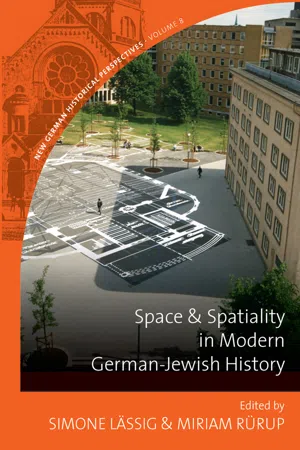
What makes a space Jewish? This wide-ranging volume revisits literal as well as metaphorical spaces in modern German history to examine the ways in which Jewishness has been attributed to them both within and outside of Jewish communities, and what the implications have been across different eras and social contexts. Working from an expansive concept of "the spatial," these contributions look not only at physical sites but at professional, political, institutional, and imaginative realms, as well as historical Jewish experiences of spacelessness. Together, they encompass spaces as varied as early modern print shops and Weimar cinema, always pointing to the complex intertwining of German and Jewish identity.
eBook - PDF
Space and Spatiality in Modern German-Jewish History
- 339 pages
- English
- PDF
- Available on iOS & Android
eBook - PDF
Space and Spatiality in Modern German-Jewish History
About this book
Trusted by 375,005 students
Access to over 1.5 million titles for a fair monthly price.
Study more efficiently using our study tools.
Information
Table of contents
- Space and Spatiality in Modern German-Jewish History
- Contents
- Illustrations
- Preface
- Introduction: What Made a Space "Jewish"? Reconsidering a Category of Modern German History
- Part I — Imaginations: Remembrance and Representation of Spaces and Boundaries
- Chapter 1 — Of Sounds and Stones: The Jewish-Christian Contact Zone of a Swiss Village in the Nineteenth Century
- Chapter 2 — Imaginations of the Ghetto: Jewish Debates on Ghettos and Jewish Society in Late Nineteenth-Century Galicia
- Chapter 3 — Modernization and Memory in German-Jewish History
- Chapter 4 — From Place to Race and Back Again: The Jewishness of Psychoanalysis Revisited
- Chapter 5 — Jewish Displacement and Simulation in the German Films of E. A. Dupont
- Chapter 6 — Layered Pasts: The Judengasse in Frankfurt and Narrating German-Jewish History after the Holocaust
- Part II — Transformations: Emergences, Shifts, and Dissolutions in Spaces and Boundaries
- Chapter 7 — The Representation and Creation of Spaces through Print Media: Some Insights from the History of the Jewish Press
- Chapter 8 — Out of the Ghetto, Into the Middle Class: Changing Perspectives on Jewish Spaces in Nineteenth-Century Germany—The Case of Synagogues and Jewish Burial Grounds
- Chapter 9 — Spatial Variations and Locations: Synagogues at the Intersection of Architecture, Town, and Imagination
- Chapter 10 — Jewish Philanthropy and the Formation of Modernity: Baron de Hirsch and His Vision of Jewish Spaces in European Societies
- Chapter 11 — Reconstructing Jewishness, Deconstructing the Past: Reading Berlin's Scheunenviertel over the Course of the Twentieth Century
- Part III — Practices: Negotiating, Experiencing, and Appropriating Spaces and Boundaries
- Chapter 12 — A Hybrid Space of Knowledge and Communication: Hebrew Printing in Jessnitz, 1718–1745
- Chapter 13 — Faith in Residence: Jewish Spatial Practice in the Urban Context
- Chapter 14 — Photography as Jewish Space
- Chapter 15 — Jews, Foreigners, and the Space of the Postwar Economy: The Case of Munich's Möhlstrasse
- Chapter 16 — Creating a Bavarian Space for Rapprochement: The Jewish Museum Munich
- Chapter 17 — Real Imaginary Spaces and Places: Virtual, Actual, and Otherwise
- Index
Frequently asked questions
Yes, you can cancel anytime from the Subscription tab in your account settings on the Perlego website. Your subscription will stay active until the end of your current billing period. Learn how to cancel your subscription
No, books cannot be downloaded as external files, such as PDFs, for use outside of Perlego. However, you can download books within the Perlego app for offline reading on mobile or tablet. Learn how to download books offline
Perlego offers two plans: Essential and Complete
- Essential is ideal for learners and professionals who enjoy exploring a wide range of subjects. Access the Essential Library with 800,000+ trusted titles and best-sellers across business, personal growth, and the humanities. Includes unlimited reading time and Standard Read Aloud voice.
- Complete: Perfect for advanced learners and researchers needing full, unrestricted access. Unlock 1.5M+ books across hundreds of subjects, including academic and specialized titles. The Complete Plan also includes advanced features like Premium Read Aloud and Research Assistant.
We are an online textbook subscription service, where you can get access to an entire online library for less than the price of a single book per month. With over 1.5 million books across 990+ topics, we’ve got you covered! Learn about our mission
Look out for the read-aloud symbol on your next book to see if you can listen to it. The read-aloud tool reads text aloud for you, highlighting the text as it is being read. You can pause it, speed it up and slow it down. Learn more about Read Aloud
Yes! You can use the Perlego app on both iOS and Android devices to read anytime, anywhere — even offline. Perfect for commutes or when you’re on the go.
Please note we cannot support devices running on iOS 13 and Android 7 or earlier. Learn more about using the app
Please note we cannot support devices running on iOS 13 and Android 7 or earlier. Learn more about using the app
Yes, you can access Space and Spatiality in Modern German-Jewish History by Simone Lässig,Miriam Rürup, Simone Lässig, Miriam Rürup in PDF and/or ePUB format, as well as other popular books in History & German History. We have over 1.5 million books available in our catalogue for you to explore.