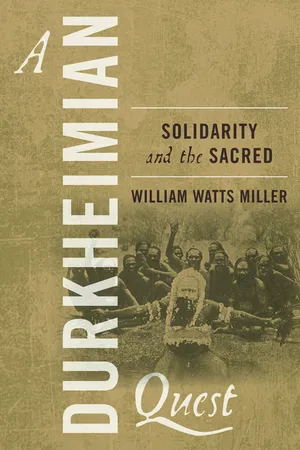
Durkheim, in his very role as a 'founding father' of a new social science, sociology, has become like a figure in an old religious painting, enshrouded in myth and encrusted in layers of thick, impenetrable varnish. This book undertakes detailed, up-to-date investigations of Durkheim's work in an effort to restore its freshness and reveal it as originally created. These investigations explore his particular ideas, within an overall narrative of his initial problematic search for solidarity, how it became a quest for the sacred and how, at the end of his life, he embarked on a project for a new great work on ethics. A theme running through this is his concern with a modern world in crisis and his hope in social and moral reform. Accordingly, the book concludes with a set of essays on modern times and on a crisis that Durkheim thought would pass but which now seems here to stay.
- 278 pages
- English
- ePUB (mobile friendly)
- Available on iOS & Android
eBook - ePub
About this book
Trusted by 375,005 students
Access to over 1.5 million titles for a fair monthly price.
Study more efficiently using our study tools.
Information
INVESTIGATIONS OF A PROJECT
CHAPTER 1
The Idea of a Social Science
The Division of Labour begins:
This book is above all an effort to treat the facts of moral life according to the method of the positive sciences. (1893a: i / 1902b: xxxvii)
So in investigating Durkheim’s work, a way to begin is with an effort to understand his very idea of a social science.
It is meant to be objective. Yet it isn’t neutral. It is committed. This is made clear from the start. He emphasizes how a science of moral life, far from having a merely academic interest, can help to identify the ideal. His ambition is to explore a route from ‘is’ to ‘ought’. He attacks ‘mystics’ who just assert this is impossible, and who accordingly ‘put human reason to sleep’ (vi / xli).
Social Science as Social Vision
In Durkheim’s work, solidarity is a basis of any social world and so a basis of any ideal of the good society. Thus books 1 and 2 of his thesis are about the division of labour as the place to look for a solidarity of modern times. But book 3 is about a failure to generate this, in modern everyday scenes of alienation, anomie and class war. On the one hand, then, he insists it is a ‘crisis of transition’ and looks to a solidarity of the future. On the other, he also insists that the only way to achieve this solidarity is if the modern world meets its own deep-rooted aspirations to freedom and equality. So in effect he comes up with a vision of a society of free autonomous persons, justice, and solidarity.
This echoes the Revolution’s Liberty, Equality, Fraternity. Or rather, it re-echoes it. The famous trio of ideals had re-emerged in the Third Republic, to become adopted as its motto in 1880 and to form part of the wider political context of Durkheim’s thesis. For the republic’s conservative opponents, the motto was a ragbag of dangerous, impossible and contradictory notions. And throughout the 1880s, there was a sustained collective effort to answer such attacks. Durkheim’s thesis was a contribution to this effort. It mobilized his new science of moral life, to offer a sociological defence of the ideals expressed in the Revolution. True, this involved reworking them, to form a coherent whole and accordingly to form a practical vision to strive to realize. But it above all involved seeing them as an expression of the aspirations of modern times, built into our world’s underlying structure and dynamic.
So this also involves the wider intellectual context of his thesis, since it is clearly a version of nineteenth-century stories of progress. In turn, these have roots in the eighteenth-century Enlightenment. Thus it is instructive to pick out the writings on enlightenment and a ‘philosophical history’ of progress by Immanuel Kant, given his general importance in the French philosophical milieu in which Durkheim was educated. Indeed, an interest in Kantian philosophical history is especially evident in a work by one of Durkheim’s examiners, Henri Marion’s Moral Solidarity (1880). Moreover, there are basic similarities between the philosophical history and Durkheim’s own line on a modern age.1
Kant’s philosophical history is ‘teleological’, in that it is about humankind’s progress towards an end. And Durkheim went out of his way to reject teleological stories, in that he emphasized a ‘mechanistic’ dynamic of obscure hidden forces. Yet so did Kant, in emphasizing a dynamic in which most of the time humanity stumbles blindly along in unawareness of an end. It is only eventually that there arises a modern ‘age of enlightenment’, increasingly conscious of the human ideal, and preparing the way for a future ‘enlightened age’, increasingly realizing it in practice. But in a seeming contradiction for a story of evolution that is so mechanical, a basic force in things is the growth of the human kernel of freedom. And this takes us to Kant’s whole concept of ‘autonomy’, which he explicitly tied in with a vision of a union of free autonomous persons – a ‘kingdom of ends’ – an ideal he first formulated in 1785, on the eve of the Revolution.
It also takes us back to Durkheim himself. It is this vision of a kingdom that became reformulated in the French milieu he inhabited, and in which he took up, interpreted and engaged with Kantian ideas. Emile Boutroux – another of his examiners – converted the kingdom into a ‘republic of persons’. Charles Renouvier – Durkheim’s left-wing philosophical hero – recast it as a ‘society of persons’. Either term will do for his own vision of an enlightened world of free autonomous persons, justice and solidarity. But it is also possible to draw on the English and American radical tradition to evoke this as a commonwealth of persons.
Although the term was never used by Durkheim himself, it might be used here. It helps to encapsulate what he saw at stake in his vision of a modern future, but also in his critique of the state we are in now.
Social Science as Social Critique
‘Every society is a moral society’, according to the conclusion to book 1 of his thesis (1893a: 249 / 1902b: 207). This is because every society runs on solidarity, in turn the source of morality. Nor does he contradict himself in book 3’s scenes of malaise. He still sees a world of society. It is just that it can have only an ‘imperfect, troubled solidarity’ (421 / 369).
This is an understatement for what comes across as a crippled solidarity. In any case, where does he locate the sources of a deficient present-day solidarity? The answer is to do with his worry over a lack of ‘intermediate groups’, and is how to understand his worries over alienation, egoism and anomie.
Alienation, Egoism, Anomie and a Lack of Intermediate Groups
In Durkheim’s overall work, an essential point about a web of intermediate groups is to link the individual with a wider society, through involvement in a web of particular definite interlinking milieux. Otherwise, there is only a mass of atomized individuals plus an authoritarian centralized state – a situation the new preface to his thesis describes as a ‘sociological monstrosity’ (1902b: xxxii).
Part of the background is his story of how the guilds of the old regime were swept away, without replacement, in the Revolution. Nor was there any role for such groups in the ideal of a republic in Rousseau’s Social Contract (1762), which became a Bible of the Revolution. In a key essay, he sees Rousseau and the Revolution as paradigmatic modern cases of how ‘individualism combines with an authoritarian conception of society’ (1898c: 260). In lectures on The Social Contract, probably given around 1897,2 he comments that its republic attaches individuals to society but not to each other: ‘they are linked with each other only because they are all linked to the community, that is, alienated within it’ (1918: 143).
This is one of the few occasions in which Durkheim mobilizes talk of alienation. But since it can include his more familiar yet changing uses of the term ‘egoism’, it helps to express what he sees as the most basic modern pathology of all. This is a real enough modern tendency to lone, atomized individuals, cut off from everyone else and wrapped up in their own thoughts, desires or interests. Alienation is the opposite of solidarity. At its most extreme, it is the absence of everything he looks for in modern solidarity – attachment to one another, attachment to intermediate groups, and attachment to a wider society.
This set of attachments is fundamental to his vision of a modern solidarity, but also to his critique of modern pathologies, including anomie. At its most general, anomie is about a lack of social and moral regulation, in a breakdown of a detailed code that governs relations with one another but also the individual’s own life and character. On the one hand, then, anomie is bound up with lack of attachment in webs of relations and so with alienation’s radical separateness. The two, together, are at the same time sources of his account of different pathological forms of individualism – cut off in a private world of thought and the imagination, or ruled by emotion, impulse and desire, or driven by a calculation of interest. On the other hand, however, it is all very well to develop a negative critique of these and their various modern philosophical expressions, such as theories of the self as a radically separate atom. But he needs to construct, more positively, an alternative account of the modern self.
What he comes up with is the individual personality – forming a distinctive individual consciousness and developing as a distinctive individual character, but precisely in the social attachments, webs of relations and different roles and outlooks of a division of labour. It could be seen as a ‘liberal-communitarian’ self. In that it is communitarian, it is about an internal sense of attachment that is deep-rooted in the personality, since deep-rooted in webs of relations. In that it is liberal, it involves both each individual’s difference, through a distinct personality, and everyone’s sameness, through the shared status of a person. Thus running through Durkheim’s work as a whole there is concern both with how a modern division of labour can make for attachment as individual personalities and with how a modern collective consciousness can make for attachment through a common belief in everyone’s status as a person. His various particular writings come with differences of emphasis on these two elements. But a basic constant is that he simultaneously defends a modern individualism to do with the personality / the person, while attacking other modern individualistic forces that he sees as pathological and associates with a world in crisis.
These especially include what he calls a ‘sordid commercialism’ – code, perhaps, for capitalism – but in any case how he describes an economistic, interest-driven individualism (1898c: 262). It is a form of individualism that he attacked throughout his career, starting with his first sociological publication. This describes a conflict of ‘unfettered egoisms’ – here, quite clearly code for capitalism – generating class war, but in the process also generating pressures for control by the state and a ‘despotic socialism’. The only escape from these alternative nightmare scenarios is a new network of intermediate occupational groups (1885a: 371). It was this early critique of ‘unfettered egoisms’ at the heart of modern economic life that then became a general critique of anomie as a lack of regulation in whatever sphere of life. But it remains basic to the account of anomie in book 3 of his thesis. It reappears in the conclusion to Suicide, on the need for new occupational groups (1897a: 434–51). It then becomes the whole focus of his new preface to The Division of Labour. In once again making the case for new occupational groups, this describes scenes of anomie and class war at the heart of modern economic and industrial life, and so at the heart of modern society itself (1902b: ii–v). The crisis cannot be solved by the state, or by reliance on vague general abstract ideals of justice. It requires, through new intermediate groups, a social organization with the power and legitimacy to translate, articulate and develop these ideals into an effective moral code.
Durkheim continued with this campaign in lectures that were given throughout the 1900s. But it was also during the 1900s that he became increasingly absorbed in issues, to do with the sacred, that eventually led on to The Elemental Forms. Even so, it was in no way to see the solution to a far-reaching crisis in a bit of ritual and symbolism. It was in looking to a whole new effervescent explosion of energies for escape from a present-day time of ‘transition and moral mediocrity’ (1912a: 610). When, in a sense, an explosion of energies came, in the Great War, the need to reconstruct society by tackling the economic and industrial crisis described in The Division of Labour is again the theme of his last article, ‘The Politics of the Future’ (1917c).
In sum, Durkheim all along hoped in life after capitalism – or at any rate, life after a ‘sordid commercialism’ – in a continuing critique of the way things are now and in a continuing campaign for social and moral reform.
Yet isn’t his ‘crisis of transition’ here to stay? Or why treat contemporary capitalism as pathological when it is so widespread and, in a sense, so ‘normal’? And how can the same type of society – modern industrial society – generate such different possible scenarios as a commonwealth of persons, capitalism, totalitarian socialism or whatever else might seem described in his work?
A way to explore these questions is through what could be called his social science’s ‘internalist’ programme. In turn, this helps with understanding what is at stake in what he himself called his social science’s ‘rationalist empiricism’.
An Internalist Programme
Durkheim’s idea of social science commits him to empirical indicators. But their rationale is to track down something else, so that it is always necessary to ask what this is. What he above all wants to track down, in his search for modern solidarity, is an underlying and unfolding logic of the division of labour as a dynamic of the modern world.
In his subsidiary thesis, he sets out a programme of how to do social science. This attacks theorists who try to explain malaise just in terms of circumstances that are exceptional, and so in some way accidental, contingent, external. On the contrary, ‘disease, as much as health, is part of the nature of a living being’ (1892a: 55). In other words, let us say, a basic rule of sociological method is always to look for an internalist explanation of things – to dig around within a social world’s own nature and dynamic for ways this can explain both its ideals and its pathologies.
So does the author of The Division of Labour break a basic rule of his own sociology’s ‘internalist’ research programme? He invokes a modern dynamic to explain our ideals, yet asserts that in itself it has nothing to do with our pathologies:
The division of labour does not produce these consequences as a result of a necessity of its nature, but only in exceptional and abnormal circumstances. (1893a: 417 / 1902b: 364)
And for good measure, he repeats the claim in his new preface (1902b: v).
It is important to notice this explicit argument of the author, even if a deviation from one of his own work’s rules of method. But it is more important to notice ways in which his work’s actual underlying arguments are in line with the rule, in providing an internalist explanation of how the division of labour is itself a source both of modern ideals and modern pathologies. Two examples have already been encountered. Thus a general theme of his work is how the dynamic of the division of labour frees things up, so that it helps to generate modern individualism in all its forms – not just those he endorsed, but complete with others he viewed as pathological. Or again, it is the division of labour’s freeing up of things that he saw as underlying the attack on the guilds of the old regime and their abolition in the Revolution – leading to his nightmare scenario of the atomized individual plus the authoritarian state, with no effective intermediate groups.
Accordingly, here is a sketch of an internalist retheorization of the division of labour as his dynamic of the modern world. Its underlying and unfolding logic necessarily involves the possibility of going in different directions and crystallizing in different scenarios. But the logic isn’t equally realized in these. On the contrary, it continues to generate pressures for a commonwealth of persons.
So it still makes sense to talk of a ‘crisis of transition’. Even if it has settled in for some time, energies for change do not go away and visions of an alternative do not disappear. This can be put another way. Contemporary capitalism isn’t an accident, with nothing to do with the division of labour and its internal logic. But it isn’t the only possibility built into the logic, and still comes out as pathological. With its economistic individualism, flourishing injustice and crippled solidarity, it is a deformation of our world’s dynamic, in comparison with its realization in development towards a commonwealth.
In the end, it is this comparison that counts in The Division of Labour, in its concern with energies for reform and aspirations to an ideal with roots in modernity’s dynamic itself:
There are no needs so well founded as these tendencies, since they are a necessary consequence of changes that have taken place in the structure of societies. (1893a: 434 / 1902b: 382)
In sum, Durkheim’s social science comes together with social vision and social critique. This normative element isn’t just a personal value-added extra. It is integrally bound up with a search for an underlying social logic of things, in an idea of social science as rationalist empiricism.
Social Science as Rationalist Empiricism
Durkheim aimed to develop an empirical social science, yet in opposition to empiricism as usually understood. This is why he variously described his approach as ‘rationalist empiricism’, ‘scientific rationalism’ and a ‘new rationalism’. It modernizes classic rationalism.
His Latin thesis was concerned with Montesquieu’s The Spirit of the Laws (1748), a leading work of the Enlightenment. But it was also to set out his own first major programmatic statement of social science, quickly turned into French to become The Rules of Sociological Method. This appeared as a set of articles in 1894. It then came out as a book, together with a preface answering his critics and insisting on his approach as ‘scientific rationalism’ (1895a: viii).
But although it now had a name, it is basically the argument of the Latin thesis that is repeated in The Rules. Both of them work their way through the study of social facts as things, the classification of societi...
Table of contents
- Cover Page
- Title Page
- Copyright Page
- Contents
- List of Tables and Figures
- Acknowledgements
- Introduction
- Part 1 Investigations of a Project
- Part 2 Essays on Modern Times
- Notes
- References
- Index
Frequently asked questions
Yes, you can cancel anytime from the Subscription tab in your account settings on the Perlego website. Your subscription will stay active until the end of your current billing period. Learn how to cancel your subscription
No, books cannot be downloaded as external files, such as PDFs, for use outside of Perlego. However, you can download books within the Perlego app for offline reading on mobile or tablet. Learn how to download books offline
Perlego offers two plans: Essential and Complete
- Essential is ideal for learners and professionals who enjoy exploring a wide range of subjects. Access the Essential Library with 800,000+ trusted titles and best-sellers across business, personal growth, and the humanities. Includes unlimited reading time and Standard Read Aloud voice.
- Complete: Perfect for advanced learners and researchers needing full, unrestricted access. Unlock 1.5M+ books across hundreds of subjects, including academic and specialized titles. The Complete Plan also includes advanced features like Premium Read Aloud and Research Assistant.
We are an online textbook subscription service, where you can get access to an entire online library for less than the price of a single book per month. With over 1.5 million books across 990+ topics, we’ve got you covered! Learn about our mission
Look out for the read-aloud symbol on your next book to see if you can listen to it. The read-aloud tool reads text aloud for you, highlighting the text as it is being read. You can pause it, speed it up and slow it down. Learn more about Read Aloud
Yes! You can use the Perlego app on both iOS and Android devices to read anytime, anywhere — even offline. Perfect for commutes or when you’re on the go.
Please note we cannot support devices running on iOS 13 and Android 7 or earlier. Learn more about using the app
Please note we cannot support devices running on iOS 13 and Android 7 or earlier. Learn more about using the app
Yes, you can access A Durkheimian Quest by William Watts Miller in PDF and/or ePUB format, as well as other popular books in Social Sciences & Philosophy History & Theory. We have over 1.5 million books available in our catalogue for you to explore.