It is important to see China's activities in the Pacific Islands, not just in terms of a specific set of interests, but in the context of Beijing's recent efforts to develop a comprehensive and global foreign policy. China's policy towards Oceania is part of a much larger outreach to the developing world, a major work in progress that involves similar initiatives in Asia, Africa, Latin America, and the Middle East. This groundbreaking study of China's "soft power" initiatives in these countries offers, for the first time, the diverse perspectives of scholars and diplomats from Oceania, North American, China, and Japan. It explores such issues as regional competition for diplomatic and economic ties between Taiwan and China, the role of overseas Chinese in developing these relationships, and various analyses of the benefits and drawbacks of China's growing presence in Oceania. In addition, the reader obtains a rare review of the Japanese response to China's role in Oceania, presented by Japan's leading scholar of the Pacific region.
eBook - ePub
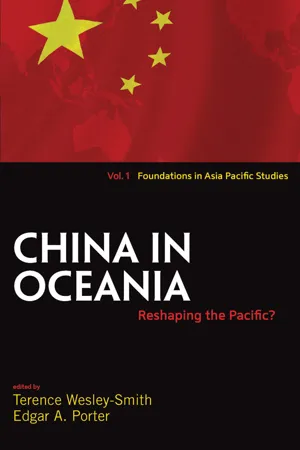
China in Oceania
Reshaping the Pacific?
- 240 pages
- English
- ePUB (mobile friendly)
- Available on iOS & Android
eBook - ePub
China in Oceania
Reshaping the Pacific?
About this book
Trusted by 375,005 students
Access to over 1.5 million titles for a fair monthly price.
Study more efficiently using our study tools.
Information

China's Pacific Engagement
Terence Wesley-Smith
A New Page in Regional History
In January 2007 Fiji coup leader and self-appointed Prime Minister Frank Bainimarama announced he would send senior officials to China to discuss enhanced relations. He did so in the face of sanctions imposed by Australia, New Zealand, and the United States, Fiji's traditional aid and security partners (Associated Press 2007). Ironically, Commodore Bainimarama's actions echoed the sentiments of the man he deposed in the military takeover. In April 2006 Prime Minister Laisenia Qarase described a meeting between island leaders and Chinese Premier Wen Jiabao as marking a “new page in regional history.” China, he argued, “defines a new and compelling reality, politically and economically” for the island countries (Qarase 2006). This chapter explores some strategic, political, and economic dimensions of this new regional reality. It challenges the sometimes disingenuous threat discourse pervading the existing literature on the topic and argues that China's rise offers Pacific Island states opportunities not available under established structures of power and influence.
China's heightened profile has not been greeted enthusiastically by other powers active in Oceania. Japan's unease is clear, and a substantial increase in aid announced in May 2006 seemed intended to counter Beijing's growing sway in the region (Associated Press 2006). Other actors appear ambivalent. In language reminiscent of the cold war, United States officials talk about the crucial need to keep island states “firmly on our side,” although it is not clear who is considered opposed (Davies 2007). New Zealand Minister for Defense and Pacific Islands Affairs Phil Goff described China's presence as a “growing reality” but urged Beijing to work in partnership with other donors and “pay proper heed to the interests of the Pacific” (Nadkarni 2006: 4). Similarly, Australia is concerned about China's role in the region but reluctant to criticize an increasingly significant trade partner. Some commentators are not so circumspect. Political scientists John Henderson and Benjamin Reilly argue bluntly that China is in the process of “incorporating the Pacific islands into its broader quest to become a major Asia-Pacific power” at the expense of the United States, Japan, and other Western allies (Henderson and Reilly 2003: 94). Susan Windybank of the Centre for Independent Studies, an influential Australian think tank, concurs, maintaining that Oceania may become a “testing ground for China's growing power, and ability to shore up allegiances in a region hitherto considered an ‘American lake’” (Windybank 2005: 29).
This talk of changing configurations of power in Oceania reflects a larger debate about the nature and implications of China's increased global activism. The nation's recent economic transformation has been spectacular, making a more prominent global role all but inevitable. It is less clear what China's rise means for the international system itself, and particularly for the unprecedented influence that the United States has enjoyed, especially since the collapse of the Soviet Union. According to Doug Guthrie, a sociology professor at New York University, the question is no longer whether China will play a major role in the world. Rather, “it is only a question of what role China will play”—and how the United States responds to this challenge to its global dominance (Guthrie 2006: 4). Some even predict a new cold war, this one fought out not in Europe but “among Pacific atolls that were last in the news when the Marines stormed them in World War II” (Kaplan 2005: 1).
This is not the first time that Pacific Island societies have faced the impositions and opportunities associated with great power competition. Strategic rivalry between expanding European powers was an important dynamic in the nineteenth-century colonization of the islands, and both world wars had destructive Pacific dimensions. Cold war tensions structured the process of decolonization in the region as well as the nature of postcolonial relations between island states and metropolitan powers. Nor has the end of the cold war enhanced the autonomy of the small, aid-dependent states of Oceania. Indeed, this has been an era of increased pressure from traditional allies, particularly Australia, to undertake extensive market-driven economic and political reforms, initiatives that island leaders have sometimes regarded as intrusive, disruptive, and even hostile. It is perhaps not surprising that most island leaders—including Commodore Bainimarama—have pragmatically welcomed the arrival of what a Time magazine cover story (22 January 2007) calls “The Chinese Century,” and the new options it appears to present.
China Goes Global
The internal transformation of the world's most populous nation over the last twenty-five years has been dramatic indeed. Since 1979, when China's leadership began to implement radical reforms, the economy has expanded extremely rapidly. GDP rose by an average of more than 10 percent per annum in the 1980s and more than 12 percent per annum in the 1990s. China now has the fourth largest economy in the world, although analysts argue that conventional measures grossly underestimate its relative strength and purchasing power (Guthrie 2006: 3–5). This economic surge is unprecedented in modern times, easily surpassing the growth performances of Japan and South Korea in the decades after World War II (Fishman 2005: 12). Furthermore, it continues apace.
The social consequences of economic change have been profound for China's population of more than 1.3 billion. Existing political and legal institutions are rapidly giving way to new ones, and family networks and cultural values have come under severe strain. Urban landscapes have been transformed virtually overnight as millions of hopeful citizens head for booming cities and coastal provinces in what may be the greatest rural exodus in human history. China's “floating population” of rural-to-urban migrants is now estimated to exceed 100 million. Meanwhile, income and other inequalities are rising rapidly across regions and economic sectors, and between rural and urban workers (Guthrie 2006: 202–213).
The velocity and intensity of change in China has produced widespread social unrest. Official statistics indicate dramatic annual increases in public protests in recent decades, and National Defense University researcher Phillip Saunders notes that in 2004 there were more than 74,000 “mass group incidents” involving 3.7 million people (Tanner 2004: 138; Saunders 2006: 3). It is beyond the scope of this chapter to analyze these destabilizing trends in any depth. However, it is worth noting that many, including the Chinese leadership, see internal instability as one of the greatest challenges facing the country in the foreseeable future. It is also worth noting that political leaders seek to counter unrest through continued economic growth. In 2003 outgoing Premier Zhu argued that development was “the key to resolving all problems” facing China. “We must,” he urged, “maintain a comparatively high growth rate in our national economy” (quoted in Tanner 2004: 145).
Economic development is the major factor propelling China onto the world's stage. Rapid growth has been largely market-driven, with foreign investment and global trade as essential components in a meteoric rise to increased wealth and power. Reliable supplies of raw materials of all sorts are increasingly important, with the search for oil and natural gas providing the single most important focus for Beijing's international trade policy. Already the world's second largest energy consumer, China's needs are rapidly outstripping domestic supplies of coal and oil. By 2020 an estimated 60 percent of the country's oil supplies will come from overseas—up from less than 8 percent in 1995 (People's Daily 2003). Chinese firms also face growing competition at home and are increasingly looking to export markets—often in developing countries—to enhance business performance. Growing trade has meant more emphasis on bilateral relations with an increasing number of trading partners and heightened interest in international organizations, such as the World Trade Organization, that regulate global trade and commerce.
The need for resources and markets largely explains China's increased presence in the Middle East, Africa, Latin America, the Caribbean, and Central Asia in recent years. Chinese business leaders often target resource-rich areas that have yet to be developed, or that rivals avoid for political or other reasons. In Africa, for example, China has invested heavily in the neglected oil industries of Sudan, Nigeria, and Angola and the mining industries of Zambia, Congo, and Zimbabwe, and is now selling competitively priced consumer goods across the continent. The value of trade with Africa doubled between 2003 and 2004, and jumped by a further 50 percent in 2005 (Lyman 2005). The volume of China's oil imports from the Middle East increased eightfold between 1992 and 2002, and the country now obtains more than 50 percent of its oil needs from that region (Liangxiang 2005).
If there is a compelling interest in a “stable international and regional environment in which China can modernize its economy and improve its relative power position,” strategic issues are also increasingly important in Beijing's view of the world (Saunders 2006: 3). Foremost among these are US efforts—real or anticipated—to offset China's rising influence, especially in the Asia Pacific region, in order to preserve its own preeminent global role, as well as fears that Japan might one day remilitarize and adopt a more aggressive regional posture. Of central concern is the issue of Taiwan, which Beijing regards as a renegade province that must eventually be reintegrated. China's leaders do not take kindly to efforts to support Taipei's ongoing bid for recognition as an independent state. As a rising power, China has a strategic interest in cultivating strong relations with other states in order to minimize potential threats while enhancing its standing and influence in the global community.
Strategic interests sometimes coincide with economic ones in China's foreign policy. For example, the country has a compelling strategic interest in the sea routes that service its burgeoning international trade, some of which—like the Malacca Straits—are vulnerable to disruption by pirates, terrorists, or hostile powers. Often, however, strategic and economic interests form separate components of foreign policy in different parts of the world. In some cases, the two foreign policy tracks may conflict with each other. For most of the last decade economic considerations appear to have trumped strategic ones as Beijing works to avoid confrontation with the United States, Japan, and Taiwan in favor of enhanced trade and investment relations with those states.
Citing significant increases in military spending in recent years, some analysts see this willingness to compromise as a temporary phenomenon, one that will pass once China has accumulated the wherewithal to adopt a more assertive posture. In this view, China is currently “punching below its weight” in international politics, awaiting the right time to mount a significant challenge to the status quo in global politics (Weinstein 2005).
China in Oceania
The island states of Oceania play a small but increasingly significant role in China's efforts to further its economic and strategic interests. The modern relationships between these two parts of the world date back to the Chinese labor migrations of the late nineteenth century and, as sociologist Bill Wilmott notes, only Tuvalu, Tokelau, and Niue have no history of Chinese settlement (Chapter 5 in this volume). China has maintained an important official presence in the region since the mid 1970s, when it first established diplomatic relations with Fiji, Western Samoa, and newly independent Papua New Guinea. Since then, Beijing has established formal or informal relations with all of the independent and self-governing states and with major regional organizations, including the Pacific Islands Forum. While some aspects of the relationship have remained constant, new economic and strategic elements have emerged in recent years. The China–Pacific Island Countries Economic and Cooperation Forum, held in Fiji in April 2006, marked a ratcheting-up of China's interest and signaled significant increases in trade, investment, aid, and technical cooperation with Oceania. In his address to the forum, Chinese Premier Wen Jiabao emphasized a long-term commitment: “China has proved and will continue to prove itself to be a sincere, trustworthy and reliable friend and partner of the Pacific Island countries forever” (Wen 2006; see Appendix for the full text of his comments).
Philip Saunders identifies commercial interests, the search for economic inputs, efforts to expand political influence, and the need to offset US challenges as the “key drivers of increased Chinese global activism” (Saunders 2006: 6–10). Elements of all four motives are apparent in China's activities in Oceania, although one, the search for political influence, is particularly significant. Some see a second, rivalry with the United States and its allies, as increasingly important.
China is interested in pursuing commercial opportunities in Oceania, and total trade between China and the forum island countries has increased by more than 200 percent since 2002, reaching an estimated value of US$1 billion by the end of 2006 (Somare 2006; see Appendix for the full text of his comments). Although the present balance of trade favors China and benefits certain Chinese companies, the overall commercial relationship is vastly more important to the island states than it is to China. Despite recent increases, trade with Oceania still only represents less than one tenth of 1 percent of the total value of China's global trade. A similar point could be made regarding tourism, which is expected to grow quite significantly now that ten Pacific countries have received Approved Destination status from China's tourism authority.1 Although of great interest to the island states, this growth in tourist traffic is unlikely to be of much concern to foreign policy planners in Beijing.
Oceania is more important to China as a source of key natural resource inputs for its burgeoning economy. China already imports significant quantities of timber and fish from Pacific Island countries, including Solomon Islands and Papua New Guinea. It has a particular interest in Papua New Guinea's vast energy and mineral resources. Officials of China's biggest oil company, China National Petroleum, have discussed the possibility of building a plant to produce liquefied natural gas in Papua New Guinea, a prospect that may have improved since early 2007 when Exxon Mobil finally scrapped its plans to pipe huge quantities of natural gas to Australia (Macdonald-Smith 2005, 2007). In March 2005, a major government-owned construction and operating company, Chinese Metallurgical Construction (Group) Corporation, purchased a majority interest in the Ramu nickel and cobalt mining project in Madang. Construction of the US$800 million complex commenced in late 2006. When complete, the mine is expected to produce 32,800 tonnes of nickel annually, all of which will be exported to support China's booming stainless steel industry (Callick 2007; Ramu Nickel Limited 2005). In 2006, the Papua New Guinea government signed an agreement to allow China Exploration and Engineering Bureau to explore further opportunities to develop gold, copper, chromites, magnesium, or other mineral resources (The National 2006).1
Although commercial motives and the quest for reliable access to particular natural resources may explain some of China's heightened interest in Oceania, they cannot explain all of it. For the last two decades, China's primary objective in the region has been to build political influence among the island states in support of Beijing's interests in international forums such as the United Nations. This remains the case today. Indeed, political motives probably best explain the large number of Chinese diplomats posted to the region, the “visit diplomacy” that brings large numbers of island leaders on goodwill trips to Beijing every year, as well as the high-profile aid projects that have built sports complexes and other public facilities in island countries over the last two decades. Along with similar efforts in the Caribbean and smaller countries in Africa, China hopes to mute international criticism of its record on human rights, advance its economic goals in organizations like the World Trade Organization, and block Japan's aspirations to play a more active international role. Of key importance in the Pacific Islands are China's ongoing efforts to isolate Taiwan.
The competition between the two Chinas for influence in Oceania dates back to the 1970s, after US President Richard Nixon's visit to Beijing and loss of UN membership pushed Taiwan to seek diplomatic recognition wherever it could (Harwit 2000: 465–467). Although Taipei's efforts yielded significant results among the smaller states of Africa, Central America, the Caribbean, and the Pacific, China's growing political and economic influence has taken its toll in recent years. Since 2003, Taiwan has lost six of its thirty diplomatic allies (and the Vatican may follow soon), although it retains informal trade and other ties with many more (Lai 2006).
Taiwan remains relatively successful in Oceania. Although Tonga switched its allegiance to China in 1998, the Marshall Islands came over to the Taiwan camp the same year. Nauru recognized China in 2002 but returned to Taiwan less than two years later. Perhaps Taipei's greatest diplomatic victory came in 2003, when China lost its long-standing formal ties to Kiribati—and its satellite tracking facility there (Herr 2007: 6–10). Today, six Pacific Island states (Kiribati, Solomon Islands, Palau, the Marshall Islands, Tuvalu, and Nauru) recognize Taiwan, while a further seven (Papua New Guinea, Samoa, Tonga, the Cook Islands, Fiji, Vanuatu, and the Federated States of Micronesia) have formal relations with C...
Table of contents
- Cover Page
- Title Page
- Copyright Page
- Contents
- List of Figures
- Acknowledgments
- Abbreviations
- Introduction: Oceania Matters
- Chapter 1. China's Pacific Engagement
- Chapter 2. A Regional Power by Default
- Chapter 3. Challenges, Opportunities, and the Case for Engagement
- Chapter 4. China's Advances in Oceania and Japan's Response
- Chapter 5. The Overseas Chinese Experience in the Pacific
- Chapter 6. Chinese in Papua New Guinea
- Chapter 7. Fiji's “Look North” Strategy and the Role of China
- Chapter 8. Milking the Dragon in Solomon Islands
- Chapter 9. China and Samoa
- Chapter 10. China's Diplomatic Relations with the Kingdom of Tonga
- Chapter 11. Changing Attitudes and the Two Chinas in the Republic of Palau
- Appendix. China and Taiwan in Oceania: Selected Documents
- Contributors
- Index
Frequently asked questions
Yes, you can cancel anytime from the Subscription tab in your account settings on the Perlego website. Your subscription will stay active until the end of your current billing period. Learn how to cancel your subscription
No, books cannot be downloaded as external files, such as PDFs, for use outside of Perlego. However, you can download books within the Perlego app for offline reading on mobile or tablet. Learn how to download books offline
Perlego offers two plans: Essential and Complete
- Essential is ideal for learners and professionals who enjoy exploring a wide range of subjects. Access the Essential Library with 800,000+ trusted titles and best-sellers across business, personal growth, and the humanities. Includes unlimited reading time and Standard Read Aloud voice.
- Complete: Perfect for advanced learners and researchers needing full, unrestricted access. Unlock 1.5M+ books across hundreds of subjects, including academic and specialized titles. The Complete Plan also includes advanced features like Premium Read Aloud and Research Assistant.
We are an online textbook subscription service, where you can get access to an entire online library for less than the price of a single book per month. With over 1.5 million books across 990+ topics, we’ve got you covered! Learn about our mission
Look out for the read-aloud symbol on your next book to see if you can listen to it. The read-aloud tool reads text aloud for you, highlighting the text as it is being read. You can pause it, speed it up and slow it down. Learn more about Read Aloud
Yes! You can use the Perlego app on both iOS and Android devices to read anytime, anywhere — even offline. Perfect for commutes or when you’re on the go.
Please note we cannot support devices running on iOS 13 and Android 7 or earlier. Learn more about using the app
Please note we cannot support devices running on iOS 13 and Android 7 or earlier. Learn more about using the app
Yes, you can access China in Oceania by Terence Wesley-Smith, Edgar A. Porter, Terence Wesley-Smith,Edgar A. Porter in PDF and/or ePUB format, as well as other popular books in Politics & International Relations & International Economics. We have over 1.5 million books available in our catalogue for you to explore.