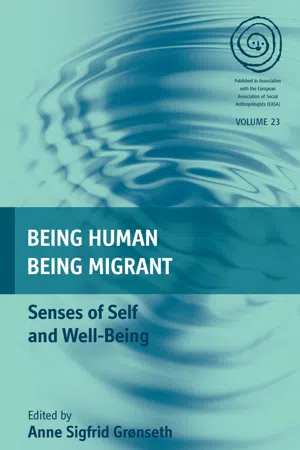
Migrant experiences accentuate general aspects of the human condition. Therefore, this volume explores migrant's movements not only as geographical movements from here to there but also as movements that constitute an embodied, cognitive, and existential experience of living "in between" or on the "borderlands" between differently figured life-worlds. Focusing on memories, nostalgia, the here-and-now social experiences of daily living, and the hopes and dreams for the future, the volume demonstrates how all interact in migrants' and refugees' experience of identity and quest for well-being.
- 184 pages
- English
- ePUB (mobile friendly)
- Available on iOS & Android
eBook - ePub
About this book
Trusted by 375,005 students
Access to over 1.5 million titles for a fair monthly price.
Study more efficiently using our study tools.
Information
Chapter 1
Fantasy, Subjectivity and Vulnerability through the Story of a Woman Asylum Seeker in Italy
Barbara Pinelli
In 2006 when I first met Rolanda, a Togolese woman who arrived in Italy in 2002 seeking political asylum, she had just been denied asylum and granted instead a humanitarian residence permit after four long years of waiting. She reached Italy alone; her husband, a political opponent of the Togolese government, had escaped to France one year before and their three-year old daughter had been left in the care of her mother. At the time of our meeting, after having spent nearly three years in four reception centres for asylum seekers, Rolanda had left Milan assistance circuits and was sharing a small flat with another Togolese woman. Descriptions of her life in Togo and her experiences in Milan overlapped in our conversations with the expression of her strong desire to rejoin her daughter. The way in which Rolanda described her exile included both her memories of the past and her hopes of reconstructing those parts of her subjectivity, which the flight from Togo had broken into pieces.
In these pages, I tackle the issue of political refuge through the experiences of this woman, exploring the ways in which life after the flight and after the breaking down of important systems of relationship and belonging is reconstructed in the host cities. In particular, and through the vicissitudes of Rolanda, I will try to show how the drama of the flight is not the only factor defining the level of suffering and vulnerability experienced by female asylum seekers. Forms of social exclusions encountered in the arrival country expose these women to further experiences of suffering and impose on them a long and systematic ‘process of subjection’ (Butler 1997; Mohanty 1993). By bringing together anthropological reflections on vulnerability and approaches on subjectivity, fantasy and subjection developed in gender theories, I will focus on the formation and reconstruction of subjectivity in suffering and vulnerable conditions. In other words, I will explore the relation between agency and process of subjection. In Italy, such dynamics of social exclusion are reinforced and worsened both by the long waiting for permits and by the strong ambiguities inherent in assistance policies that consider female asylum seekers only as subjects in need of help and emancipation.1 I have chosen to narrate Rolanda’s story because she spent an initial period within reception centres for asylum seekers and later lived outside these centres. Indeed, during this second phase, her hope and desire to reconstruct her life after the flight, as well as the resources found in the informal networks, were important elements allowing the analysis of the relationship between marginality and agency.
In particular, the reception centres where Rolanda has lived over the years pursue a strong pedagogic intention, which consists in preparing female asylum seekers for the ‘modernity’ of the context in which they had arrived. Assistance culture, bureaucratic and administrative procedures, notably the wait for papers, reinforce a sense of time suspension and lead to a perception of life as being stuck in a stagnant present. In the following pages, I will explain this point by succinctly illustrating the dynamics of daily life in some of Milan centres for female asylum seekers I had the chance to visit during my research.2 First, however, I will provide details both on Rolanda’s flight and on Italian legislation on asylum. Rolanda’s case, as I will show, illustrates the role that social networks beyond the circuits of public welfare play in providing asylum seeking women with opportunities to maintain a certain degree of control over their own lives. My description of Rolanda’s subjectivity takes into account the ‘relation between private experiences and macro-structural forces’ (Bourgois 2008: 114), in order to highlight those social forces that socially exclude women already living in vulnerable conditions. The point I mean to stress is that in spite of her vulnerability, Rolanda never became a victim. The difference between being vulnerable, on the one hand, and being a victim, on the other one, will become clearer as I illustrate the details of her migration story (as narrated by Rolanda herself) and the theoretical framework I use to analyse her case. The themes of fantasy (Moore 1994),3 intended as the desire and the hope to give to own future life a different form from the present time, and of vulnerability (Bourgois 2008; Das 2000), intended as a means to move beyond the representation of the female asylum seeker as the passive and silent subject, allow us to understand the drama of the flight, the marginality produced by the status of immigrant requesting asylum and the ways in which women like Rolanda try to create a breach in their marginality and to recompose their daily life. The concept of fantasy helped me to look at Rolanda’s present in light of her future aspirations. In spite of the vulnerability associated with her condition of asylum seeker, Rolanda tried to manage her daily life so as to achieve what really mattered in her eyes. So, whereas the notions of vulnerability and marginality focus on the power structures which restrain the lives of asylum seeking women, those of subjectivity and fantasy cast light on the hidden side of forced migrations, i.e., the multiple practices and strategies by which asylum seekers rebuild their lives on a daily basis.
Rolanda’s Life before Arrival
Rolanda was one of the women I met in the course of an ethnographic research on the experiences of female asylum seekers in Italy, which I began in 2006 thanks to a post-doctoral grant from Milan-Bicocca University. This research, involving around twenty female asylum seekers in Italy, focused on the multiple forms of violence and abuse experienced by women along the whole trajectory of forced migration: from the flight, through the transit, to the dynamics which occur at the point of arrival, in particular when female asylum seekers are forced to live in the reception centres. Part of my research was concerned with an analysis of the bureaucratic process involved in obtaining an asylum permit and the social and assistance policies associated with this. In particular, I visited some reception centres for asylum seekers, where I could observe the dynamics of relations between social workers and hosted women and the flow of daily life within these institutions. The bulk of my work has been focused on the collection of biographies and narratives of female asylum seekers.4
I have paid particular attention to the memory of forced migration, the experiences of these women in the arrival contexts, both within and beyond the assistance circuits, and their desires for the future. By giving voice to their experiences, I have tried to describe the process of becoming an asylum seeker from their own point of view, shedding light on what lies beneath the subjectivity of female asylum seekers and the multiple structures of social exclusion they encountered. In the years between 2006 and 2009, I met Rolanda several times. When we first met, she lived outside the reception centres and shared a small room with a friend. Our meetings took place mainly at her house, and I often accompanied Rolanda around the city of Milan, when she was looking for a new job, meeting women or men who belonged to her networks, or visiting the relevant institutions in order to obtain information on how to accelerate the process of being reunited with her daughter. During these meetings and these moments spent together, I learned her story.
Rolanda arrived in Italy on a flight from Benin in 2002. When I first met her in 2006 she had just obtained a humanitarian residence permit. She was twenty-nine and her daughter Sandra, who lived in Benin with Rolanda’s mother, was five. Rolanda’s husband had left Togo in 2001, following a long period of persecution.5 Rolanda had no detailed information about her husband’s flight. She only knew that he was living somewhere in France. Sporadic news had reached her through mutual acquaintances. During our conversations, she liked to describe their beautiful apartment in Togo. Large, comfortable and elegantly furnished, it was located on the top floor of a building facing the sea. In Togo, Rolanda was in charge of a tailor’s workshop, with several apprentice girls under her supervision. ‘I felt good’, she used to tell me when recollecting her comfortable life before exile.
The decision to emigrate did not come immediately after her husband’s flight but following a demonstration against the Togolese government. On that occasion, the police beat several demonstrators and one of Rolanda’s legs was almost broken. Before the demonstration, and after her husband’s flight, she had often been threatened by the army. Soldiers used to knock at her door and tried to get information about her husband. Scared about her future and that of her daughter Sandra, she decided to move to Benin with Sandra and her mother. Having arrived there in a poor condition, she was treated in a hospital managed by a group of Italian doctors. A couple of months later, thanks to an Italian family she met in the same hospital, she decided to migrate to Italy. Rolanda did not plan the details of her flight, mainly because she thought it as a temporary solution: fleeing represented virtually the only way to survive. Rolanda discussed her plans with her mother in the belief that, once in Italy, it would have been easier to reunite with her daughter and to reconstruct her life. Immediately after her arrival, she realized the burden of her displacement.
It was December 2002. Rolanda had no acquaintances in Milan, neither did she know the city. She was completely lost in terms of what to do and how to behave in order to cope with her new situation. At the airport information desk, she asked where she could find the police headquarters. The office staff sent her to Milan Central Railway Station. Here, Rolanda sought assistance from the Migrants’ Help Centre which was then located on the ground floor. Following their directions, she spent her first night in a reception centre for asylum seeking women. So began her experience with Milan structures of assistance on which she felt heavily dependent until mid-2005, when the opportunity to share a flat with her friend Perpetua materialized.
Italian Policies for Asylum Seekers
The Juridical Framework
The Italian Law on Asylum and the procedures for applying for refugee status have been modified since 2002, through Law n. 1896 and subsequently through Decree n. 140/2005, which has introduced new measures for the welfare of asylum seekers, and Decree n. 25/2008.7 Although fraught with contradictions, these rules have reduced the waiting time needed to obtain a permit. The women I met during my research project arrived in or after 2002, and few of them benefitted from the new procedures or from the speeding up of the application process. These Decrees created seven Territorial Commissions intended to deal with asylum requests.8 Before, these processes were carried out at the national level and waiting times were particularly long. The lack of proper regulations on asylum deeply affected the lives of asylum seekers, who remained entangled in a suspended time dimension.9
When Rolanda made her request, Italian law stated that the Commission had to reach a decision within six months. This period, however, could easily be protracted to one or two years: indeed, Rolanda waited for almost two years. Eventually, her application was refused. One year later, after having appealed the decision, she was granted a humanitarian residence permit. This was only the first step, as the humanitarian residence permit, even if it is renewed, lasts only one year. Moreover, according to the criteria set out by the law, the permit for family reunion is far more difficult to obtain than a job permit.
In order to convert the humanitarian residence permit into a job permit, Rolanda needed a regular job and a house which met the criteria of ‘proper housing’ established by the law. While waiting to give a final response to an asylum request, police headquarters keep renewing temporary permits, each time for the duration of three or four months. Before she received a humanitarian residence permit, Rolanda had her permits renewed in this way. Potential employers, either from temporary recruitment or private agencies, used to tell her: ‘I cannot give you a job if your permit expires in a few months and there is no guarantee on the possibility for you to stay’.
In spite of the individual resources that asylum seekers can rely on, and in spite of their longing for a better future, the gap between the formal aspects of the law and its concrete applications,10 together with the concomitant difficulty of finding a job, force them to depend on assistance structures in order to carve out a living.
In Italy, local government, network assistance, NGOs, voluntary organizations and other local actors dealing with immigration all play a fundamental role in the implementation of national immigration policies.11 The city of Milan offers a wide network of services and residential centres which are mostly managed by Catholic voluntary groups and by organizations such as the Red Cross. In line with local political discourse, these organizations represent immigrants as human beings in need, devoid of any autonomy and agency. Milan is the ‘capital’ of Northern Italy, the centre par excellence of the national economy and of employment opportunities, where those who have neither a job nor an income, and hence are dependent on the welfare system and assistance relationships, are even more excluded from regular employment and society as a whole. Yet, these people are able to access the irregular and lowly-qualified labour market, which not only develops in parallel with, but is also intimately connected to, the regular labour sector and even sustains it.
Women’s Lives in Milan Reception Centres for Asylum Seekers
Milan assistance centres are divided according to gender. As I anticipated, centres for female asylum seekers embody a specific imaginary of the female subject. Assistance policies are supported by the idea that women constitute the weaker side of forced migrations, and as a result need safe places to live. Providing accommodation and food, these centres are open all day long, unlike the dormitories for men which offer shelter only at night. Besides catering to the women’s primary needs, the organization of female centres manifests the explicit will to inculcate a sense of responsibility and autonomy in their beneficiaries, who are seen as subjects to be emancipated from their previous condition of female subjection and to be integrated into the new urban context. This rhetoric – which is a constitutive part of the way in which the staff represents its duty – translates into a set of daily educative practices aimed at producing a female subjectivity conceived of as modern, emancipated and self-reliant. The centres belong to the Municipality of Milan but they are managed by the Red Cross or by other catholic NGOs. Usually, the staff comprises a director, a number of social and educational workers, and at times also lawyers, psychologists and cultural mediators. All these professionals set out to help female asylum seekers to rebuild their stories for presentation at the Commission and provide care, support and assistance in relation to their traumatic experiences. Furthermore, social workers are always present in the reception centres, ensuring the control of the behaviour of hosted women and compliance with the rules. In this chapter, I pay attention to the ways in which the system of relations built up by social workers with female asylum seekers puts into action the imaginary on women asylum seekers, which describes them as subject to be emancipated and controlled. At the same time, it is necessary to stress the extent to which the work carried out by social workers is often precious and frustrating because of the structural conditions under which it is undertaken and because of the lack of economic resources. In spite of my presence sometimes being perceived as ‘invading’ by some of the operators – and the managers of reception centres have requested an account of my observations – other operators nevertheless had a collaborative attitude and have been helpful as I have gathered stories and carried out my research.
Each structure has its own spatial organization. As a general rule, two or three women share t...
Table of contents
- Cover
- Title Page
- Copyright Page
- Contents
- Acknowledgements
- Introduction: Being Human, Being Migrant: Senses of Self and Well-Being
- Chapter 1. Fantasy, Subjectivity and Vulnerability through the Story of a Woman Asylum Seeker in Italy
- Chapter 2. Negotiating the Past, Imagining a Future: Exploring Tamil Refugees’ Sense of Identity and Agency
- Chapter 3. Narrating Mobile Belonging: A Dutch Story of Subjectivity in Transformation
- Chapter 4. Well-Being and the Implication of Embodied Memory: From the Diary of a Migrant Woman
- Chapter 5. Towards a ‘Re-envisioning of the Everyday’ in Refugee Studies
- Chapter 6. Behind the Iron Fence: (Dis)placing Boundaries, Initiating Silences
- Epilogue: A Migrant or Circuitous Sensibility
- Notes on Contributors
- Index
Frequently asked questions
Yes, you can cancel anytime from the Subscription tab in your account settings on the Perlego website. Your subscription will stay active until the end of your current billing period. Learn how to cancel your subscription
No, books cannot be downloaded as external files, such as PDFs, for use outside of Perlego. However, you can download books within the Perlego app for offline reading on mobile or tablet. Learn how to download books offline
Perlego offers two plans: Essential and Complete
- Essential is ideal for learners and professionals who enjoy exploring a wide range of subjects. Access the Essential Library with 800,000+ trusted titles and best-sellers across business, personal growth, and the humanities. Includes unlimited reading time and Standard Read Aloud voice.
- Complete: Perfect for advanced learners and researchers needing full, unrestricted access. Unlock 1.5M+ books across hundreds of subjects, including academic and specialized titles. The Complete Plan also includes advanced features like Premium Read Aloud and Research Assistant.
We are an online textbook subscription service, where you can get access to an entire online library for less than the price of a single book per month. With over 1.5 million books across 990+ topics, we’ve got you covered! Learn about our mission
Look out for the read-aloud symbol on your next book to see if you can listen to it. The read-aloud tool reads text aloud for you, highlighting the text as it is being read. You can pause it, speed it up and slow it down. Learn more about Read Aloud
Yes! You can use the Perlego app on both iOS and Android devices to read anytime, anywhere — even offline. Perfect for commutes or when you’re on the go.
Please note we cannot support devices running on iOS 13 and Android 7 or earlier. Learn more about using the app
Please note we cannot support devices running on iOS 13 and Android 7 or earlier. Learn more about using the app
Yes, you can access Being Human, Being Migrant by Anne Sigfrid Grønseth in PDF and/or ePUB format, as well as other popular books in Social Sciences & Anthropology. We have over 1.5 million books available in our catalogue for you to explore.