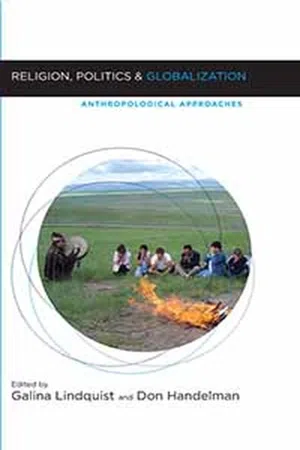
While social scientists, beginning with Weber, envisioned a secularized world, religion today is forthrightly becoming a defining feature of life all around the globe. The complex connections between religion and politics, and the ways in which globalization shapes these processes, are central themes explored in this volume by leading scholars in the field of religion. Does the holism of numerous past and present day cosmologies mean that religions with their holistic orientations are integral to human existence? What happens when political ideologies and projects are framed as transcendental truths and justified by Divine authority? How are individual and collective identities shaped by religious rhetoric, and what are the consequences? Can mass murder, deemed terrorism, be understood as a form of ritual sacrifice, and if so, what are the implications for our sensibilities and practices as scholars and citizens? Using empirical material, from historical analyses of established religions to the everyday strife of marginalized groups such as migrants and dissident movements, this volume deepens the understanding of processes that shape the contemporary world.
eBook - ePub
Religion, Politics, and Globalization
Anthropological Approaches
- 316 pages
- English
- ePUB (mobile friendly)
- Available on iOS & Android
eBook - ePub
Religion, Politics, and Globalization
Anthropological Approaches
About this book
Trusted by 375,005 students
Access to over 1.5 million titles for a fair monthly price.
Study more efficiently using our study tools.
Information
RELIGION, POLITICS, AND GLOBALIZATION
The Long Past Foregrounding the Short Present—Prologue and Introduction
This book offers a range of case-studies from around the globe—India, Indonesia, the Middle East, North Africa, Spain, the United States—that take up the tangled relationships between religion and politics in the presentness of this globalizing age. Mostly by anthropologists, the chapters exemplify how a relevant anthropology concentrates especially on the ethnographic and the factual. The case-studies illuminate the finer details of conflicts in the entanglement and the difficulties of resolving these. They add to the current understanding in the social sciences of just how mistaken were the claims of a generation and more ago that with modernization, religion withered away while much of the world's people secularized, thereby becoming heirs of the Western Enlightenment. Such claims maintained that as heirs of the Enlightenment, people should have a greater appreciation of the very metaphysics of science-based knowledge, and not only of the uses of technology. This appreciation should inspire confidence in rational decision making whose premises and outcomes are transparent and explicitly accountable for in terms of linear cause-and-effect relationships, without any irrational, mystifying mumbo-jumbo.1 Nonetheless, states that can best be called “theocratic”—religious-political systems that modernity sought to relegate to history—proliferate all over the globe and claim their say in international affairs. In avowedly secular states including those that (like the United States) formally separate church and state, religious institutions actively and influentially take part in the life of political and civil society, and groups and individuals inspired by “religious” values change cultures and societies in ways that few could have predicted. To be legitimate in the modern Western world, groups active in civil society, in social movements, and in political parties are expected to posit and position themselves based on secular rationality. Yet evidence from different parts of the globe show that these secular projects increasingly turn to whatever version of “religion” is at hand.
Our Prologue and Introduction foregrounds the chapters in this volume in broader perspective by arguing that at the roots of what we call “religion” are values of holism. The chapters illuminate numerous aspects of the conflicts and convergences between religion, politics, peoplehood, and nationhood, in which people hold together against others on the basis of often tacit feeling, but, too, the knowing of values that we are calling holistic. Moreover, we contend that such values were never extinguished during very lengthy periods in ancient and traditional worlds in which holism related first and foremost to cosmos—indeed to cosmos, as we discuss further on, that in our terms holds itself together from within itself. This kind of cosmos was shattered by the historical emergence of the monotheisms that shaped cosmoses that were “encompassed” and held together from outside themselves. These developments are associated with a lengthy period that historian Karl Jaspers and others have called the Axial Age. In this Prologue and Introduction, we call this shattering of cosmos the first great rupture, which occurred in parts of the ancient world. Nonetheless, values of holism continued through modern Western worlds, as these values became lodged in what came to be called “religion,” and still later in peoplehood, nationhood, statism, ethnicity, and not least in the individual (perhaps culminating in Foucault's idea of the care of the self).
In our broad historical tracing of “religion” further on, cosmos (and its relation to holism) will take precedence over “religion” (and its relation to holism), since the emergence of “religion” as a distinct domain in its own right occurred relatively late in human history, especially in Western Europe through the Reformation (and Enlightenment). We call this the second great rupture of cosmos, and discuss this further on. During that period, the “political” also emerged as a distinct domain in its own right (Dumont 1977). Therefore in this trace we also give priority to “religion” over “politics,” since the political as a distinct sphere emerged in counterpoint to that of religion. Yet, even as religion and politics moved into the modern age, often in competition with one another, this conflict may well point to how in today's world both religion and politics often are imbued with values of holism.2 We underscore that in doing this trace, our concern is not with causal relations through time, with any historical causality, but rather with the order of developments, with what came after what, and the significance of this for our arguments.
Values of holism in varieties of scale, density, and intensity are integral to human conditions of being, indeed, perhaps to being human. Values of holism may be thought of as cultural seed pods from which, when social conditions are ripe, holism germinates, ripens, and flourishes anew in varieties of form and context. We suggest that it is the value of holism in human ordering that often acts (both as sensibility and as intellect) in human life-worlds, in human cosmoses, to keep them together metaphysically.3 In order to state this claim, we must consider broadly the fates of values of holism during lengthy durations, even though this means that our trace must indeed remain superficial. Nonetheless, in this Prologue and Introduction, we make a start toward laying out such a trace. And, on the basis of this trace, we contend that in today's world where values of holism are present—often in the secular lineaments of nationalism, statism, ethnic peoplehood, and so forth—religion is close by. Arguing in this way, we are cutting against the grain of most contemporary studies of religion and politics that argue that in postmodernity, ties loosen and structures fall apart. In fact, this does not contradict our contention that even as things fall apart, values of holism re-form on different scales, in different patterns, and that as this occurs, religion is close by.
The chapters of this book were not written with the problematic of holism in today's globalizing world in mind—as Handelman outlined in the Preface, this volume has had a complex development. Yet we have no doubt that if one reads these works with this problematic in mind, it will become evident in a number of the chapters that when religions are present, values of holism are close by. In other words, we question whether modern (and postmodern) social orders in their manifold dimensions, whether secular or religious, can survive during lengthy periods without the “religiosity” that is embedded in values of holism, despite the claims of modernization and secularism to do away with religion, especially on rational grounds that are perceived to be embedded in science, progress, and secular ideological revolution (see especially Ezrahi 1990 on the role of science in democracy). Our contention is, of course, tautological if one thinks in terms of linear, cause-and-effect explanation: thus the tautology in arguing that values of holism index religion while in turn religion indexes values of holism. Nonetheless this is the logic of cosmos that is nonlinear in its (even partial) self-relating, self-integrating, and this too in the current era of globalization no less. Since the excision of tautology from linear, causal explaining is central to social-science thinking, we will return briefly to the issue of tautology in the section “Holism, Cosmos, Religion.” The linear claims of modernization-as-progress are especially poignant in this age of intensified globalization and migration, as the entanglements of religion and politics also close in on themselves as they intensify; witness the following two examples.
In the beginning of February 2007, newspapers reported that Abdel Karim Nabil Suleiman, a twenty-two-year-old Egyptian, faced a court trial. His crime was writing a blog, and he was charged with “disturbing the public order, spreading malevolent rumors and instigating hatred against Islam.” Blogs are private journals, a form of self-expression known as long as literacy has existed. The difference is that today's journals are laid out on the internet, to be read and commented on by any number of people unknown to the author. Private journals become a public resource; private worlds are unfolded in public space. Personal voices bypass censorship, reaching unexpected audiences, creating contacts and communities, spreading ideas and cultural forms beyond confines of national borders and political regimes.
Due to the World Wide Web, blogging today is far from a purely Western phenomenon.4 From Saudi Arabia to Morocco there are perhaps three to four thousand blogs, with fifty to one hundred popping up every day, where young people express their views. Egyptian authorities have long been trying to create a precedence by indicting a blogger; now Abdel Karim Nabil Suleiman (or Karim Amer, his internet name) was picked, and this choice prevented any protest in his support from whatever internal oppositional forces there are in Egypt. Whatever the different ideological and political opinions in this Muslim country, no one would defend a person who in his blog pronounced Islam “the root of all evil” (as the Swedish newspaper, Svenska Dagbladet, reported).5 His private statements, made public by the new practices of global cyberspace, demonstratively showed an attitude to religion as fervent as that of any religious devotee, albeit with the opposite sign. For his blog entries, Amer was sentenced to several years in prison.
This case illustrates what we know well: complex webs of power known as “politics” and actions fueled by sentiments connected to what we classify as “religion” cannot be understood separately from each other. Yet much more than this, this instance implies the following: Suleiman's blogging critique of Islam depends on the clear-cut separation of state and religion, such that religion is treated as a separate category, a distinct sphere of living, which is detachable, disposable, and can be disregarded in keeping with the thesis that modernization and secularization advance together. Perhaps from its beginnings (though perhaps some centuries later), Islam implicated a cosmos governed by the tenets of Islam that would encompass the political sphere of activity; a cosmos that was a religious polity, as it is sometimes called. For devout Muslims, Suleiman had attacked the existential legitimacy of the integral Muslim cosmos which encompasses the entirety of the world of existence, however this is understood. This instance demonstrates in a (cosmic) nutshell the perhaps endemic conflicted relationship since the onset of the European Enlightenment between “religion” and “politics.” This instance entangles national politics, religious interests, and the globalizing internet as a powerful venue of the values of individualism and freedom of expression espoused by liberal democracies, but very much in question in so many other states.
The uproar over the Mohammed cartoons that erupted a few years ago was another indication of the entanglement between spheres that—historically, socially, culturally—came to be separated during a lengthy period into the rubrics of religion and politics. World publics watched with amazement and anxiety how fervent emotions characteristic of religious faith erupted to cause tensions in international relations; and how consequences of what seemed at first an imprudent joke spread with the speed and intensity of a forest blaze all over the globe, provoking riots in distant places. The case of the Mohammed cartoons demonstrated once again the overflowing (and ever-flowing) global character of today's world, its unexpected connectivities, the permeability of national borders, and the relativity of ideologies and values considered fundamental for Western democracies, such as “freedom of speech.” Especially in the instance of the Mohammed cartoons, religious attitudes generated an internal political issue that quickly became a matter of international concern; neither religious values and ideologies nor national judicial norms and regulations could for long be contained and managed within national borders.6 Beyond telling us that increasingly all over the globe, politics and religion cannot be understood separately and that globalization is a key process in this entanglement, these two examples urge us to question once again our ideas of private and public, of national and global spheres of secular politics and religious faith.
Indeed, the last two decades have seen a spate of research on the entwinements of politics and religion. These have focused on the involvement of churches and religious movements in the politics of states and civil societies (e.g., Haynes 1998, 2006; Casanova 1994; Bruce 2003), on the role of religion in nation building and in the constitution of national and ethnic identity (Van der Meer and Lehman 1999; Halliday 2000; Hastings 1997; Goldschmidt and McAlister 2004), and on antisecularist or “fundamentalist” movements (an early example is Westerlund 1996). Attention too has been given to the role of globalization in changing the world's religious landscapes (e.g., Beyer 1994; Vasquez and Marquardt 2003). The individual chapters of this book broaden this focus, problematizing the tenuous equation between secularism and modernity. For that matter, the chapters suggest that we might well question any clear-cut distinction between the categories of “politics” and “religion” as applicable in today's world. The chapters bring globalization into this picture as vast interacting flows of ideas, plans, and practices that alter the constitution of the processes these categories attempt to chart.
In the 1960s it was commonplace in the social sciences and religious studies to assert that the world was “secularizing”: that in modern social orders, religion had lost its role, lost its way, becoming increasingly marginalized and relegated to the private, inner sphere. The modernization-secularization thesis (with its implicit evolutionist morality) was close to the hearts (and not only the minds) of many social scientists. Prominent was that which Geertz (2005: 10) calls “the reductive version of the so-called ‘secularization thesis’—that the rationalization of modern life was pushing religion out of the public square, shrinking it to the dimensions of the private, the inward, the personal, and the hidden.” Three decades later, many of the proponents of the secularization paradigm admitted that it was wrong. In 1999, Peter Berger (1991), a prominent sociologist of religion and one of the foremost theorists of secularization, declared that secularization theory was essentially mistaken. “The world of today,” he said, “is as furiously religious as it ever was, and in some places more than ever.” Asked to reconsider his recantation, Berger (2001: 194) responded that, “if modernization and secularization are intrinsically linked, one would have to argue that the United States is less modern than, say, the United Kingdom.” Another prominent sociologist of religion, Grace Davie (2007: 64), wrote recently that given the decline of the modernization-secularization thesis, “the task of the sociologist shifts accordingly: for he or she is required to explain the absence rather than the presence of religion in the modern world. This amounts to nothing less than a paradigm shift in the sociology of religion.”
Social scientists have not had a fruitful record in studying present-day religions from within themselves, through their cosmoses, their metaphysics. At the core of social-science research ideologies is the premise that scientific progress is attained through fact-based and transparent research results that are replicable. Mainstream models of social-science research are by-and-large deeply influenced by the natural and experimental sciences (though this is much less so for sociocultural anthropology and its qualitative research approaches). In these terms this means that religion can be well studied for its sociological parameters, and this is the direction that most social-science researchers take.
Yet, as phenomenon, as practice, as belief, we researchers generally position religion closer (perhaps very close to) the pole of the irrational on a continuum that runs from the irrational to the rational (where we position our disciplines and ourselves, at least our public and professional selves). Representative of this view is the recent writing of the anthropologist, F. G. Bailey (2008: 21): “Revealed Truth (God's Truth) is asserted without evidence, and to that extent, it is unauthentic; it has nothing to do with knowledge, it evades criticism, and it answers only to the emotional discomfort that accompanies feelings of uncertainty.” On the other hand, the task of the rational, of reason, “is to inquire and to demand evidence, which is, ipso facto, to put faith [i.e., religion] into question” (2008: 23). Yet should we, as social scientists, accept the common-sense logic of this continuum? Should religion at all be positioned on this continuum that is the intellectual product of the European Enlightenment and later of European modernization? By putting religion on this continuum it is, indeed ipso facto, forced to reflect the premises of the rational and the secular; and, as such, religion can only be understood as irrational. Since the politics of religion commonly reflect conflicts between secular and religious institutions, religion as cosmology (which is also a way of saying religion in its own right) can neither escape nor evade its positioning on the continuum.
Elementary premises of cosmos, of religion-as-cosmos, can run extraordinarily deep, and this must not be elided in the scramble of scholarship to attribute the resurgence of religion (and, in the recent past, the decline of religion) almost wholly to current social, political, and economic conditions in movement globally. Throughout this Introduction we are arguing, more loudly, more quietly, that the human propensity toward holistic organization, in multiple domains, on multiple levels, is profound and cannot be reduced simplistically to historical processes, nor to particular social formations. Consider, for example, one aspect of cosmic organization that the anthropologist working in a traditional social order would study as a matter of course—the dynamics of time. How time is conceived and practiced is essential to the rhythms of living, as these rhythms are essential to the existence of a world, perhaps every world. P...
Table of contents
- Cover Page
- Title Page
- Copyright Page
- Dedication Page
- Contents
- List of Figures
- Preface
- After Understanding: A Memoir of Galina Lindquist
- Religion, Politics, and Globalization: The Long Past Foregrounding the Short Present—Prologue and Introduction
- I. Shaping Religion Through Politics
- II. Open Conflicts Between Religion and Politics
- III. The Tight Embrace of Religion and Politics
- IV. Opening New Space for Religion
- Afterword: Fixation of Belief and the Dilemmas of Fallibility
- Notes on Contributors
- Index
Frequently asked questions
Yes, you can cancel anytime from the Subscription tab in your account settings on the Perlego website. Your subscription will stay active until the end of your current billing period. Learn how to cancel your subscription
No, books cannot be downloaded as external files, such as PDFs, for use outside of Perlego. However, you can download books within the Perlego app for offline reading on mobile or tablet. Learn how to download books offline
Perlego offers two plans: Essential and Complete
- Essential is ideal for learners and professionals who enjoy exploring a wide range of subjects. Access the Essential Library with 800,000+ trusted titles and best-sellers across business, personal growth, and the humanities. Includes unlimited reading time and Standard Read Aloud voice.
- Complete: Perfect for advanced learners and researchers needing full, unrestricted access. Unlock 1.5M+ books across hundreds of subjects, including academic and specialized titles. The Complete Plan also includes advanced features like Premium Read Aloud and Research Assistant.
We are an online textbook subscription service, where you can get access to an entire online library for less than the price of a single book per month. With over 1.5 million books across 990+ topics, we’ve got you covered! Learn about our mission
Look out for the read-aloud symbol on your next book to see if you can listen to it. The read-aloud tool reads text aloud for you, highlighting the text as it is being read. You can pause it, speed it up and slow it down. Learn more about Read Aloud
Yes! You can use the Perlego app on both iOS and Android devices to read anytime, anywhere — even offline. Perfect for commutes or when you’re on the go.
Please note we cannot support devices running on iOS 13 and Android 7 or earlier. Learn more about using the app
Please note we cannot support devices running on iOS 13 and Android 7 or earlier. Learn more about using the app
Yes, you can access Religion, Politics, and Globalization by Galina, Don Handelman, Galina,Don Handelman in PDF and/or ePUB format, as well as other popular books in Social Sciences & Religion. We have over 1.5 million books available in our catalogue for you to explore.