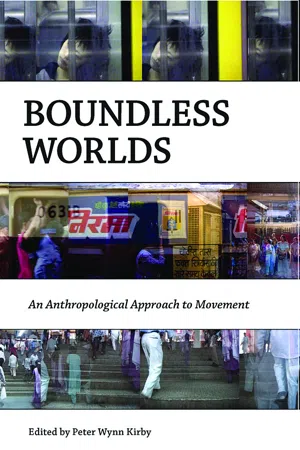
Where lived experience of surroundings is shifting, visceral, and immersive, interpretation of social spaces tends to be static and remote. "Space" and "place" are also often analyzed without grappling much (if at all) with the social, political, and historical roots of spatial practice. This volume embarks upon the novel strategy of focusing on movement as a way of understanding social spaces, which offers a means to get beyond biases inherent in the social science of space. Ethnographic studies of social life in settings as varied as nomadic Mongolia and island Melanesia, as distinct as contemporary Tokyo and war-torn Palestine, challenge Western assumptions about the universality of "space" and allow concrete understanding of how life plays out over different socio-cultural topographies. In a world that is becoming increasingly "bounded" in many ways - despite enormous changes wrought by technological, ideological, and other social developments - Boundless Worlds urges a scholarly turn, away from the purely global, toward the human dimension of social lives lived in conditions of conflict, upheaval, remapping, and improvisation through movement.
- 242 pages
- English
- ePUB (mobile friendly)
- Available on iOS & Android
eBook - ePub
About this book
Trusted by 375,005 students
Access to over 1.5 million titles for a fair monthly price.
Study more efficiently using our study tools.
Information
Chapter 1
Lost in ‘Space’: An Anthropological Approach to Movement
More than thirty years after our first encounter, both Belleville and I have
changed. But Belleville is still a place, while I am afraid I look more like a flow.
changed. But Belleville is still a place, while I am afraid I look more like a flow.
Manuel Castells (2000: 454)
The tension between place, memory, and change lies at the heart of human existence and, as Manuel Castells’s quotation cited above indicates, sometimes place allows us to understand just how mutable and protean our lives become. But that is not to say that places are fixed or even durable, save in relative terms. We live in a world shaped by flux. Islands of apparent stability are engulfed by a sea of human and animal peregrinations, linguistic and cultural change, emergent social institutions, traffic in goods as well as flows of ‘bads’ (such as disease and pollutants), circuits of material culture, exchange of images and ideologies, slow motion tectonic shifts, and climate change. Not least, our bodies are in constant motion with organs pumping fluids, lungs expanding and contracting with air, hair regenerating (or receding), bodies building and losing tissue, and cells undergoing continual birth and decay. Subject to buffeting motion and change in a broad sweep of socio-cultural contexts, it is not surprising that anthropologists find enduring attempts to create armatures of stability out of the vagaries of existence. Even the edifices we construct, which in comparison to flesh seem the essence of permanence and solidity, are effectively architectural illusions obscuring ongoing negotiation between dwellers, materials, design, and use. Movement and change – aggressively regulated, channelled, and even denied in the creation and maintenance of social institutions and the structuration of social relations – are the reviving undercurrent circulating throughout social life.
Yet while anthropology and other social sciences have long acknowledged the importance of addressing flux in socio-cultural inquiry, albeit with a diversity of approaches,1 attention to the ramifications of movement remains relatively lopsided. Extensive work on migration and diaspora cultures and on social ‘movements’ provides important insights into the fluidity of people, culture, and ideas, as I detail below; and, indeed, the current emphasis in scholarship on transnational flows of everything from labour and images to pollution and contagion in our mediated, globalizing world reveals keen interest in certain specific forms of movement as objects of analysis (e.g., A. Ong 1999; cf. Tsing 2000, 2005). Nevertheless, a focus on certain emblematically transnational or ‘global’ movements exposes lacunae in, or neglect of, other elements of mobility and flux worthy of anthropological purview (e.g., Piot 1999). As ‘users’ are drawn into the compressed space of mediated communication and accelerated travel corridors, or folded into the altered temporalities to which hypertext and split-second electronic transactions give rise – creating discontinuities between the immediacy and rootedness of lived surroundings and distant or virtual planes – so social scientists often seem seduced by the immense speed and ‘flow’ (and novelty) of new circuits into paying less attention to more quotidian themes or settings (e.g., Castells 2000; cf. Harvey 1990). And as some accounts begin to discern metonymic traces of global processes in many forms of social movement (cf. Strathern 1995 and Tsing 2000, 2005 for salient critiques), human-scale experience of movement is neglected.
Globalization and globalism (the latter indexing discourse on the global) signal important and historic transformations in our world, transformations that beg careful anthropological analysis. Yet, as I explore below, ways of thinking about and addressing globalization expose problems in how anthropologists confront questions of movement that pose great difficulties for the discipline. Some of these interpretive obstacles have been created by the historical legacy of ‘space’ in Euro-American discourse.
Social scientists’ keen interest in ‘space’ in recent years stems, to a considerable extent, from the belief that spatial knowledge, architectures, symbolism, and action comprise an analytical cross-section of social phenomena that can help lead to a deeper, more insightful understanding of varied social contexts. Unfortunately, this chimera of ‘space’ often leads to vastly divergent results. Recent work in anthropology and other social science (detailed in the sections below, as well as in subsequent chapters in this volume) has made it increasingly clear that what is generally termed ‘space’ is guilty by association with a wide array of concepts from the European intellectual tradition that in fact lead us away from a clearer understanding of the multiplicities of social life. Indeed, far from being an unlucky bystander, ‘space’ has lain, in many ways, at the very heart of brutal European (and other) encroachments on less powerful societies, not to mention domination of domestic populations. Cartesian-influenced conceptions of space and linked technologies of power, such as cartography and development schemes, have etched political notions of segregation, domination, and control onto the surface of the world, reshaping the globe itself to ‘Western’ specifications – so much so, in fact, that it has become difficult to countenance use of this term without severely undermining research objectives. Against the backcloth of contemporary social developments, with stewardship of planetary ecology and responses to infectious disease pandemics complicated by uneven geopolitical terrain; with transnational flows of migrants, capital, and ‘culture’ making state frontiers seem increasingly arbitrary, obstructive, and anachronistic; with creation of far-flung social networks via communications technologies, expanded travel corridors, and other means of social and intellectual exchange continuing apace; and with heavy-handed counter-jihadist measures, however understandable at times, provoking public outcry at lost freedoms and unfortunate excesses, a sustained interrogation of ‘space’ and a renewed appreciation of movement seem particularly timely.
The collection’s attention to the politics of demarcation penetrates straight to the heart of these issues, particularly the tension between social boundaries and social movement reflected to some extent in the volume’s title. The political ramifications of ‘marking one’s territory’, common both to the competitive spraying of territory in the animal world and to the (often equally bestial) erection of boundaries between human groupings, are undeniable. But beyond these rites of possession and division, human engagement with the world consists of a ceaseless marking, and remarking, of our environs, a circulating interplay between the trammelled routes and existing toponyms that accrete to ‘places’ through history-laden social contact with terrain and the daily embodied iterations and symbolic interchange that transpire in the simplest journey or sensory immersion in a social milieu.2 As several of the book’s contributors vividly illustrate, autochthonous notions of place, interval, and (topo)genealogy are, to be sure, laden with power.3 Yet Cartesian ideas of space seem particularly culpable in denying relations between ‘objects’ contained within its abstracted field. Therefore, while attuned to the important socio-political dimensions of topologies of hierarchy and exclusion and control in a range of societies, this volume remains sensitive to how the axes of space have been extended and overlaid on top of existing notions of relation, proximity, and affect, replotting in x,y,z co-ordinates alternative social mappings, and facilitating proliferation of a certain culturally-anchored set of political relations that have long been assumed as givens in all too many scholarly analyses.
This volume of essays brings together nine scholars whose thoughtful, rigorous, and penetrating socio-historical investigations give the lie to conventional understandings of space and its interpretation. These scholars have, each in their own way, distinguished themselves as shrewd investigators of alternative understandings of spatial phenomena specifically and as bold critics of ‘conventional wisdom’ in socio-cultural inquiry more generally. Taken together, the collected essays comprise a subtle and concerted assault on the constellation of familiar notions that combine to make ‘space/place’ not only a considerable hurdle impeding understanding of varied social groupings but, to some, an epithet reviling simplistic, ethnocentric or hackneyed thinking.
Significantly, this collection does not propose abandoning the term ‘space’ entirely (though one contributor, Tim Ingold, has argued that this is an essential first step (Ingold 2001)). Rather than coin new jargon or produce convoluted intellectual formulations, we prefer to construct a coherent and many-pronged attack on flawed invocations of this concept while pointing the way towards a more sensible and socio-historically sound account of the rich complexities of practical and symbolic interventions into human environs. A strong thread weaving through the contributions is the importance of movement: movement as an essential component of the effervescence and improvisation of social life, movement in defiance of political strictures, indeed, the inevitability of movement across or along spatio-political structures or boundaries intended to restrict movement, control dissent or difference, and pacify populations. The collected essays, in relating their research findings, reveal important dimensions of ‘topo-logics’ of richly varied provenance and, in turn, identify the ways in which human lives belie the cold, empty, passionless rationality of space as imposed in social settings and as implicated in some structuring of human thought itself.
One criterion for selecting essays – aside from a demonstrated sensitivity to the spatial politics of occupation, demarcation and movement – was a willingness to look beyond disciplinary boundaries. (To be sure, many of the volume’s critiques of policed geopolitical frontiers and enforced spatial/cultural protocols could be directed at overly zealous boundary maintenance between scholarly disciplines.) Another was the ability to combine broad theoretical sophistication with original and specialist research. The result is nine essays that consider appropriations and engagement in social milieux as diverse as contemporary Palestine, hinterland Mongolia, community Tokyo, and Island Melanesia; spatial dynamics of cross-cultural contact in colonial South Asia, on the one hand, and in multinational corporate France, on the other; and frictions between spatio-temporally localized traditions and global ambitions in both networked knowledge industries in rural Finland and in politically mobilized ‘post-diaspora’ Tibet. The essays taken as a whole comprise a concerted and coherent attempt to interrogate (largely ‘Western’) occupations and manipulations of space against the backdrop of how people actually move through, exist in, conceive of, and represent these spaces in their everyday lives in varied social contexts. Many anthropological collections analysing ‘space’ and/or ‘place’ (e.g., Low and Lawrence-Zúñiga 2003; Gupta and Ferguson 1997; as well as Feld and Basso 1996, to a lesser extent – Hirsch and O’Hanlon 1995 stands as a notable exception) dive into theoretical analysis of ethnographic subjectivities and experiences of place in our contemporary age without grappling much (if at all) with the social/political/historical roots of these important socio-cultural phenomena. In order to lay sturdy foundations for this discussion, I review and interpret below the rise of ‘space-thinking’ in European and diaspora societies (and its imposition on other parts of the world) before moving on to engage with alternative means of approaching the study of bodies and surroundings in a range of socio-cultural settings.
Making ‘Space’
Space has been in the making for millennia, and yet it is clear that the origins of ‘Cartesian’ space, as presently leveraged and experienced, extend back at least to Greek civilization’s intellectual achievement of creating rationality and abstraction out of the heterogeneity and unevenness of the world. While the intellectual roots of this process took sustenance from linguistic developments4 and a logic imposed on philosophical questions of all stripes, the trope of space grew most clearly out of mathematical advances (cf. Jonas 1982),5 perhaps most vividly illustrated by Euclidian geometry. Chief among these was the Greeks’ success in severing relations between objects, denying characteristics of place and creating infinite division and transferability within two-dimensional surface-planes and three-dimensional cones, spheres, polyhedra, and so on, in conceptual ‘space’ (Euclid 1990 [c.300 BCE]). Implicated in Greek metaphysics’ objectification and logic of conversion was a system of mnemonics, pioneered and refined into an ‘art’ (Yates 1966) by the Greeks, in which visualized spaces (often in fact places, rooms and corridors from actual buildings visited by devotees and etched in their mind’s eye through long hours of practice) became festooned with interchangeable images of objects and personae used to symbolize, store, and conjure up complex information (Yates 1966; Fabian 1983). Though these cavernous precincts of the mnemonically trained mind generally remained fixed, the contents of the architectonic spaces could be altered at will.6 This cold, rational conception of space – refined through subsequent centuries to the present day and resulting in a ‘spatialization of consciousness’ (Fabian 1983, emphasis removed) that shapes rhetoric, conceptions of the world, and their presentation (Fabian 1983; cf. Havelock 1982: 9, 311–12) – has had a pervasive influence on academic and other engagement with the world. Not only do memory and rhetoric and pedagogy bear the stamp of this spatialized approach to knowledge (W. Ong 1958), with spatio-cultural forms such as taxonomies, grids, kinship diagrams, and so forth shaping encounters with social data (Fabian 1983), but a complex of space-focused biases and stances and predispositions has created pervasive distortions in how social scientists, and others, interpret surroundings and the societies they study. Amid these conditions of persistent intellectual disengagement from lived experience, people continue to ‘see’ the world through the filter of space.
Developments of spatial representation in art and architecture both reflected and reinforced this process. To take painting, for example: from classical times through the Middle Ages there was extensive, though crude, use of two-dimensional media to represent three-dimensional scenes. But the refinement of linear-perspectival composition in Renaissance painting signalled an expansion of ‘space-thinking’ (and ocularcentrism)7 that would have important ramifications for European and other engagements with and representations of their surroundings. Leon Battista Alberti characterized perspective as a ‘velo’ (veil) of threads stretched across a frame and allowing the pyramid-shaped perspective of the scene to be perceived as a grid extending from the vanishing-point to the surface of the painting (from Alberti’s fifteenth-century De Pictura, cited in Edgerton 1975: 118) and then in a reverse pyramid from the surface of the painting to the viewer that implied (and imposed) a ‘monocular, unblinking, fixed eye’ (Jay 1993: 54; cf. Hirsch 1995). This Quattrocento perspectival reckoning framed the world in terms of a strict, sophisticated set of geometrical and optical principles – couched in the production of verisimilitude – and implicated the viewer in the structuring of th...
Table of contents
- Cover
- Title
- Copyright
- Contents
- Acknowledgements
- 1 Lost in ‘Space’: An Anthropological Approach to Movement
- 2 Against Space: Place, Movement, Knowledge
- 3 Spatiality, Power, and State-Making in the Organization of Territory in Colonial South Asia: The Case of the Anglo–Gorkha Frontier, 1740–1816
- 4 Embodying Spaces of Violence: Narratives of Israeli Soldiers in the Occupied Palestinian Territories
- 5 This Circle of Kings: Modern Tibetan Visions of World Peace
- 6 A Weft of Nexus: Changing Notions of Space and Geographical Identity in Vanuatu, Oceania
- 7 At Home Away from Homes: Navigating the Taiga in Northern Mongolia
- 8 Toxins Without Borders: Interpreting Spaces of Contamination and Suffering
- 9 Movements in Corporate Space: Organizing a Japanese Multinational in France
- 10 Making Space in Finland’s New Economy
- Conclusion
- Visual Appendix
- Notes on Contributors
- Index
Frequently asked questions
Yes, you can cancel anytime from the Subscription tab in your account settings on the Perlego website. Your subscription will stay active until the end of your current billing period. Learn how to cancel your subscription
No, books cannot be downloaded as external files, such as PDFs, for use outside of Perlego. However, you can download books within the Perlego app for offline reading on mobile or tablet. Learn how to download books offline
Perlego offers two plans: Essential and Complete
- Essential is ideal for learners and professionals who enjoy exploring a wide range of subjects. Access the Essential Library with 800,000+ trusted titles and best-sellers across business, personal growth, and the humanities. Includes unlimited reading time and Standard Read Aloud voice.
- Complete: Perfect for advanced learners and researchers needing full, unrestricted access. Unlock 1.5M+ books across hundreds of subjects, including academic and specialized titles. The Complete Plan also includes advanced features like Premium Read Aloud and Research Assistant.
We are an online textbook subscription service, where you can get access to an entire online library for less than the price of a single book per month. With over 1.5 million books across 990+ topics, we’ve got you covered! Learn about our mission
Look out for the read-aloud symbol on your next book to see if you can listen to it. The read-aloud tool reads text aloud for you, highlighting the text as it is being read. You can pause it, speed it up and slow it down. Learn more about Read Aloud
Yes! You can use the Perlego app on both iOS and Android devices to read anytime, anywhere — even offline. Perfect for commutes or when you’re on the go.
Please note we cannot support devices running on iOS 13 and Android 7 or earlier. Learn more about using the app
Please note we cannot support devices running on iOS 13 and Android 7 or earlier. Learn more about using the app
Yes, you can access Boundless Worlds by Peter Wynn Kirby in PDF and/or ePUB format, as well as other popular books in Social Sciences & Anthropology. We have over 1.5 million books available in our catalogue for you to explore.