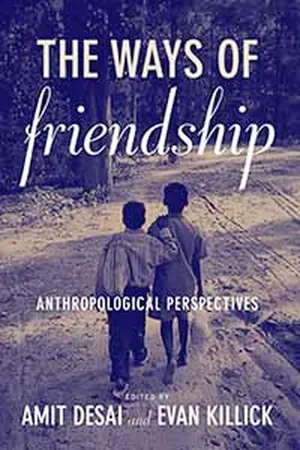
Friendship is an essential part of human experience, involving ideas of love and morality as well as material and pragmatic concerns. Making and having friends is a central aspect of everyday life in all human societies. Yet friendship is often considered of secondary significance in comparison to domains such as kinship, economics and politics. How important are friends in different cultural contexts? What would a study of society viewed through the lens of friendship look like? Does friendship affect the shape of society as much as society moulds friendship? Drawing on long-term ethnographic fieldwork in Asia, the Middle East, Africa, Latin America and Europe, this volume offers answers to these questions and examines the ideology and practice of friendship as it is embedded in wider social contexts and transformations.
eBook - ePub
The Ways of Friendship
Anthropological Perspectives
- 228 pages
- English
- ePUB (mobile friendly)
- Available on iOS & Android
eBook - ePub
About this book
Trusted by 375,005 students
Access to over 1.5 million titles for a fair monthly price.
Study more efficiently using our study tools.
Information
Chapter 1
On ‘Same-Year Siblings’ in Rural South China1

This chapter draws attention to the little-known Southern Chinese idiom and institution of fictive/ritual kinship which I shall render in English as ‘same-year siblingship’. ‘Same-year siblings’ are non-kin men or women born in the same year who found it necessary or desirable to formally reconfigure their relationship by means of a kinship metaphor of agnatic siblingship. This public idiom and institution of ‘relatedness’, to use a concept recently celebrated in the field of kinship studies (Carsten 2000b), is analogous to other well-known Chinese phenomena of fictive/ritual kinship, such as ‘sworn siblinghood’, but it has never been the object of systematic ethnographic attention. In this chapter, I shall try to correct this omission with data recently collected in the province of Guangdong. My ultimate analytical goal, in line with the spirit of this volume, will be to argue that the detailed ethnographic study of this phenomenon of fictive/ritual kinship suggests that ‘friendship’ is an important and highly productive subject of anthropological inquiry in its own right (see Killick and Desai in this volume).
Located in the coastal southern region near Hong Kong and Macao, the province of Guangdong is well known for its spectacular rates of economic growth and urbanization following the post-Mao reforms of the 1980s, but it first caught the attention of anthropologists back in the 1950s and 1960s due to the phenomenon of ‘lineage-village organization’. As described in the ‘classic’ literature (see Freedman 1958, 1966), this is a ‘traditional’ form of agrarian ritual-social organization centred on patrilineal descent and territory that differs from similar modes of organization found, for example, in small-scale African societies because it is compatible with class stratification and state organization. Despite this comparative qualification, the ‘classic’ analytical emphasis on descent and territory was to have a strong influence on subsequent studies of kinship and sociality in the region, and these studies have in turn inspired the development of a powerful model of Chinese rural sociality in which friendship plays a very marginal role due to the dominance of agnatic kinship and locality (see Santos 2006).
The data presented in this chapter will both revise the original portrayal of rural South China given in this more general ‘classic’ model of Chinese rural sociality, and provide a post-Mao update. As in previous studies of Chinese sworn siblinghood (e.g. Gallin and Gallin 1977; Jordan 1985; Stockard 1992), my aim is to contribute to the widening of the study of relatedness in rural China beyond agnatic kinship and locality (see also Sangren 1984; Judd 1994; Yan 1996, 2003; Kipnis 1997; Stafford 2000a, 2000b; M.L. Cohen 2005). However, unlike most research on Chinese sworn siblinghood, the present discussion of ‘same-year siblingship’ will not take as its starting point the ideology of fictive/ritual kinship behind this idiom and institution, but rather the practical/affective phenomenon that leads to its strategic deployment in the first place. This is the phenomenon of friendship, or, as I will argue, a particularly well-matched form of friendship between same-sex persons of the same age/generation.
This focus on friendship via fictive/ritual kinship may seem somewhat novel within the field of China studies, but it is certainly not novel within the broader field of anthropology. As Robert Paine (1969) and more recently Sandra Bell and Simon Coleman (1999a) and Fernando Santos-Granero (2007) have pointed out, most classic discussions of friendship in ‘non-modern’, ‘non-Euro-American’ settings were notable for beginning and ending with phenomena of fictive/ritual kinship, such as the ‘Mesoamerican bond of compadrazgo’ or the ‘tribal bond-friendship’ (cf. Pitt-Rivers 1973). Unlike these discussions, however, I shall not assume a priori that the phenomenon of friendship has nothing to do with cross-cultural requirements for practical/affective well-being, nor that it represents an urban middle-class occurrence typical of ‘modern’ societies such as the ‘Euro-American’ where kinship no longer plays a prominent organizational role in wider society.
Building on this analytical caution, the data presented here on contemporary rural South China will show precisely that the fact that friendship is less visible and less formally valued than other forms of sociality (e.g. agnatic kinship) does not mean that it is less important to people or less ubiquitous in society. It only means that it often has to remain in the shadows or else be masked, as in the case of ‘same-year siblings’, with socially reassuring metaphoric clothing (cf. Uhl 1991). These data will lead me to suggest that friendship in rural South China has an expressive style of its own that does not entirely overlap with the modern Euro-American ideology of friendship (described, for example, by Paine 1969 and sociologically deconstructed by Allan 1979, 1989) as a highly autonomous, voluntary and affective personal relationship between particular individuals.
My aim is not to suggest that different socio-cultural contexts and structures are bound to engender different forms of friendship that are in turn indicative of friendship's varying degrees of prominence and centrality across cultures and social structures (see Y.A. Cohen 1961). Rather, my point will be to argue that the phenomenon of friendship is a key form of human relatedness in its own right despite significant historical, regional and cultural variations in the way in which it is represented in public discourses, rituals and practices (cf. Bell and Coleman 1999b; Santos-Granero 2007). This is a key form of human relatedness that is clearly separate from kinship and marriage in that it is directly associated neither with the question of sexuality and procreation nor with the question of the succession of generations and the appropriation of children. As defined in the present chapter, friendship constitutes a major form of individual and/or collective alliance which is marked by frequent, voluntary displays of mutual generosity and trust that can be more or less instrumental but that are always based on both affective and practical reasons. Towards the end of the chapter, I shall argue that the recognition of the centrality of friendship across cultures has important implications for recent debates about kinship and intimacy, and may lead ethnographers to make innovative contributions to the study of altruism and cooperation among humans.
The Contexts of Friendship in Contemporary Rural South China
Harmony Cave2 is the pseudonym of the small Cantonese ‘common-surname village’ (tuhng-sing-chyun)3 or ‘single-lineage village’ where I undertook fourteen months of intensive fieldwork between 1999 and 2001 and where I returned for additional field research in 2005, 2008 and 2009.4 This village has a total population of about 700 individuals and is located in the ‘hilly regions’ of Northern Guangdong in the township of Brightpath, at about 250 km north of the provincial capital (Guangzhou). This is a relatively out-of-the-way rural township that is often praised by visiting urbanites for the beauty of its agrarian landscape of paddy-rice fields, figure-shaped limestone mountains, and small, compact ‘lineage-villages’5 still built for the most part with traditional clay bricks.
Agrarian as this landscape may seem, the Brightpath region is currently at the heart of a massive wave of ‘temporary labour migration’ to the wealthier southern urban cores of the province. This is part of a complex historical process that started to occur in the 1980s soon after the beginning of Deng's reform programme. Largely unable to change residence due to official restrictions on rural-to-urban migration, among other reasons, most local labour migrants invest their savings back home not just in personal projects like new ‘modern’ family houses, but also in collective projects like the reconstruction of old ‘traditional’ ancestral halls and temples which were destroyed or abandoned during the Maoist period. This widespread investment in pre-Communist forms of symbolic capital shows that the collectivist reforms of the Maoist period were not enough to eradicate people's sense of belonging to traditional corporate organizations, such as localized lineages or temple associations. Hence one of the major effects of Deng's reforms in the local society – and in much of rural South China (see for example Potter and Potter 1990; Siu 1990, 1993; Aijmer and Ho 2000; Ku 2003) – was the ‘public revival’ of many of the customs and traditions associated with these ‘old’ agrarian institutions of ritual-social organization.
Of course, these newly ‘revived’ old customs and traditions are only a poorly reproduced copy of their pre-Communist template. Particularly relevant to our discussion is the phenomenon of ‘lineage-village organization’ whose renewed vitality can be illustrated, for example, by the resurgence of the practice of communal ancestor worship or by the continuing adherence to the practice of village patrilocal exogamy. While these practices are clearly symptomatic of a return to past traditions, they are also at the heart of important socio-cultural metamorphoses which include the increasing monetarization and inflation of the local ritual economy. For example, although the ‘traditional’ system of marriage exchanges involving bridewealth and dowry is still in place, it is now almost exclusively centred on money, and the ‘economic value’ of these exchanges has already reached levels previously unknown to the local rural society.6
Brightpath's new ‘old’ lineage formations are also significantly weaker than their pre-Communist counterparts. This is because the local rural society has not remained static during the last five to six decades of socialist and post-socialist reforms. Rather, it has undergone a complex process of transformation whereby the ‘old’ lineage structures of social organization have lost much of their material power not just to the rising Communist state and its various ‘modern’ technologies of governance, but also to the rising younger generations (women included) and their equally ‘modern’ aspirations. As in much of rural China (Yan 2003), these individualistic aspirations were significantly empowered by the radical social reforms of the Maoist era, which were aimed at inter-generational and gender equality. More recently, the post-Mao institution of an increasingly liberal and market-oriented regime has further empowered the younger generations by giving them greater opportunities to move, spatially and economically. Today, this growing power of the younger generations is quite clear, for example, in their tendency to establish a separate family ‘stove’ and sometimes construct a separate family house immediately after marriage and regardless of parental opinion.
The relative weakness of Brightpath's new ‘old’ lineage formations notwithstanding, it is quite clear that agnatic kinship and locality still constitute key formal dimensions of the local dynamics of relatedness. People's affinal networks through marriage also play a fundamental structuring role in the local rural society, not least because after marriage women tend to maintain relations with their mothers, siblings and natal villages. Outside the realms of kinship and marriage, there are other equally important official and non-official, local and trans-local routes of relatedness such as administrative networks, marketing networks, popular religion networks and migration networks.
While most of these networks have already been the object of detailed ethnographic studies, the same cannot be said of friendship and friendship-based networks, as friendship is a largely neglected topic of research among sinological anthropologists. As Alan Smart (1999: 126–9) notes, it was only as recently as the 1990s that there was a relative upsurge of interest in the topic of friendship. On the one hand, scholars have drawn attention to friendship while making sense of the more general phenomenon of ‘guanxi [M]’ or network building in the current market-oriented post-Mao period (see Yang 1994; Yan 1996; Kipnis 1997). On the other hand, scholars have looked at friendship while focusing on the prominence of the topic of separation and reunion in Chinese idioms of kinship and relatedness (see Stafford 2000b). The only problem with this literature, to come back to rural South China, is that it largely draws on data collected either in urban settings or else in rural settings (for example, in North China) not associated with lineage-village organization. As a result, this literature does not directly challenge the ‘classic’ lineage-centred picture of rural South China as a place in which friendship remains as marginal as the old Confucian moral orthodoxy depicts it: in other words, the least important of the ‘five basic relationships’ – the others being ‘ruler and minister’, ‘father and son’, ‘husband and wife’ and ‘elder and younger brother’ – seen to be at the heart of the world of humans (see Kutcher 2000).
Friendship among Agnatic Village Relatives
I shall first look at the interpersonal relations between residents of ‘single-lineage villages’ like Harmony Cave. The dominant view here is that kinship is of paramount importance because the closely-knit agnatic and territorial foundations of these villages imply that the residents are bound to be on intimate, amicable terms with one another. This view is probably derived from the impression that these villages are like ‘big harmonious families’, an impression that is encouraged by people's normative representations of these villages as ‘big families’ (daaih-ga).
This ‘big family’ picture is also supported by data such as the local practical kinship terminology, according to which all native village residents of ego's age-cohort (or of ego's formal lineage generation) are referred to as ego's brothers/sisters, those of younger generations as ego's nephews/nieces, grandsons/granddaughters, and so on, and those of older generations as ego's uncles/aunts, grandfathers/grandmothers, and so on.7 It is far from being clear, however, whether when people refer, for example, to the eldest son of their father's brother (FBeS) as their ‘eldest brother’ (daaih-go), they are doing so in a metaphoric or literal sense.8 My own field observations suggest that both hypotheses are equally valid because the meaning that people give to these kin terms changes according to the situation and context of usage. This means that the ‘big family’ picture of these villages is very misleading if taken in a strictly literal sense.
The same is true of the assumption that the residents of these ‘big family’ villages are bound to show to one another the kind of amicable behaviour that one sometimes finds in some particularly harmonious nuclear families. Although the closely-knit agnatic and territorial foundations of these villages provides a formal background of kin amity (which helps to reduce conflict and enhance cooperation), there is still a lot of competition at both the familial and the individual levels (see Watson 1985). As a result, people do not and cannot take active cooperation and support for granted, and, as such, they also have to work hard to make friends (i.e., their own, individual alliances) amongst their neighbours, usually persons of the same sex and of the same age-cohort. Early feminist scholars such as Margery Wolf (1972) have already drawn attention to the importance of this phenomenon of friendship among Taiwanese village women in the context of the Chinese patrilocal rural family and its customary rules of partible, patrilineal inheritance, but there is no reason to restrict this phenomenon to women.
Even in ‘single-lineage villages’ like Harmony Cave, where the practice of village patrilocal exogamy institutes remarkable sex/gender-based variations in social behaviour, it is quite clear that both men and women are affected by the phenomenon of intra-village friendship, which is described by them as a form of close voluntary association subject to the whims of history and dependent on various practical and affective factors. That this phenomenon is not always visible (in the case of both men and women) to the short-term visitor is because its unfolding does not imply that people will openly and normatively refer to their friendlier agnatic village relatives as their ‘friends’ or even as their ‘kin-friends’. On the contrary, people simply refer to them as ‘agnatic village relatives’ or ‘fellow villagers’, and leave the friendship-like bonds in question unmentioned.9 This is not because these bonds are trivial, but because, as we shall see, they are less formally valued than the bonds of localized agnatic kinship.
What if the person with whom one establishes a relationship of close relatedness does not live in one's village and is not a relative? Can this person be formally known as a ‘friend’? Does this mean that we have to distinguish between formal and informal friendship?
The Circle of Relatives and Friends
Frequently differentiated in terms of their practical/affective degree of proximity, utility and/or loyalty, formally recognized ‘friends’ (pahng-yauh), including ‘good friends’ (hou pahng-yauh or louh-yauh), are usually persons of the same sex and of the same age-cohort living in neighbouring ‘lineage-villages’ within the township area or within neighbouring township marketing communities. The blossoming of this kind of formal friendship, as with informal friendship, usually requires some kind of shared context of activity (cf. Allan 1979, 1989; see also Froerer in thi...
Table of contents
- Cover Page
- Title Page
- Copyright Page
- Contents
- Acknowledgements
- Introduction: Valuing Friendship
- 1. On ‘Same-Year Siblings’ in Rural South China
- 2. Ayompari, Compadre, Amigo: Forms of Fellowship in Peruvian Amazonia
- 3. Friendship, Distance and Kinship-Talk amongst Mozambican Refugees in South Africa
- 4. Friendship, Kinship and Sociality in a Lebanese Town
- 5. A Matter of Affection: Ritual Friendship in Central India
- 6. Close Friends: The Importance of Proximity in Children's Peer Relations in Chhattisgarh, Central India
- 7. Making Friends, Making Oneself: Friendship and the Mapuche Person
- 8. The Value of Friendship: Subject/Object Transformations in the Economy of Becoming a Person (Bermondsey, Southeast London)
- Afterword: Making Friendship Impure: Some Reflections on a (Still) Neglected Topic
- Notes on Contributors
- Index
Frequently asked questions
Yes, you can cancel anytime from the Subscription tab in your account settings on the Perlego website. Your subscription will stay active until the end of your current billing period. Learn how to cancel your subscription
No, books cannot be downloaded as external files, such as PDFs, for use outside of Perlego. However, you can download books within the Perlego app for offline reading on mobile or tablet. Learn how to download books offline
Perlego offers two plans: Essential and Complete
- Essential is ideal for learners and professionals who enjoy exploring a wide range of subjects. Access the Essential Library with 800,000+ trusted titles and best-sellers across business, personal growth, and the humanities. Includes unlimited reading time and Standard Read Aloud voice.
- Complete: Perfect for advanced learners and researchers needing full, unrestricted access. Unlock 1.5M+ books across hundreds of subjects, including academic and specialized titles. The Complete Plan also includes advanced features like Premium Read Aloud and Research Assistant.
We are an online textbook subscription service, where you can get access to an entire online library for less than the price of a single book per month. With over 1.5 million books across 990+ topics, we’ve got you covered! Learn about our mission
Look out for the read-aloud symbol on your next book to see if you can listen to it. The read-aloud tool reads text aloud for you, highlighting the text as it is being read. You can pause it, speed it up and slow it down. Learn more about Read Aloud
Yes! You can use the Perlego app on both iOS and Android devices to read anytime, anywhere — even offline. Perfect for commutes or when you’re on the go.
Please note we cannot support devices running on iOS 13 and Android 7 or earlier. Learn more about using the app
Please note we cannot support devices running on iOS 13 and Android 7 or earlier. Learn more about using the app
Yes, you can access The Ways of Friendship by Amit Desai, Evan Killick, Amit Desai,Evan Killick in PDF and/or ePUB format, as well as other popular books in Social Sciences & Cultural & Social Anthropology. We have over 1.5 million books available in our catalogue for you to explore.