The powerful impact of Socialism and Communism on modern German history is the theme which is explored by the contributors to this volume. Whereas previous investigations have tended to focus on political, intellectual and biographical aspects, this book captures, for the first time, the methodological and thematic diversity and richness of current work on the history of the German working class and the political movements that emerged from it. Based on original contributions from U.S., British, and German scholars, this collection address a wide range of themes and problems.
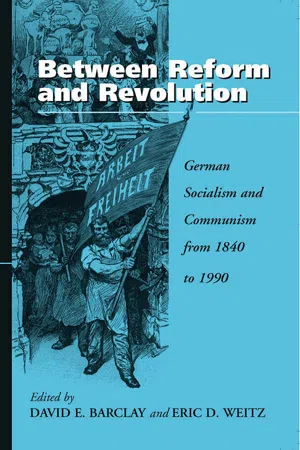
eBook - ePub
Between Reform and Revolution
German Socialism and Communism from 1840 to 1990
- 596 pages
- English
- ePUB (mobile friendly)
- Available on iOS & Android
eBook - ePub
Between Reform and Revolution
German Socialism and Communism from 1840 to 1990
About this book
Trusted by 375,005 students
Access to over 1.5 million titles for a fair monthly price.
Study more efficiently using our study tools.
Information


DIAGNOSING THE “GERMAN MISERY”
Radicalism and the Problem of National
Character, 1830 to 1848
Character, 1830 to 1848
Although liberals, republican-democrats, and the tiny number of Germans who might retrospectively be called “socialist” were not oblivious to their differences in the 1830s, they all acknowledged common membership in the Bewegungspartei, the party of movement. Even by the standards of the loose factional groupings that acted politically in the German states of that time, however, the Bewegungspartei was less a real party than an invisible assembly of conscientious opponents of the reactionary monarchies of Germany. By the early 1840s, Karl Marx was not alone in recognizing that the crude division of German politics into opposing parties of “movement” and “resistance” had become untenable and was no longer adequate to a more complex reality. “Without parties there is no development,” he wrote in 1842, and “without demarcation there is no progress.”1 In that same year, the progressive poets Georg Herwegh and Ferdinand Freiligrath quarreled publicly over the proper relationship between poets and party politics. Prompted by this debate, the prominent editor of the Left Hegelian Hallische Jahrbücher, Arnold Ruge, contended that the interests of the Zeitgeist were served neither by reactionaries who denied parties nor by an undifferentiated party of progress. The real aim of the question posed in the title of Ruge's article “Who Is and Who Is Not a Party?” was to discover the party which could carry the banner of the progressive spirit of the age.2
German radical politics during the 1840s was dominated by this question. No single party emerged as the clear leader of the Left in that decade, but by the time of the revolution in 1848, the relatively undifferentiated Bewegungspartei had split into groups that saw nearly as much to oppose in each other as in the princely regimes. Moreover, not only had the socialist Left recognized its grievance with liberalism, but Marx and Engels had swept away their rivals for the leadership of the far Left in Germany. Knocked out of contention were the republican-democrats, the Young Hegelians, and the “True Socialists,” those utopians who based their socialism on the philosophic humanism of Ludwig Feuerbach. Of course, it was not until the 1880s, after the many bleak years following the failed Revolution of 1848, that Marxism came to dominate socialist politics in Germany; but Marx and Engels's success prior to 1848 may be measured by the conversion of the radical German exiles in Paris, London, Brussels, and Switzerland from Jacobinism and Christian or utopian socialism to “scientific” communism. They changed the name of their “League of the Just” to the “League of Communists” and appointed Marx and Engels to write their party manifesto in 1847.
That famous text declares that the global spread of capitalism has stripped the proletariat of every trace of national character. Though the Communist Manifesto deemed the proletarian conquest of national power a tactical necessity, it reasoned that communist revolution must inevitably be international since the universal force of capitalism may only be overturned by the universal class which is its product. Radical internationalism was the most historically fateful claimant to the banner of progressive politics in the 1840s. However, this essay will show that socialist internationalism was itself channeled in the tracks of a specific German left-wing discourse about the problems of German national character. Consider the following portraits of national character drawn by men who were on the left of the political spectrum in their respective eras. In 1800, Friedrich Schiller wrote that the Germans are “chosen by the world spirit, in the midst of ephemeral struggles, to work on the eternal edifice of humanity.”3 Decades later, Ferdinand Lassalle declared it the mission of the German Volk to lead the way to the universal freedom of all humanity.4 On the other hand, Heinrich Heine observed in the 1830s that “a German's patriotism means that his heart contracts and shrinks like leather in the cold, and a German then hates everything foreign, no longer wants to become a citizen of the world, a European, but only a provincial German.”5 Or, again, Engels described the Germans as the “philistines of world history”; and, in 1890, he claimed that the German “Spießbürgertum…remains stuck even as the movement of history again seizes Germany; [this character] was strong enough to impress upon all German classes a general German type.”6 How should one make sense of the conflict between these representations of Germanness within the German Left? One answer, of course, would be to distinguish between a nationalist and an internationalist Left in nineteenth-century Germany. That was Marx and Engels's strategy when they criticized the Lassallean socialists in the 1860s and 1870s. Yet that poses the alternatives too sharply. These conflicting representations of German national character should be understood, rather, as dynamically interrelated aspects of the self-understanding of the German Left in the nineteenth century.
This essay will show how the tension and interplay between these images of Germanness coalesced into a defining feature of German radicalism after the defeat of revolutionary hopes in the early 1830s. During the 1840s, the ambiguity of the left-wing perception of German character underlay a vital positional strategy in the German Left's internecine struggles for self-clarification and differentiation. In each of the key ideological confrontations in that crucial decade, the relationship between the “universal” and merely “parochial” elements of German character was a crucial point of contention. Through the answers that radicals gave to this question, they claimed for themselves the “universal” content of the German character while accusing their rivals of embodying the parochial qualities of Germanness. Hence, the left-wing discourse about national character became a powerful rhetorical vehicle for the substantive discussion of radical strategies and goals that defined the German Left in the 1840s. Contrary to much of the earlier scholarship on the history and theory of early socialism, then, this essay is less concerned with the pronouncements of left-wing intellectuals on the nationality problem than with the role played by the diagnosis of national character in the process of theoretical development and political identity-formation.
1.
By the early nineteenth century, the image of Germany as the land of poets and philosophers, of spirit and inwardness, had gained a firm hold over the imaginations of both Germans and foreigners. This was the representation of Germanness popularized by Madame de Staël throughout Europe, and it survived long into twentieth-century literature and historiography in the figure of the “unpolitical German.” Chauvinist “anti-revolutionary” nationalists could find solace in this portrait of the German character, since it appeared to promise an obedient citizenry. Surprisingly, progressive Germans also viewed these characteristics as Germany's greatest virtues, not as political liabilities. So, for instance, it was a common assumption of the Prussian Reform Era that these qualities of soulful introspection and reflection had helped Germans to avoid the violence of revolution and civil war, while still allowing them to embark on an ambitious course of reform.
Philosophers divined an even more illustrious meaning in the Germans' special affinity for spirit. At the end of the eighteenth century, rationalist universalism was the common coin of the German Enlightenment. The cosmopolitan humanism of Herder, Kant, Lessing, and other Aufklärer did not utterly vanish with the Romantic reaction against the Enlightenment, but in the first years of the nineteenth century there was a noticeable tendency to identify universalism as a particularly German trait. Schiller was not alone in his belief that Germany was chosen by the World Spirit to fulfill the potential of all humanity. Novalis assigned a special role to Germany in the restoration of universal Christendom because of what he thought was Germany's greater immunity to the corrosive atheism of western Europe. Others seized upon Herder's claims for the purity of the German language to insist on Germany's special status.7 This could quickly slide into chauvinism, as it did in Ernst Moritz Arndt, Joseph Görres, and Friedrich Ludwig Jahn; but for Schiller and even for Fichte in his Addresses to the German Nation, German specialness was expected to serve the general cause of humanity. For many progressive-minded Germans, the idea that Germany had a unique cosmopolitan mission was not incompatible with the goal of a national – even a democratic-national – state. Nonetheless, it is also easy to see this representation of Germanness as a consolation for the absence of a unified German state. Universality of spirit cancelled out political fragmentation and particularity; indeed, the celebrated universality of the Germans depended precisely on the obstacles to forming narrower political identities in Germany.8
It was Hegel's conception of German universality that proved most influential among German progressives in the early nineteenth century. According to Hegel, the German Protestant Reformation had demonstrated the essential freedom of the Christian message by creating a religion of free individualism. Freedom became identical with the “Protestant principle,” the emergence and development of which formed the core and content of Hegel's idea of modern history. Hegel did not tie this Protestant ideal to a narrow national or confessional context, for he traced two paths in the modern history of freedom. One path culminated in the critical rationalism of Kant, the theoretical liberation of the human intellect from all received beliefs; but it was the French Revolution, albeit in an imperfect and problematic way, that made the Protestant principle the standard of the world, the principle on which all true political and social order must be built. Hegel, thus, insisted on a parallel between the German revolution in spirit and the French revolution in politics that was to have a long career among German progressives in the early nineteenth century.9 The parallel was not perfect, however, because both paths finally converged once again in Germany, or, to be more precise, in Hegel himself. That is, the full realization of the Protestant principle was to be found in Hegel's mediation of the inner and exterior, German and French, histories of freedom.
2.
The identification of Germany with universality was never without its critics, who included both ethnic nationalists and monarchists. By the early 1830s, some German radicals had also begun to question the representation of German identity celebrated by progressive Germans since the 1790s. Their disaffection stemmed from growing frustration with the failure of the German states to grant civic freedoms after Napoleon's defeat. This disillusionment deepened in the years after the French Revolution of 1830, when reactionary governments and indifferent publics derailed radical hopes for revolutionary change in Germany. The July Revolution did much to rekindle republican and democratic sentiment in Germany, suppressed since the Carlsbad Decrees of 1819 by rigorous censorship and bans on political organization.10 Like the German Jacobins of the 1790s or the democratic-nationalist Burschenschaftler of the late 1810s, the democrats of the 1830s identified the German Volk as the indivisible sovereign power that transcends the fragmentation and particularism of old-regime Germany.11 They combined nationalist demands for a unified German republic with cosmopolitan respect for human and civil rights and a utopian vision of a future brotherhood of nations. Both themes figured prominently in the speeches delivered to the great crowd gathered at the Hambach Festival in May 1832 and in the writings of young democrats like Jakob Venedey, Georg Büchner, Ludwig Börne, Heine, or the Young Germans.12
If the republicans of the early 1830s embraced the populist-democratic language of Jacobin nationalism, however, circumstances undermined the synthesis of democratic nationalism and cosmopolitanism. In the years of struggle against Napoleon, many of the leading German nationalists had renounced their hopes for a democratic Volk in favor of an ethnic and linguistic-cultural concept of national identity that could neutralize revolutionary impulses and rally rulers and subjects, aristocrats and commoners, to the defense of a shared German identity. The dominance of demagogic, anti-democratic, and virulently anti-French nationalism in Germany by 1830 meant that republicans had to fight not only princes and aristocrats but also nationalists who claimed to speak for the genuine interests and aspirations of the Volk. Under the strain of this two-front war, some of the greatest democratic publicists of the 1830s grew skeptical of the possibility of uniting a benign love of Fatherland with a cosmopolitan, democratic orientation. Compounding this skepticism, the new German democrats had to contend with the cumulative disappointments of two revolutions, 1789 and 1830, that had now come and gone without stirring the German people.
Although republicans continued to address the German Volk, often from foreign exile, their appeals were deeply ambivalent. Like many eighteenth-century critics of despotism, t...
Table of contents
- Cover Page
- Title Page
- Copyright Page
- Contents
- List of Abbreviations
- Introduction
- Chapter 1 - Diagnosing the “German Misery”: Radicalism and the Problem of National Character, 1830 to 1848
- Chapter 2 - Working-Class Politics at the Crossroads of Conservatism, Liberalism, and Socialism
- Chapter 3 - The Lassallean Labor Movement in Germany: Organization, Social Structure, and Associational Life in the 1860s
- Chapter 4 - Bürger and Workers: Liberalism and the Labor Movement in Germany, 1848 to 1914
- Chapter 5 - “Genossen und Genossinnen”: Depictions of Gender, Militancy, and Organizing in the German Socialist Press, 1890-1914
- Chapter 6 - The Social Democratic Electorate in Imperial Germany
- Chapter 7 - Latent Reformism and Socialist Utopia: The Spd in Göttingen, 1890 to 1920
- Chapter 8 - A Social Republic? Social Democrats, Communists, and the Weimar Welfare State, 1919 to 1933
- Chapter 9 - The Iron Front: Weimar Social Democracy between Tradition and Modernity
- Chapter 10 - Communism and the Public Spheres of Weimar Germany
- Chapter 11 - The Rise and Fall of Red Saxony
- Chapter 12 - Cultural Socialism, the Public Sphere, and the Mass Form: Popular Culture and the Democratic Project, 1900 to 1934
- Chapter 13 - The Social Origins of Unity Sentiments in the German Socialist Underground, 1933 to 1936
- Chapter 14 - Communist Resistance between Comintern Directives and Nazi Terror
- Chapter 15 - Rethinking Social Democracy, the State, and Europe: Rudolf Hilferding in Exile, 1933 to 1941
- Chapter 16 - Ordnungsmacht and Mitbestimmung: The Postwar Labor Unions and the Politics of Reconstruction
- Chapter 17 - The Soviets, the German Left, and the Problem of “Sectarianism” in the Eastern Zone, 1945 to 1949
- Chapter 18 - Pronatalism, Nationbuilding, and Socialism: Population Policy in the Sbz/Ddr, 1945 to 1960
- Chapter 19 - German Social Democracy and European Unification, 1945 to 1955
- Chapter 20 - The Politics of Culture and the Culture of Everyday Life in the Ddr in the 1950s
- Chapter 21 - Social Democratic Gender Policies, the Working-Class Milieu, and the Culture of Domesticity in West Germany in the 1950s and 1960s
- Chapter 22 - Is the Spd Still a Labor Party? from “Community of Solidarity” to “Loosely Coupled Anarchy”
- Chapter 23 - Good-bye to all That: The Passing of German Communism and the Rise of a New New Left
- Selective Bibliography
- List of Contributors
- Index
Frequently asked questions
Yes, you can cancel anytime from the Subscription tab in your account settings on the Perlego website. Your subscription will stay active until the end of your current billing period. Learn how to cancel your subscription
No, books cannot be downloaded as external files, such as PDFs, for use outside of Perlego. However, you can download books within the Perlego app for offline reading on mobile or tablet. Learn how to download books offline
We are an online textbook subscription service, where you can get access to an entire online library for less than the price of a single book per month. With over 1.5 million books across 990+ topics, we’ve got you covered! Learn about our mission
Look out for the read-aloud symbol on your next book to see if you can listen to it. The read-aloud tool reads text aloud for you, highlighting the text as it is being read. You can pause it, speed it up and slow it down. Learn more about Read Aloud
Yes! You can use the Perlego app on both iOS and Android devices to read anytime, anywhere — even offline. Perfect for commutes or when you’re on the go.
Please note we cannot support devices running on iOS 13 and Android 7 or earlier. Learn more about using the app
Please note we cannot support devices running on iOS 13 and Android 7 or earlier. Learn more about using the app
Yes, you can access Between Reform and Revolution by David E. Barclay, Eric D. Weitz, David E. Barclay,Eric D. Weitz in PDF and/or ePUB format, as well as other popular books in History & German History. We have over 1.5 million books available in our catalogue for you to explore.