Psychologists have done a great deal of research on the effects of trauma on the individual, revealing the paradox that violent experiences are often secreted away beyond easy accessibility, becoming impossible to verbalize explicitly. However, comparatively little research has been done on the transgenerational effects of trauma and the means by which experiences are transmitted from person to person across time to become intrinsic parts of the social fabric. With eight contributions covering Africa, Central and South America, China, Europe, and the Middle East, this volume sheds new light on the role of memory in constructing popular histories – or historiographies – of violence in the absence of, or in contradistinction to, authoritative written histories. It brings new ethnographic data to light and presents a truly cross-cultural range of case studies that will greatly enhance the discussion of memory and violence across disciplines.
eBook - ePub
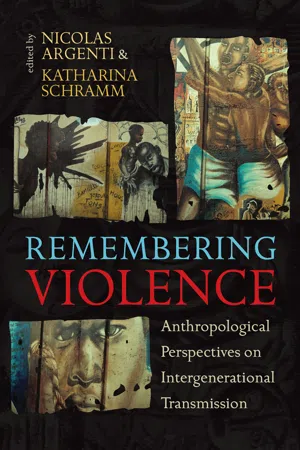
Remembering Violence
Anthropological Perspectives on Intergenerational Transmission
- 280 pages
- English
- ePUB (mobile friendly)
- Available on iOS & Android
eBook - ePub
Remembering Violence
Anthropological Perspectives on Intergenerational Transmission
About this book
Trusted by 375,005 students
Access to over 1.5 million titles for a fair monthly price.
Study more efficiently using our study tools.
Information
Introduction
Remembering Violence:
Anthropological Perspectives on
Intergenerational Transmission
How does violence affect remembering? How are the large–scale cataclysms, crises, disasters and dispersals that befall communities entrusted by one generation of witnesses to the next? If bearing witness to violence cannot be a disinterested act, and if memory – despite its relationship to the past – is always deployed in the present, a question arises regarding the mediation of memory, or the relationship of remembering to forgetting: How is memory partially (and necessarily) constituted by forgetting? What is the exact nature of the Faustian bargain between transmission and obliteration? If memories of large–scale man–made catastrophes are passed on from the original generation of victims and perpetrators to their children, how do inchoate, individual experiences of political violence – devoid as they often are of any logic, structure or narrative sense – coalesce into an accepted body of knowledge that can be coherently uttered and invested in collectively as legitimate and representative: how, in other words, do individual memories contributes to social memory before social memory can once again – now in the shape of postmemories (Hirsch 1997, 1999; Hirsch and Spitzer 2006: 85) – shape individual subjective experience in the dialectic of self and society?
The last few decades have seen a veritable explosion of studies of memory, not only in the humanities and the social sciences but also – and first of all – in public culture and contemporary politics. In popular culture as in academia today, memory sometimes seems to apply to a bewilderingly widening array of phenomena, some of which are apparently only tangentially or metaphorically related to what we commonly understand by memory. Increasing anxiety in academia regarding what constitutes memory (or remembering, remembrance, commemoration, and their ever–present antonyms, forgetting, obliteration and oblivion1) and what qualifies as trauma or as post–traumatic stress highlights the role of memory as a site of struggle outside of academia and clinical practice, in society itself.
Memory is not a simple, unmediated reproduction of the past, but rather a selective re–creation that is dependent for its meaning on the remembering individual or community's contemporary social context, beliefs and aspirations (Huyssen 1995). Indeed, individual memories devoid of such contextualisation and the selective amnesia, telescoping and transformations they entail are considered pathological in their solipsistic detail and isolating particularity. At the collective level, similarly, we could not imagine a social reality in which all of the events of the past and all of the manifold ways in which those events were experienced and interpreted by a multitude of different individuals, factions and interest groups are somehow preserved in the present. By their very nature, the re–creations of the past produced by memory are partial, unstable, often contested, and prone to becoming sites of struggle. As Matt Matsuda puts it, ‘“memory” is not a generic term of analysis, but itself an object appropriated and politicized’ (1996: 6). At the individual and the collective level alike, these can even be ‘false’ memories, but this does not mean that they are not memories for all that, nor does it mean that the very real emotive and political salience with which these memories can be endowed and deployed are somehow void. In this sense, as Stephan Feuchtwang (2006) has recently demonstrated, even ‘false’ memories bear a relation to truths beyond their supposed originary events; a form of meta–truth about the present that is projected back in time.
Anxieties about the reliability of memory give rise to concerns regarding the aims and consequences of focusing on memory.2 These concerns have been played out in part in a strict separation between memory and history (cf. Halbwachs 1992, Nora 1989, 1992), the former considered subjective, ‘living’, continuous and organic, and the latter objective, distanced, transformative and critical. Often, this distinction is accompanied by a dichotomy between non–literate or ‘simple’ (i.e. non–Western) and ‘modern’ or ‘complex’ (i.e. Western) societies (e.g. Nora 1989, 1992). Some writers have refuted this essentialist view, insisting on the areas of overlap between the two fields. Hirsch and Stewart (2005), for instance, very usefully distinguish between history and historicity; the latter term highlighting ‘the manner in which persons operating under the constraints of social ideologies make sense of the past, while anticipating the future’. Where history refers to an assumed empirically verifiable past, historicity ‘concerns the ongoing social production of accounts of pasts and futures.’ (Hirsch and Stewart 2005: 262).
The focus on memory in much emerging research similarly highlights the social construction of the past across cultures. In his attempt to extend the concept of memory beyond Maurice Halbwachs' presentist theory of social framing, Jan Assmann (1992) distinguishes between communicative memory – which is actively produced in social groups through everyday interactions – and what he calls cultural memory, which reaches much deeper into the past and is expressed in myths, genealogies or ‘traditions’ and lies outside the realm of the everyday. To him, the distinction between societies that ‘remember’ and those that ‘have history’, which underlies Pierre Nora's (1989, 1992) conception of lieux de mémoire, is a false dichotomy that elides the historical consciousness of non–literate societies. Writing on the dynamics of memory, history and forgetting in Madagascar, Jennifer Cole (2001) also blurs the clear–cut boundaries between memory and history, showing how historical consciousness might influence memorial practice and vice versa. Joining the sceptics in questioning the new ubiquity of memory, Michael Lambek (2006: 210–11) warns us that the very project of trying to locate a field of enquiry that escapes the hegemony and the monolithic essentialisations of history might paradoxically result in new discourses of authority that are themselves reifications of the oppressed and marginalised to whom the researcher seeks to give a voice:
The risk is that we assume that somewhere there exists pure and unsullied memory, memory which accurately reproduces the experience of its subjects and that is their unique possession, that holds and moulds their essence, that is itself an essence. In making ‘memory’ the object of study, we run the risk of naturalising the very phenomenon whose heightened presence or salience is in need of investigation (2006: 211).
Clearly, memory cannot be assumed to represent an objective past that has been excluded by historical practice and historiography. This would be to reproduce the essentialisation of some historical writing in contradistinction to which memory is looked to as an escape. Nevertheless, it may still be the case that memory – in all of its heterogeneity, its instability and its liability to contestation – represents ‘the history that cannot be written’ (Lambek 2006: 211; see also Gold and Gujar 2002). It is precisely because memory cannot be trusted as history that it needs to be explored, not as a record of the past, but of the present of those whose interests, views, experiences and life–worlds are somehow inimical to or have fallen outside of the historical project.
The contributions to this book restrict themselves to the specific question of how political violence is remembered, how memories of this violence are transmitted, and the uses to which the memories are put. So far, despite the all–pervading memory–boom, few collections have been explicitly concerned with an anthropological exploration of this subject. One of the early efforts in the field has been Richard Werbner's (1998) seminal edited volume on Memory and the Postcolony, the scope of which is limited to African(ist) perspectives on the violent configurations of the postcolonial state. Another, more recent volume, edited by Baruch Stier and J. Shawn Landres (2006), is concerned with the connection between religion, violence, memory and place, whereby the focus lies on mutual implications between the sacralisation of violence and the violence of religion, and not so much on the specifics of the relationship between violence and memory. Silverstein and Makdisi (2005) make the connection between violence and memory explicit; yet again their analyses are restricted to one contemporary situation, namely that in the Middle East and North Africa, where violence is a major factor of present–day politics. This volume, which is global in its scope, aims to contribute to the nascent anthropology of memory by focusing in particular on the issue of the intergenerational transmission of memories of violence.3
In an age in which discussing the subjective experience of political violence is impossible without reference to trauma and to post–traumatic stress disorder (PTSD), this volume raises questions as to whether the trauma paradigm is to be understood as an empirical description of a universal human psychic response to violence, as a Western culture–bound syndrome, as a folk model of suffering, as a social movement, or as a global discourse as manifold in its interpretations as it is pervasive in its reach. Is trauma an analytical model, or the latest social movement to which students of memory should devote their analytical attention? Can one move from an analytical model of individual, psychic trauma to one of collective or social trauma as one can between individual and collective memory?4 Can trauma (in its association with disruptiveness, inescapability and repetitiveness) and memory (in its connotations with identity, continuity and selectivity) be analytically joined to address the impact of past violence on the present? And if so, can the collective trauma of a generation of victims be passed to their offspring in the next generation, and how might this transference exactly take place?
To Ron Eyerman (2001) it is precisely the phenomenon of intergenerational transmission that produces what he calls ‘cultural trauma’. In his discussion of African American collective identity he distinguishes cultural from psychological or physical trauma as follows:
Cultural trauma refers to a dramatic loss of identity and meaning, a tear in the social fabric, affecting a group of people that has achieved some degree of cohesion. In this sense, the trauma need not necessarily be felt by everyone in a community or experienced directly by any or all. While it may be necessary to establish some event as the significant ‘cause’, its traumatic meaning must be established and accepted, a process which requires time, as well as mediation and representation (2001: 2).
In this model, present–day discrimination re–produces the trauma of racism, while slavery is nothing more nor less than the historical reference through which the ongoing contemporary experience is framed.
Thought–provoking and enlightening as humanist interpretations of the trauma paradigm such as these are, they are culturally and historically specific. Although the contributors to this volume, all of them anthropologists, are cognisant with and, to a greater or lesser degree, informed by recent theories of trauma, they have not started off with a clear–cut definition of what constitutes ‘trauma’ or the ‘memory of violence’, but rather inductively explored those questions on the basis of concrete ethnographic case studies.
From History to Memory and Back Again
Despite the controversy surrounding the term, the origins of the notion of collective memory in the social sciences can still be traced back to the work of Maurice Halbwachs (1992) and ultimately to his mentor Durkheim's notion of collective consciousness. Halbwachs' method is not to look to individual memories as the building blocks of collective memory, but simply to point out that individual memories cannot exist on their own, as dreams do, but are the result of regular intercourse with others. It therefore follows that what psychologists often take to be the most intimate realm of human thought and experience is in fact a result of collective social interaction. Individual memories are necessarily shared memories, and memories that are not shared are rapidly forgotten; they are therefore not memories at all (1992: 53).
Not only did Halbwachs make the case for collective memory, but he also broadened the range of phenomena that were to be considered as memories. In his case study concerning the Catholic rite of communion, for example, he argues convincingly that a contemporary practice that is engaged in and understood as such in fact re–enacts the death and resurrection of Christ that is believed to have happened in the past (1992: 90–119).5 Unlike historical recording, this form of remembering or commemoration is embodied, and as such it collapses the distance and the linearity that history introduces to time; juxtaposing the past and the present and returning a body of believers to the originary events of their faith from which the passage of time would divorce them. Nor does such commemoration necessarily entail a conservative outlook or a reactionary stance. Halbwachs makes the argument that memory serves the purpose of facilitating change in society – even revolution – by masking that change in the guise of continuity. Hence, old rites and religious customs often serve to give a sense of continuity and legitimacy to new political systems. Halbwachs observes that the patrician titles, ranks and manners of the feudal nobility in France were preserved even as the entire feudal system was being radically supplanted by a bureaucratic one. ‘In this way’, he tells us, ‘the new structure was elaborated in the shadow of the old…The new ideas became salient only after having for a long time behaved as if they were the old ones. It is upon a foundation of remembrances that contemporary institutions were constructed’ (1992: 125).
Halbwachs goes on to argue that in time, the memories that had been held by or attributed to the nobility were passed on to the bourgeoisie, and to society as a whole, which became the new repository of memory in a meritocratic, republican France. Halbwachs thus demonstrates that social practices or beliefs are also memories, and that it is because the contemporary or synchronic can also be seen from a diachronic point of view that it can be bathed in the hallowed aura of sanctity associated with the timeless and traditional. To the contention that rites and embodied practices are not memories because they serve only contemporary purposes and interests, Halbwachs responds that the apparent timelessness of ritual in fact conceals a chronology that makes the past essential to the negotiation of the present.6
Halbwachs' pioneering work on collective memory led to what we might term a democratisation of history and of memory (Bahloul 1996; Radstone and Hodgkin 2006: 2; Samuel 1994), in which some historians (especially those of the annales school) used Halbwachs' insights to suggest that not only the elite, but also ordinary people, the illiterate and the oppressed might be able to construct histories for themselves, and to act as the guardians and repositories of accepted forms of knowledge about the past. Accepting the voices of informants as valid sources, alongside ‘objective’ textual sources, signalled an ethnographic turn in history that was later paralleled by a historical turn in anthropology – a new preoccupation with memory which once again was concerned with establishing an alternative to histories seen to be too closely associated with patriarchal discourses of the state and practices of state formation.7
In anthropology and history alike then, an emphasis on memory and on oral history can be seen as an attempt to privilege voices that have been marginalised or silenced by projects of state–formation and empire building. Such a position can also implicitly be seen to privilege the subjective experience of individuals and communities over the ‘objective’ social and historical processes that elide individuals and their fallible and partial knowledge, experiences and beliefs. Additionally, the notion of counter–memories (Foucault 1977; Zemon–Davis and Stern 1989; cf. Baker 1994) points towards the continuous struggle between dominant and marginal voices in the production of history/memory. Where critics of the annales school would object that the latter's histories are based on anecdotes and hearsay and consequently lack analytical rigour and historical authority, advocates of the turn to memory would reply that orthodox historical approaches are needlessly positivistic in their insistence on ‘evidence’ and that their search for ‘facts’ as a means of shedding light on ‘what really happened’ is pursued at the cost of eliding the experience of ordinary people, which is ultimately the only historical fact that there is (see Wilson 2002).
As Jan Vansina (1985) has argued for Sub–Saharan Africa, one of the consequences of this turn to memory has been what one might term the de–textualisation of history and the replacement of often rather slender archives with more loquacious informants. As recognition has spread among historians that th...
Table of contents
- Cover Page
- Title Page
- Copyright Page
- Contents
- List of Illustrations
- List of Tables
- Acknowledgements
- 1: Introduction: Remembering Violence: Anthropological Perspectives on Intergenerational Transmission
- Bodies of Memory
- Performance
- Landscapes, Memoryscapes and the Materiality of Objects
- Generations: Chasms and Bridges
- Notes on Contributors
- Index
Frequently asked questions
Yes, you can cancel anytime from the Subscription tab in your account settings on the Perlego website. Your subscription will stay active until the end of your current billing period. Learn how to cancel your subscription
No, books cannot be downloaded as external files, such as PDFs, for use outside of Perlego. However, you can download books within the Perlego app for offline reading on mobile or tablet. Learn how to download books offline
Perlego offers two plans: Essential and Complete
- Essential is ideal for learners and professionals who enjoy exploring a wide range of subjects. Access the Essential Library with 800,000+ trusted titles and best-sellers across business, personal growth, and the humanities. Includes unlimited reading time and Standard Read Aloud voice.
- Complete: Perfect for advanced learners and researchers needing full, unrestricted access. Unlock 1.5M+ books across hundreds of subjects, including academic and specialized titles. The Complete Plan also includes advanced features like Premium Read Aloud and Research Assistant.
We are an online textbook subscription service, where you can get access to an entire online library for less than the price of a single book per month. With over 1.5 million books across 990+ topics, we’ve got you covered! Learn about our mission
Look out for the read-aloud symbol on your next book to see if you can listen to it. The read-aloud tool reads text aloud for you, highlighting the text as it is being read. You can pause it, speed it up and slow it down. Learn more about Read Aloud
Yes! You can use the Perlego app on both iOS and Android devices to read anytime, anywhere — even offline. Perfect for commutes or when you’re on the go.
Please note we cannot support devices running on iOS 13 and Android 7 or earlier. Learn more about using the app
Please note we cannot support devices running on iOS 13 and Android 7 or earlier. Learn more about using the app
Yes, you can access Remembering Violence by Nicolas Argenti, Katharina Schramm, Nicolas Argenti,Katharina Schramm in PDF and/or ePUB format, as well as other popular books in Social Sciences & Social History. We have over 1.5 million books available in our catalogue for you to explore.