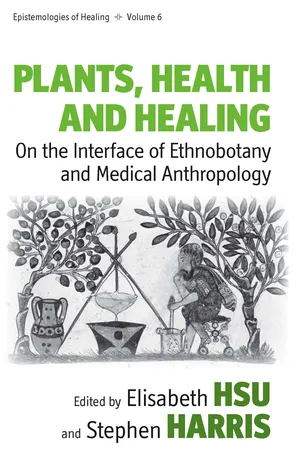
Plants have cultural histories, as their applications change over time and with place. Some plant species have affected human cultures in profound ways, such as the stimulants tea and coffee from the Old World, or coca and quinine from South America. Even though medicinal plants have always attracted considerable attention, there is surprisingly little research on the interface of ethnobotany and medical anthropology. This volume, which brings together (ethno-)botanists, medical anthropologists and a clinician, makes an important contribution towards filling this gap. It emphasises that plant knowledge arises situationally as an intrinsic part of social relationships, that herbs need to be enticed if not seduced by the healers who work with them, that herbal remedies are cultural artefacts, and that bioprospecting and medicinal plant discovery can be viewed as the epitome of a long history of borrowing, stealing and exchanging plants.
Despite the central role of plants in our health and happiness, we largely overlook them. Landscapes apparently devoid of humans or other mammals, although teeming with plant life, are regularly dismissed as barren. Yet plants often have long histories of associations with man. Beyond the role of plants as fuel, shelter and food, humans discovered how to harness plant chemistry as medicine. Ethnobotany, the study of the interactions between humans and plants, is integral to human natural history.
The value of different medicinal plants to different cultures must have been discovered on numerous occasions and that knowledge passed from generation to generation. Furthermore, as humans investigated their environments and moved plants around, such information may have been transported with the plants, not revealed, left behind, forgotten, ignored or new information discovered. As medicinal plants were moved between different contexts, the cultural and social frameworks in which they were used may have varied, leading to differing indigenous and non-indigenous responses to these plants. Medicinal plants, and the indigenous knowledge about them, are cultural and biological assets. However, today, such knowledge is widely known to have an explicit commercial value within a framework created by the tension between scientific and anthropological approaches to ethnobotany.
The importance of medicinal plants means they may be moved as humans migrate. Furthermore, humans may learn to use non-native plants. The relationships between humans and non-native plants are complex, often confounded by social, political, as well as medicinal needs. Concerns over the use of non-native plants are associated with the separation of use and knowledge and the influence on drug efficacy. These concerns may be played out in entire countries or empires, or in individual communities or families.
In his article ‘Non-Native Plants and Their Medicinal Uses’, Stephen Harris brings a botanical point of view to the issue of plants as human medicines and takes a broadly-based historical perspective to consider the means by which plants have been moved accidentally and deliberately by humans. A case study of the famous antimalarial quinine, isolated from the bark of the Andean tree Cinchona, illustrates how important medicinal plants can be as they are moved by humans from the wild in their region of origin to areas of cultivation where they might be more easily protected, controlled and exploited. However, this case study emphasizes that users of a plant may be separated from the people that have traditional knowledge of it and hence may misunderstand the plant. Correct identification, and understanding of the variation within a medicinal plant species, is crucial to understanding its basic biology and how to use it most effectively.
Historical knowledge about plants, particularly in Western cultures, has usually been investigated through the examination of manuscript and printed sources. However, such investigations rarely involve detailed, comparative, scholarly analyses of the sources. Irrespective of the difficulties of correlating names in such documents with modern plant names, the process is potentially flawed since it is biased; it largely ignores traditional knowledge. The knowledge contained in such sources is that of the literate, yet much traditional knowledge is likely to have been held by peoples with an oral tradition. This ‘unrecorded’ knowledge about medicinal plants is easily lost or only recorded piecemeal and out of context, leading to value knowledge being dismissed as ‘old wives' tales’ or ignored.
The article on ‘Qing hao
(Herba Artemisiae annuae) in the Chinese Materia Medica', which Elisabeth Hsu wrote after several consultations with one of the few specialists of Chinese pharmacotherapy, Frédéric Obringer, and with the assistance of several Chinese scholars who cracked some difficult translation problems, discusses transformations of cultural practices involving similar plant materials. She highlights the fact that the Chinese herbal drug qing hao, which today has been proven to contain the highly effective anti-malarial artemisinin, was not initially considered for acute fever episodes. She demonstrates that early texts recommended it for the treatment of festering wounds caused by weapons or parasites (presumably as an antiseptic) or as a food additive, that it was not merely hailed for its fragrance, but also for its appetite-enhancing and vitality-engendering qualities. However, thousand years after its earliest known records, qing hao gained prominence within the genre of the materia medica as a remedy against intermittent fevers. Hsu explains these different recommendations in the light of how the plant was prepared. She argues against the concept of ‘natural herbs’ and emphasizes that herbal remedies are cultural artefacts which humans developed in close interaction with other humans and the plant materials. Although Hsu emphasizes that plants are prepared and consumed in culturally specific practices, she concludes her article, just like Harris, by stressing the importance of plant taxonomy and the insights it provides about the plant's qualities which must remain of foremost interest also to the social and cultural anthropologist.
1. Non-Native Plants and Their Medicinal Uses
Stephen Harris
Humans rely on plants for food, medicine, shelter, energy and beauty. Bread wheat is the product of ten thousand years of domestication. The Egyptian Ebers Papyrus (c. 1550 BCE) refers to knowledge of medicinal plants that dates back to at least 3000 BCE. Substances extracted from hallucinogenic plants have enabled man to encounter his gods. Wood and coal have been humans' primary sources of shelter and energy. The beauty of plants has inspired the transformation of landscapes. The scientific investigation of plants and their conservation has been justified, and is still justified, by the explicitly anthropocentric object...
Table of contents
Cover Page
Title Page
Copyright Page
Dedication Page
Contents
List of Illustrations
List of Tables
Introduction. Plants in Medical Practice and Common Sense: On the Interface of Ethnobotany and Medical Anthropology
History; Editorial Introduction
Anthropology: Editorial Introduction
Plant Portraits: Editorial Introduction
Notes on Contributors
Index
Trusted by 375,005 students
Access to over 1.5 million titles for a fair monthly price.
Study more efficiently using our study tools.
Frequently asked questions
Yes, you can cancel anytime from the Subscription tab in your account settings on the Perlego website. Your subscription will stay active until the end of your current billing period. Learn how to cancel your subscription
No, books cannot be downloaded as external files, such as PDFs, for use outside of Perlego. However, you can download books within the Perlego app for offline reading on mobile or tablet. Learn how to download books offline
Perlego offers two plans: Essential and Complete
Essential is ideal for learners and professionals who enjoy exploring a wide range of subjects. Access the Essential Library with 800,000+ trusted titles and best-sellers across business, personal growth, and the humanities. Includes unlimited reading time and Standard Read Aloud voice.
Complete: Perfect for advanced learners and researchers needing full, unrestricted access. Unlock 1.5M+ books across hundreds of subjects, including academic and specialized titles. The Complete Plan also includes advanced features like Premium Read Aloud and Research Assistant.
Both plans are available with monthly, semester, or annual billing cycles.
We are an online textbook subscription service, where you can get access to an entire online library for less than the price of a single book per month. With over 1.5 million books across 990+ topics, we’ve got you covered! Learn about our mission
Look out for the read-aloud symbol on your next book to see if you can listen to it. The read-aloud tool reads text aloud for you, highlighting the text as it is being read. You can pause it, speed it up and slow it down. Learn more about Read Aloud
Yes! You can use the Perlego app on both iOS and Android devices to read anytime, anywhere — even offline. Perfect for commutes or when you’re on the go. Please note we cannot support devices running on iOS 13 and Android 7 or earlier. Learn more about using the app
Yes, you can access Plants, Health and Healing by Elisabeth Hsu, Stephen Harris, Elisabeth Hsu,Stephen Harris in PDF and/or ePUB format, as well as other popular books in Scienze sociali & Botanica. We have over 1.5 million books available in our catalogue for you to explore.