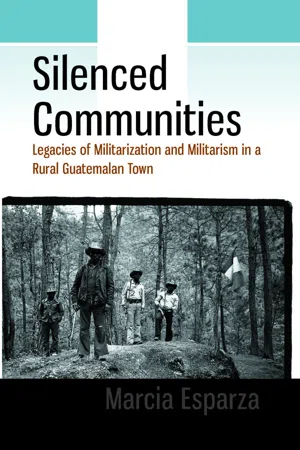
Although the Guatemalan Civil War ended more than two decades ago, its bloody legacy continues to resonate even today. In Silenced Communities, author Marcia Esparza offers an ethnographic account of the failed demilitarization of the rural militia in the town of Santo Tomás Chichicastenango following the conflict. Combining insights from postcolonialism, subaltern studies, and theories of internal colonialism, Esparza explores the remarkable resilience of ideologies and practices engendered in the context of the Cold War, demonstrating how the lingering effects of grassroots militarization affect indigenous communities that continue to struggle with inequality and marginalization.
eBook - PDF
Silenced Communities
Legacies of Militarization and Militarism in a Rural Guatemalan Town
- 294 pages
- English
- PDF
- Available on iOS & Android
eBook - PDF
Silenced Communities
Legacies of Militarization and Militarism in a Rural Guatemalan Town
About this book
Trusted by 375,005 students
Access to over 1.5 million titles for a fair monthly price.
Study more efficiently using our study tools.
Information
Table of contents
- Silenced Communities
- Contents
- Illustrations
- Acknowledgements
- Introduction — "My Soul Is a Military Soul"
- Chapter 1 — The Methodological Crisis Revisited
- Chapter 2 — A Postcolonial Reenactment: The Cold War Civil Self-Defense Patrol System
- Chapter 3 — A Chameleonlike Army: Civic Action, a Postcolonial Strategy
- Chapter 4 — The Beheading of a Popular Maya Uprising in a "Red Community"
- Chapter 5 — Early Disbanding, Postgenocide Resistance, and Na'tab'al (Memory)
- Chapter 6 — "Inverted Discourse": Collaboration in "White Communities"
- Chapter 7 — Nationalistic Mythology Revival: Failure to Dismantle the Internal Enemy Myth
- Chapter 8 — A "Silence That Hurts": Garrison Communities
- Chapter 9 — Militaristic Legacies: Lynching and La Cadena
- Chapter 10 — A Forseen Aftermath: Decree 3-2014
- Appendix
- Bibliography
- Index
Frequently asked questions
Yes, you can cancel anytime from the Subscription tab in your account settings on the Perlego website. Your subscription will stay active until the end of your current billing period. Learn how to cancel your subscription
No, books cannot be downloaded as external files, such as PDFs, for use outside of Perlego. However, you can download books within the Perlego app for offline reading on mobile or tablet. Learn how to download books offline
Perlego offers two plans: Essential and Complete
- Essential is ideal for learners and professionals who enjoy exploring a wide range of subjects. Access the Essential Library with 800,000+ trusted titles and best-sellers across business, personal growth, and the humanities. Includes unlimited reading time and Standard Read Aloud voice.
- Complete: Perfect for advanced learners and researchers needing full, unrestricted access. Unlock 1.5M+ books across hundreds of subjects, including academic and specialized titles. The Complete Plan also includes advanced features like Premium Read Aloud and Research Assistant.
We are an online textbook subscription service, where you can get access to an entire online library for less than the price of a single book per month. With over 1.5 million books across 990+ topics, we’ve got you covered! Learn about our mission
Look out for the read-aloud symbol on your next book to see if you can listen to it. The read-aloud tool reads text aloud for you, highlighting the text as it is being read. You can pause it, speed it up and slow it down. Learn more about Read Aloud
Yes! You can use the Perlego app on both iOS and Android devices to read anytime, anywhere — even offline. Perfect for commutes or when you’re on the go.
Please note we cannot support devices running on iOS 13 and Android 7 or earlier. Learn more about using the app
Please note we cannot support devices running on iOS 13 and Android 7 or earlier. Learn more about using the app
Yes, you can access Silenced Communities by Marcia Esparza in PDF and/or ePUB format, as well as other popular books in Politics & International Relations & Genocide & War Crimes. We have over 1.5 million books available in our catalogue for you to explore.