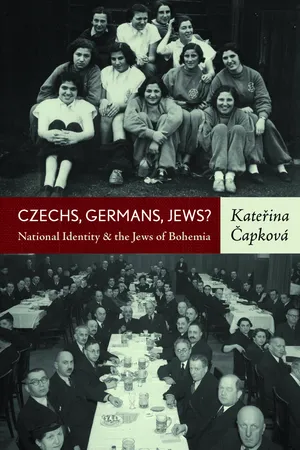
The phenomenon of national identities, always a key issue in the modern history of Bohemian Jewry, was particularly complex because of the marginal differences that existed between the available choices. Considerable overlap was evident in the programs of the various national movements and it was possible to change one's national identity or even to opt for more than one such identity without necessarily experiencing any far-reaching consequences in everyday life. Based on many hitherto unknown archival sources from the Czech Republic, Israel and Austria, the author's research reveals the inner dynamic of each of the national movements and maps out the three most important constructions of national identity within Bohemian Jewry – the German-Jewish, the Czech-Jewish and the Zionist. This book provides a needed framework for understanding the rich history of German- and Czech-Jewish politics and culture in Bohemia and is a notable contribution to the historiography of Bohemian, Czechoslovak and central European Jewry.
- 298 pages
- English
- ePUB (mobile friendly)
- Available on iOS & Android
eBook - ePub
About this book
Trusted by 375,005 students
Access to over 1.5 million titles for a fair monthly price.
Study more efficiently using our study tools.
Information
Chapter 1
THE BASIC FEATURES OF THE JEWISH COMMUNITY IN PRAGUE AND IN BOHEMIA

Until the middle of the nineteenth century, the Prague Jewish community was one of the numerously most important communities in central Europe. Before the First Partition of Poland in 1772, Prague had the largest Jewish community in Cisleithania, the Austrian part of the Habsburg Monarchy. There were more Jews in Prague than in Berlin even in the 1830s.1 At the end of the nineteenth century, however, Prague was, in comparison with Berlin, Vienna, Budapest and Warsaw, only a provincial city and its Jewish community was insignificant in size. Even more striking are the figures from the interwar period, when the number of Jews in these metropolises grew into hundreds of thousands and Prague, with its 35,000 Jewish inhabitants, lagged behind.2
This paradox stems from two features particular to Jewish settlement in Prague and Bohemia in general. First, Prague, unlike most central and western European cities, had continuous Jewish settlement with only two short interruptions, one in the middle of the sixteenth century, the other in the middle of the eighteenth. The demographic growth of the Jewish population had been limited by the legislation known as the Familianten Gesetz since the early eighteenth century.3 Despite all this, the situation in Prague was far better than in Berlin, Vienna and other European cities where the settlement of Jews was either forbidden or highly restricted for many years (in Vienna, for example, until the middle of the nineteenth century).
Second, the paradoxical development of the Jewish population of Prague in the nineteenth century was the result of Prague’s not having been a destination for Jews fleeing from territories that had belonged to Poland before 1772. This phenomenon, which had far-reaching consequences for Jewish settlement in Bohemia, had several causes. One was that Prague was outside the migration routes both to Vienna and to the ports of Germany, Holland and Belgium. Another was that in the last third of the nineteenth century Prague City Hall was in Czech hands and so Yiddish-speaking Jews may well have feared the language barrier and also, very likely, the antisemitism of a Slav nation. Also, as William O. McCagg has noted, Jews from Russia and Galicia avoided Prague because, unlike Budapest, Vienna and Pressburg, Prague lacked an important Orthodox Jewish community with a sufficient infrastructure.4
Before World War I, the Jews of Bohemia therefore had only limited experience of eastern European Jewish immigration. In 1911, for example, a theatre company from L’viv (Lemberg or Lwów) in Galicia arrived in Prague. Whereas the company had met with success in Berlin and other German and Austrian towns, their performances in Prague were a failure. One important reason was probably that in the western capitals, unlike in Prague, their performances were attended mainly by eastern European Jewish immigrants, whose mother tongue was Yiddish. Another reason was that the theatre company and the Prague audiences each had completely different conceptions of Jewishness. The Galician actors’ ardour for Judaism and their knowledge of Jewish traditions and religious texts, as well as their uncouth behaviour, shocked the Prague audiences. Even for Zionists from the Bar Kochba student association the performances were a disappointment. And yet it was these young Zionists who had latched on to Martin Buber’s ideas about eastern Jewry bringing salvation to the western Jews and being a great source of inspiration to them. After watching a play by Abraham Goldfaden (1840–1908), the first important Yiddish playwright, even these young Zionists could not help feeling that the actors were part of the uneducated rabble with whom they, as intellectuals, had nothing in common. For Franz Kafka (1883–1924), who almost never missed a performance, the encounter with Yiddish-speaking actors provided, on the other hand, the impulse to search for his own Jewish identity.5
A large number of refugees did not reach Prague and other Bohemian towns until 1914–1916, when the Austrian-Russian front had temporarily come to a halt in Galicia. Most of them, however, left Bohemia even before the end of the war. The Galician refugees who remained were ordered out of the country by the government of the new state of Czechoslovakia in 1918–1919. According to the estimates of the Ministry of the Interior from December 1919, 1,428 Jewish war refugees lived in Bohemia (515 in Prague) and the Ministry planned to reduce their number with continuous ‘repatriation’ in the following months.6 The Prague Jewish community thus, paradoxically, became ‘more western’7 than the Jewish communities of Berlin, London, Paris and Vienna, where eastern European refugees became an integral part of local Jewish society.
In Bohemia, where Jews mostly had a lukewarm attitude to religion, the situation was not changed even by the many traditional Jews who had come to Prague from Subcarpathian Ruthenia between the two world wars.8 They may have been among those who most conscientiously attended the Alt-Neu Synagogue,9 but they did not substantially influence the nature of the Prague Jewish Community, tending to adapt themselves to the way of life of the society around them.
Returning to the period before World War I, we see that Prague and Bohemia as a whole did not experience a growth in Jewish population as a result of ‘eastern Jewish’ immigration. As Jana Vobecká has recently shown, even the natural growth of the Bohemian Jewish population between 1857 and 1900 was declining and she estimates the number to be 28,000 people.10 It is generally assumed that the most frequent destination of Bohemian Jews was Vienna,11 and that they also left for Germany and the United States.
And yet, even though almost no Jews immigrated to Bohemia, and in fact the Bohemian Jewish population was on the decline, the Jewish community in Prague doubled in size in the second half of the nineteenth century as a result of internal migration. The statistics of 1900 reveal a surprising phenomenon: 91 per cent of the Jews who settled in Prague were born in Bohemia (25 per cent in Prague and 66 per cent in predominantly Czech areas of Bohemia).12 By contrast, only 3 per cent of the Jews of Moravia and Silesia felt drawn to Prague; most Moravian Jews preferred Vienna.13
But not only Prague became a magnet for members of the numerous small Jewish communities in central Bohemian villages and towns. Immediately after the restrictions on mobility and settlement had been lifted in 1849, new Jewish communities were established in border regions in north and west Bohemia, where the population was predominantly German-speaking. Jews, like many Czechs at that time, moved to places known for rapid development of industry, especially Liberec (Reichenberg), Děčín (Tetschen), Most (Brüx) and Teplice (Teplitz) and also spa towns like Mariánské Lázně (Marienbad) and Carlsbad. The number of Jews who decided to leave for these new communities was similar to the influx of Jews into Prague.
Jewish immigrants came to Prague at the peak of the period of national conflict between Czechs and Germans, which culminated in the unrest of 1897, sparked by the Badeni language ordinances.14 Most Jewish immigrants to Prague came from predominantly Czech-speaking parts of Bohemia. After moving to Prague, however, they were confronted with an overwhelmingly German-speaking Jewish community. Because of the key social position of the German-speaking Jews in Prague, many newcomers tried to be part of this higher-ranking society and so sent their children to German schools. This was true, for example, of the families of Kafka, Bergmann, Kohn and Weltsch. Despite the thousands of newcomers from predominantly Czech regions, the German-speaking Jewish élite held all the important social positions in Prague until the foundation of the Czechoslovak Republic after the war. Soon afterwards, however, this situation changed.
Urbanization played an important role in the secularization of the Jews of Bohemia. Nineteenth and twentieth-century urbanization there led to a striking difference between Jews living in villages and Jews living in cities. Jews in the country, whether in a German or Czech milieu, had a highly traditional way of life.15 The difference between the traditional countryside and the secularized urban milieus is evident also in numerous memoirs and belles-lettres. The best known examples are probably the works of fiction by Vojtěch Rakous (born Adalbert Österreicher, 1862–1935), a leading proponent of Czech-Jewish assimilation. His stories about two characters, Modche and Rezi, provide unique, though surely idealized, testimony to the symbiosis of Christians and Jews in the Bohemian countryside. His writing also provides evidence that the rural Jews maintained Jewish traditions. Similarly, some Zionists remark in their memoirs that they owed their Jewish consciousness to their childhood in rural Bohemia. The philosopher and leading Zionist activist Samuel Hugo Bergmann (1883–1975), for example, wrote in his 1958 birthday greetings to Karel Pacovský, a member of the Theodor Herzl Society, who came from the village of Zálužany, south Bohemia:
I’d have to write a whole essay if I wanted to explain here to the young generation what these small Czech villages meant to Jewishness. In Israel we now talk a lot about ‘Jewish self-confidence’ and how such self-confidence should be grafted on here to the young generation. We don’t really know how to do that. There, in a small village, Jewish self-confidence wasn’t a problem. In each village there was usually only one Jewish family, at most two or three. And what a Jewish life it was, even though it was far removed from Orthodoxy!16
Even though we lack serious research on the rural Jews of Bohemia, these and other testimonies suggest that the situation here hardly differed from that of rural Jews in Germany. Though the number of Jews in villages shrunk from the second half of the nineteenth century onwards, those Jews who remained did not share the same problems with their coreligionists in the big cities. As Steven Lowenstein argues for Germany, ‘[m]uch of the picture we have of German Jewry overall – its cultural contributions, identity problems, far-reaching assimilation – was not true of rural Jewry.’17 Like rural Jews in Germany (mainly in the south of the country), Bohemian rural Jews were often well rooted locally, proud of having lived in the same place for generations. Jews became an integral part of the social and economic infrastructure of villages and small towns. And because they had co-existed with their Christian neighbours for generations, they took their own Jewishness for granted.
The decline of small rural communities was, however, rapid. In 1872, for example, there were 327 Jewish communities in the Bohemian Lands, but by 1890 there were only 247.18 According to the 1921 census, 69 per cent of all people of the Jewish faith lived in towns with populations of more than 10,000.19 Urbanization continued in the First Republic as well. Whereas in 1921 there were 205 Jewish communities in Bohemia and Moravia, their number declined to 170 over the next ten years.20
It is truly startling that although Prague was an important European centre of Jewish religious learning until the end of the eighteenth century, the local Jewish community was one of the most secularized in Europe by the beginning of the twentieth century. Most Jews were ‘three-day’ Jews, attending synagogue only on the High Holidays. Before World War I they were called ‘four-day’ Jews, because they went to synagogue also to celebrate the birthday of Emperor Francis Joseph.21
One of the best-known, eloquent accounts of the lukewarm attitude of the Jews of Bohemia to the Jewish religion is Kafka’s Brief an den Vater (1919). In this ‘letter’ Kafka reproaches his father for having been unable, or simply unwilling, to communicate anything of what it meant to be a Jew. He then enumerates his experiences connected with the synagogue, which are all negative.22 And the journalist and script-writer Willy Haas (1891–1973), for instance, writes:
Nothing remained in us of the faith of our forebears . . . . We were neither Jews nor Christians, and yet we were believers. Our faith was of a dual character: first we believed in Original Sin, about which we knew more than many Christians; second, we believed in the veiled nature and absolute unattainability of God, who manifested Himself only in the brutality, corruption and malicious glee of some petty officials, a God, who shaped our fate much in t...
Table of contents
- Cover Page
- Title Page
- Copyright Page
- Dedication
- Contents
- List of Illustrations
- Acknowledgements
- A Note on Personal and Place Names
- Abbreviations
- Map of Czechoslovakia and the Bohemian Lands
- Introduction
- Chapter 1. The Basic Features of the Jewish Community in Prague and in Bohemia
- Chapter 2. Jews as a National Minority in the New Republic
- Chapter 3. German Jews
- Chapter 4. Czech-Jews
- Chapter 5. Zionists
- Conclusion
- Bibliography
- Index
- Footnotes
Frequently asked questions
Yes, you can cancel anytime from the Subscription tab in your account settings on the Perlego website. Your subscription will stay active until the end of your current billing period. Learn how to cancel your subscription
No, books cannot be downloaded as external files, such as PDFs, for use outside of Perlego. However, you can download books within the Perlego app for offline reading on mobile or tablet. Learn how to download books offline
Perlego offers two plans: Essential and Complete
- Essential is ideal for learners and professionals who enjoy exploring a wide range of subjects. Access the Essential Library with 800,000+ trusted titles and best-sellers across business, personal growth, and the humanities. Includes unlimited reading time and Standard Read Aloud voice.
- Complete: Perfect for advanced learners and researchers needing full, unrestricted access. Unlock 1.5M+ books across hundreds of subjects, including academic and specialized titles. The Complete Plan also includes advanced features like Premium Read Aloud and Research Assistant.
We are an online textbook subscription service, where you can get access to an entire online library for less than the price of a single book per month. With over 1.5 million books across 990+ topics, we’ve got you covered! Learn about our mission
Look out for the read-aloud symbol on your next book to see if you can listen to it. The read-aloud tool reads text aloud for you, highlighting the text as it is being read. You can pause it, speed it up and slow it down. Learn more about Read Aloud
Yes! You can use the Perlego app on both iOS and Android devices to read anytime, anywhere — even offline. Perfect for commutes or when you’re on the go.
Please note we cannot support devices running on iOS 13 and Android 7 or earlier. Learn more about using the app
Please note we cannot support devices running on iOS 13 and Android 7 or earlier. Learn more about using the app
Yes, you can access Czechs, Germans, Jews? by Kateřina Čapková in PDF and/or ePUB format, as well as other popular books in History & Eastern European History. We have over 1.5 million books available in our catalogue for you to explore.