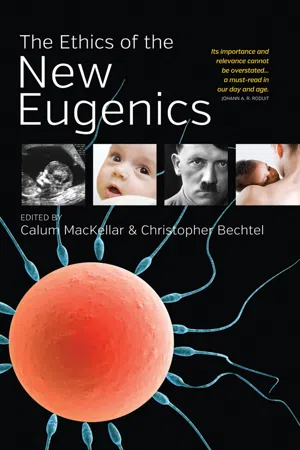
Strategies or decisions aimed at affecting, in a manner considered to be positive, the genetic heritage of a child in the context of human reproduction are increasingly being accepted in contemporary society. As a result, unnerving similarities between earlier selection ideology so central to the discredited eugenic regimes of the 20th century and those now on offer suggest that a new era of eugenics has dawned. The time is ripe, therefore, for considering and evaluating from an ethical perspective both current and future selection practices. This inter-disciplinary volume blends research from embryology, genetics, philosophy, sociology, psychology, and history. In so doing, it constructs a thorough picture of the procedures emerging from today's reproductive developments, including a rigorous ethical argumentation concerning the possible advantages and risks related to the new eugenics.
eBook - ePub
The Ethics of the New Eugenics
- 242 pages
- English
- ePUB (mobile friendly)
- Available on iOS & Android
eBook - ePub
The Ethics of the New Eugenics
About this book
Trusted by 375,005 students
Access to over 1.5 million titles for a fair monthly price.
Study more efficiently using our study tools.
Information
GENERAL INTRODUCTION TO EUGENIC PROCEDURES

The topic of eugenics is generally perceived as being multifaceted, with different procedures being considered in both positive and negative ethical lights. The present moral distinction among these eugenic practices being made all the more difficult because of the abuses which took place in Nazi Germany which gave all forms of eugenics a very bad press. But some indirect eugenic practices, such as the selection of a partner, are generally seen as being acceptable by society even though they may not be recognized as having a eugenic component.
However, some eugenic procedures in contemporary society do still receive negative attention. These often relate to the ability to screen and select or deselect biological entities with specific genetic traits that have been created randomly, such as gametes, embryos and foetuses. Genetic improvements may also eventually be possible through genetic manipulation of gametes, embryos and foetuses but also human beings after birth.
In theory, selection procedures enable scientists and prospective parents to control the genetic make-up of potential children by (1) eliminating the unwanted, (2) selecting the desirable, or (3) redesigning and improving those entities or children who already exist. However, it should be emphasized that even a successful genetic selection or manipulation may not always produce the desired results since most traits of interest to parents seeking better children are heavily influenced by the environment. Moreover, these procedures are not equally feasible and vary in the frequency of practice though each activity raises its own ethical questions.1
This chapter will scrutinize eugenic procedures which may affect future children. Examples of each practice will clarify exactly what is at stake, as well as demonstrating the relevance of the discussion for the twenty-first century by presenting three components:
(1) The procedure will be clearly described in lay language without compromising scientific accuracy.
(2) The method in question will then receive an ethical analysis. This examination engages a number of serious arguments in favour and against the procedure and demonstrates that ethical judgements are not straight forward.
(3) Each section will finally present relevant regulatory provisions including pertinent legal data. This will mainly be in addition to the following international legislation from bodies such as the United Nations, UNESCO and the Council of Europe while also addressing the United Kingdom legal framework as a typical example of a regulatory context in a large Western state that has an advanced expertise in reproductive procedures.
In summary, the legislation and recommendations provided in this book validate the need to ethically address the various procedures being presented in the following sections since they demonstrate that each issue has already been considered to be far more than just science fiction.
General Legislation Concerning Eugenic Procedures
Before discussing the ethical perspectives relating to the different procedures which may be considered as eugenic practices it is important to set the scene with regards to legislations which have been implemented especially since the Second World War. When the different eugenic procedures will be discussed in the following sections, these legal instruments, which are of a general nature, should be kept in mind since they can be considered as foundational legislation.
United Nations
The Universal Declaration of Human Rights (Adopted and proclaimed on 10 December 1948)
Article 1:
All human beings are born free and equal in dignity and rights. They are endowed with reason and conscience and should act towards one another in a spirit of brotherhood.
All human beings are born free and equal in dignity and rights. They are endowed with reason and conscience and should act towards one another in a spirit of brotherhood.
Article 3:
Everyone has the right to life, liberty and security of person.
Everyone has the right to life, liberty and security of person.
United Nations Education, Scientific and Cultural Organization (UNESCO)
Universal Declaration on Bioethics and Human Rights (Adopted by acclamation on 19 October 2005 by the 33rd session of the General Conference of UNESCO)
Article 11 – Non-discrimination and non-stigmatization:
No individual or group should be discriminated against or stigmatized on any grounds, in violation of human dignity, human rights and fundamental freedoms.
No individual or group should be discriminated against or stigmatized on any grounds, in violation of human dignity, human rights and fundamental freedoms.
Universal Declaration on the Human Genome and Human Rights (Adopted on 11 November 1997)
Article 6:
No one shall be subjected to discrimination based on genetic characteristics that is intended to infringe or has the effect of infringing human rights, fundamental freedoms and human dignity.
No one shall be subjected to discrimination based on genetic characteristics that is intended to infringe or has the effect of infringing human rights, fundamental freedoms and human dignity.
Article 11:
Practices which are contrary to human dignity, such as reproductive cloning of human beings, shall not be permitted. States and competent international organizations are invited to co-operate in identifying such practices and in taking, at national or international level, the measures necessary to ensure that the principles set out in this Declaration are respected.
Practices which are contrary to human dignity, such as reproductive cloning of human beings, shall not be permitted. States and competent international organizations are invited to co-operate in identifying such practices and in taking, at national or international level, the measures necessary to ensure that the principles set out in this Declaration are respected.
Council of Europe (Forty-seven Countries)
Convention for the Protection of Human Rights and Fundamental Freedoms (CETS No.: 005, Entered into force on 3 September 1953)
Article 14 – Prohibition of discrimination:
The enjoyment of the rights and freedoms set forth in this Convention shall be secured without discrimination on any ground such as sex, race, colour, language, religion, political or other opinion, national or social origin, association with a national minority, property, birth or other status.
The enjoyment of the rights and freedoms set forth in this Convention shall be secured without discrimination on any ground such as sex, race, colour, language, religion, political or other opinion, national or social origin, association with a national minority, property, birth or other status.
Convention for the Protection of Human Rights and Dignity of the Human Being with Regard to the Application of Biology and Medicine (CETS – No. 164, Entered into force on 1 December 1999)2
Article 11 – Non-discrimination:
Any form of discrimination against a person on grounds of his or her genetic heritage is prohibited.
Any form of discrimination against a person on grounds of his or her genetic heritage is prohibited.
European Union (Twenty-eight Countries)
Charter of Fundamental Rights of the European Union (Proclaimed in Nice on 7 December 2000)
Article 3 – Right to the integrity of the person:
2. In the fields of medicine and biology, the following must be respected in particular: … the prohibition of eugenic practices, in particular those aiming at the selection of persons.
2. In the fields of medicine and biology, the following must be respected in particular: … the prohibition of eugenic practices, in particular those aiming at the selection of persons.
United Kingdom Legislation
Disability Discrimination Act (1995)
Under this Act, a disability is defined as ‘a physical or mental impairment which has a substantial and long-term adverse effect on a person’s ability to carry out normal day to day activities’. ‘Impairment’ is not defined, but regulations clarify certain exclusions. The Disability Discrimination Act protects disabled people (children and adults) from discrimination and less favourable treatment for a reason relating to their disability.
Under this Act, a disability is defined as ‘a physical or mental impairment which has a substantial and long-term adverse effect on a person’s ability to carry out normal day to day activities’. ‘Impairment’ is not defined, but regulations clarify certain exclusions. The Disability Discrimination Act protects disabled people (children and adults) from discrimination and less favourable treatment for a reason relating to their disability.
Human Fertilisation and Embryology Act 2008
In the United Kingdom it is not legal to specifically select persons or embryos for disability in reproduction. Section 14 (4) of the Human Fertilisation and Embryology Act 2008 states that ‘Persons or embryos that are known to have a gene, chromosome or mitochondrion abnormality involving a significant risk that a person with the abnormality will have or develop a serious physical or mental disability, a serious illness, or any other serious medical condition, must not be preferred to those that are not known to have such an abnormality’.
In the United Kingdom it is not legal to specifically select persons or embryos for disability in reproduction. Section 14 (4) of the Human Fertilisation and Embryology Act 2008 states that ‘Persons or embryos that are known to have a gene, chromosome or mitochondrion abnormality involving a significant risk that a person with the abnormality will have or develop a serious physical or mental disability, a serious illness, or any other serious medical condition, must not be preferred to those that are not known to have such an abnormality’.
Selection through Migration
In the past, and especially at the beginning of the twentieth century, a number of countries implemented selection procedures on the kind of people they wished to accept as immigrants. This kind of selection would conform to the definition of a eugenic practice, namely, it would be a strategy or decision aimed at effecting, in a manner which is considered to be positive, the genetic heritage of a child, a community or humanity in general.
As already indicated, an example of such a practice happened in 1917 when the US government excluded from immigration ‘all idiots, imbeciles, feebleminded persons, epileptics, [and] insane persons’ on the basis, amongst other factors, that they may be detrimental to the heritage of the United States.3 In 1924, the US Congress also accepted the Immigration Restriction Act, which was strongly influenced by eugenic considerations, to restrict immigration to certain ethnic makeup. This was followed, in 1929, by the implementation of national origins quotas in US immigration policies.4
At present, some modern governments still have restrictions in place in the kinds of professional persons who can be accepted as immigrants. These are generally people who are considered to be an asset to the country, though these individuals are not selected on the basis of biology or at least not directly.
Some governments, on the other hand, are trying to encourage specific sections of their societies, including certain nationalities, to emigrate back to their countries of origin with financial inducements. These are usually people who are not usually seen as a benefit to the country in which they are presently resident. Again this encouragement is not based on biological origin, though it may play a small indirect part.
Selection of Reproductive Partner
In many countries, relationships that lead to procreation usually begin by a mutual attraction which represents a whole set of reasons. A couple does not generally come together just because the relationship may bring forth children. But it is likely that a person selects a partner because of at least some perceived suitability as a parent, even if this perception is unconscious. Suitable qualities for a parent include specific characteristics that a person considers to be positive and desires to see in his or her future children. For example, a woman may choose a healthy man whom she finds physically attractive for his eye or hair colour and strong features, but the attraction may also arise because she (even unconsciously) desires similar or complementary characteristics in her children. At a more fundamental level, selection may occur based on the phenomenon known in genetics as ‘assortative mating’, that is, the reality that people often choose partners who are like them. There is often a positive correlation between husbands and wives on IQ scores and in specific cognitive abilities. Thus, it can be argued that all decisions to have a child involve some kind of selection to varying degrees, and as a result, natural conception is not entirely a random exercise.
Another limitation in the randomness of selecting a partner arises when issues of consanguinity or closeness are expressed with respect to incest. Indeed, a lot of discussion has arisen concerning the origins of any prohibition for persons selecting reproductive partners who are too near or similar to themselves. In this regard there is often an unfortunate combination between the origins of the prohibition relating to incest and the reasons for its maintenance long after the grounds for its existence have ceased to exist. It should also be noted that incest was not always prohibited, as in Pharaonic and Ptolemaic Egypt as well as in ancient Iran.5,6
When prohibitions in sexual and matrimonial relationships did take p...
Table of contents
- cover
- Title Page
- Copyright Page
- Contents
- Acknowledgements
- A Note on the Text
- Abbreviations and Acronyms
- Introduction
- The History of Eugenics
- General Introduction to Eugenic Procedures
- General Ethical Discussion
- Arguments Supporting the New Eugenics
- Arguments Opposing the New Eugenics
- Conclusion
- Appendix I. Past and Present Personalities Supporting Eugenic Policies
- Appendix II. Scottish Council on Human Bioethics Recommendations on Eugenics
- Glossary
- Bibliography
- Index
Frequently asked questions
Yes, you can cancel anytime from the Subscription tab in your account settings on the Perlego website. Your subscription will stay active until the end of your current billing period. Learn how to cancel your subscription
No, books cannot be downloaded as external files, such as PDFs, for use outside of Perlego. However, you can download books within the Perlego app for offline reading on mobile or tablet. Learn how to download books offline
Perlego offers two plans: Essential and Complete
- Essential is ideal for learners and professionals who enjoy exploring a wide range of subjects. Access the Essential Library with 800,000+ trusted titles and best-sellers across business, personal growth, and the humanities. Includes unlimited reading time and Standard Read Aloud voice.
- Complete: Perfect for advanced learners and researchers needing full, unrestricted access. Unlock 1.5M+ books across hundreds of subjects, including academic and specialized titles. The Complete Plan also includes advanced features like Premium Read Aloud and Research Assistant.
We are an online textbook subscription service, where you can get access to an entire online library for less than the price of a single book per month. With over 1.5 million books across 990+ topics, we’ve got you covered! Learn about our mission
Look out for the read-aloud symbol on your next book to see if you can listen to it. The read-aloud tool reads text aloud for you, highlighting the text as it is being read. You can pause it, speed it up and slow it down. Learn more about Read Aloud
Yes! You can use the Perlego app on both iOS and Android devices to read anytime, anywhere — even offline. Perfect for commutes or when you’re on the go.
Please note we cannot support devices running on iOS 13 and Android 7 or earlier. Learn more about using the app
Please note we cannot support devices running on iOS 13 and Android 7 or earlier. Learn more about using the app
Yes, you can access The Ethics of the New Eugenics by Calum MacKellar, Christopher Bechtel, Calum MacKellar,Christopher Bechtel in PDF and/or ePUB format, as well as other popular books in Medicine & Ethics in Medicine. We have over 1.5 million books available in our catalogue for you to explore.