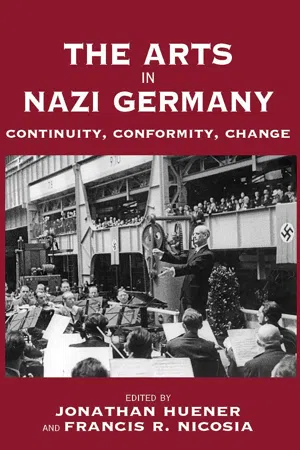
Culture and the arts played a central role in the ideology and propaganda of National Socialism from the early years of the movement until the last months of the Third Reich in 1945. Hitler and his followers believed that art and culture were expressions of race, and that "Aryans" alone were capable of creating true art and preserving true German culture. This volume's essays explore these and other aspects of the arts and cultural life under National Socialism, and are authored by some of the most respected authorities in the field: Alan Steinweis, Michael Kater, Eric Rentschler, Pamela Potter, Frank Trommler, and Jonathan Petropoulos. The result is a volume that offers students and interested readers a brief but focused introduction to this important aspect of the history of Nazi Germany.
eBook - ePub
The Arts in Nazi Germany
Continuity, Conformity, Change
- 236 pages
- English
- ePUB (mobile friendly)
- Available on iOS & Android
eBook - ePub
The Arts in Nazi Germany
Continuity, Conformity, Change
About this book
Trusted by 375,005 students
Access to over 1.5 million titles for a fair monthly price.
Study more efficiently using our study tools.
Information
Chapter One
ANTI-SEMITISM AND THE ARTS
IN NAZI IDEOLOGY AND POLICY
IN NAZI IDEOLOGY AND POLICY

ON 18 APRIL 1937, THE GREAT GERMAN NOVELIST Thomas Mann delivered an address to a Jewish audience in Carnegie Hall in New York City. Mann was one of the few German cultural luminaries who had voluntarily chosen a life in exile rather than remain in Nazi Germany. The main focus of his speech was on the contribution of Jews to the cultural and intellectual life of Germany, and, more generally, Europe. The Jews, Mann asserted, had brought something special and different to European culture. Mann attempted to articulate what this difference was. “The Jews,” he observed: “are called the people of the Book. We must be aware of all the sensitiveness, receptivity, spiritual maturity, knowledge of suffering, love of the spiritual which is here symbolically implied in the word Book in order properly to understand the debt of gratitude which especially in Germany the literary spirit owes to the Jews.” But this was not all. Mann continued to explain that the unique cultural and intellectual perspective of the Jews in Germany had derived from their “Mediterranean-European-Oriental” nature, an element otherwise missing in German society. Over the many centuries of Jewish habitation in central Europe, the intellectual essence of the Jews had become “part and parcel of, altogether inalienable from German morals and culture.” For this reason, Mann concluded, no genuinely cultured German could be an anti-Semite.1
What is striking is Mann's insistence that Jews were in some fundamental way different from other Germans. He regarded this difference as a positive thing, as a source of creativity, and he championed what has often been called the “German-Jewish symbiosis,” a mutually beneficial interdependence between two distinct entities. In believing that Jews and Germans were essentially different from one another, Mann was very much a person of his times. Adherents of the Zionist movement also underscored the unique cultural, spiritual, and even racial characteristics of the Jews. In their eyes, both the persistence of anti-Semitism among Gentiles and the pursuit of a pure Jewish identity underscored the futility of pursuing a Jewish symbiosis with other cultures. And then there were the anti-Semites, for whom the preferred metaphor for describing the Jewish relationship with Gentiles was not symbiosis, but rather parasitism.
The notion of Jews as economic and cultural parasites was a fundamental tenet of Nazism. From the beginning of its existence as an organized movement, the Nazi Party had emphasized the need for an ethnic cleansing of German art and culture. In its founding document, the 25-point program of 1920, the party had called for the “legal prosecution of all those tendencies in art and literature which corrupt our national life, and the suppression of cultural events which violate this demand.”2 Between the Nazi party's inception and its seizure of power in 1933, its official newspaper, the Völkischer Beobachter, consistently devoted ample space to artistic and cultural criticism. Hitler's keen personal interest in the arts, which he repeatedly displayed throughout his political career, may well have reflected an effort to overcome personal failure as an artist during his Vienna days. During the Nazi Kampfzeit, the “era of struggle” before 1933, Hitler's speeches often emphasized the need for a new national art policy (Kunstpolitik). In his book Mein Kampf (1924–25), Hitler elaborated upon his conception of the relationship between art and a future National Socialist regime. “It is the business of the state,” he wrote, “to prevent a people from being driven into the arms of spiritual madness” and to guarantee “the preservation of those original racial elements which bestow culture and create beauty and dignity of a higher mankind.”3 This racialist conception of culture remained a core principle in Hitler's worldview. Throughout his years in power, Hitler was actively involved in the details of cultural policy, even to the point where he decided personally on the ambiguous racial credentials of artists and entertainers.4
Other Nazi spokesmen frequently elaborated upon National Socialist cultural principles. Alfred Rosenberg, the party's chief of ideology, explained that the völkisch state had the responsibility to cultivate the healthy and to root out the decadent in the nation's cultural life: “There arises from the idea of a cultural community the duty to nurture culture. Biologically as well as spiritually understood, this means that we have the duty above all to promote organic growth, to promote that which is inwardly strong and necessary to life, that which serves the values of Germans and their beauty ideal. At the same time, the community must keep as far away as possible any growth which is sick or inwardly foreign, and which does not act in the best interests of Germandom but in the interest of undermining the German being.”5 In the same vein, Joseph Goebbels, the Minister for Public Enlightenment and Propaganda (Reichsminister für Volksaufklärung und Propaganda), often articulated the differences between the National Socialist conception of culture and the “liberal” principles that had prevailed in Germany during the Weimar Republic. The cultural and spiritual welfare of the “people's community” (Volksgemeinschaft), Goebbels liked to emphasize, took priority over the rights of the individual artist. The liberal notion of “art for art's sake” was, therefore, inconsistent with the tenets of National Socialism. As Goebbels explained, “we have replaced individuality with Volk and individual people with Volksgemeinschaft.” The state had not only the right but also the obligation to advance art in the interests of the Volksgemeinschaft. “Culture is the higher expression of the creative power of a nation,” and the artist as a “giver of meaning” is “as indispensable to the state as those who provide its material existence.”6
German culture, the Nazis claimed, had been contaminated by alien influences, particularly Jewish ones. According to the Nazi view, Jews, lacking their own country, lived parasitically off their host societies, nourishing themselves economically and culturally at the expense of others. Having assimilated into German society, so went the Nazi argument, Jews moved into positions of influence in the press, music, theater, the visual arts, and other fields of cultural endeavor. But the Nazi racist view of the world ruled out the possibility of full and genuine assimilation. Jews, the Nazis argued, would always think and act like Jews, no matter how much they might take on the external characteristics of Germans. According to this logic, Jews could never really pursue an authentically Germanic culture, but only contaminate that culture with their own innately Jewish sensibility. An important responsibility of a Nazi government would be to purge Jews and their cultural production from German society.
These ideas were not invented by the Nazis. They extend well back into the nineteenth century, having arisen as part of the anti-Semitic reaction against the emancipation of the Jews and their subsequent integration into the mainstream of German society.7 Nineteenth century Germany (and other countries as well) had seen two phases in the development of anti-Semitism. Initially, anti-Semitism had focused on the religious and cultural otherness of the Jews. The answer to the so-called Jewish Question would be found in religious conversion to Christianity and assimilation to German culture. In the late nineteenth century, however, with the rise of Social Darwinism and modern biological racism, anti-Semites in Germany and elsewhere began to advocate the exact opposite. They no longer saw the Jews as a religious, cultural, and social group, but rather as a race. Racist anti-Semitism (like racism more generally) assumed that the characteristics, behaviors, and values of the Jews were fixed and unchangeable. Neither religious conversion nor cultural assimilation would alter their essential Jewishness. Racist anti-Semites, therefore, regarded assimilation as a dangerous chimera, a process they believed would facilitate Jewish parasitism by allowing the Jews to disguise themselves as Germans. Nazism embodied the legacy of this tradition of racist and exclusionist, as opposed to assimilationist, anti-Semitism.
As racist anti-Semitism developed in the late nineteenth and early twentieth centuries, its exponents attempted to document the parasitical influence of assimilated Jewry over German art and culture. Among the most frequently cited texts was “Judaism in Music,” an essay published in 1850 by the composer Richard Wagner.8 Although the essay did not explicitly define the Jews as a race, it tended in that direction by linking supposedly Jewish musical traits to physical characteristics that were frequently ascribed to Jews. Wagner claimed that German music was a “worm-infested corpse” that had been taken over by Jews. Despite their attempts to sound German, in Wagner's opinion, Jews, in both their speech and their music, could not help but retain the sounds that were peculiar to their nature. Jews might imitate German musical styles, but in the end their compositions and performances would always bear the marks of their Jewish origins. Wagner's depiction of Jews as an alien contaminant in German culture became common currency in the increasingly racist anti-Semitic polemics of the late nineteenth century. This view was represented in many of the standard works of that emerging genre. It was present, most notably, in the writings of Wagner's son-in-law, Houston Stewart Chamberlain, whose book The Foundations of the Nineteenth Century, published in 1899, became a touchstone work for later racist right-wing political movements.
It should be emphasized that a racial interpretation of art was by no means limited to occasional rants by disgruntled aesthetes. It appeared increasingly in writings that purported to be grounded in scholarship. Among the most influential proponents of this ostensibly scientific approach were Richard Eichenauer, Paul Schultze-Naumburg, and Hans F. K. Günther. Eichenauer's book Musik und Rasse (Music and Race), published in 1932, echoed the central theme of Wagner's “Judaism in Music,” but used a language that was much more informed by racial theory.9 Eichenauer criticized Jewish composers such as Gustav Mahler for attempting to sound German, and attacked modernist composers of Jewish background, most important among them Arnold Schoenberg, for their corrosive influence on German music.
Schultze-Naumburg's book Kunst und Rasse (Art and Race), published in 1928, was a frontal assault on modernism in the visual arts.10 Through the use of many illustrations, Schultze-Naumburg attempted to demonstrate the close resemblance between the physical appearance of mentally disabled and physiologically deformed people on the one hand, and the images contained in modern paintings on the other. Through this method he hoped to prove a causal link between racial degeneration and modern art. While his publications did not focus specifically on Jews, Schultze-Naumburg was active in the anti-Semitic Kampfbund für deutsche Kultur (Combat League for German Culture), which was a creation of the Nazi movement.
Hans F. K. Günther was a prolific author of works on the origins of the “Nordic” and other races. In his book on the Jewish race, Rassenkunde des jüdischen Volkes (Racial Characteristics of the Jewish People), published in 1930, Günther made extensive use of artistic evidence to underscore the racial differences between Jews and other Europeans.11 Günther interpreted the cultural influence attained by Jews in Germany as an incursion of an alien “racial soul” from Asia Minor, where he believed the primary racial origin of the Jewish people could be found. In 1930, Günther received a professorship at the University of Jena, made possible by Nazi participation in a coalition government in the German state of Thuringia. This same government also appointed Schultze-Naumburg to direct the Academy of Architecture, Visual Arts, and Design in the city of Weimar.
Both of these appointments reflected the escalating intensity of the culture war that raged in Germany during the period from 1918 to 1933. Nazi resentment of Jewish influence in the arts was closely connected with an antimodernist aesthetic sensibility. Although artistic modernism had made important inroads in Germany before 1918, it was during the Weimar Republic that it emerged in its full force in literature, painting and sculpture, architecture, music, and theater. Many of the artistic innovations attracted the wrath of cultural conservatives spanning the right side of the political spectrum. They condemned artistic modernism as overly cerebral and international. It did not conform to their notion of authentic “Germanness.” The Nazi critique was especially emphatic in its emphasis on racial decay as the underlying cause of aesthetic degeneration. The regulation of cultural production through censorship would not by itself suffice to set matters right. They believed that the underlying cause of artistic decay had to be addressed by removing Jews and other alien influences from German cultural life.
One must ask why the Nazi assertion of a connection between Jewry and certain artistic innovations was deemed credible by many Germans. It is undeniable that Jews, or at least persons of Jewish heritage, numbered among the most prominent exponents of artistic modernism in the early twentieth century. This truth should not be rejected by Jews simply because anti-Semites have exploited it. At the same time, we must recognize how the Nazis misrepresented this truth. In actuality, the vast majority of Jewish artists in Germany were rather traditional in their aesthetic outlook, but Nazi ideology could not accommodate this reality. The Nazis saw Jewish cultural influence in Germany as a destructive pincers. Aesthetically progressive Jews were seen as corrupting German culture from the outside, while artistically traditional Jews were doing the same from the inside. In the racist cultural logic of Nazism, the Jews were damned no matter what.
During their fight to attain power in Germany, the Nazis translated this dimension of anti-Semitism into a strategy for attracting and mobilizing followers.
In 1928, the party created the Combat League for German Culture as a vehicle for expanding the Nazi movement's appeal among culturally conservative members of Germany's educated middle class.12 The Combat League's leader, Alfred Rosenberg, was a close associate of Hitler and the chief of ideology in the party. The Combat League's stated mission was to “defend the value of the German essence” in the “midst of present-day cultural decadence” by promoting every “authentically native expression of German cultural life.” It hoped to educate Germans about the “connections between race, art, and science.” It would highlight the work of German artists who had been “silenced” by the forces of decay. Among the enemies of the “German essence,” the Combat League identified Jews, communists, modernists, feminists, and the exponents of “nigger jazz.” Public lectures were relatively inexpensive and easy to organize, and therefore quickly became the most common form of Kampfbund function. Early lecturers included Othmar Spann, a well-known theorist of authoritarian corporatism, and Alfred Heuss, the editor of the prestigious Zeitschrift für Musik (Journal of Music). Most often, however, it was Rosenberg himself who appeared on the podium to denounce the cultural manifestations of Judaism, Marxism, liberalism, and feminism. The Combat League remained a small organization of only a couple of thousand members, but its high-profile condemnations of “degenerate” modernism probably reinforced the widespread perception of Jews as agents of cultural decay.
When the Nazis cam...
Table of contents
- Cover Page
- Title Page
- Copyright Page
- Contents
- Preface
- Introduction: The Arts in Nazi Germany - Continuity, Conformity, Change
- 1. Anti-Semitism and the Arts in Nazi Ideology and Policy
- 2. The Impact of American Popular Culture on German Youth
- 3. The Legacy of Nazi Cinema: Triumph of the Will and Jew Süss Revisited
- 4. Music in the Third Reich: The Complex Task of “Germanization”
- 5. A Command Performance? The Many Faces of Literature under Nazism
- 6. The Art World in Nazi Germany: Choices, Rationalization, and Justice
- A. Letter from Wilhelm Furtwängler to Joseph Goebbels 12 April 1933
- B. Law for the Establishment of a Provisional Chamber of Film 14 July 1933
- C. The Reich Chamber of Culture Law 22 September 1933
- D. First Decree for the Implementation of the Law for the Reich Chamber of Culture 1 November 1933
- E. Activities of the Cultural Association of German Jews [Jewish Cultural League] April 1934
- F. The German Authorities and the Cultural Association of German Jews [Jewish Cultural League] 19 June 1934
- G. Ten Principles for the Creation of German Music 28 May 1938
- H. From Hitler's “Speech on Culture” (Kulturrede) at the Nuremberg Party Congress September 1938
- I. What Are People Reading? A Questionnaire in Berlin Book Stores December 1940
- Contributors
- Selected Bibliography
- Index
Frequently asked questions
Yes, you can cancel anytime from the Subscription tab in your account settings on the Perlego website. Your subscription will stay active until the end of your current billing period. Learn how to cancel your subscription
No, books cannot be downloaded as external files, such as PDFs, for use outside of Perlego. However, you can download books within the Perlego app for offline reading on mobile or tablet. Learn how to download books offline
Perlego offers two plans: Essential and Complete
- Essential is ideal for learners and professionals who enjoy exploring a wide range of subjects. Access the Essential Library with 800,000+ trusted titles and best-sellers across business, personal growth, and the humanities. Includes unlimited reading time and Standard Read Aloud voice.
- Complete: Perfect for advanced learners and researchers needing full, unrestricted access. Unlock 1.5M+ books across hundreds of subjects, including academic and specialized titles. The Complete Plan also includes advanced features like Premium Read Aloud and Research Assistant.
We are an online textbook subscription service, where you can get access to an entire online library for less than the price of a single book per month. With over 1.5 million books across 990+ topics, we’ve got you covered! Learn about our mission
Look out for the read-aloud symbol on your next book to see if you can listen to it. The read-aloud tool reads text aloud for you, highlighting the text as it is being read. You can pause it, speed it up and slow it down. Learn more about Read Aloud
Yes! You can use the Perlego app on both iOS and Android devices to read anytime, anywhere — even offline. Perfect for commutes or when you’re on the go.
Please note we cannot support devices running on iOS 13 and Android 7 or earlier. Learn more about using the app
Please note we cannot support devices running on iOS 13 and Android 7 or earlier. Learn more about using the app
Yes, you can access The Arts in Nazi Germany by Jonathan Huener, Francis R. Nicosia, Jonathan Huener,Francis R. Nicosia in PDF and/or ePUB format, as well as other popular books in History & German History. We have over 1.5 million books available in our catalogue for you to explore.