There is a growing interest in studies that document the relationship between science and medicine - as ideas, practices, technologies and outcomes - across cultural, national, geographic terrain. Tibetan medicine is not only known as a scholarly medical tradition among other Asian medical systems, with many centuries of technological, clinical, and pharmacological innovation; it also survives today as a complex medical resource across many Asian nations - from India and Bhutan to Mongolia, Tibet (TAR) and China, Buryatia - as well as in Western Europe and the Americas. The contributions to this volume explore, in equal measure, the impacts of western science and biomedicine on Tibetan grounds - i.e., among Tibetans across China, the Himalaya and exile communities as well as in relation to globalized Tibetan medicine - and the ways that local practices change how such "science" gets done, and how this continually hybridized medical knowledge is transmitted and put into practice. As such, this volume contributes to explorations into the bi-directional flows of medical knowledge and practice.
eBook - ePub
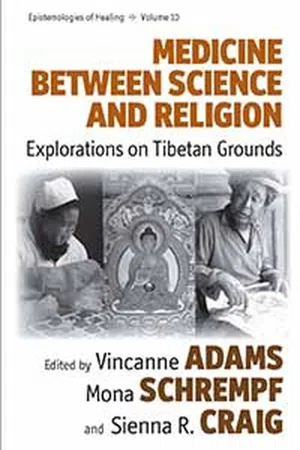
Medicine Between Science and Religion
Explorations on Tibetan Grounds
- 324 pages
- English
- ePUB (mobile friendly)
- Available on iOS & Android
eBook - ePub
Medicine Between Science and Religion
Explorations on Tibetan Grounds
About this book
Trusted by 375,005 students
Access to over 1.5 million titles for a fair monthly price.
Study more efficiently using our study tools.
Information
Chapter 1
Introduction: Medicine in Translation between Science and Religion
A growing body of scholarship from the fields of history, anthropology, science and technology studies, and philosophy addresses the translation of scientific epistemologies as practices between and across cultures. Nowhere is this engagement more compelling than in discussions of medicine: what it consists in, how its claims to knowledge and efficacy are validated, how it allows for innovation and at the same time advocates a consistent empirical position, and how it is configured within cultural and national imaginaries and global markets. Likewise, socio-cultural and colonial studies of medicine reveal how biomedical science – translated into a variety of clinical, technological, sociological and political interventions aimed at improving the well-being of its ‘target’ populations – has had a tremendous impact at local, regional and global levels: from public health efforts in the early days of colonialism to the era of post-war health development campaigns, and now through the globalization of pharmaceutically-oriented clinical research.
Such inquiries have also given rise to new analyses about the problem of defining ‘science’ and locating its origins in ‘Western’, i.e., European-American, cultures. Arguments over what constitutes ‘modern science’ – and, by extension, ‘modern medicine’ – have often become political rather than empirical battles. As scholars in science studies have shown (such as Latour 1999, Needham 1956, Harding 2006, Prakash 1999), this moment in our intellectual history, and the scholarship it is producing, recalls the metaphor of an onion whose layers of skin never seem to end. The more layers get peeled away, the more new layers emerge, revealing the grounds upon which scientific truth claims are diaphanous, and contingent on a politics of knowledge. That which is labelled ‘modern science’ (or, for that matter, biomedicine) rarely looks the same from one location, time and culture of its practice to the next (see Traweek 1992, Verran 2001, Lock 2001). Furthermore, the dichotomization and historicization of healing practices into those deemed advanced modern ‘scientific medicine’ and those that are provisionally labelled ‘religious’, ‘traditional’ or ‘alternative’ medicine is by now recognized as itself a product of a specific epistemological view – a view deeply embedded in the Enlightenment and in colonialist engagements with the natural and social world (see Prakash 1999, Nandy 1990, Langford 2002, Adams 2002a, 2002b). The infiltration of biomedical science into locales far from its sites of origin – a phenomenon brought about by colonialism, international travel, development aid and the market dissemination of technology – have also been well studied in many fields.
Scholarship that attempts to show how ideas and practices of science in general, and biomedicine in particular, are being shaped by their engagements on non-Western grounds is comparatively abundant if one includes explorations of public health and international health development (cf., Nichter 2008). And yet, despite this growing interest, there are still relatively few studies that document the relations between science, medicine and religion – as ideas, practices, technologies and outcomes influencing each other – across cultural, national, geographic and historically situated terrain. Medicine between Science and Religion: Explorations on Tibetan Grounds makes its contribution here. Rather than framing our ethnographies and analyses as instances that reveal the (hegemonic) impacts of biomedicine in Tibetan contexts, we are interested in showing how this engagement works in (at least) two directions. Despite their dominance in international public health and clinical research systems worldwide, biomedical science and practices are being shaped and reshaped through their interactions with diverse Tibetan settings. These modern Tibetan contexts – the milieu in which healing encounters, clinical research, institutional development and medical history play out – are further characterized by an intimate and interwoven connection between culture and religion. Similarly, Tibetan medicine, as it engages biomedical and scientific technologies and beliefs, is often re-envisioned in ways that reflect these translations of science.
The contributions to this volume explore the impact of Western science and biomedicine on Tibetan grounds – i.e., among Tibetans across China, the Himalayas and exile communities – as well as in relation to globalized Tibetan medicine. We discuss the ways in which local practices change, how ‘science’ is undertaken and scientific knowledge is produced in such contexts, and how this continually hybridized medical knowledge is transmitted and put into practice. As such, this volume also reveals ways in which modern science is sometimes ‘Tibetanized’ within clinical and research practices around the world.
A Sowa Rigpa Sensibility
One of the key motivations for this book is to address the tendency to see the problems of encounter and translation between medical traditions as battle zones, in which, for example, using biomedical notions of disease or therapy means, sui generis, excluding Tibetan notions or vice-versa. Rather, each chapter in Medicine between Science and Religion helps to map the bi-directional, and sometimes multidirectional, flow of ideas and practices across medical worlds. Most ethnographic analyses of science and medicine in cross-cultural encounters begin with analytical frameworks adopted from biological science or social science methodology, which can presume an objectivist and empirical reporting of encounters without recognizing that the very notions of objectivity and empiricism are themselves already embedded in a specific kind of modernity and scientific discourse (Shapin and Schaffer 1989). In these accounts, biomedicine (as a normative ideal and, often, a locally specific set of practices) offers the analytical framework for comparison, as if the encounter with the ‘other’ on medical terrain always presupposes the need for an engagement with the biological sciences that derives first and foremost from a modern, Western viewpoint.
Instead of starting with the supposition that such translations of medicine across cultures must begin with, or emerge from, a biomedical frame, we adopt and apply an approach that begins with sowa rigpa. The ‘science of healing’ – as sowa rigpa is most often translated and used to denote the foundations of traditional Tibetan medicine – is our epistemological starting point, our orientation.1 We chose the terms ‘science of healing’, from among the various possible translations of these Tibetan words, in order to deliberately complicate the notion of science itself, as we explain further below. We also chose this translation to distinguish our thread of analysis from what might be called the ‘Mentsikhang model’2 of standardized Tibetan medicine. Our use of the term sowa rigpa signifies more than the classical body of Tibetan medical knowledge, as expounded in the Gyüshi or the Four Tantras, to include other forms of Tibetan healing knowledge and practices that have either become marginalized within modern institutions of Tibetan medicine or have been seen as belonging to the domain of ‘religion’. We start from the position of troubling the notion of ‘science’ by making it the leaping off point for discussions of sowa rigpa, its epistemological grounds and its multivalent sensibilities. We argue that our appropriation of a sowa rigpa ‘sensibility’ facilitates an understanding of ‘medicine’ between ‘science’ and ‘religion’ in polysemous ways, which include being self-reflective of our own (Euro-American) points of view. Such a sensibility begins with the processes of looking at medical and social worlds – participating in them, empirically knowing them, and being conscious of their effects on health and well-being. In this sense, the concept of a ‘science of healing’ is appropriate for the territory we intend to chart, in methodological and analytical terms.
Given our focus in this volume on Tibetan medicine and its interaction with Western medicine or what we call ‘biomedicine’, a sowa rigpa sensibility becomes a useful analytical approach precisely because the deeper one reflects on the Tibetan words that comprise this phrase, the more complex translation becomes. The analytical concept of a ‘science of healing’ lends itself to multiple layers of epistemological exploration and commitment (Meyer 1981, Schrempf 2007a, Pordié 2008). Rig, as a signifier, has a host of meanings: from knowledge in general, to intelligence, from science to creativity. In Tibetan, rigpa or rignä refers to most scholarly fields of study available in monastic settings, including medicine. As a classificatory concept, then, it makes no distinction between scientific and religious knowledge. Similarly, sowa most commonly alludes to curing or healing; it also means to nourish, repair or comfort, and refers to ‘health’ itself. Together, the words signify a concept organized around the phrase's objective: to make well and complete. It brings together knowledge, intelligence and creativity in order to serve the goal of making health, healing, curing, nourishing and comforting achieve a balance that is both internal (bodily) and external (body in relation to environment). However, we also note that doctors of Tibetan medicine might define ‘science’ differently and in various ways.3
What emerges, then, from this close reading of the term sowa rigpa is a larger sense of meaning that makes sowa rigpa useful as a technique of analysis and practice, and a way of approaching our subject matter in this book. Specifically, we see the notion of sowa rigpa as a way of talking about what it is that our contributors do in their own work and analysis. Beyond this, sowa rigpa is a way of thinking about how to approach the study of any medical system, not just Tibetan medicine. In sum, the fact that sowa rigpa emerges from the Tibetan vernacular is at once crucial and, in some ways, secondary. We suggest that other such epistemological starting points could emerge from other ethnographic contexts. For us, to begin here seems the most conceptually fruitful and methodologically sound procedure. Put another way, sowa rigpa is epistemologically subtle, crossing as it does the boundary between science and creative practice, between knowledge and experience. A sowa rigpa sensibility is efficacious both in its coherence and its permeability. Although one could argue that this may be true for most, if not all, medico-empirical traditions, we believe that sowa rigpa has particular qualities worth delineating.
In ethnographic terms, sowa rigpa is the phrase most often used by the diverse array of practitioners represented in this volume (and beyond) for what they practice. As we discuss in more detail below, the phrase also implies a moral framework which such practitioners abide by. In this sense, sowa rigpa orients us towards a fairly coherent set of theoretical and cosmological presuppositions that have held true among ethnically (and culturally) Tibetan healers for many centuries, across diverse geographic and cultural terrains. The phrase sowa rigpa is found in the Four Tantras, texts which forms the basis of Tibetan medical theory; it is also found in the ritual initiations given to some medical practitioners.
Here it is worth explaining to the non-specialist some of the basics of the ‘science of healing’. An exegesis of Tibetan medicine, in its most basic forms of coherence, always begins with an understanding of the five cosmo-physical elements (jungwa nga) of wind (lung), earth (sa), fire (mé), water (chu) and space (namkha) in relation to the three nyépa of wind (lung), bile (tripa) and phlegm (péken). Commonly translated as ‘humours’, nyépa is more accurately defined as ‘faults’ or ‘deficiencies’ (for more on this, see Gerke, in this volume). Just as the five elements are integral to an understanding of the non-essential nature of all material existence, so too can the nyépa be seen as the underlying presence of a moral cosmology in material form (by way of lä, or karma). According to the Gyüshi, the three nyépa correspond to the ‘three poisons’ (dusum) of Tibetan Buddhist tradition – ignorance, anger and desire – while the element of space is interpreted as consciousness (namshé).4
The choreography of interdependence between the nyépa and the five elements (in consort with the three bodily channels, or tsasum, and the seven bodily constituents, or lüzung dün) enable physiological function. A philosophy of cosmo-physical balance (or imbalance, as the case may be) is reflected in methods of diagnosis, from the mechanics of pulse and urine analysis to the types of questions asked of a patient by a practitioner during an examination. Furthermore, Tibetan medicine is rooted in the idea that there are both proximal and ultimate causes of disease or imbalance. Therapeutic interventions are not only pharmaceutical (using formulas that combine animal, mineral and vegetal substances), but also dietary or physical (such as massage or moxibustion). Medical interventions can also emerge through ritual, from the performance of exorcisms to instructions in specific meditative or yogic practices or mantra. This aspect of Tibetan medicine has often been the most challenged by interactions with biomedicine, and as part of modernization and the politics of secularization occurring in different locales. Likewise, the production of Tibetan medicines and the training of practitioners often involve engagements in religious practice at a number of levels. Most sowa rigpa practitioners and Tibetan patients view Sangyä Menla, the Medicine Buddha, as the primordial source of Tibetan medical knowledge. As interaction with biomedicine increases, many of the wider practices that are associated with religion in Tibetan medicine are looked upon with more reflexive scrutiny.
At the same time, we recognize that sowa rigpa both refers us to and orients us towards a wide range of differences within what might be called a healing tradition, reflecting a tremendous adaptability to local environments, cultural differences, spiritual and practical resources for practitioners and patients, as well as larger socio-structural and even political demands.5 In Tibet proper, one could historically and in the present find a huge variety of practices among healers – from individuals skilled in ritual or religious matters to those with practical pharmacological and compounding knowledge, from healers trained in monastic settings to those trained in a domestic tradition by a family lineage of practitioners. Expertise varies even though all such practitioners heal patients. There is, in fact, no generic Tibetan word for ‘healer’. Various terms, such as menpa (literally ‘the one with medicine’ or ‘doctor’), amchi (‘doctor’, a loan word from Mongolian), mopa (‘diviner’, specializing in ritual diagnosis and healing), lhapa (‘oracle’ or ‘spirit medium’, also specializing in ritual healing) and ngagpa (‘Tantric practitioner’, another type of ritual healing specialist, sometimes called an ‘exorcist’), all refer to specific and distinctive bodies of knowledge and skill.
Despite these differences, the Tibetan practitioners we refer to in this book are all skilled in the techne – the art and science – of sowa rigpa, in the sense that they are informed by basic philosophical and cosmological tenets of this healing science. We recognize, however, that even in Tibet historically and at the present time, there is and has been a good deal of contestation over what Tibetan medicine entails (or should entail), and which types of healing practices are considered legitimate, let alone ‘scientific’. This emerges not only from processes of distinguishing professional boundaries, but also as a result of engagement with politics, with new forms of medicine, such as biomedicine, and with social trends, all of which challenge some techniques more than others. For example, healers who become possessed, such as lhapa, are often stigmatized by various authorities (namely, state or monastic institutions), while practitioners who adopt a radical materialist view towards the causes and conditions of illness or who are oriented explicitly towards a profit-driven approach to making Tibetan formulas might be lauded or reviled, depending on context.
In this volume, we see similar patterns of permeability and flexibility in the practices of sowa rigpa. Despite allegiance to core epistemological principles, there is a wide variety in what is emphasized in the practices of Tibetan medicine in different locales. In Russia at the turn of the twentieth century, massage techniques were emphasized among Tibetan medical practitioners (Saxer, in this volume). The focus on twenty-first-century United States is on the meditative and ‘spiritual’ aspects of Tibetan medicine (Chaoul, in this volume). In Xining (Amdo) in Eastern Tibet, medicinal baths are the most popular medical therapies (Adams et al., in this volume).
In her work on Traditional Chinese Medicine (TCM), anthropologist Mei Zhan proposes a process that she calls ‘worlding’ (2009) to describe how TCM has a presence far beyond its sites of origin in the world, and that its practitioners are self-consciously aware of the challenges and possibilities afforded by this expansion. We extend this argument here. The ‘worlding’ of Tibetan medicine reveals that it has the capacity to be shaped and transformed, adapting to local needs and expectations, while still holding fast to a coherent set of principles that define its epistemological foundations (Cuomu, in this volume). This quality of perseverance and flexibility points to what we identify as a sowa rigpa sensibility. We prefer this term to other analytical referents, such as ‘modern’, ‘hybrid’ or ‘syncretic’, because we wish to preserve the analytical distinction between medical sensibilities and their differential capacities to be flexible and adaptive on the ground. It is an epistemological distinction rather than a question of theory that we want to focus on, thus our use of the term ‘sensibility’ instead of ‘theory’. In this reading or in our use of the phrase ‘sowa rigpa sensibility’, we are not implying that other medical traditions are not flexible or adaptive; rather, our focus in this text is on how Tibetan medicine shows these qualities in its own ways across a broad range of practitioners, geographic locales, and political, cultural and historical time frames.
Bates (1995), Kuriyama (1999) and Farquhar (1992), among others, have argued that the epistemological foundations of knowledge make a difference not only in how medicines are practiced, and how these p...
Table of contents
- Cover Page
- Title Page
- Copyright Page
- Dedication Page
- Contents
- List of Figures
- Acknowledgements
- Notes on Transliteration
- 1. Introduction: Medicine in Translation between Science and Religion
- I - Histories of Tibetan Medical Modernities
- II - Producing Science, Truth and Medical Moralities
- III - Therapeutic Rituals, Situated Choices
- IV - Research in Translation
- Notes on Contributors
- Index
Frequently asked questions
Yes, you can cancel anytime from the Subscription tab in your account settings on the Perlego website. Your subscription will stay active until the end of your current billing period. Learn how to cancel your subscription
No, books cannot be downloaded as external files, such as PDFs, for use outside of Perlego. However, you can download books within the Perlego app for offline reading on mobile or tablet. Learn how to download books offline
Perlego offers two plans: Essential and Complete
- Essential is ideal for learners and professionals who enjoy exploring a wide range of subjects. Access the Essential Library with 800,000+ trusted titles and best-sellers across business, personal growth, and the humanities. Includes unlimited reading time and Standard Read Aloud voice.
- Complete: Perfect for advanced learners and researchers needing full, unrestricted access. Unlock 1.5M+ books across hundreds of subjects, including academic and specialized titles. The Complete Plan also includes advanced features like Premium Read Aloud and Research Assistant.
We are an online textbook subscription service, where you can get access to an entire online library for less than the price of a single book per month. With over 1.5 million books across 990+ topics, we’ve got you covered! Learn about our mission
Look out for the read-aloud symbol on your next book to see if you can listen to it. The read-aloud tool reads text aloud for you, highlighting the text as it is being read. You can pause it, speed it up and slow it down. Learn more about Read Aloud
Yes! You can use the Perlego app on both iOS and Android devices to read anytime, anywhere — even offline. Perfect for commutes or when you’re on the go.
Please note we cannot support devices running on iOS 13 and Android 7 or earlier. Learn more about using the app
Please note we cannot support devices running on iOS 13 and Android 7 or earlier. Learn more about using the app
Yes, you can access Medicine Between Science and Religion by Vincanne Adams, Mona Schrempf, Sienna R. Craig, Vincanne Adams,Mona Schrempf,Sienna R. Craig in PDF and/or ePUB format, as well as other popular books in Social Sciences & Religion. We have over 1.5 million books available in our catalogue for you to explore.