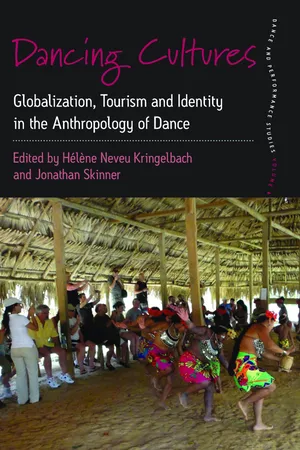
Dance is more than an aesthetic of life – dance embodies life. This is evident from the social history of jive, the marketing of trans-national ballet, ritual healing dances in Italy or folk dances performed for tourists in Mexico, Panama and Canada. Dance often captures those essential dimensions of social life that cannot be easily put into words. What are the flows and movements of dance carried by migrants and tourists? How is dance used to shape nationalist ideology? What are the connections between dance and ethnicity, gender, health, globalization and nationalism, capitalism and post-colonialism? Through innovative and wide-ranging case studies, the contributors explore the central role dance plays in culture as leisure commodity, cultural heritage, cultural aesthetic or cathartic social movement.
eBook - ePub
Dancing Cultures
Globalization, Tourism and Identity in the Anthropology of Dance
- 236 pages
- English
- ePUB (mobile friendly)
- Available on iOS & Android
eBook - ePub
Dancing Cultures
Globalization, Tourism and Identity in the Anthropology of Dance
About this book
Information
Dance and Globalization
Chapter 1
Globalization and the Dance Import–Export Business: The Jive Story
All the jive is gone!
All the jive is gone!
What an awful fix, can’t get my kicks,
‘Cause all the jive is gone!
—Andy Kirk and the Twelve Clouds of Joy, ‘All the Jive is Gone’ (1936)
‘Are You Hep to the Jive?’
Jive is a living history. It is a language and a movement – both bodily and counter-cultural – which spans the centuries and crosses the continents, and takes us from the Middle Passage to the D-Day landings, from swing and Lindy hop ‘joints a jumpin” in Harlem, New York, to zoot-suit retro swing revivals in Herrang, Sweden. In his history of jive, Bill Milkowski refers to jive as a language, ‘like cussing … a language of emotion: a means of describing how one is affected by certain experiences or situations’ (Milkowski 2001: 20). Like soul and hiphop, jive can be a slang of inclusion, a cockney ebonics, an idiolect marking out a group, fraternal and black – ‘African-American bohemianism’ (Saul 2003: 7) in this case. It is a term said to have been invented in the 1920s by the Chicago-based musician Louis Armstrong, and popularized in the 1930s by Cab Calloway, the ‘Professor of Jive’. ‘Are You Hep to the Jive’ (1940) is – besides ‘Minnie the Moocher’ (1931) and ‘Take the “A” Train’ (1941) – one of Calloway’s signature numbers, one which asks the listener if they are up to date, ‘hip with’ the jive, the dance as well as the latest trends and fashions.1 ‘Jive’ was also a codeword for marijuana on the streets and in the lyrics of many big-band anthems. Calloway published his own Hepster’s Dictionary (Calloway 1944) that defined jive as Harlemese speech for ‘stuff’, as in ‘did you bring the jive’, or as blarney as in ‘He can jive his way into any hep cat’s heart’. Postwar, jive lost this meaning and ‘hep’ fell out of favour as a popular term. Jive became a term of derision, slang for someone talking nonsense (‘You’re just jiving with me’), cajoling, jarring (‘What you say don’t jive with what I saw’) or misleading another, an insult even (‘You jive-ass motherfucker’). Jive did, however, remain as a term referring to a dance style, a variation on the jitterbug, a swing dance with roots in Lindy hop, ‘syncopated raw emotion’ in the words of William White (cited in Erenberg 1998: 37).
This chapter is about the hybrid history of this jive dance, a tale of dance imports and dance exports which covers its transformation from 1940s African-American swing expression to 1990s British ceroc franchise. This story concentrates upon the dancers and their creative take up of the dance, its adoption and adaptation, and its connection with social and technological change in the twentieth century. As such, jive has been associated – variously – with resistance, moral corruption and depraved identities, sensual and sexy swing counter-culture, and modern sassy high-impact entertainment organization. In all of its guises and through all its transformations, jive – mid twentieth-century ‘traditional’ and late twentieth-century ‘modern’ – has played upon and played with people’s emotions, affections and imaginations. Incorporated into this social study of jive is also an apologue on emotion, one that shows how emotional cultural forms are commercially appropriated. Implicit in this account of jive is the thesis that identity and the emotions are not obviated by the globalization of dance styles – the commoditization of a dance. Rather, modern-day dance organizations featuring swing – and salsa – ‘dance imports, serve a key social purpose as an emotional outlet in an increasingly indifferent society.
Jive Origins: Personal and Emotional, Global and Historical
We also learned about what had happened to Swing through the rest of the country. The dance had been transformed, and in different ways, depending on local conditions. The Carolinas had a languid, slowed-down version that had become known as the Shag. St. Louis had a fast version – the Imperial Style, they called it – that retained certain features of the old Charleston. Texas had two styles called the Push and the Whip. California was home to a version called the West Coast Swing. Not only were these different stylistically from each other and from the Lindy (or Savoy Style Swing, as some began to call it), but outside of New York, Swing clubs tended to emphasize competitions, while we tended to view our dances as social events. (Crease 1996: 259)
Jive has historical tentacles in a number of dance styles, foremost among them the jitterbug and other swing dances. In order to understand jive – the dance as opposed to the codeword-like language – whether from traditional jitterbug and swing, modern Ceroc and le roc, or ballroom jive (rock-step and chassis-to-the-side), it is thus important to situate it in the matrix of dance styles and the historical context of its inception in the swing era before exploring its own global diffusion. Let me take you, then, to prewar North America during the Great Depression when crooners and balladeers were the popular musicians, when Cab Calloway and Louis Armstrong and Benny Goodman were making their breakthrough, making a living playing to segregated audiences, earning white dollars from their gigs that they were unable to spend in the segregated diners and cafés outside their music venues.
According to Lewis Erenberg (1998: 3–6) in his cultural history of big-band jazz, Swingin’ the Dream, the swing era was ushered in at the end of the Prohibition years (1919 to 1933) by Benny Goodman and his racially integrated orchestra – of ‘Sing, Sing, Sing’ (1937) fame – with their cross-country tour of the US.2 In early 1935 they left New York on the brink of failure, struggling to get bookings in competition with the sweet singers who had toppled the jazz era and were then in vogue. In a ballroom in Michigan they played to an audience of barely thirty people, mostly musicians. At the Elitch Gardens near Denver the audience demanded that they play waltzes, and when Goodman and his orchestra declined they demanded their money back. They had their break, however, on the last night of their tour at the Los Angeles Palomar Ballroom on 21 August 1935: after opening with some conventional melodies ‘trumpeter Bunny Berigan yelled “let’s cut this shit”, and Goodman decided that if they were going to fail, the band would go down swinging’ (Erenberg 1998: 4). The evening was an outstanding success with the dancers mobbing the band during and after the numbers they played. And so, after a staggered return to New York via Chicago, the Goodman players returned as the triumphant ‘Kings of Swing’, playing to sell-out audiences for the rest of the swing era until disbanding in 1948 when that era gave way to bebop and the up-tempo jazzy melodies and improvisations of Charlie Parker and Dizzie Gillespie.
Sandwiched between jazz phases, the ‘golden age’ of swing (1935 to 1948) is associated with the rise of the ballroom and the decline of the nightclub; it was a time when music swept up the youthful masses: white Anglo-Saxon Protestants (WASPs), African-Americans and immigrants alike, one new pluralist democracy of dancers. This is not to idealize the past. The swing era was also a time of commercialism, mass music and exploitation: for Jones (1963), swing shifted from verb to noun to become a commodity to be bought and sold and manipulated by whites. Jive was to follow a similar commercial route as we shall see later on. The swing dance floors and band areas were generally segregated as a rule and, during this golden age, there were great musical and dance struggles between black and white bands: the former with looser inflections and style than the latter, with band leader Paul Whiteman attempting to ‘civilize’ African-American music and Duke Ellington trying to claim European technique for black jazz (Erenberg 1998: xii); and, ostensibly, black and white dance styles as West African body movements competed with European steps, improvisational body movement from the hips with repetitive footwork and dance sequences (Batchelor 1997: 16–17).
The result was a blend as dancers brought to the musicians their muscle memories, their dance training, and what they saw around them and what had been brought to the dance floor in the past: ragtime (an array of ‘trotting’ dances dating from about 1890 to 1914 from the post-emancipation ‘cakewalk’ to the animal dances such as the ‘turkey trot’, all possibly arising as African-American parodies of white social dances; see Cook 1998: 136); the Charleston of the first two decades of the twentieth century (an eight-count dance with oppositional limb movements, shoulder shimmies and hip twists, a dance with African rhythms and Ashanti tribal movements which spawned the Lindy); and its successor the ‘black bottom’ dance, which was described and epitomized in Perry Bradford’s 1919 dance song ‘The Original Black Bottom Dance’, an offbeat solo challenge dance thought to be a precursor to modern tap dancing:
Hop down front and then you doodle [slide] back,
Mooch to your left and then you mooch to your right,
Hands on your hips and do the mess around,
Break a leg [wobble] until you’re near the ground,
Now that’s the old black bottom dance.
Now listen folks, open your ears,
This rhythm you will hear –
Charleston was on the afterbeat –
Old black bottom’ll make you shake your feet,
Believe me it’s a wow.
Now learn this dance somehow,
Started in Georgia and it went to France,
It’s got everybody in a trance
It’s a wing, that old black bottom dance.3
Batchelor (1997: 59) notes that this dance from the American South migrated from New Orleans and Nashville, and was perhaps named after Nashville’s river-front section, the Black Bottom, or after the black soils and mud of either the Suwannee river or the Mississippi delta.
These dances diffuse and mutate, interbreeding with each other. The Lindy hop, for example, is very much a dance derived by mutation (Batchelor 1997: 86–87). It is a mix of the Texas Tommy (a kick and a hop three times on each foot followed by a slide and then a breakaway where partners separated and could do what they wanted before returning together) with the ‘collegiate’ (similar to the Charleston) and the ‘breakaway’ (when partners break from a close and closed hold). Shorty George Snowden (of ‘Shorty George’ dance-step fame, a kind of bent-kneed ice-skating impression) is said to have defined the Lindy hop dance as a reaction to the dancing and celebrations around him in honour of Charles Lindbergh’s non-stop flight from New York to Paris, a feat of great courage and good fortune, flying with a cracked fuel tank, a bag of sandwiches and with a periscope through the floor of the plane for navigation – ‘Lindy’ resorted to hailing trawlers to ask them the way! Shorty came up with an abbreviation of newspaper headlines, and trombonist TeRoy Williams’s music ‘The Lindbergh Hop’. Whether the Lindy hop has these beginnings – or is from Lindy Lou, the sobriquet for a coloured girl – it is a dance which is now associated with the Savoy Ballroom in New York where it was initially banned before it was tolerated, accepted and then promoted and celebrated.
The Lindy hop was a dance that evolved with the music into a 4/4 rhythm as dancers and musicians challenged and fed off each other, before it turned into six- or eight-count Lindy. Through Evette Jensen, the jazz dancer Norma Miller gives a personal account of how the dancing looked then:
The Lindy Hop started in Harlem with black dancers; when white bands became part of the Swing Era, white kids tended to follow bands like Benny Goodman’s. It was about this time that the dance got faster and wilder. When the King of Swing, as they called Goodman, played at the Paramount Theater in New York in 1938, the audience went wild and danced in the aisles. Goodman supposedly said that they looked like a bunch of Jitterbugs, and the name stuck. The promoters picked up the term and started hyping the new dance, the Jitterbug. To the rest of us, it looked like the Lindy Hop. (Miller and Jensen 1996: 248)
At the time, more than one million African-Americans had moved to the great urban industrial cities such as New York and Chicago. These dances became their outlets as they socialized and relaxed at ‘rent parties’ and ‘house shouts’ or at the ballroom. Dances such as the Texas Tommy and the jitterbug blurred in contests, crossing and recrossing, mixing and remixing, as the dance communities self-perpetuated themselves through competitions, shows, block parties and ballroom socials. This migratory shift in population and the changing entertainment patterns at the start of the twentieth century are identified by Katrina Hazzard-Gordon as a move in the ‘“jook” continuum’ (Hazzard-Gordon 1990: x–xi), from African-American working class bar-cum-diner-cum-dance venue to that of the ‘commercial urban complex’ of public (membership) clubs, city dance halls and ballrooms. This shift in location is expressed and described in the change in black music from blues and jazz to swing. It is an example of urbanization and globalization at the dawn of an era of new mass-market and new media technologies of production and reproduction, a time when the proscribed and punished black body began to turn into a new black aesthetic – ‘from coon to cool’ (Gottschild 2003).
Globalization and Dance Imports and Exports
[A]s was the case with swing music, styles of playing and dancing change as these forms were appropriated by white practitioners and finessed to a white aesthetic standard. This meant that the grounded, from-the-hips, smooth style of dancing … became a bouncy, upright, jerky style taught at white dancing schools such as those run by Arthur Murray. (Gottschild 2000: 74)
Dance diffused through the medium of musicians and dancers. Both performed a bricolage in public, drawing from their repertoires, their tool kits, to impress audiences. According to Batchelor, the dances evolved, diffused and blended from Africa to the New World of the Caribbean and the USA, spilling out of the ‘communication hubs for land, water and rail travel’ (Batchelor 1997: 15). Lindy steps are considered to have been seen amongst the Ejor of Sierra Leone and Hausa girls in Nigeria, Charleston steps amongst the Igbo of West Africa and in Shango on Trinidad. In the USA, these dances spread from centres such as New Orleans, travelling up the rivers on the river boats; from Chicago along the railroads; from New York via post-industrial advertising, and capitalist Mecca for clubs (the Cotton Club), dance halls (the Savoy Ballroom) and music labels (Decca); and from Hollywood, Los Angeles, the capital of the film industry and the centre of commercial broadcasting. Between New York and Los Angeles lay Kansas City and Denver, important stopovers for bands touring the east or west coasts. Other tours, Batchelor (1997: 29) identifies, were circuits of the Theatre Owners Booking Association (TOBA) which numbered some eighty theatres in 1929 with bands rotating through the South and Midwest – Chicago, Kansas City, Oklahoma City, Dallas, New Orleans, Atlanta, Durham. There was also a smaller ‘Round the World’ circuit for the more successful bands that rotated around New York (Harlem), Philadelphia, Baltimore and Washington. The idea behind these diffusion circuits was to maintain a steady stream of quality shows for the lowest possible price.
These bands and dancers – such as the Whitman Sisters vaudeville act with bands and dancers in toe, and the Cab Calloway Band which travelled by train (with their own carriages) – plied the new urban centres, playing to the new immigrants, the displaced and landless, the diasporic, and the successful and wealthy new capitalist elite. The dancing swinging world developed as an ‘alternate public sphere’ (Gilroy 1987) for the new urban arrivals who could practice an old illiterate technology, using their bodies as currency, treading and retreading their diasporas, first from Africa and second from plantation to city. The success and growth of the swing era is thus one which rides upon the rural exodus and the then new twentieth-century transport technologies and media innovations: the bands travelled by road and rail, a reversal south along some of the old ‘structured travel circuits’ (Clifford 1994: 309) of the underground slave escape routes; the dance was named after a famous transatlantic pilot; the music was broadcast by radio and sold on recordings. Swing, in turning from noun to verb to noun was harnessed by and harnesser of the features of advanced capitalism (cf. Anderson 1994), the birth of a mass media in particular. The ‘spontaneous union’ of the dancing jivers, swingers and jitterbugs, the testing and crossing of class and racial barriers, the ‘feeling inside of togetherness not achieved in any other activity’ (Erenberg 1998: 52), all came from these new swing dances which had been ushered in by Benny Goodman and his band. And we must remember that Goodman’s success only came about in California, at the end of many months of travelling, and after a few shows on NBC’s Let’s Dance radio programme which had cued in the fans’ musical tastes before Goodman’s tipping-point evening with them.
Above, I have presented a history of the evolution and diffusion of swing. I have shown how it has been tied to certain regions and places: West Africa, the West Indies, New Orleans, L...
Table of contents
- Cover Page
- Title Page
- Copyright Page
- Contents
- List of Figures
- Acknowledgements
- Introduction: The Movement of Dancing Cultures
- Part I: Dance and Globalization
- Part II: Tourism, Social Transformation and the Dance
- Part III: Dance, Identity and the Nation
- Epilogue Making Culture through Dance
- Notes on Contributors
- Index
Trusted by 375,005 students
Access to over 1.5 million titles for a fair monthly price.
Study more efficiently using our study tools.
Frequently asked questions
Yes, you can cancel anytime from the Subscription tab in your account settings on the Perlego website. Your subscription will stay active until the end of your current billing period. Learn how to cancel your subscription
No, books cannot be downloaded as external files, such as PDFs, for use outside of Perlego. However, you can download books within the Perlego app for offline reading on mobile or tablet. Learn how to download books offline
Perlego offers two plans: Essential and Complete
- Essential is ideal for learners and professionals who enjoy exploring a wide range of subjects. Access the Essential Library with 800,000+ trusted titles and best-sellers across business, personal growth, and the humanities. Includes unlimited reading time and Standard Read Aloud voice.
- Complete: Perfect for advanced learners and researchers needing full, unrestricted access. Unlock 1.5M+ books across hundreds of subjects, including academic and specialized titles. The Complete Plan also includes advanced features like Premium Read Aloud and Research Assistant.
We are an online textbook subscription service, where you can get access to an entire online library for less than the price of a single book per month. With over 1.5 million books across 990+ topics, we’ve got you covered! Learn about our mission
Look out for the read-aloud symbol on your next book to see if you can listen to it. The read-aloud tool reads text aloud for you, highlighting the text as it is being read. You can pause it, speed it up and slow it down. Learn more about Read Aloud
Yes! You can use the Perlego app on both iOS and Android devices to read anytime, anywhere — even offline. Perfect for commutes or when you’re on the go.
Please note we cannot support devices running on iOS 13 and Android 7 or earlier. Learn more about using the app
Please note we cannot support devices running on iOS 13 and Android 7 or earlier. Learn more about using the app
Yes, you can access Dancing Cultures by Hélène Neveu Kringelbach, Jonathan Skinner, Hélène Neveu Kringelbach,Jonathan Skinner in PDF and/or ePUB format, as well as other popular books in Media & Performing Arts & Performing Arts. We have over 1.5 million books available in our catalogue for you to explore.