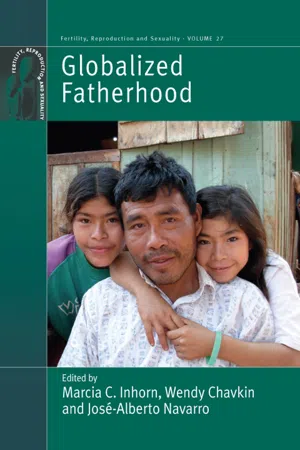
Using an entirely new conceptual vocabulary through which to understand men's experiences and expectations at the dawn of the twenty-first century, this path-breaking volume focuses on fatherhood around the globe, including transformations in fathering, fatherhood, and family life. It includes new work by anthropologists, sociologists, and cultural geographers, working in settings from Peru to India to Vietnam. Each chapter suggests that men are responding to globalization as fathers in creative and unprecedented ways, not only in the West, but also in numerous global locations.
eBook - ePub
Globalized Fatherhood
- 430 pages
- English
- ePUB (mobile friendly)
- Available on iOS & Android
eBook - ePub
Globalized Fatherhood
About this book
Trusted by 375,005 students
Access to over 1 million titles for a fair monthly price.
Study more efficiently using our study tools.
Information
Part I
CORPORATE FATHERHOOD
Chapter 1
THE CORPORATE FATHER
Jude Browne
Introduction
What does a political commitment to gender equality mean in the context of fatherhood? In what ways should the state support or compel fathers so as to effect greater gender equality? If there is any consensus on these questions in the gender literature, then it is that existing family leave policy—even the most progressive—falls short of a satisfactory answer. Typically, this failure is understood either in economic terms—that policy provision is simply inadequate in scale—or in terms of individual preferences that should be encouraged to change. Indeed, both of these approaches are intended to incentivize men to take up more caring duties—a theme that has become central to the politics of gender equality (Gornick and Meyers 2008; Haas and Rostgaard 2011; Hobson 2002; Kamerman and Moss 2009).
Some scholars, such as Berit Brandth and Elin Kvande (2009a), Linda Haas (2003), and myself (Browne 2006), have conducted large-scale empirical studies of employing institutions and the particular problems therein associated with gender equality and associated policies, such as parental leave. From these detailed studies, it seems clear that effective policy must be built upon a nuanced picture of how fathers are not only limited by economic considerations or driven by individual aspirations but are also constrained by a complex range of structural and institutional factors. My argument in this chapter is that, despite gender equality being a fundamental right of all European citizens, existing approaches fail to address such crucial structural and institutional factors and little has been offered in these empirical studies by way of a new direction. To this end I turn to the “default model” of political philosophers Anca Gheaus and Ingrid Robeyns (2011) and consider its merits as a state-level approach to gender equality.
What follows is divided into three main sections. The first is intended to provide some context for the arguments presented in subsequent sections. I begin by introducing the concept of “relational fatherhood,” which I find useful for thinking about the efficacy of policy models aimed at working parents and gender equality ideals. I go on to illustrate the shortcomings of existing parental leave provisions, focusing on two very different European models. On the one hand, I set out the U.K. approach, which offers relatively low levels of provision to parents, and on the other, I consider the Nordic approach, using Sweden and Norway as examples. These Nordic states (along with Finland and Iceland) are widely considered as having developed the most effective public policy for facilitating the combination of parenting duties and employment. Nonetheless Nordic policies have been criticized in recent debates as failing to deliver sufficient gender equality. In order to think about how these criticisms might inform ideal policy design, I analyze, in the second section, a proposal by political philosophers Gheaus and Robeyns that employs “the normative power of defaults” (174). While I consider this model appealing, I argue that its key objective—to motivate fathers to take on greater primary-carer roles—should not be the primary basis on which to design parental leave policy. Instead, as I set out in the third section, I focus on the more structural constraints facing relational fatherhood. To contextualize this view, I present a series of responses from qualitative interviews with a number of corporate leaders based in Britain with responsibility for a great many employees (often worldwide). While I do not claim a representative account, these particular insights nevertheless indicate how the choices made by fathers cannot be reduced simply to the particular aspirations of the individuals in question or corollaries of economic facts, but are formed by a range of expectations, pressures, and restrictions that are part of the institutional fabric itself. I argue that current state approaches to gender equality lack the necessary focus or mechanisms for addressing these structural constraints at the institutional level and that a reinterpretation of Gheaus and Robeyns’s default model has much to offer by way of solution.
Fatherhood Shaped
There are of course many types of father: genetic, step, adoptive, legally designated. Perhaps the father is partnered to the genetic mother, with a non-related partner, is single, or is one of two gay fathers. He might be a long-distance father, estranged, absent, or even unknown. Irrespective of the various biological and legal characteristics and circumstances, the central feature of fatherhood is the way in which a father relates to his child.1 In this chapter I focus less on those aspects of fatherhood that concern the economic or symbolic relationships between father and child, although these are important. Rather, I concentrate on what I call “relational fatherhood.” This concept is intended to capture a basic condition of parenting—time spent personally interacting with a child—physically caring, playing, emotionally engaging, and educating, etc., and is a crucial theme of gender politics. The most concentrated form of relational fatherhood is the primary-carer father, who takes (even if only for a relatively short period) the primary responsibility for childcare. One of the aims of this chapter is to contribute to current debates on the power dynamics between institutions and (gendered) individuals through a consideration of how relational fatherhood and, in particular, fathers who wish to become primarycarer fathers are restricted from doing so by current governmental approaches to gender equality, existing policy design, and institutional structures.
While the facilitation of relational fatherhood is not an explicit political goal for most European states, the promotion of gender equality is. My argument, however, is that any society in which relational fatherhood is substantially limited is intrinsically unequal in the key respect of how fathers and mothers are able to relate to their children. Scholars in this area are all too familiar with the ways in which limitations of this kind result from policy design that is inadequate or underfunded, such as that of the United Kingdom and, moreover, that even generously funded provisions, such as those often found in the Nordic states, also result in more gendered outcomes than might have been hoped for (see for example, Brandth and Kvande 2009b; Haas and Rostgaard 2011). Some critics have used this observation to refocus discussion away from economic incentives onto a broader conception of how individual behavior might be changed (e.g., Gheaus and Robeyns 2011). My argument is that these analyses underplay the structural constraints on relational fatherhood and in particular the power relations between individuals and institutions. First, however, I set out the U.K. approach, the shortcomings of which show the fundamental importance of economic incentives to policy outcomes. This will be followed by examples of the latest provisions in the Nordic states of Sweden and Norway.
U.K. Approach
The Conservative–Liberal Democrat coalition government of the United Kingdom is split in its opinion on the merits of extending parental leave beyond the most basic of provisions. David Cameron, the Conservative Prime Minister, has labeled this as nothing more than “political correctness,”2 while Liberal Democrat Deputy Prime Minister Nick Clegg described earlier policy as “Edwardian” and championed reform.3 These reforms, however, fall far short of the substantive changes needed, and strong economic incentives against relational fatherhood persist.
As a full member state of the European Union, the United Kingdom is directly subject to a wide range of laws, social policy objectives, and principles that are set and monitored at the supranational EU level, including by the European Court of Justice and European Court of Human Rights. One such example is the Principle of Equal Treatment, which is a foundational principle of all EU equality and anti-discrimination law widely considered the most sophisticated equality legislation in the world. The Principle of Equal Treatment is the legal requirement that individuals who are alike in relevant and specified respects be treated equally.4 The question that immediately follows, in the context of parental leave, is: What are the relevant respects in which a father and a mother can be alike and thus be treated equally?
Under the Principle of Equal Treatment, pregnancy is a specific condition that qualifies mothers as being in an exclusive category. Fathers, then, cannot be like mothers “in the relevant respect” and therefore are lawfully excluded from maternity leave. As EU law sets out: “Maternity leave … is intended to protect a woman’s biological condition and the special relationship between a woman and her child over the period which follows pregnancy and childbirth, by preventing that relationship from being disturbed by the multiple burdens which would result from the simultaneous pursuit of employment” (Case C-366/99 Griesmar [2001] ECR I-9383, paragraph 43). Accordingly, maternity, paternity, and parental leave can be provided as distinct forms of leave. This is the case in the United Kingdom, where Statutory Maternity Leave from employment is available for a total of fifty-two weeks and is paid for a maximum of thirty-nine weeks—six weeks of which are paid at 90 percent of average gross weekly earnings and the remaining thirty-three weeks at the current rate of £136.78 per week (or 90 percent of average gross weekly earnings if lower).5 Paternity leave is available to the father (or partner of the mother) for two weeks and is paid at the same rate as the lower standard of Statutory Maternity Pay (£136. 78 per week). Since 2011, up to nineteen weeks paid leave (at the same rate of £136.78) has been available if a child’s parents decide to extend the father’s paternity leave, but only if the mother has already returned to work and has left the required amount of her leave unused so as to transfer it to the father or co-parent. The father or co-parent may only take this additional paternity leave after the first twenty weeks of the child’s life and before the child is twelve months old. Finally, under the European Union’s Revised Framework Agreement on Parental Leave Directive (2010/18/EU) citizens of the United Kingdom can apply for four months’ leave, including at least one month’s entitlement exclusively for the father or co-parent. The European Union introduced the Parental Leave Directive to “encourage men to assume an equal share of family responsibilities.”6 However, the United Kingdom has interpreted this leave entitlement as unpaid (a choice entirely at the EU member state’s discretion).
The most recent U.K. Equality and Human Rights Commission (EHRC) report (Equality and Human Rights Commission 2009), based on interviews with 4,500 parents, states that the take-up rate of paternity provision (set at the statutory rate) is around 55 percent. For context, the average male wage in U.K. is £556 per week (United Kingdom 2013), and it is easy to see how many working families would struggle to decrease one family income by circa 75 percent (to £136.78 per week). The ECHR reports that of the 45 percent who did not take up this paternity leave, 88 percent said they would have liked to but were unable to do so. Reasons given included unsupportive employers and work commitments (19 percent) while a further 49 percent said they could not afford to take the leave at its current level of pay (Equality and Human Rights Commission 2009: 18). Moreover, 54 percent of fathers with children under the age of one year stated that they felt they spent too little time with their children, and 53 percent of parents reported that their current arrangements were by “necessity rather than choice” (17).
As “additional paternity leave” legislation only came into force in the United Kingdom in 2011, there is as yet insufficient data on the take-up rates, but the likelihood is that the restriction of paternity leave to the statutory rate means it will be low. The EHRC (Equality and Human Rights Commission 2009) reports that overall 60 percent of parents think fathers are unable to spend as much time as they need with their children due to working arrangements and conclude that “modern mothers and fathers defy the Fifties stereotype of stay-at-home mums and breadwinner dads. They aspire to approach parenting as a team effort, shared between mothers, fathers, partners and other carers.”
U.K. policy inhibits relational fatherhood. The limitations and in particular the low levels of pay offered in these provisions tend to herd parents into unequal caring roles along stereotypically gendered lines, irrespective of preferences. Aspirations of more equal parenting are, in general, outweighed by the economic implications of current policy that makes no serious attempt to facilitate relational fatherhood and in so doing compounds gender inequality. This seems nonsensical and contrary to what we might think the Principle of Equal Treatment ought to be about.7
Nordic Approach
As many of us interested in gender politics have come to expect, the Nordic states provide particularly generous options for working parents.8 Indeed it is always the Nordic states that compete for first place in rankings of equality and socially progressive policy design reported by, for example, the World Economic Forum’s Global Gender Gap Report (Hausmann et al. 2012) and the United Nations Development Programme’s (2011) Human Development Report. In this section I briefly set out the provisions of Sweden and Norway as examples of Nordic parental leave entitlements. Unlike the U.K,, each offers a period of well-paid non-transferable leave to both the mother and the father (“use it or lose it” parent-specific quotas), as well as similarly well-paid longer periods of leave, which can be taken by either parent. In both cases, the state and employer share the cost of parental allowance, which is taxed like other income and counts toward pensions.
Sweden is presently governed by a coalition of the Moderate Party, the Liberal Party, the Centre Party and the Christian Democrats.9 Sweden is a full member state of the European Union (like the United Kingdom) but has a longstanding history of family and employment policy provision that, like all other Nordic states, far exceeds the current EU interpretation of the Principle of Equal Treatment. In addition to a period of two weeks’ maternity leave and ten days’ paternity leave, working parents are provided with 240 working days each of paid parental leave per child. (Swedish leave is purposefully calculated in days rather than weeks or months so as to encourage more flexible use of leave entitlement.) Of these 480 days, 390 are paid at 80 percent of earnings to a ceiling of SEK424,000 (£38,896) per year and the remaining ninety days are paid at a standardized set rate of SEK180 (£16.50) per day. Sixty days of paid parental leave are reserved for each parent while the rest can be transferred to either parent. In 2010 fathers took virtually all of their paternity leave (97 percent) but only 23 percent of all parental leave days (Haas et al. 2011). The Swedish government also provides a “gender equality bonus,” which is a tax reduction for the parent who has stayed at home the longest when he or she return...
Table of contents
- Cover Page
- Title Page
- Copyright Page
- Contents
- List of Tables and Figures
- Acknowledgments
- Introduction. Globalized Fatherhood: Emergent Forms and Possibilities in the New Millennium1
- Part I. Corporate Fatherhood
- Part II. Transnational Fatherhood
- Part III. Primary Care Fatherhood
- Part IV. Clinical Fatherhood
- Part V. Infertile Fatherhood
- Part VI. Gay/Surrogate Fatherhood
- Part VII. Ambivalent Fatherhood
- Part VIII. Imperiled Fatherhood
- Notes on Contributors
- Index
Frequently asked questions
Yes, you can cancel anytime from the Subscription tab in your account settings on the Perlego website. Your subscription will stay active until the end of your current billing period. Learn how to cancel your subscription
No, books cannot be downloaded as external files, such as PDFs, for use outside of Perlego. However, you can download books within the Perlego app for offline reading on mobile or tablet. Learn how to download books offline
Perlego offers two plans: Essential and Complete
- Essential is ideal for learners and professionals who enjoy exploring a wide range of subjects. Access the Essential Library with 800,000+ trusted titles and best-sellers across business, personal growth, and the humanities. Includes unlimited reading time and Standard Read Aloud voice.
- Complete: Perfect for advanced learners and researchers needing full, unrestricted access. Unlock 1.4M+ books across hundreds of subjects, including academic and specialized titles. The Complete Plan also includes advanced features like Premium Read Aloud and Research Assistant.
We are an online textbook subscription service, where you can get access to an entire online library for less than the price of a single book per month. With over 1 million books across 990+ topics, we’ve got you covered! Learn about our mission
Look out for the read-aloud symbol on your next book to see if you can listen to it. The read-aloud tool reads text aloud for you, highlighting the text as it is being read. You can pause it, speed it up and slow it down. Learn more about Read Aloud
Yes! You can use the Perlego app on both iOS and Android devices to read anytime, anywhere — even offline. Perfect for commutes or when you’re on the go.
Please note we cannot support devices running on iOS 13 and Android 7 or earlier. Learn more about using the app
Please note we cannot support devices running on iOS 13 and Android 7 or earlier. Learn more about using the app
Yes, you can access Globalized Fatherhood by Marcia C. Inhorn, Wendy Chavkin, José-Alberto Navarro, Marcia C. Inhorn,Wendy Chavkin,José-Alberto Navarro in PDF and/or ePUB format, as well as other popular books in Social Sciences & Gender Studies. We have over one million books available in our catalogue for you to explore.