Scholarship related to environmental questions in Latin America has only recently begun to coalesce around citizenship as both an empirical site of inquiry and an analytical frame of reference. This has led to a series of new insights and perspectives, but few efforts have been made to bring these various approaches into a sustained conversation across different social, temporal and geographic contexts. This volume is the result of a collaborative endeavour to advance debates on environmental citizenship, while simultaneously and systematically addressing broader theoretical and methodological questions related to the particularities of studying environment and citizenship in Latin America. Providing a window onto leading scholarship in the field, the book also sets an ambitious agenda to spark further research.
eBook - ePub
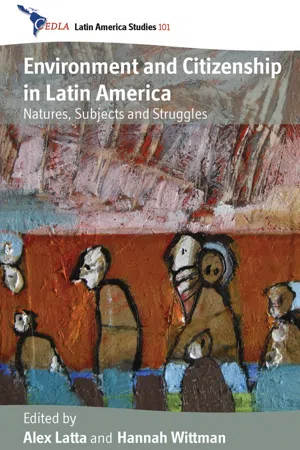
Environment and Citizenship in Latin America
Natures, Subjects and Struggles
- 262 pages
- English
- ePUB (mobile friendly)
- Available on iOS & Android
eBook - ePub
Environment and Citizenship in Latin America
Natures, Subjects and Struggles
About this book
Trusted by 375,005 students
Access to over 1.5 million titles for a fair monthly price.
Study more efficiently using our study tools.
Information
1 Citizens, Society and Nature
Sites of Inquiry, Points of Departure
Alex Latta and Hannah Wittman
‘What science has identified as the ancestor of corn is a grass: teosintle. It is a grass from which corn emerged only as a result of an exchange between this grass and humans. In this respect, corn is the product of a dialogue between the human and the vegetable worlds … corn could not have been created unless humans started to converse with teosintle. To understand this is to understand the world in a very different way. … In the past, corn taught us to be humans. Today, at a time when the market rules, what we believe is that corn can help us once again to recuperate our humanity.’
—Amado Ramírez Leyva, Mixtec restaurant owner and food activist in Oaxaca, Mexico (quoted in Poole and Alonso Rascón 2009, 32–33)
‘If they want to begin to pay us a little of the debt that the winka have with us mapuche, if they insist on giving me something of their modernity, I will wait for it here on my land, and I will see what parts of it are useful to me, what I will take from it, but I will not in exchange abandon the spirits of my landscape.’
—Nicolasa Quintremán Kalpán, Mapuche-Pewenche elder speaking of her resistance to the Ralco hydroelectric project on the Bío Bío River, in Southern Chile (quoted in Chihuailaf 1999, 143, our translation)
‘Bebo agua, luego existo, luego voto.’ (I drink water, therefore I exist, therefore I vote.)
—Graffiti in Cochabamba, Bolivia (Perreault 2010)
These words from Latin American activists remind us of something fundamental about the politics of the environment. They reaffirm that nature is not only an object of social struggle, but is also inextricably intertwined with the very voices that render the environment political. This book explores that intertwining, examining the way that socio-political subjects are mutually constituted with the ecological practices and institutions that they create, defend and reshape over time. To do so it draws on the concept of citizenship – a category of being that rests at the centre of modern forms of political order. Debates about environmental citizenship have taken on strategic importance for scholars, policy makers and civil society actors as they rethink individual and collective engagement with ecological challenges. This volume in part aims to build on these debates, but we also invite readers to revisit dominant conceptions of what it means to study environmental questions through the lens of citizenship. In particular, the chapters in this collection demonstrate that addressing socio-ecological relationships and struggles in the Global South requires nuanced attention to the ways citizenship itself is constituted and contested. As such, our premise is not simply that the lens of citizenship can shed new light on the politics of nature, but also that debates and conflicts over the fate of nature can help us better understand what is at stake in the politics of citizenship in Latin America and beyond.
Latin American Articulations of Citizenship and Environment
Latin America provides a rich context for research on the environmental dimensions of citizenship: its cultural diversity, its shared histories of conflict, and the multiplicity of specific ecological and territorial landscapes as exemplified in an array of indigenous cosmovisions. With a fraught and uneven history of conquest, imperialism, ethnic conflict and resource-related economic development, Latin America presents a complex field of socio-ecological relations. It is home to political cultures informed by a range of influences, including European traditions, such as republicanism, liberalism and Marxism; social and political traditions specific to the settler societies of the region, such as the Bolivarian revolution and Paulo Freire’s pedagogy of the oppressed; and, principally, a long heritage of indigenous socio-political institutions, from the Mayan usos y costumbres to the Mapuche admapu. Each of these various political traditions is embedded in specific visions of socioecological relations, from the Quichua’s social organization of cultivation linked to reverence for the pachamama to liberalism’s institutions of private property. These political-ecological inheritances are constantly being reinvented and recombined, as witnessed in the Zapatista autonomous municipalities of Mexico, the Brazilian landless workers movement and the indigenous recuperation of the state in Bolivia.
During the latter part of the twentieth century, Latin American societies emerged from an era of authoritarian regimes and began processes of democratic renewal, with the environment becoming one of the first issues around which civil society movements coalesced. As a reflection of the ecological pressures associated with rapid modernization and globalization, based largely on the export of agricultural products and natural resources, the environment has remained an enduring theme of public debate and popular protest. This political ferment around environmental issues has made important contributions to new characterizations of the rights, responsibilities and relations of citizenship in Latin America, bridging the concerns of environmental justice, democratic participation and livelihoods (Latta and Wittman 2010).
Constitutional changes in Brazil, Argentina, Colombia, Peru and Venezuela have variously reconsidered rights related to access to land and a healthy environment (Gudynas 2009), while Ecuador’s 2008 constitution goes so far as to provide rights to nature itself. Articulating these changes to the global scale, in 2004 the United Nations Environment Program (UNEP) launched a Latin America Global Environmental Citizenship Project (Unep/Pnuma 2006). This has been followed by other formal recognitions of the relationship between environment and citizenship, including the Peruvian Ministry of Environment’s 2009 Environmental Citizenship Prize, Brazil’s Secretariat of Institutional Articulation and Environmental Citizenship and Chile’s Youth National Environmental Citizenship Day.
Reflecting these trends, scholarship related to environmental questions in Latin America has increasingly incorporated themes related to citizenship. Researchers working with rural and indigenous peoples have probed relationships that link the politics of land, livelihood and identity, often in the context of struggles for political recognition and agency (see, for example, Yashar 2005; Latta 2007a; Postero 2007; Nuijten and Lorenzo 2009; Wittman 2009, 2010); others studying democratization and institutional reform in the environmental sector have looked to citizen participation processes as key facets in new modes of governance (Menegat 2002; Palerm and Aceves 2004; Bachmann, Delgado and Marín 2007; Walker et al. 2007); an emerging literature on environmental justice in the region also crosses into questions of democracy and participation (Hochstetler and Keck 2007; Carruthers 2008); and efforts to historicize the political ecology of specific resources, such as water or fossil fuels, have linked struggles over these resources to the evolution of citizenship and popular imaginaries of the nation (Castro 2006; Perreault and Valdivia 2010).
In the current Latin American conjuncture a period of formal democratic consolidation has been more-or-less completed in a series of countries that experienced dictatorial regimes during the second half of the twentieth century. Nevertheless, the depth of the democratic transition in many of these nations remains in flux, not least because democracy returned under market conditions that have produced profound cultural shifts away from collective modes of popular mobilization, along with a simultaneous narrowing of the ideological spectrum among members of the political class. In this context the increasing linkage of environment and citizenship in Latin America, both within a top-down policy discourse of environmental rights and obligations and as an empirical dimension of socio-political conflicts reshaping citizenship from the bottom up, poses a new series of questions for scholars and practitioners alike.
Environmental Citizenship: A Contested Concept
Over the past decade, debates about environmental citizenship have risen to prominence in the field of environmental politics, with some crossover into interdisciplinary scholarship rooted in other areas of the social sciences. These debates have rejuvenated perennial discussions about the links between ecology and democracy, as well as the socio-political conditions required to cultivate sustainable development. There are a number of key insights and conversations within the literature that serve as important points of reference as we orient ourselves to the task of building a research agenda around environment and citizenship in Latin America. The first of these points is related to alternate philosophical frameworks for citizenship. There are several traditions that vie for precedence in the way that the ecological dimension is integrated into the institutions and practices of citizenship, most strongly evident as a debate between liberalism, with its emphasis on rights (see Hayward 2002; Bell 2005; Hailwood 2005) and republicanism, which places a much stronger accent on obligations or virtues (see Smith 1998; Dobson 2003). As social actors draw on the language of citizenship to shape their identities and political projects they draw alternately or simultaneously on these overarching traditions, with different implications for the way that nature is articulated to the political sphere.
A second important dimension of the literature on environmental citizenship deals with issues of scale and the territoriality of formal political communities within the modern nation-state. A series of scholars have argued that there is a problematic disconnect between the spatial characteristics of ecological problems and conflicts, on the one hand, and the traditional containers of political community, on the other (see Newby 1996; Jelin 2000; Valencia Sáis 2005). In an example of one widely cited response to this disjuncture, Andrew Dobson (2003) has argued that the notion of the ecological footprint promises a new way of constituting citizenship obligations, where political community is reimagined according to the material relationships that link together human communities across vast distances. For Dobson this is a powerful way of linking citizenship to justice. He is particularly concerned that consumers in the Global North recognize and act to reduce the size of their ecological footprint on ecological systems and human communities in the Global South. We can equally see how rethinking the territorial basis for citizenship helps make sense of the growth of transnational activist networks, as a response in the political sphere to the tremendous deterritorialisation of economic and commodity flows.
A third strand of scholarship on environmental citizenship has focussed on deliberation as a core tenet of democratic citizenship, emphasizing the way that deliberative approaches to education and political contest can advance the incorporation of ecological questions into public consciousness and offer more scope for broadly participatory decision making on environmental questions (see Barry 1999; Carlsson and Jensen 2006; Schlosberg, Shulman and Zavestoski 2006). Though it currently comprises a more limited piece of the scholarship on environmental citizenship, this approach has affinities with a broader literature on deliberative theories of green democracy (see Barns 1995; Dryzek 2000).
While the literature on environmental citizenship offers many insights relevant to the issues and cases addressed by the contributors to this book, three key limitations are worth highlighting. First, environmental citizenship emerged most strongly as a normative theoretical project aimed at rethinking citizenship according to the imperative of responding to ecological crisis. As a result of this orientation, academic debates on environmental citizenship are often significantly removed from the lived experience of ‘actually existing’ citizenly agency vis-à-vis environmental questions. In a second related problem, some of the strongest voices in the existing literature are those linked to the republican project of cultivating responsible environmental citizens. An obligations approach to citizenship can risk depoliticizing ecological questions by locating citizen action in the context of individual behavioural change, rather than political debate and collective struggle. Recent empirical work on environmental citizenship bears out our concern about this risk, as an increasing number of researchers go in search of ‘good’ environmental citizens, as part of efforts to test whether increased knowledge of ecological problems actually prompts individuals to change their attitudes and behaviours (see Flynn, Bellaby and Ricci 2008; Jagers 2009; Wolf, Brown and Conway 2009).
The final limitation of existing conceptions of environmental citizenship is linked to a geographical bias in the literature, which has thus far paid little attention to empirical contexts in Latin America and other regions of the Global South. Preoccupied with the cultivation of ‘green’ behaviour among rapaciously consuming citizens in the North, researchers have generally failed to probe the interface of environment and citizenship from the perspective of political subjects whose relationship to the environment is defined instead by the ecological dimensions of socio-economic marginalization. As we approach this interface in the Latin American context it is crucial to be aware that the history of socio-ecological struggle in the region is markedly different from the environmentalism of North America or Europe. Characterizing the Brazilian environmental movement, Angus Wright (2008) observes that in the face of extreme inequality, a lack of state accountability and a culture of impunity for the economic elite, there is a certain urgency to the question of citizenship itself that colours popular ecological struggles in the region (see also Hochstetler and Keck 2007). In Brazil and elsewhere in Latin America, the politics of nature closely link struggles for recognition and inclusion in the political collective with simultaneous struggles for economic and ecological survival. In this sense, it is important to heed the call from political ecologists to pay attention to how unequal power relations take shape across multiple fields, conflicts and territorial spaces (see Bryant and Bailey 1997; Díez and Dwivedi 2008).
The research agenda that we propose in response to these limitations is broadly framed by our attempt to remedy the theoretical and geographical biases of current debates, proposing Latin America as a new site of empirical exploration. We assert that Latin America provides a host of experiences that can help engender theoretical and methodological innovation to address the conceptual limitations of environmental citizenship described above, while a focus on citizenship can help us better understand what is at stake in the environmentalism of the South. The chapters in this collection remind us that environmental questions are almost always already tangled with struggles over the shape of citizenship identities, institutions and practices. In seeking to tease apart these relationships we draw on immanent critiques of environmental citizenship, including some of our own existing contributions, emphasizing two key points of departure. First, as Liette Gilbert and Catherine Phillips (2003) sustain, citizenship constitutes not a set of static rights and duties but rather a dynamic space of struggle, within which rights can be claimed. In other words, even as nature is politicized by citizens enacting their political and ecological subjectivities, such enactment in turn involves an active reshaping of those subjectivities. This is particularly true when subaltern political subjects are the ones to bring environmental questions into political debate, since their efforts to politicize nature are simultaneously encapsulated in demands that their voices be heard by the broader political community – that their full citizenship in that community be recognized and honoured.
The second key point of departure for conceptual innovation has to do with the way that the dynamic relationship between environment and citizenship is also bound up with other dimensions of social life. Sherilyn MacGregor (2006a, 2006b), for instance, argues that the new responsibilities invoked by the notion of environmental citizenship do not play evenly across different fields of social experience. In particular, she highlights the particularity of women’s experiences of both participatory democracy and citizen responsibility in a world characterized by gender inequality. In this light, she proposes an understanding of citizenship where nature and gender are simultaneously contested. We might equally insert race, identity or class into the equation, as dimensions of socio-political life that have an undeniable bearing on the way citizenship’s articulation with environment is experienced and contested by different actors. These and other contributions to the debate (see Jelin 2000; Latta 2007b; Gabrielson 2008; Wittman 2010) begin to take us beyond the scope of citizenship that is merely environmental (in the sense of being ‘green’) and into an analytical domain where citizenship instead serves as a node or crucible where ecological questions become politicized together with an array of other issues fundamental to the very shape of the polities, ecologies, societies and conflicts that citizens inhabit. This treatment of citizenship thus sheds new light on the convergent politicization of nature and human marginality in response to the hegemonic projects of development, modernization and globalization (Díez and Dwivedi 2008).
Sites of Inquiry
While the contributions to this collection are characterized by a series of crosscutting empirical concerns and analytical orientations, we have grouped them according to the way in which particular chapters foreground three central thematic elements. The first section draws out the co-construction of nature and social subjectivity around questions of citizenship. The chapters in part two analyse dynamics of marginalization and the struggles for recognition and justice that rise in response. The final selection of chapters takes a closer look at the relationships between citizens and states in shifting regimes of environmental governance. In what follows we offer a preliminary orientation to each of these three sections of the book.
Assembling Nature’s Citizens
The literature on environmental citizenship is mostly based on the assumption that citizenship needs to be made environmental in various ways, implying an original ontological separation of nature and society. Instead, we assert that nature and socio-political subjectivity are mutu...
Table of contents
- Cover Page
- Title Page
- Copyright Page
- Contents
- Acknowledgements
- Chapter 1. Citizens, Society and Nature: Sites of Inquiry, Points of Departure
- Assembling Nature’s Citizens
- Environmental Marginality and the Struggle for Justice
- Citizens, Environmental Governance and the State
- List of Contributors
- Index
Frequently asked questions
Yes, you can cancel anytime from the Subscription tab in your account settings on the Perlego website. Your subscription will stay active until the end of your current billing period. Learn how to cancel your subscription
No, books cannot be downloaded as external files, such as PDFs, for use outside of Perlego. However, you can download books within the Perlego app for offline reading on mobile or tablet. Learn how to download books offline
Perlego offers two plans: Essential and Complete
- Essential is ideal for learners and professionals who enjoy exploring a wide range of subjects. Access the Essential Library with 800,000+ trusted titles and best-sellers across business, personal growth, and the humanities. Includes unlimited reading time and Standard Read Aloud voice.
- Complete: Perfect for advanced learners and researchers needing full, unrestricted access. Unlock 1.5M+ books across hundreds of subjects, including academic and specialized titles. The Complete Plan also includes advanced features like Premium Read Aloud and Research Assistant.
We are an online textbook subscription service, where you can get access to an entire online library for less than the price of a single book per month. With over 1.5 million books across 990+ topics, we’ve got you covered! Learn about our mission
Look out for the read-aloud symbol on your next book to see if you can listen to it. The read-aloud tool reads text aloud for you, highlighting the text as it is being read. You can pause it, speed it up and slow it down. Learn more about Read Aloud
Yes! You can use the Perlego app on both iOS and Android devices to read anytime, anywhere — even offline. Perfect for commutes or when you’re on the go.
Please note we cannot support devices running on iOS 13 and Android 7 or earlier. Learn more about using the app
Please note we cannot support devices running on iOS 13 and Android 7 or earlier. Learn more about using the app
Yes, you can access Environment and Citizenship in Latin America by Alex Latta, Hannah Wittman, Alex Latta,Hannah Wittman in PDF and/or ePUB format, as well as other popular books in Biological Sciences & Civics & Citizenship. We have over 1.5 million books available in our catalogue for you to explore.