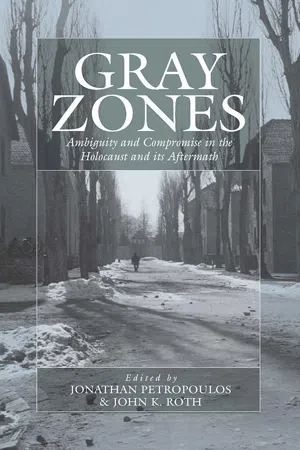
Few essays about the Holocaust are better known or more important than Primo Levi's reflections on what he called "the gray zone," a reality in which moral ambiguity and compromise were pronounced. In this volume accomplished Holocaust scholars, among them Raul Hilberg, Gerhard L. Weinberg, Christopher Browning, Peter Hayes, and Lynn Rapaport, explore the terrain that Levi identified. Together they bring a necessary interdisciplinary focus to bear on timely and often controversial topics in cutting-edge Holocaust studies that range from historical analysis to popular culture. While each essay utilizes a particular methodology and argues for its own thesis, the volume as a whole advances the claim that the more we learn about the Holocaust, the more complex that event turns out to be. Only if ambiguities and compromises in the Holocaust and its aftermath are identified, explored, and at times allowed to remain--lest resolution deceive us--will our awareness of the Holocaust and its implications be as full as possible.
eBook - PDF
Gray Zones
Ambiguity and Compromise in the Holocaust and its Aftermath
- 440 pages
- English
- PDF
- Available on iOS & Android
eBook - PDF
Gray Zones
Ambiguity and Compromise in the Holocaust and its Aftermath
About this book
Information
Table of contents
- Series Page
- Title Page
- Copyright Page
- Table of Contents
- Prologue
- Part I: Ambiguity and Compromise in Writing and Depicting Holocaust History
- Chapter 1 The Ambiguities of Evil and Justice
- Chapter 2 "Alleviation" and "Compliance"
- Chapter 3 Between Sanity and Insanity
- Chapter 4 Sonderkommando: Testimony from Evidence
- Chapter 5 A Commentary on "Gray Zones" in Raul Hilberg's Work
- Chapter 6 Incompleteness in Holocaust Historiography
- Part II: Identity, Gender, and Sexuality During and After the Third Reich
- Chapter 7 Choiceless Choices
- Chapter 8 "Who am I?" The Struggle for Religious Identity of Jewish Children Hidden by Christians During the Shoah
- Chapter 9 Hitler's Jewish Soldiers
- Chapter 10 A Gray Zone Among the Field Gray Men
- Chapter 11 Pleasure and Evil
- Chapter 12 The Gender of Good and Evil
- Part III: Gray Spaces: Geographical and Imaginative Landscapes
- Chapter 13 Hitler's "Garden of Eden" in Ukraine
- Chapter 14 Life and Death in the "Gray Zone" of Jewish Ghettos in Nazi-Occupied Europe
- Chapter 15 "Almost-Camps" in Paris
- Chapter 16 Alternate Holocausts and the Mistrust of Memory
- Chapter 17 Laughter and Heartache
- Chapter 18 The Holocaust in Popular Culture
- Chapter 19 The Grey Zone
- Part IV: Justice, Religion, and Ethics During and After the Holocaust
- Chapter 20 Gray into Black
- Chapter 21 Catalyzing Fascism
- Chapter 22 Postwar Justice and the Treatment of Nazi Assets
- Chapter 23 The Gray Zones of Holocaust Restitution
- Chapter 24 The Creation of Ethical "Gray Zones" in the German Protestant Church
- Chapter 25 Gray-Zoned Ethics
- Epilogue
- Select Bibliography
- About the Editors and Contributors
- Index
Trusted by 375,005 students
Access to over 1.5 million titles for a fair monthly price.
Study more efficiently using our study tools.
Frequently asked questions
Yes, you can cancel anytime from the Subscription tab in your account settings on the Perlego website. Your subscription will stay active until the end of your current billing period. Learn how to cancel your subscription
No, books cannot be downloaded as external files, such as PDFs, for use outside of Perlego. However, you can download books within the Perlego app for offline reading on mobile or tablet. Learn how to download books offline
Perlego offers two plans: Essential and Complete
- Essential is ideal for learners and professionals who enjoy exploring a wide range of subjects. Access the Essential Library with 800,000+ trusted titles and best-sellers across business, personal growth, and the humanities. Includes unlimited reading time and Standard Read Aloud voice.
- Complete: Perfect for advanced learners and researchers needing full, unrestricted access. Unlock 1.5M+ books across hundreds of subjects, including academic and specialized titles. The Complete Plan also includes advanced features like Premium Read Aloud and Research Assistant.
We are an online textbook subscription service, where you can get access to an entire online library for less than the price of a single book per month. With over 1.5 million books across 990+ topics, we’ve got you covered! Learn about our mission
Look out for the read-aloud symbol on your next book to see if you can listen to it. The read-aloud tool reads text aloud for you, highlighting the text as it is being read. You can pause it, speed it up and slow it down. Learn more about Read Aloud
Yes! You can use the Perlego app on both iOS and Android devices to read anytime, anywhere — even offline. Perfect for commutes or when you’re on the go.
Please note we cannot support devices running on iOS 13 and Android 7 or earlier. Learn more about using the app
Please note we cannot support devices running on iOS 13 and Android 7 or earlier. Learn more about using the app
Yes, you can access Gray Zones by Jonathan Petropoulos,John Roth in PDF and/or ePUB format, as well as other popular books in History & German History. We have over 1.5 million books available in our catalogue for you to explore.