The civil war in Sri Lanka and the part that nationalism seemed to play in it inspired the writing of this book some twenty-three years ago. The argument was developed through a comparative analysis of nationalism in Sri Lanka with the author's native Australia. At the time this constituted an innovative approach to comparison in anthropology, as well as to nationalism and its possibilities. It was not based on differences but on the way in which perspectives from within the two nationalisms, when seen side-by-side, could present an understanding of their implication in producing the violence of war, racism, and social exclusion. The book has lost none of its importance and urgency as proven by the chapters in the Appendix, written by top scholars working in Sri Lanka and in Australia. These contributions bring together new material and critically explore the book's themes and their continued relevance to the various trajectories in nationalist processes since the first publication of the book.
eBook - ePub
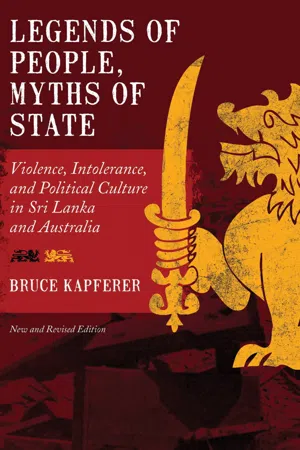
Legends of People, Myths of State
Violence, Intolerance, and Political Culture in Sri Lanka and Australia
- 446 pages
- English
- ePUB (mobile friendly)
- Available on iOS & Android
eBook - ePub
Legends of People, Myths of State
Violence, Intolerance, and Political Culture in Sri Lanka and Australia
About this book
Trusted by 375,005 students
Access to over 1.5 million titles for a fair monthly price.
Study more efficiently using our study tools.
Information
1
Cultures of Nationalism
Political Cosmology and the Passions
Nationalism makes the political religious and places the nation above politics. The nation is created as an object of devotion and the political forces which become focused upon it are intensified in their energy and passion. The religion of nationalism, wherein the political is shrouded in the symbolism of a “higher” purpose, is vital to the momentum of nationalism. This momentum, which if anything is on the increase, has been among the most liberating, but also among the most oppressive and destructive, political energies of this century. The religious form of nationalism which is so much part of this process has engulfed social and other religious and political ideas and doctrines—liberal democracy, communism, socialism, fascism, and anarchism—in its path. These have all become subordinate to the nationalist purpose and have received renewed energy and have been transformed or fashioned within the religion of nationalism.
Culture has assumed pride of place in the litany of nationalisms everywhere. Almost universally the culture that nationalists worship is those things defined as the founding myths and legends of the nation and the customs and traditions and language of the nation. These are at once constituted within the nation and constitute the nation. They are integral to national sovereignty and are made sacred in the nation as the nation is made sacred in them. The customs, language, and traditions of the nation are often referred to as primordial, the root essence of nationalism and national identity, those that generate the feeling or sentiment of national unity and legitimate national independence. This primordial value of culture is intrinsic to nationalist religion. It is a value emergent in the historical circumstances of the growth of nationalism. The primordialism of the cultural in nationalism is the construction of nationalism itself and is not to be regarded as independent of nationalism.
Culture in nationalism is seen in a particular way. It becomes an object, a reified thing, something which can be separated or abstracted from its embeddedness in the flow of social life. Made into a religious object, culture becomes the focus of devotion. It can have the character of a religious fetish, an idol, a thing which has self-contained magical properties capable of recreating and transforming the realities of experience in its image. This appearance of culture in the religion of nationalism has a basis in fact. Culture spiritualized has indeed become an instrument in the forging and defining of nation and in the perpetration of some of the most appalling crimes against humanity the world has yet known (Mosse 1970). Such nationalist passion can be seen to be generated in the act of religious contemplation of culture in which a national self and a national other are defined and receive significance in the explanation of evil and suffering. This, as Hegel foresaw in his examination of the French revolutionary Jacobin Terror, can be seen as being at the root of the modern human devastations of nationalism. Hegel likens the Terror to a “Hindu fanaticism of pure contemplation,” which is not apart from the world but is rather engaged in the practices of lived political and social realities.
It takes place in religion and politics alike as the fanaticism of destruction—the destruction of the whole subsisting social order—as the elimination of individuals who are objects of suspicion to any social order, and the annihilation of any organization which tries to arise anew from the ruins. Only in destroying does this negative will possess the feeling of itself as existent (Hegel 1952, 5:22).
In this book I shall explore two modern nationalisms, Sinhalese Buddhist nationalism and Australian egalitarian nationalism. Both have realized their existence in destruction. Death and extinction are key symbolic aspects of their life, as Benedict Anderson (1983) has noted for nationalism more widely. Sinhalese nationalism is constructed out of its myths of history and the deeds of its heroes, wherein Tamils threaten to destroy or subsume Sinhalese but are themselves conquered and destroyed. These ideas are integral to the modern social and political practice of nationalism in Sri Lanka and are part of a current tragedy, and in the fires of its passions, Sinhalese, and especially Tamils, are being consumed. Australian nationalism gathers its religious focus in the flames of the destruction of war. In the midst of death and extinction are born the legends of Australian national identity. These legends, which contain the spirit of national liberation no less than do the myths of Sinhalese nationalists, also have force in the cause of human suffering. The passion of their ideas in practice bears a relation to certain forms of intolerance and prejudice in Australia. These are destructive and are certainly instrumental in the anguish of those against whom they are directed, as they may also be of those who engage them.
Australians may object that the ideas and practice of their nationalism should be brought into association with that which is being experienced in Sri Lanka at present. The scale of human suffering in the present nationalism of Sri Lanka hardly bears comparison, and most Australians would not consider such internal conflagration thinkable, let alone possible. After all, to cite the title of a well-known book critical of Australian serendipity—a word derived from Serendib, the Arab name of Sri Lanka—Australia is a Lucky Country, free from the suffering of other far-distant realities. But Australians should be conscious of the terrible destruction in the past of the Australian Aborigines, a destruction made possible in the practice of ideas that underline much Australian nationalist thought. I should add that the argument of Australian nationalism is cognate with European nationalisms that have wrought the greatest human destruction of this century.
I am concerned with the religious form of nationalism and with the influence of culture, as defined by nationalists, in this religious form. Their conjunction in the production of nationalist passions which can manifest great human anguish and suffering is a primary focus of this analysis. Australia and Sri Lanka are the settings in which I explore this issue and through which I consider modern nationalism more generally. Their nationalisms highlight what I think has been obscured in scholarly and more popular debate concerning the phenomenon of nationalism. There has been a tendency to assume that because nationalism is a worldwide phenomenon it is necessarily universal in form. This is so in the hard-nosed, down to earth, sociological universalism of Gellner (1983), who considers all nationalism to be basically founded in the same social and material conditions, and in the culturism of Geertz (1973; see also Anderson 1983), who conceives of nationalism broadly as cleaving to a similar religious attitude and form (Kapferer 1987). Kedourie (1985) in an important work on European nationalism almost takes a diffusionist stance. Nationalism born in the emergence of a European individualism is an exported spiritual commodity which varies around the same ideological themes. From the Marxist point of view it is generally argued that nationalism is a product of European colonialism, capitalist expansion, the creation of international and local bourgeoisies, an instrument in class domination, and so on. I do not dispute the significance of these views of the nature and force of modern nationalism.
There is much that is common to nationalism throughout the world in its cultural and social process. Many nationalisms have spawned yet other nationalisms, which have assumed variant form in the cultural dialectics of their political resistance and reaction. Many aspects of Sinhalese and Australian nationalism are similar. Their roots are in the circumstances of British colonialism and their elites are often inclined toward English values despite their overt rejection of these values. The internal political forces of their nationalisms are to be seen in the context of wider capitalist processes in which the conflicts of class in both countries are constituted. Both Australian and Sinhalese nationalism, in their specific historical settings, obscure the grounds of class conflict and unite otherwise opposed classes in the force of their nationalism.
Despite their similarities some nationalisms are radically distinct in their religious form and in what I describe as their political culture. In other words, what is reified as the culture of particular nationalisms sometimes contains an argument that is far from reducible to nationalism, generally. It is an argument that elaborates a specific political universe which points to or highlights certain significant meanings over others in the social and cultural worlds of experience. The meanings accentuated, moreover, carry implications for further action and, I suggest, can motivate action in accordance with the direction of the nationalist argument. I am not presenting an idealist view, one which gives to nationalist ideas a determination of their own. They gain their determination through the political and social structures and processes of the worlds of which they are already a part. Their force is generated, as I shall demonstrate, by their action within and upon a wider spectrum of situated ideas and meanings which are possibly more complex, multivalent, and various than those present and selected within a culture of nationalism—its particular collection of significant myths and traditions.
The “cone of light” that a culture of nationalism casts over a diverse cultural and social reality is one that illuminates the same insistent message. The culture of nationalism or the meanings of a nationalist ideology tend to be coherent and systematic. They are totalitarian in form or tend increasingly in this direction in the historical and political settings in which they gather force. As such, supported dialectically by the political events to which they yield significance and further impetus, they mold diverse realities within their uniform message. Realities once multiple and even distinct begin to refract similar messages and to shine with the same burning light that is shone over them. The political and social settings in which a culture of nationalism finds significance begin to assume its totalitarian form and with all too frequent tragic result. In this sense nationalism is vital in the creation and transformation of cultural and political realities. It conditions what it reflects, and this is critical to my understanding of the power of the cultures of nationalism in giving direction to action and in firing the passions.
The religions of Sinhalese and Australian nationalism are distinct in their argument and these arguments, or what I shall refer to at different points as their logic or structures of reasoning (Hacking 1982, Rabinow 1986), are part of their religious form and integral to their religious passion. Here I expand on the discussion of Benedict Anderson (1983) on the religion of nationalism. Anderson, I think correctly, identifies some of the distinctive religious features of nationalism in general. He concentrates upon the universalization of temporal and spatial schemes in modern nationalism whereby all in the nation are conceived of as progressing in unison through the one space and time. The historical circumstances that yield these conceptions account, in Anderson’s analysis, for the spread of the religion of nationalism and for its power in human action and emotion. I agree with this view and with Anderson’s important statement that nationalism is very different in form from the universalizing cosmic religions it has apparently supplanted. The specific directions taken by the actions of certain nationalisms, however, boil down eventually to a consideration of historical specificities. While this is valid, Anderson undervalues aspects of the particular arguments which modern nationalisms may transformationally incorporate into their religious schemes. These arguments extend an understanding of the force of the nationalist imagination which Anderson explores.
Before I outline those arguments of Sinhalese and Australian nationalism that are important to the discussion of this book, I wish to stress that the religions of nationalism I shall examine are not religious by virtue of the religions they may incorporate. Much modern nationalism declares its religion to be synonymous with the religion it subsumes—an Islamic nationalism, a Christian Democratic nationalism, Hindu nationalism. I note, however, that the religions so harnessed to nationalism are often regarded as purified and more orthodox than before. Here is the point, they are purified in their nationalist incorporation. Nationalists, in effect, declare their nationalism to be a higher religious form than those erstwhile universalist religions they appear to supplant. The religious fundamentalism, moreover—the purification of religion or religious “revitalization” or revivalism—that is so often linked to modern nationalist movements highlights the fundamentalist and revivalist character of nationalism itself. I suggest that it is the fundamentalism of nationalism—of which the primordialism of nationalism and the search for the essence of national identity are aspects—which conditions the fundamentalism of the religions that are incorporated into nationalism. The fundamentalism of nationalism is, of course, directly connected with the totalitarian form of nationalist religion, by no means intrinsic to the religion subsumed by nationalism, and with the systematic coherence of nationalist political culture to which I have already referred.
It follows from the foregoing that one modern nationalism is not necessarily more or less religious than another. Australians assert a secular nationalism, Sinhalese an expressly Buddhist nationalism. What I stress is that the religion of nationalism is in nationalism per se and not in the religious ideas it may incorporate. Australian nationalism displays its religious form in its rejection of the religious, in the same way that Sinhalese nationalism develops its religious form in the assertion of Buddhism and the active incorporation of it.
I do not state that the religious ideas that may be included in modern nationalism are irrelevant to an understanding of the religious form of nationalism and its political process. Far from it. Such a suggestion would contradict much of the thrust of my discussion in this book. Australian nationalism, its secularism notwithstanding, derives some of the force behind its argument from its elaboration within the historical and cultural world of Western Christianity quite as much as Sinhalese nationalism gains its power within a Buddhist historical world. What I am saying is that the religion of nationalism, in relation to its historical, social and political context, transforms or interprets the import of the religious ideas and themes it incorporates within its own religious scheme.
Buddhism, for example, gains its significance within the religion and practice of Sinhalese nationalism and not vice versa. While Sinhalese nationalism may be Buddhist, the Buddhism which is brought to consciousness is that conditioned within the nationalist process. The Buddhist ideas practiced by Sinhalese and to which they refer are wide and various. Sinhalese nationalism selects within the many possibilities of Buddhism in practice and realizes a particular logic, a logic made integral to Sinhalese nationalism and forceful to its process.
Tambiah makes a similar point in the setting of Thai Buddhist nationalism. I cite his statement for its relevance especially to my later analysis of Sinhalese Buddhist nationalism, which extends from a discussion of some of the important Sinhalese religious chronicles.
It must be stated at the outset that the canonical texts of Buddhism (just as the Bible of Christianity or the core texts of any other religion) are complex and rich in meaning … capable of different levels of interpretation. … Any perspective that naïvely assumes that there are certain unambiguous prescriptions and value orientations in Buddhism from which can be deduced behavioral correlates that bear an intrinsic and inherent relation to the religion is inaccurate, usually misguided, and sometimes pernicious. In other words, the question of the nexus between Buddhism and this-worldly conduct is more open than has been imagined by certain scholars, including the illustrious Max Weber (Tambiah 1976, 402.)
To clarify my own argument as well, the import of Buddhism or any religion is inextricably part of its practice, which includes its interpretation. The Buddhism of Sinhalese nationalism is a Buddhism of nationalist practice and interpretation, a Buddhism reconstituted in the religion of nationalism. The violence, destruction, and prejudice of Sinhalese and Australian nationalisms are not to be reduced to an essential Buddhism or Christianity, for example, which exist outside the import and significance they achieve within nationalism. The energy and force of Buddhist and Christian themes are formed and realized in the religious order of nationalism itself.
The reasoning of Sinhalese and Australian nationalism is contained in their respective cosmologies, in the myths, legends, and other traditions to which these nationalisms accord value. The logic of their cosmologies is revealed in the hermeneutics of the rites of the nation, in the interpretations of the cultural world of the nation offered by such rites, and in other ritual events that nationalists may value or to occurrences in daily experience which their myths and traditions may render sensible.
The conceptions of the nation, of the state, of power, and of the person are very different in Sinhalese Buddhist nationalist cosmology from their conception in Australian nationalist cosmology. The thesis of this book is centered on this difference, for I shall argue that the dynamics of the respective nationalisms, their religious ideological force within the wider cultural worlds of which they are a part, the character of the suffering they can engender, and the significance that the human beings caught in their schemes routinely attach to events in their lives influencing their action, are integral to the arguments elaborated within these nationalist cosmologies. I shall outline some of the critical differences.
Broadly, I consider that in Sinhalese Buddhist nationalist cosmology the nation and the state compose a unity. In cosmological conception the state protectively encloses the nation of Sinhalese Buddhists, whose integrity as persons is dependent on this encompassment. The state in such a conception encloses other peoples or nations who are not Sinhalese Buddhists. But critical here is that these peoples are maintained in hierarchical subordination to Sinhalese Buddhists. The encompassing and ordering power of the state is hierarchical, and the integrity of nations, peoples, and persons within the Sinhalese Buddhist state is dependent on the capacity of the state to maintain by the exercise of its power the hierarchical interrelation of all those it encloses. The failure in the power of the Sinhalese Buddhist state to maintain hierarchy in the whole order it circumscribes threatens the integrity of persons. Thus the fragmentation of the state is also the fragmentation of the nation and is also the fragmentation of the person.
Australian nationalist cosmology places the nation and the state in ambivalent relation. In the populist traditions of Australian nationalism, the nation includes the state. The state achieves its integrity in the will of the nation and the people. The integrity of persons as autonomous and discrete individuals is a property of individuals per se. Indeed, the ordering power of the state potentially disorders the integrity of persons. This is so when the state moves into dominant and inclusive relation to the nation. Ideally, I suggest, in Australian nationalism the power of the state mediates between nations, peoples, and persons. Australian identity is not founded in an Australian state, as it is in Sinhalese Buddhist nationalism, but in the Australian nation conceived as separate from the state. In Australian nationalism the subsumption of the Australian nation within the power of the state can be a manifestation of the malign force of the state whereby personal autonomy and integrity are destroyed. The conception is radically different from Sinhalese Buddhist nationalism wherein the state is a benign force in its ordering encompassment. The nation and the person are vital and whole within such ordering power. Unlike the Australian conception, the incapacity of the state to encompass and to establish an hierarchical order in Sinhalese Buddhist nationalism transforms the state, for example, into a malevolent form that destroys the person.
The contrast I have drawn builds upon the comparative work of Louis Dumont (1977, 1980, 1986), which is based on his researches into Indian and European ideological systems. He makes a distinction between the hierarchical world of India and the conceptual realities of European and North American ideologies founded in egalitarianism and the valuation of the individual. I shall not develop upon Dumont uncritically. Neither, I should add, am I concerned to argue within his schema alone. Tambiah (1976) and many others are important to my understanding of the Sinhalese Buddhist material. But it is Dumont more than any other anthropologist of whom I am aware who has directed his ethnographic researches and related knowledge of the texts toward the comparative understanding of ideology. This is so in the sense that he has explored the inner logic of different and variant ideological forms and with reference to such burning modern issues as nationalism. I must freely acknowledge Dumont’s influence, but at the same time the reader should note that there are aspects of Dumont’s larger intellectual project which I do not share.
I am not concerned to demonstrate that hierarchy, for example, is universal or to show that Western egalitarianism and individualism are later transformations upon hierarchical conceptions. This has been an issue of wide scholastic discussion, and the argument made by Dumont is but one among many. In the ideological context of political debate Dumont’s position scares some hares. It opposes political positions right across the modern political spectrum from radical Marxists through anarchists to conservative populists.1 This is especially so where such positions are that equality and inequality are natural within humankind, integral to the autonomous individual as an empirical, biological, species being. Dumont demonstrates that such a position is an ideological construction, and he is committed to showing that its social forces are prejudice and the imprisonment of humanity, not necessarily its release. Much of his argument is that egalitarianism engages hierarchical conceptions within it and that it is the very ideological suppression of hierarchy and, it should be stressed, the transformation of the meaning of hierarchy in egalitarianism, which is part of the potential dehumanizing power of egalitarianism. More mundanely, Dumont is attacking conceptions comm...
Table of contents
- Cover Page
- Title Page
- Copyright Page
- Contents
- Preface to the New and Revised Edition
- Preface to the Paperback Reissue
- Introduction
- 1 Cultures of Nationalism Political Cosmology and the Passions
- Part 1 Evil and the State
- Part 2 People Against the State
- Notes
- References
- Appendices Legends of People, Myths of State and the Current Context: By Way of Introduction
- Index
Frequently asked questions
Yes, you can cancel anytime from the Subscription tab in your account settings on the Perlego website. Your subscription will stay active until the end of your current billing period. Learn how to cancel your subscription
No, books cannot be downloaded as external files, such as PDFs, for use outside of Perlego. However, you can download books within the Perlego app for offline reading on mobile or tablet. Learn how to download books offline
Perlego offers two plans: Essential and Complete
- Essential is ideal for learners and professionals who enjoy exploring a wide range of subjects. Access the Essential Library with 800,000+ trusted titles and best-sellers across business, personal growth, and the humanities. Includes unlimited reading time and Standard Read Aloud voice.
- Complete: Perfect for advanced learners and researchers needing full, unrestricted access. Unlock 1.5M+ books across hundreds of subjects, including academic and specialized titles. The Complete Plan also includes advanced features like Premium Read Aloud and Research Assistant.
We are an online textbook subscription service, where you can get access to an entire online library for less than the price of a single book per month. With over 1.5 million books across 990+ topics, we’ve got you covered! Learn about our mission
Look out for the read-aloud symbol on your next book to see if you can listen to it. The read-aloud tool reads text aloud for you, highlighting the text as it is being read. You can pause it, speed it up and slow it down. Learn more about Read Aloud
Yes! You can use the Perlego app on both iOS and Android devices to read anytime, anywhere — even offline. Perfect for commutes or when you’re on the go.
Please note we cannot support devices running on iOS 13 and Android 7 or earlier. Learn more about using the app
Please note we cannot support devices running on iOS 13 and Android 7 or earlier. Learn more about using the app
Yes, you can access Legends of People, Myths of State by Bruce Kapferer in PDF and/or ePUB format, as well as other popular books in Social Sciences & Politics. We have over 1.5 million books available in our catalogue for you to explore.