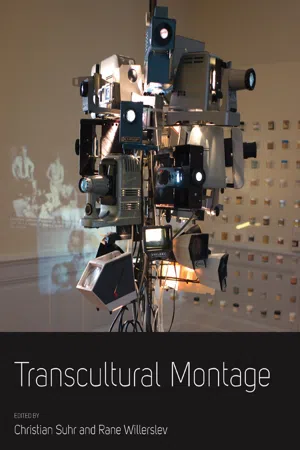
The disruptive power of montage has often been regarded as a threat to scholarly representations of the social world. This volume asserts the opposite: that the destabilization of commonsense perception is the very precondition for transcending social and cultural categories. The contributors—anthropologists, filmmakers, photographers, and curators—explore the use of montage as a heuristic tool for comparative analysis in anthropological writing, film, and exhibition making. Exploring phenomena such as human perception, memory, visuality, ritual, time, and globalization, they apply montage to restructure our basic understanding of social reality. Furthermore, as George E. Marcus suggests in the afterword, the power of montage that this volume exposes lies in its ability to open the very "combustion chamber" of social theory by juxtaposing one's claims to knowledge with the path undertaken to arrive at those claims.
- 300 pages
- English
- ePUB (mobile friendly)
- Available on iOS & Android
eBook - ePub
Transcultural Montage
About this book
Trusted by 375,005 students
Access to over 1.5 million titles for a fair monthly price.
Study more efficiently using our study tools.
Information
PART I
Montage as an Analytic
Considering the fragmented and fragmentary qualities of montage, it comes as no surprise that its audacious principle of juxtaposition has been adopted as a sort of “talisman” of modernity itself (Teitelbaum 1992: 7). Indeed, for filmmakers of a futuristic bend, such as Dziga Vertov and Sergei Eisenstein, montage was not just a technique but the key signifier of an old world shattered and a new industrial age in construction (Phillips 1992: 31). To their minds, the aim of cinematic montage was to “shock” viewers into embracing the new industrial age. However, while there is little doubt that new technological practices such as cinema became effective weapons in the fast and rapid dissemination of industrialization, montage cannot and should not be reduced to cinema, let alone the modern epoch. Much evidence suggests that the key techniques at work in montage predate cinema. Eisenstein, for example, claimed that a crucial inspiration for his theory of montage was the ancient Japanese tradition of haiku poems with their simple juxtapositions of words (1949: 32). Several of this volume’s contributors draw further attention to this insight that a more nuanced cultural history of montage is needed: one that recognizes that montage extends beyond what might be denoted the technologically modern. They do so by describing how the dynamics of montage reflect social and ritual practices in remote and rural areas of India and Africa, among other places. Applying montage as a heuristic model for anthropological analysis, they demonstrate how the concept allows for less subject-centered and more dexterous and flexible insights into social reality.
Bruce Kapferer (chapter 1) sets out to reinterpret the phenomena of ritual through the framework of montage as described in Gilles Deleuze’s (2000; 2005) works on cinema. Kapferer effectively reverts the evolution of modern cinema and what Deleuze calls the “time-image” by pointing out how an old anti-sorcery Buddhist ritual in Sri Lanka effectively anticipated the potential of cinematic montage with its way of shuffling the ritual participants through multiple and contradictory viewpoints. As he states: “aside from the obvious differences of cinema and ritual there is an underlying unity.” Kapferer shows that montage as an analytical model of ritual allows for an entirely new view of its transformative potential, which has been lost or at least downplayed in the customary takes on ritual as drama or theater. Ritual, Kapferer argues, is not primarily about subject-centered embodiment and the symbolic performance of mythology as many anthropologists have suggested. As in cinema, what is at stake in ritual is a continuous emerging, shaping, and reshaping of subject positioning that works to collapse any sense of singular bodily unity. Within both ritual and cinema, “perspective is multiple” and “interpretation and meaning are continually open.” Hence, as a Deleuzian montage machine, the Sinhala anti-sorcery ritual works by exploding the perspectives of the ritual participants, thereby allowing renewed access into the realm of the virtual.
Also drawing on Deleuze’s theory of montage, Morten Nielsen (chapter 2) takes issue with prevalent notions of social change as building on patterned acts of symbolic elicitation (see Wagner 1977: 631; Strathern 1988: 181). Nielsen is puzzled by peculiar forms of rather unpatterned, inconsistent, and heterogeneous cultural inventions that emerge in the pursuit of settling land disputes in Mozambique. To think his way through this, he introduces the “temporal aesthetics” of montage as an alternative approach to the study of elicitory processes. Just as montage is never tied exclusively to the image but rather constitutes a “third thing,” the oscillation of identities between “buyer” and “newcomer” in these land disputes never comes to rest in any one position. Instead, the elicitation of identity is the result of abrupt temporal shifts and cuts. To conquer land in rural Mozambique, then, is to produce oneself through techniques of montage, in shapes and contours which are never strictly given and which do not fit within any linear unfolding of stable identities.
From these case studies, it seems clear that montage is not, as some authors have suggested (Teitelbaum 1992; Marcus 1994), entirely synonymous with modernity, but is a formal principle at work in a broad range of artistic, cultural, religious, and political practices. There appears to be a need, therefore, to pluralize the notion of montage beyond cinema and its techniques of editing. In Mozambique and in the Sinhala Buddhist rituals, montage works as a transformer of commonsense perception. As such, montage is not a matter of direct perceptible experience alone but triggers a communicative spark between the concretely experienced and the imaginary or extra-real.
This take on montage resonates with Stuart McLean’s (chapter 3) suggestion that montage does not simply refer to visual or, by extension, textual, methods but rather is a mode of engagement with the world more generally. This montage mode of being-in-the-world, McLean identifies through comparisons of almost Frazerian proportions, ranging from volcanic eruptions in the North Atlantic to early twentieth-century poetry to European folk legends about human–animal metamorphosis. McLean’s overall message is that the reality of the “between” is not something to be explained under an already established rubric of social historical context. Instead, it should be the informing principle of anthropological comparativism itself—that is, “an open-ended practice of creating new objects of knowledge and reflection” that did not necessarily exist prior to their juxtaposition. What requires explanation is not the “between,” as much anthropology would have it, but rather the systems of order with which we try to contain the between. Montage as an analytic is one possible way to set things right, McLean argues. It aligns itself not with explanatory recourse to an established order of significations (society, history, context) but with “generative instability that inheres in juxtaposed elements.”
Most importantly, this generative instability of montage implies that the world cannot be represented as complete or stable. Indeed, the visible world is never offered to us in its totality but only in fragments (Willerslev and Ulturgasheva 2007). Seeing, in other words, is as much about failing to see as it is about transparency. Or to put it as strongly as possible: seeing entails blindness—seeing is also blindness. Andrew Irving (chapter 4) explores this perhaps deepest stratum of vision, namely the complicity between blindness and sight in relation to the AIDS-sick art photographer John Dugdale. As Dugdale’s illness gradually makes him blind, he experiences how the apprehension of colors cannot be confined to vision alone; colors take on for him a texture that includes dimensions of tactility, sonority, and smell. Thus, visual sensory information is continuously integrated, transformed, and disintegrated in collision with the other senses. Montage, in Irving’s description, becomes an analytic to capture the fundamentally fractured and fracturing nature of human sense perception. As Merleau-Ponty also argued, we need to be partially blind in order for things to stand out in their visibility. Blindness, in other words, is not just illness but is the actual condition of seeing. This unsettling truth is forcefully evoked through the figure of montage.
References
Deleuze, Gilles. 2000. Cinema 2: The Time-Image. London: The Athlone Press.
———. 2005. Cinema 1: The Movement-Image. London: Continuum.
Eisenstein, Sergei. 1949. Film Form: Essays in Film Theory, ed. and trans. Jay Leyda. New York: Harcourt Brace and Company.
Marcus, George E. 1994. “The Modernist Sensibility in Recent Ethnographic Writing and the Cinematic Metaphor of Montage.” In Visualizing Theory: Selected Essays from V.A.R. 1990–1994, ed. Lucien Taylor, 37–53. New York and London: Routledge.
Phillips, Christopher. 1992. “Introduction.” In Montage and Modern Life, 1919–1942, ed. Matthew Teitelbaum, 21–36. Cambridge, MA, and London: MIT Press.
Strathern, Marilyn. 1988. The Gender of the Gift: Problems with Women and Problems with Society in Melanesia. Berkeley: University of California Press.
Teitelbaum, Matthew. 1992. “Preface.” In Montage and Modern Life, 1919–1942, ed. Matthew Teitelbaum, 6–20. Cambridge, MA, and London: MIT Press.
Wagner, Roy. 1977. “Analogic Kinship: A Daribi Example.” American Ethnologist 4(4): 623–42.
Willerslev, Rane, and Olga Ulturgasheva. 2007. “The Sable Frontier: The Siberian Fur Trade as Montage.” Cambridge Anthropology 26(2): 79–100.
CHAPTER 1
Montage and Time
Deleuze, Cinema, and a Buddhist Sorcery Rite
My broad aim in this chapter is to join cinema to ritual, to make the artistic explorations of a science/technology of the present-future, as Gilles Deleuze might have said, reflect on practices that are past or primordially oriented in an originary sense. What I will argue is that a cinematically informed analytical approach (in which, for example, concepts such as montage and its relation to time consciousness are found) enables new descriptive possibilities for grasping the significance of ritual practice. While not obviating symbolic and performance perspectives—usually developing from dramatic and theater metaphors—another and possibly more powerful approach to ritual and its existential effects is opened. Moreover, a perspective through cinema enables an expansion of how ritual achieves its pragmatic or reconstitutive effects. I will indicate that aside from the obvious differences of cinema and ritual there is an underlying unity. Indeed, I will suggest that ritual is already cinematic in dynamic, in terms of Deleuze’s understanding, and has anticipated some of the potentials that cinema and its continuing innovations (in current digital technology, for example) is realizing through the artistic creators of film.
I start with a brief comment on Deleuze’s two volumes on film (1986, 1989). Deleuze’s work on cinema is effectively an ethnography that demonstrates central themes of his post-structuralist philosophy. In my opinion, it is a work as grand in conception as Claude Lévi-Strauss’s magnificent structuralist work, Mythologiques. As Lévi-Strauss uncovers new visions of significance for a general understanding of human being through the myths, rituals, and other practices of Amazonian peoples, so Deleuze through the creative works of film uncovers innovative ways of describing existential processes and the place of human being within them. Through the technologies of the present constantly developing into the future, Deleuze opens new pathways for understanding human action and events. Lévi-Strauss attempts something similar, but through the imaginal creations of a destroyed or rapidly disappearing humanity that is quickly becoming a lost past. Both Deleuze and Lévi-Strauss attempt to overturn dominant and conventional understandings. However, the latter’s stress on meaning (even if highly suppressed relative to interpretive Geertzian perspectives) and the paradigmatic and structural properties of myth, or narrative and story over the creative potentials of practice, would be challenged by Deleuze.1
Here he would be joined by Victor Turner, who disagrees with Lévi-Strauss in a similar way. Contra to Lévi-Strauss, Turner values ritual over myth and, as with Deleuze, is influenced by Friedrich Nietzsche’s stress on creativity and the continual generation of the new. The influence of Nietzsche’s discourse regarding the Apollonian/Dionysian tensions of Greek drama in The Birth of Tragedy is evident through much of Turner’s work. Turner’s (1967, 1969) stress on process and reflexive dynamics in rite has resonance with certain directions in Deleuze’s cinema works. This is apparent not merely in Deleuze’s focus on creativity, but in the equation that can be made between Turner’s stress on process, symbol, and reflexivity, on the one hand, and Deleuze’s concentration on time, image, and consciousness, on the other. The implication behind the argument to follow is that Deleuze’s approach usefully breaks from what might be referred to as the dominance of meaning in much anthropological analysis, especially of ritual, and which continues in Turner’s work, a major influence on my own. Furthermore, I will suggest that Deleuze’s development through cinema of a perspective on time and consciousness will open up the significance of Turner’s emphasis on process and reflexivity and perhaps offer an opportunity to extend beyond Turner at least in the understanding of ritual. I comment also that with Deleuze in relation to the arts, Turner (1985) was concerned to marry the findings of science/technology to ritual analysis. He did so in a way that used science to confirm his ritual understandings. This, I think, is not the emphasis of Deleuze, which places art and science more in partnership on a course of enquiry in which neither has ultimate authority.
I start my discussion with an outline of some of the main themes in Deleuze’s works on Cinema that I then take up through a discussion of a major Sinhala Buddhist anti-sorcery rite known as the Suniyama. This ritual is fully described in Kapferer 1997, and other significant discussions are in 1983, 2005, 2012 [1988], which is one reason for its discussion here as more extensive available published material is accessible to the reader. However, the major reason for presenting the Suniyama materials is that these were primarily influenced by a Husserlian-influenced phenomenological approach combined with a Turnerian symbolic/reflexive orientation. Nevertheless, I note, that in the earlier work I did develop a critical approach to Edmund Husserl and attempted to expand beyond the limitations of his stress on intentionality. The Deleuzian perspective I apply here can be grasped as a further extension upon this critique, and directed toward a different phenomenology that Deleuze explores through his Cinema works and which I consider, may expand both our understanding of a particular rite and possibly ritual more generally. Furthermore, the reanalysis of the Suniyama materials via a Deleuzian perspective that I present here reveals further possibilities of the ethnography that fits with dimensions of the practice I recorded whose significance was insufficiently realized in the earlier analyses. The reconsideration of the Suniyama gives point to the philosophical arguments that Deleuze presents in Cinema and their relevance for forms of practice that may be conceived as outside their sphere of relevance. The point that I underline here is that Deleuze’s Cinema works are not merely about cinema. Cinema is a phenomenon that enables Deleuze to pose major questions concerning the dynamics of creative/constructional human action and the grounds of existential experience, and accordingly develop a potentially valuable conceptual scheme of greater import than the understanding of cinema alone. While Deleuze’s concepts are developed through a consideration of the technological problematics of cinematic creation, they are intended to open the horizons of understanding concerning the processes engaged in the creation of human realities in general. The discussion of ritual here through Deleuze’s conceptual understanding of cinema is in this larger Deleuzian spirit where an approach developed in the context of one kind of phenomenon can extend an understanding of another.
Deleuze’s Cinema and a Generative Dynamics of Images
Deleuze concentrates his philosophical ethnography of the cinema on the nature of the image and a shift from the movement-image of classical cinema, and its sensory-motor schema, to the modern cinema and its development of the time-image, the image in itself. Here he comes to...
Table of contents
- Cover
- Half title
- Title
- Copyright
- Contents
- List of Illustrations
- Acknowledgments
- Introduction. Montage as an Amplifier of Invisibility
- Part I. Montage as an Analytic
- Part II. Montage in Writing
- Part III. Montage in Film
- Part IV. Montage in Museum Exhibitions
- Afterword. The Traffic in Montage, Then and Now
- Notes on Contributors
- Index
Frequently asked questions
Yes, you can cancel anytime from the Subscription tab in your account settings on the Perlego website. Your subscription will stay active until the end of your current billing period. Learn how to cancel your subscription
No, books cannot be downloaded as external files, such as PDFs, for use outside of Perlego. However, you can download books within the Perlego app for offline reading on mobile or tablet. Learn how to download books offline
Perlego offers two plans: Essential and Complete
- Essential is ideal for learners and professionals who enjoy exploring a wide range of subjects. Access the Essential Library with 800,000+ trusted titles and best-sellers across business, personal growth, and the humanities. Includes unlimited reading time and Standard Read Aloud voice.
- Complete: Perfect for advanced learners and researchers needing full, unrestricted access. Unlock 1.5M+ books across hundreds of subjects, including academic and specialized titles. The Complete Plan also includes advanced features like Premium Read Aloud and Research Assistant.
We are an online textbook subscription service, where you can get access to an entire online library for less than the price of a single book per month. With over 1.5 million books across 990+ topics, we’ve got you covered! Learn about our mission
Look out for the read-aloud symbol on your next book to see if you can listen to it. The read-aloud tool reads text aloud for you, highlighting the text as it is being read. You can pause it, speed it up and slow it down. Learn more about Read Aloud
Yes! You can use the Perlego app on both iOS and Android devices to read anytime, anywhere — even offline. Perfect for commutes or when you’re on the go.
Please note we cannot support devices running on iOS 13 and Android 7 or earlier. Learn more about using the app
Please note we cannot support devices running on iOS 13 and Android 7 or earlier. Learn more about using the app
Yes, you can access Transcultural Montage by Christian Suhr, Rane Willerslev, Christian Suhr,Rane Willerslev in PDF and/or ePUB format, as well as other popular books in Social Sciences & Film & Video. We have over 1.5 million books available in our catalogue for you to explore.