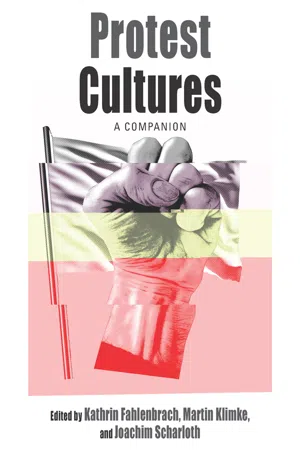
Protest is a ubiquitous and richly varied social phenomenon, one that finds expression not only in modern social movements and political organizations but also in grassroots initiatives, individual action, and creative works. It constitutes a distinct cultural domain, one whose symbolic content is regularly deployed by media and advertisers, among other actors. Yet within social movement scholarship, such cultural considerations have been comparatively neglected. Protest Cultures: A Companion dramatically expands the analytical perspective on protest beyond its political and sociological aspects. It combines cutting-edge synthetic essays with concise, accessible case studies on a remarkable array of protest cultures, outlining key literature and future lines of inquiry.
eBook - ePub
Protest Cultures
A Companion
- 568 pages
- English
- ePUB (mobile friendly)
- Available on iOS & Android
eBook - ePub
Protest Cultures
A Companion
About this book
Trusted by 375,005 students
Access to over 1 million titles for a fair monthly price.
Study more efficiently using our study tools.
Information
Part I

Perspectives on Protest
Chapter 1
Protest in Social Movements
Protest: A Definition
Protest includes nonroutinized ways of affecting political, social, and cultural processes. Especially from the 1960s on, survey research recognized that a “new set of political activities has been added to the citizens’ political repertoire.”1 Among “unconventional” forms of political participation, social science research listed signing petitions, lawful demonstration, boycotts, withholding of rent or tax, occupations, sit-ins, blocking traffic, and wildcat strikes. This expansion of the repertoire of political participation was indeed a long-lasting characteristic of democratic politics. More than two decades later, analyses of the World Value Surveys polls confirmed that “many of these forms of activity, such as petitions, demonstrations, and consumer boycott, are fairly pervasive and have become increasingly popular during recent decades. Protest politics is on the rise as channel of political expression and mobilization.”2
The very spread of protest opened a debate about the possibility to consider it as a nonroutine or nonconventional repertoire. While more and more frequently used by a broad range of actors, it is however still true that law-and-order coalitions, time and again, challenged the legitimacy of forms of action that are still often based on the disruption of everyday routines and often rules and regulation. Not by chance, new waves of protest are repressed with vigor even in democracies.3
Another characteristic of protest is it being relational. As social movement studies have stressed, typical of protest is the use of indirect channels to influence decision makers, setting in motion a process of persuasion mediated by mass media and powerful allies. As Michael Lipsky noted, “protest is successful to the extent that other parties are activated to political involvement.”4
Different typologies of protest have been suggested. Protest can be more or less radical in nature, ranging from more conventional petitioning to more conflictual blockades, and including a number of episodes of violence. Forms of protest can also be distinguished according to the logic, or modus operandi, which the activists assign them: logic of numbers, logic of damage, or logic of testimony.5
Protest as a Strategic Option
Research on social movements has analyzed the choices between forms of protest as strategic options that take into account a multiplicity of objectives, balancing the need to keep members’ commitment with that of gaining the support of the public and influencing public decision makers.6 For social movements, given their lack of material resources to invest in material selective incentives, it is particularly important to find tactics, which are also suitable for realizing internal aims. For the labor movement, strikes had more than a simply instrumental function,7 and this is also true of occupations for the student movement, both reinforcing collective identity and reciprocal solidarity. In the most recent wave of protest, the camps have emerged as forms of protest endowed with very high prefigurative capacity. In Tahir Square, Placa del Sol, or Sintagma Square—and the thousands of other squares occupied for weeks or months all over the globe—the occupation of a public square is much more than just a disruptive tactic, allowing instead to experiment with new practices of democracy and new forms of social relations.8
Actions that are well-suited to strengthen internal solidarity might however, under some conditions, reduce external support. If radical, direct actions tend to maintain rank-and-file support, they however risk alienating potential allies as the more peaceful and institutional a course of unconventional political action is (petitioning, for example), the greater the level of public approval (as opinion polls have shown). The camps of the Indignados movements acquired such a strong identification capacity that police evictions brought about serious crises.
Mass media is extremely relevant to propagate the movement messages but also very difficult to please for outsiders.9 Research on protest coverage has demonstrated,10 in order to obtain media coverage, action must involve a great many people, utilize radical tactics, or be particularly innovative. At the same time, however, research has also time and again confirmed that the mass media tends to stigmatize political violence as deviant, criminal behavior. While new technologies (of the Web 1.0 and Web 2.0 type) have undoubtedly increased the capacity of social movement organizations, and even single activists to communicate, difficulty remains in expanding the public audience to beyond those who are already sympathetic.11
Some forms of action may also cause an escalation in repression and alienate sympathizers. In particular, violence polarizes the social conflicts, transforming “relations between challengers and authorities from an open, many-sided game into a bipolar one in which people are forced to choose sides, allies defect, bystanders retreat and the state’s repressive apparatus swings into action.”12
The choice of form of action is instrumental, and as mentioned, protest has also a prefigurative function for social movement activists. The aims do not justify the means, and much of the debate inside social movements is about not only the efficacy but also the meaning and symbolic value. Stressing the euphoria and pleasures involved in protest, James Jasper observes indeed that “tactics represent important routines, emotionally and morally salient in these people’s lives.”13
Repertoire and Historical Changes
Beyond instrumental and ethical concerns, the choice of forms of action is also constrained in time and space. Charles Tilly has used the concept of a repertoire of collective action to define the differences in the types of contentious actions widespread in particular historical periods.14 His research pointed first of all at the order that could be found in what was mainly considered as disorder, and the political struggles readable in what authorities presented as disturbance. As he noted, repertoires are made by a repetition of a limited number of actions and aim at political effects.
Stressing the role of ordinary people in making history, he looked at the evolution of contentious politics in France and Great Britain, marked by a deep change, developing between the end of the eighteenth century and the beginning of the nineteenth century. Before then, protest was present in European history: peasants burned down mills in protest against increases in the price of bread; citizens dressed up in order to mock their superiors; funerals could be turned into the occasion for denunciations of injustice. These contentious gatherings had some characteristics in common: they were parochial scope, addressed mainly local actors or the local representatives of national actors, and relied on patronage—“appealing to immediately available power holders to convey grievances or settle disputes, temporarily acting in the place of unworthy or inactive power holders only to abandon power after the action.”15
The new repertoire of European protest, which developed toward the end of the eighteenth century—involving actions such as strikes, electoral rallies, public meetings, petitions, marches, insurrection, and the invasion of legislative bodies—was instead national, “though available for local issues and enemies, it lends itself easily to coordination among many localities,” and autonomous, as “instead of staying in the shadow of existing power holders and adapting routines sanctioned by them, people using the new repertoire tend to initiate their own statements of grievances and demands.”16 Additionally, if in the past, people used to participate as members of preconstituted communities, in the modern repertoire, they participate as representatives of particular interests.
The concept of repertoire points is the specific, historically bound characteristics of protest: it is in fact finite in its forms that are constrained in both time and space. In fact, repertoires are reproduced over time, because they are what protesters “know how.” The forms of action used in one protest campaign tend to be adopted and adapted in subsequent ones, as activists imitate what happened in previous waves of protest. Traditions are in fact transmitted from one generation of activists to another. For instance, the public march developed out of the practice of holding electoral banqueting and then evolved through the institutionalization of specific rituals and structures such as the closing rally and the stewarding of marches.17
Rooted in the shared political cultures of the activists, repertoires contain the options known and considered practicable, while excluding others. The repertoire of contentions is then “something like the theatrical or musical sense of the word; but the repertoire in question resembles that of commedia dell’arte or jazz more than that of a strictly classical ensemble: people know the general rules of performance more or less well and vary the performance to meet the purpose at hand.”18
Repertoires are however also innovated, through experiments with new forms and new combination of old ones. Forms of actions—especially successful ones—are imported from other movements, countries, and generation. The European history of contentious testifies for the generalization of some forms of action (such as strike or road blocks) from specific social and political groups to most of them. In addition, each new generation introduces specific forms in the repertoire, or adapts old ones.19 The rituals of marches has for instance changed over time adapting to modern (or “postmodern”) times: from those oriented to show unity and organization to more theatrical ones, giving space to a colorful expression of diversity and subjectivity. Imported from the premodern repertoire, forms of protest like charivari or “Katzenmusik” found at times their place also in contemporary conflicts.
Cycles and Opportunities
Action produces action, as protest events tend indeed to cluster in time. As Beissinger observed, in his analysis of the nationalist conflicts that developed with the breakdown of the Soviet Union, in order to understand protest one has to consider that “events and the contention over identity which they represent are not distributed randomly over time and space. Their appearance is structured both temporally and spatially.”20 So, protests come in chains, series, waves, cycles, and tides “forming a punctuated history of heightened challenges and relative stability.”21 This means that events are “linked sequentially to one another across time and space in numerous ways: in the narrative of the struggles that accompany them, in the altered expectations that they generate about subsequent possibilities to contest; in the changes that they evoke in the behavior of those forces that uphold a given order, and in the transformed landscape if meaning that events at times fashion.”22 In Beissinger’s words, waves of protest, as “modular phenomenon,” proceeds as “increasing number of groups with less conducive structural preconditions are drawn into action as a result of the influence of the prior successful example of others.”23
Similarly, cycles of protest have been defined as phases of heightened contention that develop across the social and political system. As Tarrow notes, they include “a rapid diffusion of collective action from more mobilized to less mobilized sectors; a quickened pace of innovation in the forms of contention; new or transformed collective action frames; a combination of organized and unorganized participation; and sequences of intensified inter-actions between challengers and authorities which can end in reform, repression and sometimes revolution.”24
As economic cycles, also protest cycles are expected to...
Table of contents
- Cover Page
- Title Page
- Copyright Page
- Contents
- List of Figures
- List of Tables
- Acknowledgments
- Introduction
- Part I. Perspectives on Protest
- Part II. Morphology of Protest: Constructing Reality
- Part III: Morphology of Protest: Media
- Part IV: Morphology of Protest: Domains of Protest Actions
- Part V: Morphology of Protest: Re-Presentation of Protest
- Part VI. Pragmatics of Protest: Protest Practices
- Part VII: Pragmatics of Protest: Reactions to Protest Actions
- Part VIII: Pragmatics of Protest: Long-Term Consequences
- Index
Frequently asked questions
Yes, you can cancel anytime from the Subscription tab in your account settings on the Perlego website. Your subscription will stay active until the end of your current billing period. Learn how to cancel your subscription
No, books cannot be downloaded as external files, such as PDFs, for use outside of Perlego. However, you can download books within the Perlego app for offline reading on mobile or tablet. Learn how to download books offline
Perlego offers two plans: Essential and Complete
- Essential is ideal for learners and professionals who enjoy exploring a wide range of subjects. Access the Essential Library with 800,000+ trusted titles and best-sellers across business, personal growth, and the humanities. Includes unlimited reading time and Standard Read Aloud voice.
- Complete: Perfect for advanced learners and researchers needing full, unrestricted access. Unlock 1.4M+ books across hundreds of subjects, including academic and specialized titles. The Complete Plan also includes advanced features like Premium Read Aloud and Research Assistant.
We are an online textbook subscription service, where you can get access to an entire online library for less than the price of a single book per month. With over 1 million books across 990+ topics, we’ve got you covered! Learn about our mission
Look out for the read-aloud symbol on your next book to see if you can listen to it. The read-aloud tool reads text aloud for you, highlighting the text as it is being read. You can pause it, speed it up and slow it down. Learn more about Read Aloud
Yes! You can use the Perlego app on both iOS and Android devices to read anytime, anywhere — even offline. Perfect for commutes or when you’re on the go.
Please note we cannot support devices running on iOS 13 and Android 7 or earlier. Learn more about using the app
Please note we cannot support devices running on iOS 13 and Android 7 or earlier. Learn more about using the app
Yes, you can access Protest Cultures by Kathrin Fahlenbrach, Martin Klimke, Joachim Scharloth, Kathrin Fahlenbrach,Martin Klimke,Joachim Scharloth in PDF and/or ePUB format, as well as other popular books in Social Sciences & Political History & Theory. We have over one million books available in our catalogue for you to explore.