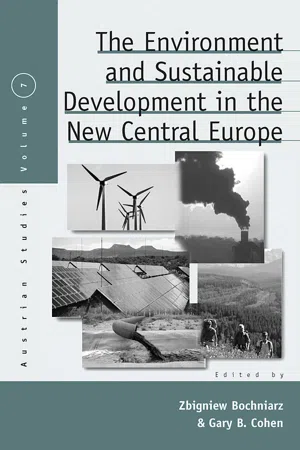
With the enlargement of the European Union, the accession countries are coming under pressure to develop and meet EU standards for environmental protection and sustainable development. In this ongoing process, global economic liberalization, regulatory policy, conservation, and lifestyle issues are all involved, and creative solutions will have to be found. Historians, geographers, economists, ecologists, business management experts, public policy specialists, and community organizers have come together in this volume and examine, for the first time, environmental issues ranging from national and regional policy and macroeconomics to local studies in community regeneration. The evidence suggests that, far from being mere passive recipients of instruction and assistance from outside, the people of Central and East Central Europe have been engaged actively in working out solutions to these problems. Several promising cases illustrate opportunities to overcome crisis situations and offer examples of good practices, while others pose warnings. The experiences of these countries in wrestling with issues of sustainability continue to be of importance to policy development within the EU and may serve also as examples for both developed and developing countries worldwide.
eBook - ePub
The Environment and Sustainable Development in the New Central Europe
- 280 pages
- English
- ePUB (mobile friendly)
- Available on iOS & Android
eBook - ePub
The Environment and Sustainable Development in the New Central Europe
About this book
Trusted by 375,005 students
Access to over 1.5 million titles for a fair monthly price.
Study more efficiently using our study tools.
Information
Chapter 1
FROM COMMUNISM TO CLIMATE CHANGE
The Sustainability Challenge and Lessons from Central Europe

Robert Wilkinson
Central Europeans have much to teach the world. Nations, communities, corporations, and citizens are confronting profound changes in global environmental, political, economic, and social systems. As global systems change, we respond in different ways—some effective and positive, some not. This short article posits the notion that Central Europe is a place to look for an understanding of how to process profound and fundamental change in effective, civilized, thoughtful ways. The world should, I argue, study examples provided by the people of this region for clues that may help bring about a transition to sustainability.
There is no obvious connection between the ideology behind a political/economic system and a physical process occurring in the atmosphere. I suggest that the real challenges posed both by ideology and global environmental challenges are people problems. That is, they are problems largely of our own making and they are problems that can best be resolved by thoughtful people committed to civilized change. The science of climate change is reviewed briefly below. But I will argue that science is not the hard part. Sustainability will require changes in our thinking: our notions of right and wrong, good and bad. It will require a new level of dialogue and decision making in the long-term public interest.
In the past century, Europe experienced serious consequences from an exaggerated enthusiasm for ideologies: nationalism, fascism, communism, and now perhaps capitalism. Rather than dwell on communism, let me instead give you a glimpse of what I saw in Central Europe and throughout the Soviet Union as the Soviet system collapsed a little over a decade ago. It is the transition from that system to an entirely new one that I wish to focus on. Specifically, it is the way people were able to process this change in what can only be described as a remarkable—indeed elegant—process.
My connection to Central Europe stems from a special opportunity I had in 1990 to set up a new graduate program in Environmental Science and Policy at the newly formed Central European University. I had the pleasure of recruiting brilliant young scholars in every country of Central Europe—from Albania and the countries of what was then Yugoslavia (as it was coming apart) in the south, up through the “center” of Central Europe to the Baltic states in the north. All of the countries of the former Soviet Union were included, so I also recruited students across Belarus, Ukraine, and Russia to eastern Siberia, and down through Central Asia as well. It was a unique time in history. When I started, the Soviet Union was not “former” and Czechoslovakia was still one country. The wall was just down and Germany had been re-united. Yugoslavia was in the process of coming apart.
My job was to figure out the key environmental issues throughout the region, set up a brand new graduate program and curriculum, and then recruit scholars from every country. As I traveled throughout the region I found extraordinary beauty in old European cities, forests, mountains, agricultural lands, and communities. I also witnessed the problems first-hand. The challenges were immense. At Chernobyl, I was told I had five minutes to observe the crumbling sarcophagus, whereupon I would be at the maximum “safe” dose of radiation. The people of Ukraine and Belarus are still coping daily with the effects of the “event” at the nuclear facility. At the Aral Sea I witnessed the destruction of a once-rich fishery and ecosystem. Again, the people are living with this disaster today. To the west, in Central Europe, I visited “secret” towns that were not on the maps. They were the source of “yellow cake” for bombs. Open ponds held radioactive waste. The list of environmental problems was long. Coal mines, power plants, and steel mills polluted the air and water throughout the region. This is the image that many in the West saw on the covers of magazines like The Economist and National Geographic. What many failed to see was the strength of the people and their desire to fix the problems and rebuild their communities—physical, human, and ecological.
Throughout the region, in every country, I was inspired by people’s ability to think clearly and creatively about the changes that were needed and ways to get started. I interviewed political leaders, dissidents, scientists, students, and many others to learn the nature and extent of the specific environmental issues facing the region. It was a young woman in Prague who provided the most interesting and insightful response. Foregoing the usual answers to my questions regarding problems—air pollution, forest death, water pollution and so on—she looked at me with serious and thoughtful eyes and said: “It is us, of course. It is our way of thinking. That is our environmental problem. That is what we must change.”
People like this young woman in Prague played a major role in the profound transition of Central Europe in the late 1980s and early 1990s. I have no scholarly research upon which to base this assertion, but I make it with confidence nonetheless: Women played a critically important and unique role in the changes that occurred in Central Europe and the former Soviet Union. (This does not mean, of course, that women played an exclusive role. I do believe, however, that their contribution to this important chapter of history is underappreciated.) I had the privilege to meet many of these brave women in every country of Central Europe, and throughout the former Soviet Union. Their strength and courage was, I believe, a key part of the reason that the transition occurred as it did. They often faced down authorities with little more than a passionate concern for their children’s health and a clear sense of the need for change. Their actions were not without substantial risk. Yet, they prevailed. The authorities knew they were right. And they also realized that these women were serious about the changes that were needed. In community after community, country after country, I met these women and listened to their stories. Their impact is a piece of scholarship that should be pursued by someone far more qualified than me. The history of the transition of the Soviet system, and in particular the role of women and environmental issues, is an important story. It is one of the important lessons from Central Europe, and it is one that should not be lost.
As we contemplate major challenges confronting the world a decade after the transition in Central Europe, it is clear that in the way Central Europeans handled profound changes there are lessons and valuable insights for a world facing the challenge of sustainability. Of these challenges, climate change due to global warming is perhaps the most serious. The scientific debate over the existence and seriousness of the issue is fairly well understood, except in some scientifically challenged quarters. A quick review of the science is merited, but it is presented only to consider the opportunity we have to apply lessons about change processes.
There is broad scientific agreement that global warming is occurring and that climate change and variability pose important challenges. Scenarios developed in 2001 for the third assessment by the Intergovernmental Panel on Climate Change, the international effort examining the science of climate change, indicate that in the period from 1990 to 2100, surface temperatures (averaged globally) will increase by 1.4 to 5.8 °C (2.5 to 10.4 °F) relative to 1990. Global mean sea level is projected to rise by 0.09 to 0.88 meters (3.5 to 35 inches), primarily due to thermal expansion and glacial and ice sheet melting.1
The U.S. National Research Council’s (NRC) Committee on the Science of Climate Change confirmed in its report to the current U.S. administration (Climate Change Science: An Analysis of Some Key Questions) that “Greenhouse gases are accumulating in Earth’s atmosphere as a result of human activities, causing surface air temperatures and subsurface ocean temperatures to rise. Temperatures are, in fact, rising.”2 The NRC committee’s report confirmed the work of the Intergovernmental Panel on Climate Change (IPCC). The committee found that the IPCC report “is an admirable summary of research activities in climate science.”3
The U.S. government also has clearly acknowledged the role people play in causing this change:
Humans are exerting a major and growing influence on some of the key factors that govern climate by changing the composition of the atmosphere and by modifying the land surface. The human impact on these factors is clear. The concentration of carbon dioxide (CO2) has risen about 30% since the late 1800s. The concentration of CO2 is now higher than it has been in at least the last 400,000 years. This increase has resulted from the burning of coal, oil, and natural gas, and the destruction of forests around the world to provide space for agriculture and other human activities. Rising concentrations of CO2 and other greenhouse gases are intensifying Earth’s natural greenhouse effect. Global projections of population growth and assumptions about energy use indicate that the CO2 concentration will continue to rise, likely reaching between two and three times its late-19th-century level by 2100. This dramatic doubling or tripling will occur in the space of about 200 years, a brief moment in geological history.4
At the time of the Environment and Sustainable Development in the New Central Europe conference, I had just returned from meetings in Hungary addressing the potential impacts of climate change on Lake Balaton. In the preceding weeks, Central Europe experienced flooding in Austria, the Czech Republic, Germany, and elsewhere that was described as a “hundred-year” event. Similar problems occurred to the east in southern Russia and other parts of the region. Lives were lost. Damages were in the billions of U.S. dollars. When I was there in the fall, there was considerable discussion of climate change and the recognition that increases in precipitation and flooding are potential impacts associated with global warming. In short, Central Europeans were taking the threat seriously. Whether these floods were in fact a direct result of a changing climate is not the point. More crucial is that if climate change brings more events like the floods of 2002, it will be a serious problem. The Central Europeans I met with were asking a sensible question: What do we need to change to address this problem?
Like the Soviet system in decades past, it may appear to many of us at present that the worldwide economic system and energy infrastructure that are causing greenhouse gas emissions are unchangeable. Certainly, we might argue, they cannot be changed in a short period of time. Not many people would have predicted, even as late as the mid 1980s, that the Soviet system would be completely transformed—and eliminated—at the end of that decade. Yet, a huge political-economic system changed fundamentally in a matter of several years. It is astonishing to consider how thoughtfully all parties dealt with such profound changes. The scale and depth of the changes experienced by Central Europe were far greater than those projected in any scenario contemplated to deal with climate change. The systems through which we realize our productivity, mobility, and basic needs must change to avert serious climate change. As Central Europe has demonstrated, such change is both possible and desirable.
Our challenges are largely of our own making, from ideologies to environmental problems. We need to learn how to transition our systems—economic, political, and social—to sustainable models. Central Europe has much to teach the world about transitions toward sustainability. New policy approaches are emerging in response to a recognition of the need to restore and protect the environment while achieving productivity and profitability.
Central Europe taught the world by elegant example how economic and political systems can change for the better. As the young woman patiently explained to me: “The problem is us, of course. It is our way of thinking.” Sustainability will require us to learn from the talented and thoughtful people of Central Europe. Let us hope we recognize this soon. As the Hopi elders remind us, “We are the people we have been waiting for.”
Notes
1. Intergovernmental Panel on Climate Change (IPCC), Climate Change 2001: The Scientific Basis. Contribution of Working Group I to the Third Assessment Report of the Intergovernmental Panel on Climate Change, ed. J. T. Houghton, Y. Ding, D. J. Griggs, M. Noguer, P. J. van der Linden, X. Dai, K. Maskell, and C. A. Johnson (Cambridge: Cambridge University Press, 2001).
2. National Research Council, Committee on the Science of Climate Change, Climate Change Science: An Analysis of Some Key Questions (Committee on the Science of Climate Change, Division on Earth and Life Studies) (Washington D.C.: National Academy Press, 2001). National Academy Press, http://www.nap.edu
3. Intergovernmental Panel on Climate Change, http://www.met-office.gov.uk/sec5/CR_div/ipcc/wg1/
4. National Assessment Synthesis Team, Climate Change Impacts on the United States: Report for the United States Global Change Research Program (Cambridge: Cambridge University Press, 2001), 12. http://prod.gcrio.org/nationalassessment/
Part One
THE ENVIRONMENT AS POLICY PRIORITY
Chapter 2
ASSESSING SUSTAINABILITY OF THE TRANSITION IN CENTRAL EUROPEAN COUNTRIES
A Comparative Analysis
Sandra O. Archibald and Zbigniew Bochniarz*
Introduction
Since the late 1980s, the Hubert H. Humphrey Institute of Public Affairs at the University of Minnesota has been involved in policy-oriented research, institutional design for sustainable development, and the reform of management and economic education in seven Central and East European (CEE) countries. After conducting the bulk of the work in the 1990s, we became interested in examining whether the radical reforms introduced in those countries contributed to breaking negative economic, social and environmental trends in the CEE countries....
Table of contents
- Cover
- Title
- Copyright
- Contents
- List of Figures and Tables
- Acknowledgements
- Notes on Contributors
- Introduction: Legacies, Challenges, and New Beginnings
- 1. From Communism to Climate Change: The Sustainability Challenge and Lessons from Central Europe
- Part One: The Environment as Policy Priority
- Part Two: The Economics of Sustainable Development
- Part Three: Water Policies and Institutions
- Part Four: Agriculture and Rural Development
- Select Bibliography
- Index
Frequently asked questions
Yes, you can cancel anytime from the Subscription tab in your account settings on the Perlego website. Your subscription will stay active until the end of your current billing period. Learn how to cancel your subscription
No, books cannot be downloaded as external files, such as PDFs, for use outside of Perlego. However, you can download books within the Perlego app for offline reading on mobile or tablet. Learn how to download books offline
Perlego offers two plans: Essential and Complete
- Essential is ideal for learners and professionals who enjoy exploring a wide range of subjects. Access the Essential Library with 800,000+ trusted titles and best-sellers across business, personal growth, and the humanities. Includes unlimited reading time and Standard Read Aloud voice.
- Complete: Perfect for advanced learners and researchers needing full, unrestricted access. Unlock 1.5M+ books across hundreds of subjects, including academic and specialized titles. The Complete Plan also includes advanced features like Premium Read Aloud and Research Assistant.
We are an online textbook subscription service, where you can get access to an entire online library for less than the price of a single book per month. With over 1.5 million books across 990+ topics, we’ve got you covered! Learn about our mission
Look out for the read-aloud symbol on your next book to see if you can listen to it. The read-aloud tool reads text aloud for you, highlighting the text as it is being read. You can pause it, speed it up and slow it down. Learn more about Read Aloud
Yes! You can use the Perlego app on both iOS and Android devices to read anytime, anywhere — even offline. Perfect for commutes or when you’re on the go.
Please note we cannot support devices running on iOS 13 and Android 7 or earlier. Learn more about using the app
Please note we cannot support devices running on iOS 13 and Android 7 or earlier. Learn more about using the app
Yes, you can access The Environment and Sustainable Development in the New Central Europe by Zbigniew Bochniarz, Gary B. Cohen, Zbigniew Bochniarz,Gary B. Cohen in PDF and/or ePUB format, as well as other popular books in Biological Sciences & 20th Century History. We have over 1.5 million books available in our catalogue for you to explore.