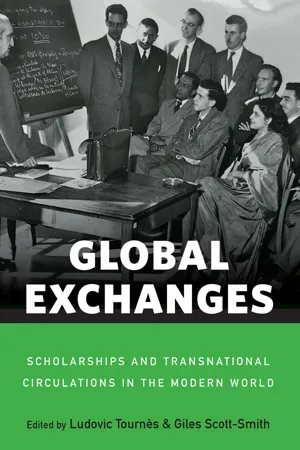
Exchanges between different cultures and institutions of learning have taken place for centuries, but it was only in the twentieth century that such efforts evolved into formal programs that received focused attention from nation-states, empires and international organizations. Global Exchanges provides a wide-ranging overview of this underresearched topic, examining the scope, scale and evolution of organized exchanges around the globe through the twentieth century. In doing so it dramatically reveals the true extent of organized exchange and its essential contribution for knowledge transfer, cultural interchange, and the formation of global networks so often taken for granted today.
Trusted by 375,005 students
Access to over 1.5 million titles for a fair monthly price.
Founded in 1901, the Rhodes scholarship scheme is one of the longest-running programs of scholarly exchange still in existence. It has been the model for many schemes that have since emerged. As such, it offers an ideal context for examining as well as raising new questions about the organization and overall efficacy of scholarly exchange across the twentieth century.
This chapter is the first attempt at a general historical analysis of the way in which the scholarship shaped the lives of those who received it. It takes a dual approach to the long view on scholarly exchange. Not only does it track the scholarship through the twentieth century, it also looks back to the 1890s and to the ideas and precedents that informed Cecil John Rhodes and his executors. Beginning by placing the foundation of the Rhodes scholarships in their historical context, the chapter then goes on to examine three basic issues that underpin most international exchange programs: first, the geographic distribution of award; second, gender parity in award; and, third, the long-term geographic mobility of scholars. By bringing together historical and quantitative methods, it points to identifiable patterns of continuity, change, and regional diversity in the management and effect of the scheme.
Rhodes Scholarships: History and Origins
In 1901, the Cape Town politician and mining magnate, Cecil Rhodes, left his considerable fortune to the establishment of a scheme of traveling scholarships. Bringing the most promising young men from across the English-speaking world to Oxford, Rhodes hoped to “instil into their minds the advantage to the Colonies as well as to the United Kingdom of the retention of the Unity of the Empire” and affect “the union of the English-speaking peoples throughout the world.” At the heart of Rhodes’ scheme was his belief that the experience of living and studying together in a residential university would “broaden [the] views” of his scholars, “instruct them in life and manners” and in the process foster ties of mutual understanding that would serve to “render war impossible.” It was, Rhodes believed, “educational relations [that] make the strongest tie.”1 Interpersonal relationships and informal forms of association, rather than the explicit content of educational programs, were therefore at the core of Rhodes’ idea.
In attempting to define the type of scholar he sought, Rhodes stipulated four selection criteria: (1) literary and scholastic attainment; (2) energy to use one’s talents to the full, as exemplified by fondness for and success in sports; (3) qualities of truth, courage, devotion to duty, sympathy for the protection of the weak, kindliness, unselfishness and fellowship; and (4) the exhibition of moral force of character and of instincts to lead that will guide one to esteem the performance of public duty as the highest aim. He explicitly sought scholars who would be “not merely bookworms,” but rather “capable leaders of men”: a global elite who, through influence and public office, would work for future world order. This was a notion of leadership that extended beyond disciplinary proficiency and intellectual capacity. It emphasized the physical and charismatic qualities of leaders, and placed as much stress on character and personality as it did on their academic attainments.
Targeted initially at the British colonies of white settlement (Canada, Australia, Southern Africa and New Zealand) and also the United States, Germany, Bermuda and Jamaica, the program expanded over the course of the twentieth century to also include African states, India and Pakistan, and for a time also Malaysia, Singapore and Hong Kong.2 From 2015, a further expansion has extended the scholarships to China.3
Across this period, the meaning and representation of the scholarship has also changed. It was initially embraced by liberal imperialist politicians, who saw it as a way of creating common sentiments across borders, but received a lukewarm reception from Oxford academics, who thought that selection on the basis of well-roundedness would lower academic standards of the whole institution. From the 1930s on, Rhodes’ vision of imperial citizenship came under further criticism, not least from Rhodes scholars themselves, who began to champion national sentiments. The emphasis and popular understanding of the scheme shifted again after World War II, when in the 1950s its remit was expanded to include the countries of what was newly styled as the multiracial British Commonwealth of Nations—moving from a discourse that emphasized race and the English-speaking peoples to one that rather invoked internationalism. It was at this time too that the Rhodes program was taken up as a model for the Fulbright scholarships and since then it has been frequently cited as the inspiration of many newer schemes. Throughout this period, a key message from the Rhodes Trust was the informal moral obligation upon scholars to return and contribute to their countries of selection. At the start of the twenty-first century, the emphasis has shifted again. Reflecting changing political and economic governance patterns, “rather than imperial or national, it is increasingly now good global citizens that Cecil Rhodes’ traveling scholarships are thought to create.”4 The Trust itself has begun to highlight the contributions of Rhodes scholars in various fields, including as Nobel laureates, Olympians and heads of state.5
How are we to examine the effects of the Rhodes program when not only its geographic distribution but also its stated aims, self presentation and context have changed radically across the twentieth century? High-profile individuals such as Bill Clinton, Bob Hawke, Wasim Sajjad, John Turner and Norman Manley have done much to shape the public image and maintain the program’s prestige. But—although they form an important subset of alumni—most scholars have not gone on to careers as political representatives.6 Despite publicly available information on eligibility, internal analyses of more recent cohorts, sectional studies (e.g. The Rhodes Project on female Rhodes scholars) and the Trust’s promotional materials, a consolidated, longitudinal assessment of the Rhodes program is still needed. In this chapter we analyze the publicly accessible data on Rhodes scholars as published in the Register of Rhodes Scholars to reveal their mobility patterns over the course of the twentieth century.7
The Rhodes Foundation in Context
This volume emphasizes the need to take the long view on scholarly exchange programs—to move away from a hagiographic focus on a small cohort of prominent “familiar suspects” and instead to examine the program’s impact on the later careers of all grantees. This is an important and necessary endeavor, but in focusing on the after-effects of exchange programs, there is a danger of reifying their moment of foundation—an event that is frequently given mythic status by the programs themselves and their institutional histories. This is particularly true in the case of the Rhodes scholarships which are frequently celebrated as the personal creation of Cecil Rhodes and abstracted from the wider context out of which they grew. Until very recently, it was traditional for scholars to raise a toast to “The Founder” at formal events of the Rhodes Trust.
In his 1998 biography of Cecil Rhodes, Robert Rotberg does acknowledge that Rhodes “almost certainly derived his ideas” from two men who, in the 1890s, were already planning a scholarship scheme for colonial students.8 In the July of 1891, J. Astley Cooper, editor of the London weekly publication Greater Britain, had published his proposal for a “periodical gathering of representatives of the [English] race in a festival and contest of industry, athletics, and culture.”9 Cooper argued that such an event would foster imperial goodwill while also strengthening “family bonds” with the United States. He first proposed the idea of university scholarships as part of this festival in an article a few months later, adding in parentheses “(there are none in existence yet).”10
A year later, Professor Thomas Hudson Beare, an engineer from South Australia who held chairs at University College London and the University of Edinburgh, developed Cooper’s plans further, suggesting they should be called the “Britannic scholarships” and outlining the details of a scheme that shares distinct similarities with that later proposed by Rhodes.11 A hundred scholars were to travel to Britain from each of the principal (white settler) colonies, while postgraduate awards were to enable British students to pursue research in the empire. “On his return to his Colony,” concluded Beare, “each student would form a nucleus around which would gather all that was best, and each would form another of those invisible ties, stronger than any which can be devised by the cunning of law makers, which will keep together, for good or ill, the Anglo-Saxon race.” According to Rotberg, Rhodes “doubtless learned” of these ideas through his and Cooper’s close associate, the journalist and imperialist William Thomas Stead, and throughout the 1890s Rhodes gave more and more attention to his educational “big idea.”12 With their emphasis on fostering informal ties through friendship among students from the white settler colonies, and with their connection to sport and physical activity, Cooper and Beare’s “Britannic Scholarships” point clearly to the connections that Rhodes’ contemporaries were making between imperial federation, sociability and education.
At the time of Cooper’s 1891 claim, there in fact already existed an empire-wide scheme of traveling scholarships. These were the 1851 Exhibition scholarships, established in 1899 by the Commissioners of the 1851 Great Exhibition and awarded to “the most promising students” from the universities of the settler colonies, Ireland and the provincial cities of Britain so that they might “complete their studies either in those colleges or in the larger institutions of the metropolis.” Given the publicity accorded to the 1851 Exhibition scholarships in scientific circles, it is likely that Beare knew them well. With a focus on “extending the influence of science and art upon productive industry,” they differed from the scheme of Cooper and Beare in two main respects: first, the 1851 Exhibition scholarships placed an explicit emphasis upon the content of studies; and, second, they placed the universities in the colonies alongside those in the provincial centers of Britain, seeing both as key to “national” development.13
Unlike Cooper and Beare, and later Rhodes, the 1851 commissioners did not principally see their scholarships as a mechanism for fostering imperial loyalty, but rather as a means of building national scientific and industrial capacity.14 In this, the 1851 Exhibition scholarships were by no means unique. By the 1890s, a host of universities across the colonies of the British empire had established scholarships that were designed to take their most promising graduates on to further study in Britain.15 In fact, Thomas Hudson Beare was himself a recipient of one of them—the South Australian scholarship. And when in the 1890s Rhodes was thinking about the form his own program might take, there were already eight “traveling scholarships” taking graduates from the Cape of Good Hope University to the United Kingdom. Such scholarships were focused on academic attainment and saw study in the ancient universities of Scotland and England as the apex of local educational structures.
The tension between these two hopes for scholarly exchange—as a means of fostering identity and goodwill on the one hand, and intellectual and technical capacity on the other—sit at the heart not just of the Rhodes program...
Table of contents
Cover
Title Page
Copyright Page
Contents
List of Figures and Tables
Acknowledgments
List of Abbreviations
Introduction: A World of Exchanges: Conceptualizing the History of International Scholarship Programs (Nineteenth to Twenty-First Centuries)
Part I. National and Imperial Power Politics
Part II. International Understanding and World Peace
Part III. The Cold War: A Golden Age of Scholarship Programs
Part IV. The Globalization Moment: New Geography and New Challenges
Conclusion: 150 Years of Scholarship Programs: Old Trends and New Prospects in the Global Landscape
Selected Bibliography
Web Resources
Index
Frequently asked questions
Yes, you can cancel anytime from the Subscription tab in your account settings on the Perlego website. Your subscription will stay active until the end of your current billing period. Learn how to cancel your subscription
No, books cannot be downloaded as external files, such as PDFs, for use outside of Perlego. However, you can download books within the Perlego app for offline reading on mobile or tablet. Learn how to download books offline
Perlego offers two plans: Essential and Complete
Essential is ideal for learners and professionals who enjoy exploring a wide range of subjects. Access the Essential Library with 800,000+ trusted titles and best-sellers across business, personal growth, and the humanities. Includes unlimited reading time and Standard Read Aloud voice.
Complete: Perfect for advanced learners and researchers needing full, unrestricted access. Unlock 1.5M+ books across hundreds of subjects, including academic and specialized titles. The Complete Plan also includes advanced features like Premium Read Aloud and Research Assistant.
Both plans are available with monthly, semester, or annual billing cycles.
We are an online textbook subscription service, where you can get access to an entire online library for less than the price of a single book per month. With over 1.5 million books across 990+ topics, we’ve got you covered! Learn about our mission
Look out for the read-aloud symbol on your next book to see if you can listen to it. The read-aloud tool reads text aloud for you, highlighting the text as it is being read. You can pause it, speed it up and slow it down. Learn more about Read Aloud
Yes! You can use the Perlego app on both iOS and Android devices to read anytime, anywhere — even offline. Perfect for commutes or when you’re on the go. Please note we cannot support devices running on iOS 13 and Android 7 or earlier. Learn more about using the app
Yes, you can access Global Exchanges by Ludovic Tournès, Giles Scott-Smith, Ludovic Tournès,Giles Scott-Smith in PDF and/or ePUB format, as well as other popular books in Education & History of Education. We have over 1.5 million books available in our catalogue for you to explore.