- 240 pages
- English
- PDF
- Available on iOS & Android
eBook - PDF
About this book
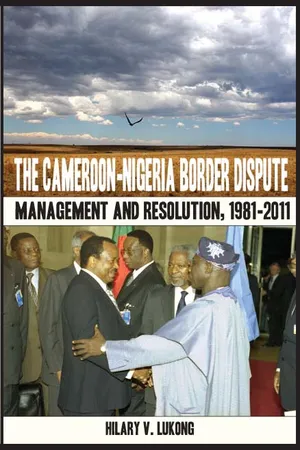
At independence, Cameroon and Nigeria adhered to the OAU principle of UTI POSSEDETIS JURIS by inheriting the colonial administrative borders whose delineation in some parts was either imperfect or not demarcated or both. The two countries tried to correct these anomalies. But such efforts were later thwarted by incessant geostrategic reckoning, dilatory, and diversionary tactics in the seventies and eighties that persisted and resurfaced in the nineties with a more determined posture. On two occasions, the border conflict almost boiled over to a full-scale war. First, in May 1981 when there was the exchange of fire between Cameroonian and Nigerian coast guards and second, in February 1994 when Nigeria marched her troops into Cameroon?s Bakassi Peninsula. Elsewhere in Africa, border incidents like these have often degenerated into war. But Cameroon and Nigeria together with the international community managed these protracted incidents from escalating into war. This book examines the part played by the disputing parties, Cameroon and Nigeria; the mediation, conciliatory and adjudicatory role of third parties; and the regional and international organisations, in the process of the resolution of the border dispute from 1981-2011. The study situates the nature and dynamics of the dispute historically, and comprehensively explores in detail its causes, settlement and resolution.
Information
Table of contents
- Cover
- Title page
- Copyright page
- Dedication
- Contents
- Illustrations
- Tables
- Foreword
- Acknowledgements
- Abbreviations and Acronyms
- Introduction
- Chapter 1 - Stakes and Causes of the Border Dispute
- Chapter 2 - Bilateral Management of the Border Dispute, 1981-2002
- Chapter 3 - Multilateral Management of the Border Dispute, 1981-2002
- Chapter 4 - The Settlement of the Dispute through Adjudication by the International Court of Justice, 1994-2002
- Chapter 5 - The Process of the Implementation of the International Court of Justice Verdict, 2002-2011
- Chapter 6 - Confidence Building Measures between Cameroon and Nigeria, 2002-2011
- Conclusion
- Appendices
- Sources
- Index
- Back cover
Trusted by 375,005 students
Access to over 1.5 million titles for a fair monthly price.
Study more efficiently using our study tools.
Frequently asked questions
Yes, you can cancel anytime from the Subscription tab in your account settings on the Perlego website. Your subscription will stay active until the end of your current billing period. Learn how to cancel your subscription
No, books cannot be downloaded as external files, such as PDFs, for use outside of Perlego. However, you can download books within the Perlego app for offline reading on mobile or tablet. Learn how to download books offline
Perlego offers two plans: Essential and Complete
- Essential is ideal for learners and professionals who enjoy exploring a wide range of subjects. Access the Essential Library with 800,000+ trusted titles and best-sellers across business, personal growth, and the humanities. Includes unlimited reading time and Standard Read Aloud voice.
- Complete: Perfect for advanced learners and researchers needing full, unrestricted access. Unlock 1.5M+ books across hundreds of subjects, including academic and specialized titles. The Complete Plan also includes advanced features like Premium Read Aloud and Research Assistant.
We are an online textbook subscription service, where you can get access to an entire online library for less than the price of a single book per month. With over 1.5 million books across 990+ topics, we’ve got you covered! Learn about our mission
Look out for the read-aloud symbol on your next book to see if you can listen to it. The read-aloud tool reads text aloud for you, highlighting the text as it is being read. You can pause it, speed it up and slow it down. Learn more about Read Aloud
Yes! You can use the Perlego app on both iOS and Android devices to read anytime, anywhere — even offline. Perfect for commutes or when you’re on the go.
Please note we cannot support devices running on iOS 13 and Android 7 or earlier. Learn more about using the app
Please note we cannot support devices running on iOS 13 and Android 7 or earlier. Learn more about using the app
Yes, you can access The Cameroon Nigeria Border Dispute by V. Lukong in PDF and/or ePUB format, as well as other popular books in Politics & International Relations & African History. We have over 1.5 million books available in our catalogue for you to explore.