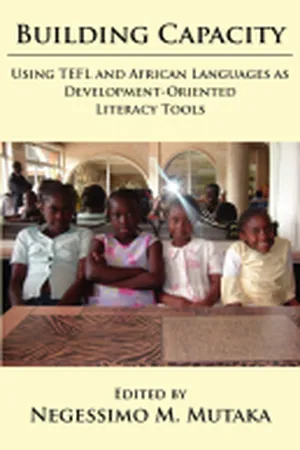
" ""Building Capacity promotes the vision that the teaching of African languages can best achieve its aim of boosting the economic and cultural development of the Africans if they are made to work in synergy with a revamping of the course contents of international languages that will be taught within the frame of a development-oriented literacy curriculum. Great emphasis is put on the oral skills in the use of African languages as they are to serve as a link between the community and the school for the ultimate revitalization of the positive aspects of African cultures in a world beset by globalization. The book is supplemented with a sample of texts in the appendix that are meant to be a bridge between formal texts taught in classrooms and literacy texts that can raise the genuine interests of the local populations in that they address their immediate needs. Among the possible topics language teachers are encouraged to explore in their classes are those concerning economic development, but also such issues as health, education, the environment, food security, and conflict resolution. """"In the face of the growing interest in the use of African Languages by Africans as symbols of personal and cultural identity and as means of empowering the rural communities in the entreprise of national development, the need for a methodologically appropriate manual to guide the teaching and learning of African languages becomes urgent.This book is a timely response, predicated on a policy of the symbiotic use of African languages along with partner (foreign-official) languages, to attain a balanced level of economic and socio-cultural development.It is based on a compendium of well- thought-out principles geared towards a rapid acquisition of written and oral language skills that are congruent with and reflect the socio-cultural and economic concerns of the linguistic community."""" Beban Sammy Chumbow, Professor of Linguistics, University of Yaounde I """"Among the numerous proposals in this book is the necessity for Africans, and I would add, for the communities of Asia and Latin America, to re-think the contents of their language courses and assign them an objective which aims at the integral development of their communities. It is indeed imperative that these courses reflect clear objectives of seeking social, cultural, and economic developments that harmonize with African, Asian, and Latin American values that are deep rooted in their respective various cultures."""" Jean-Pierre Angenot Professor of Linguistics, Federal University of Rond?nia, Porto Velho, Brazil."""
eBook - PDF
Building Capacity
About this book
Trusted by 375,005 students
Access to over 1.5 million titles for a fair monthly price.
Study more efficiently using our study tools.
Information
Table of contents
- Cover
- Title Page
- Copyright Page
- Contents
- Preface
- Chapter One
- Part One: on Teaching English as a Foreign Language (TEFL)
- Part Two: African languages and literacy
- Appendix. Literacy texts
- Back Cover
Frequently asked questions
Yes, you can cancel anytime from the Subscription tab in your account settings on the Perlego website. Your subscription will stay active until the end of your current billing period. Learn how to cancel your subscription
No, books cannot be downloaded as external files, such as PDFs, for use outside of Perlego. However, you can download books within the Perlego app for offline reading on mobile or tablet. Learn how to download books offline
Perlego offers two plans: Essential and Complete
- Essential is ideal for learners and professionals who enjoy exploring a wide range of subjects. Access the Essential Library with 800,000+ trusted titles and best-sellers across business, personal growth, and the humanities. Includes unlimited reading time and Standard Read Aloud voice.
- Complete: Perfect for advanced learners and researchers needing full, unrestricted access. Unlock 1.5M+ books across hundreds of subjects, including academic and specialized titles. The Complete Plan also includes advanced features like Premium Read Aloud and Research Assistant.
We are an online textbook subscription service, where you can get access to an entire online library for less than the price of a single book per month. With over 1.5 million books across 990+ topics, we’ve got you covered! Learn about our mission
Look out for the read-aloud symbol on your next book to see if you can listen to it. The read-aloud tool reads text aloud for you, highlighting the text as it is being read. You can pause it, speed it up and slow it down. Learn more about Read Aloud
Yes! You can use the Perlego app on both iOS and Android devices to read anytime, anywhere — even offline. Perfect for commutes or when you’re on the go.
Please note we cannot support devices running on iOS 13 and Android 7 or earlier. Learn more about using the app
Please note we cannot support devices running on iOS 13 and Android 7 or earlier. Learn more about using the app
Yes, you can access Building Capacity by M. Mutaka in PDF and/or ePUB format, as well as other popular books in Education & Education Theory & Practice. We have over 1.5 million books available in our catalogue for you to explore.