eBook - PDF
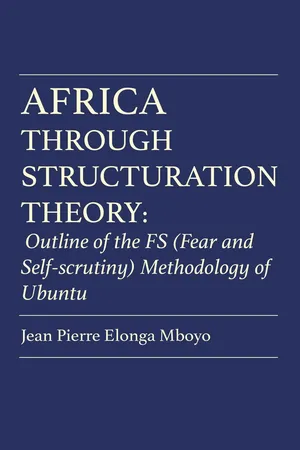
Africa Through Structuration Theory
Outline of the FS (Fear and Self-scrutiny) Methodology of Ubuntu
- 237 pages
- English
- PDF
- Available on iOS & Android
eBook - PDF
Africa Through Structuration Theory
Outline of the FS (Fear and Self-scrutiny) Methodology of Ubuntu
About this book
Despite all the talk about African Renaissance, much of the continent is plagued by poverty and instability. To break out of that cycle, the guardians of African heritage (the old independence freedom fighters turned political leaders and their successors) and much of Afrocentric literature rightly promotes African ideas and solutions for African problems. While the idea in itself is noble, the danger is for Africa to close itself off and ignore ?outside? technical and intellectual innovations that it desperately needs to advance further. Africa through Structuration Theory - ntu?joins the discourse by attempting to restore intellectual freedom and convincingly defends structuration theory not only as the way forward for Africa but also as a legitimately African concept. It is innovative, refreshing and deserves to be heard across the world and appreciated especially by African graduates,?current and future?leaders of various African institutions or businesses, non-Africans who might hesitate to refer to such a theory when trying to understand and deal with African problems and the wider public who constitute the audience for this book. New in this edition: All chapters have been tightened up to make a clearer and more robust case. Chapter three, in particular, has been developed further in an attempt to demonstrate how Ubuntu is an African version of structuration theory. Overall, having both approached the subject from a rational perspective and presented Ubuntu in its preferred version, it became imperative to discuss the status/role of the African body in the expression of human agency and characterise different leadership practices in Africa that do not necessarily reflect the ideals of Ubuntu. Hence, Chapter 6: Body sociology and Africa and Chapter 7: The FS (fear and self-scrutiny) methodology of Ubuntu: a mapping of the field.
Information
Table of contents
- Cover
- Title page
- Copyright page
- Dedication
- Acknowledgement
- Contents
- Foreword
- Preface
- Préface
- Chapter 1 - ‘African-Centred leadership’ and the theory of structuration: a response to Obiakor
- Chapter 2 - Structure and agency: (an issue of trust?)
- Chapter 3 - Duality of structures: a (not THE) methodology
- Chapter 4 - Double de-contextualisation: a methodological myth or reality?
- Chapter 5 - Higher education in the DRC and Sub-Saharan Africa: duality of structures in action
- Chapter 6 - Body sociology and Africa
- Chapter 7 - The FS (Fear and Self-Scrutiny) methodology of Ubuntu: a mapping of the field
- References
- Index
- Back cover
Trusted by 375,005 students
Access to over 1.5 million titles for a fair monthly price.
Study more efficiently using our study tools.
Frequently asked questions
Yes, you can cancel anytime from the Subscription tab in your account settings on the Perlego website. Your subscription will stay active until the end of your current billing period. Learn how to cancel your subscription
No, books cannot be downloaded as external files, such as PDFs, for use outside of Perlego. However, you can download books within the Perlego app for offline reading on mobile or tablet. Learn how to download books offline
Perlego offers two plans: Essential and Complete
- Essential is ideal for learners and professionals who enjoy exploring a wide range of subjects. Access the Essential Library with 800,000+ trusted titles and best-sellers across business, personal growth, and the humanities. Includes unlimited reading time and Standard Read Aloud voice.
- Complete: Perfect for advanced learners and researchers needing full, unrestricted access. Unlock 1.5M+ books across hundreds of subjects, including academic and specialized titles. The Complete Plan also includes advanced features like Premium Read Aloud and Research Assistant.
We are an online textbook subscription service, where you can get access to an entire online library for less than the price of a single book per month. With over 1.5 million books across 990+ topics, we’ve got you covered! Learn about our mission
Look out for the read-aloud symbol on your next book to see if you can listen to it. The read-aloud tool reads text aloud for you, highlighting the text as it is being read. You can pause it, speed it up and slow it down. Learn more about Read Aloud
Yes! You can use the Perlego app on both iOS and Android devices to read anytime, anywhere — even offline. Perfect for commutes or when you’re on the go.
Please note we cannot support devices running on iOS 13 and Android 7 or earlier. Learn more about using the app
Please note we cannot support devices running on iOS 13 and Android 7 or earlier. Learn more about using the app
Yes, you can access Africa Through Structuration Theory by Elonga Mboyo in PDF and/or ePUB format, as well as other popular books in Social Sciences & Black Studies. We have over 1.5 million books available in our catalogue for you to explore.