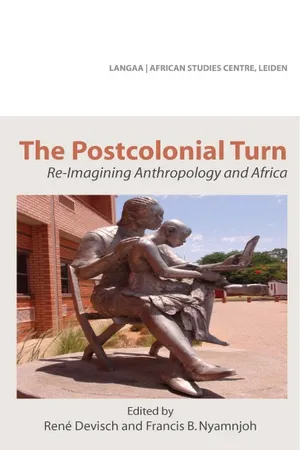
eBook - PDF
The Postcolonial Turn
Re-Imagining Anthropology and Africa
- 468 pages
- English
- PDF
- Available on iOS & Android
eBook - PDF
The Postcolonial Turn
Re-Imagining Anthropology and Africa
About this book
This innovative book is a forward-looking reflection on mental decolonisation and the postcolonial turn in Africanist scholarship. As a whole, it provides five decennia-long lucid and empathetic research involvements by seasoned scholars who came to live, in local people?s own ways, significant daily events experienced by communities, professional networks and local experts in various African contexts. The book covers materials drawn from Botswana, Cameroon, the Democratic Republic of Congo, Mozambique, Nigeria, South Africa and Tanzania. Themes include the Whelan Research Academy, rap musicians, political leaders, wise men and women, healers, Sacred Spirit churches, diviners, bards and weavers who are deemed proficient in the classical African geometrical knowledge. As a tribute to late Archie Mafeje who showed real commitment to decolonise social sciences from western-centred modernist development theories, commentators of his work pinpoint how these theories sought to dismiss the active role played by African people in their quest for self-emancipation. One of the central questions addressed by the book concerns the role of an anthropologist and this issue is debated against the background of the academic lecture delivered by Ren? Devisch when receiving an honorary doctoral degree at the University of Kinshasa. The lecture triggered critical but constructive comments from such seasoned experts as Valentin Mudimbe and Wim van Binsbergen. They excoriate anthropological knowledge on account that the anthropologist, notwithstanding his or her social and cognitive empathy and intense communication with the host community, too often fails to also question her own world and intellectual habitus from the standpoint of her hosts. Leading anthropologists carry further into great depth the bifocal anthropological endeavour focussing on local people?s re-imagining and re-connecting the local and global. The book is of interest to a wide readership in the humanities, social sciences, philosophy and the history of the African continent and its relation with the North.
Information
Table of contents
- Cover
- Title page
- Copyright page
- Contents
- List of Figures
- Contributors
- Acknowledgements
- 1 - The Postcolonial Turn: An Introduction
- Part 1 - A Staunch Critique of Intellectual Colonialism and the Pursuit of Sociocultural Endogeneity
- Part 2 - Bifocality at the Core of the Borderlinking Anthropological Endeavour
- Part 3 - Cross-pollination in African Academe between Cosmopolitan Sciences and Local Knowledge
- Part 4 - Toward the Local Domestication of the Ruling Modern Logic: The ‘Clash of Civilisations’ Revisited
- Back cover
Trusted by 375,005 students
Access to over 1.5 million titles for a fair monthly price.
Study more efficiently using our study tools.
Frequently asked questions
Yes, you can cancel anytime from the Subscription tab in your account settings on the Perlego website. Your subscription will stay active until the end of your current billing period. Learn how to cancel your subscription
No, books cannot be downloaded as external files, such as PDFs, for use outside of Perlego. However, you can download books within the Perlego app for offline reading on mobile or tablet. Learn how to download books offline
Perlego offers two plans: Essential and Complete
- Essential is ideal for learners and professionals who enjoy exploring a wide range of subjects. Access the Essential Library with 800,000+ trusted titles and best-sellers across business, personal growth, and the humanities. Includes unlimited reading time and Standard Read Aloud voice.
- Complete: Perfect for advanced learners and researchers needing full, unrestricted access. Unlock 1.5M+ books across hundreds of subjects, including academic and specialized titles. The Complete Plan also includes advanced features like Premium Read Aloud and Research Assistant.
We are an online textbook subscription service, where you can get access to an entire online library for less than the price of a single book per month. With over 1.5 million books across 990+ topics, we’ve got you covered! Learn about our mission
Look out for the read-aloud symbol on your next book to see if you can listen to it. The read-aloud tool reads text aloud for you, highlighting the text as it is being read. You can pause it, speed it up and slow it down. Learn more about Read Aloud
Yes! You can use the Perlego app on both iOS and Android devices to read anytime, anywhere — even offline. Perfect for commutes or when you’re on the go.
Please note we cannot support devices running on iOS 13 and Android 7 or earlier. Learn more about using the app
Please note we cannot support devices running on iOS 13 and Android 7 or earlier. Learn more about using the app
Yes, you can access The Postcolonial Turn by Rene Devisch, B. Nyamnjoh, Rene Devisch,B. Nyamnjoh in PDF and/or ePUB format, as well as other popular books in Social Sciences & Cultural & Social Anthropology. We have over 1.5 million books available in our catalogue for you to explore.