The general-in-chief did not command the million-man Union army that fought in the Civil War, as most historians have assumed; rather, he was a member of a management team that included the president and the secretary of war. The president, as commander-in-chief, created the position by appointing an officer to it, and he could dismiss that officer at any time and choose not to appoint another. The general-in-chief had to cooperate closely with the president and the secretary of war to ensure the team functioned effectively.
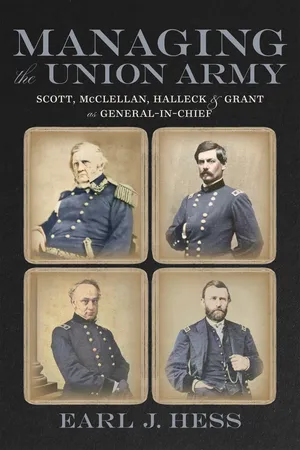
In Managing the Union Army, renowned Civil War historian Earl J. Hess upends our understanding of the general-in-chief, his role in the Union military system, and his influence on the conflict's outcome. Hess reinterprets the accomplishments and failures of the four men who held the position, evaluating Winfield Scott, George B. McClellan, Henry W. Halleck, and Ulysses S. Grant in ways that might surprise many students of Civil War military history.
The Union general-in-chief could take on four major responsibilities. The first was to serve as a military advisor to the president and the secretary of war. The second was to develop policies to govern the huge Union army. The third was to recommend officers to command corps, field armies, and military departments. The fourth was to actually command a portion of the army in field operations, a role that Grant alone fulfilled. Hess shows how the performance of the four men varied greatly across the three other tasks. He also details Grant's unique achievement as a field commander—ending the war, which none of the other Union generals-in-chief were able to do.
Hess illuminates how personality traits helped or hindered the generals-in-chief during the war. McClellan's deeply flawed personality contributed to his failure in fulfilling the duties of the position. Grant's strongly positive personality and will-do attitude, by contrast, helped him to succeed more fully in the role than any of his predecessors.
Hess also offers a much more positive evaluation of Halleck than is typical of the scholarly literature on Civil War commanders. Halleck was not only a successful general-in-chief but also fundamentally supported Grant during the last year of the conflict by serving as chief of staff of the U.S. Army, a fourth member of the management team. From an elderly though distinguished officer like Scott, to Grant, the most effective general of the Civil War, the office of general-in-chief evolved into the crucial military position in the Federal war effort. Hess's study, through a close examination of administrative history, offers a dramatically new way of understanding how the Union army worked in the Civil War.
eBook - ePub
Managing the Union Army
Scott, McClellan, Halleck, and Grant as General-in-Chief
- 468 pages
- English
- ePUB (mobile friendly)
- Available on iOS & Android
eBook - ePub
About this book
Information
Subtopic
American Civil War HistoryIndex
HistoryTable of contents
- Cover
- Title Page
- Copyright Page
- Dedication
- Contents
- List of Illustrations
- Introduction
- 1. Winfield Scott
- 2. George B. McClellan
- 3. Interim Period and Henry W. Halleck
- 4. Halleck at the Helm
- 5. Halleck and His Troublesome Generals
- 6. Halleck at Apogee
- 7. Ulysses S. Grant
- 8. Grant Takes Charge
- 9. Grant from the Wilderness to Petersburg
- 10. Grant, Butler, Smith, and Early
- 11. Grant in the Summer of 1864
- 12. Grant in the Fall of 1864
- 13. Grant Closes the Rebellion
- 14. Drawdown, Long-Term Change, and Reflections
- Conclusion
- Notes
- Bibliography
- Index
Trusted by 375,005 students
Access to over 1.5 million titles for a fair monthly price.
Study more efficiently using our study tools.
Frequently asked questions
Yes, you can cancel anytime from the Subscription tab in your account settings on the Perlego website. Your subscription will stay active until the end of your current billing period. Learn how to cancel your subscription
No, books cannot be downloaded as external files, such as PDFs, for use outside of Perlego. However, you can download books within the Perlego app for offline reading on mobile or tablet. Learn how to download books offline
Perlego offers two plans: Essential and Complete
- Essential is ideal for learners and professionals who enjoy exploring a wide range of subjects. Access the Essential Library with 800,000+ trusted titles and best-sellers across business, personal growth, and the humanities. Includes unlimited reading time and Standard Read Aloud voice.
- Complete: Perfect for advanced learners and researchers needing full, unrestricted access. Unlock 1.5M+ books across hundreds of subjects, including academic and specialized titles. The Complete Plan also includes advanced features like Premium Read Aloud and Research Assistant.
We are an online textbook subscription service, where you can get access to an entire online library for less than the price of a single book per month. With over 1.5 million books across 990+ topics, we’ve got you covered! Learn about our mission
Look out for the read-aloud symbol on your next book to see if you can listen to it. The read-aloud tool reads text aloud for you, highlighting the text as it is being read. You can pause it, speed it up and slow it down. Learn more about Read Aloud
Yes! You can use the Perlego app on both iOS and Android devices to read anytime, anywhere — even offline. Perfect for commutes or when you’re on the go.
Please note we cannot support devices running on iOS 13 and Android 7 or earlier. Learn more about using the app
Please note we cannot support devices running on iOS 13 and Android 7 or earlier. Learn more about using the app
Yes, you can access Managing the Union Army by Earl J. Hess in PDF and/or ePUB format, as well as other popular books in History & American Civil War History. We have over 1.5 million books available in our catalogue for you to explore.