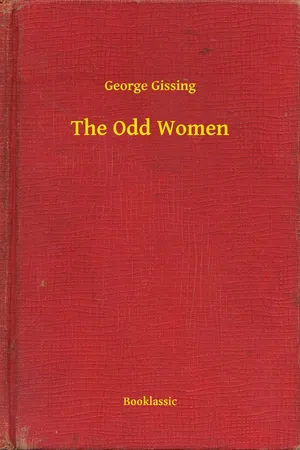
The Odd Women is an 1893 novel by the English novelist George Gissing. Its themes are the role of women in society, marriage, morals and the early feminist movement.
eBook - ePub
The Odd Women
About this book
Information
Subtopic
Literature GeneralIndex
LiteratureChapter 1 THE FOLD AND THE SHEPHERD
'So to-morrow, Alice,' said Dr. Madden, as he walked with his
eldest daughter on the coast-downs by Clevedon, 'I shall take steps
for insuring my life for a thousand pounds.'
It was the outcome of a long and intimate conversation. Alice
Madden, aged nineteen, a plain, shy, gentle-mannered girl, short of
stature, and in movement something less than graceful, wore a
pleased look as she glanced at her father's face and then turned
her eyes across the blue channel to the Welsh hills. She was
flattered by the confidence reposed in her, for Dr. Madden,
reticent by nature, had never been known to speak in the domestic
circle about his pecuniary affairs. He seemed to be the kind of man
who would inspire his children with affection: grave but benign,
amiably diffident, with a hint of lurking mirthfulness about his
eyes and lips. And to-day he was in the best of humours;
professional prospects, as he had just explained to Alice, were
more encouraging than hitherto; for twenty years he had practised
medicine at Clevedon, but with such trifling emolument that the
needs of his large family left him scarce a margin over
expenditure; now, at the age of forty-nine—it was 1872—he looked
forward with a larger hope. Might he not reasonably count on ten or
fifteen more years of activity? Clevedon was growing in repute as a
seaside resort; new houses were rising; assuredly his practice
would continue to extend.
'I don't think girls ought to be troubled about this kind of
thing,' he added apologetically. 'Let men grapple with the world;
for, as the old hymn says, "'tis their nature to." I should grieve
indeed if I thought my girls would ever have to distress themselves
about money matters. But I find I have got into the habit, Alice,
of talking to you very much as I should talk with your dear mother
if she were with us.'
Mrs. Madden, having given birth to six daughters, had fulfilled
her function in this wonderful world; for two years she had been
resting in the old churchyard that looks upon the Severn sea.
Father and daughter sighed as they recalled her memory. A sweet,
calm, unpretending woman; admirable in the domesticities; in speech
and thought distinguished by a native refinement, which in the most
fastidious eyes would have established her claim to the title of
lady. She had known but little repose, and secret anxieties told
upon her countenance long before the final collapse of health.
'And yet,' pursued the doctor—doctor only by courtesy—when he
had stooped to pluck and examine a flower, 'I made a point of never
discussing these matters with her. As no doubt you guess, life has
been rather an uphill journey with us. But the home must be guarded
against sordid cares to the last possible moment; nothing upsets me
more than the sight of those poor homes where wife and children are
obliged to talk from morning to night of how the sorry earnings
shall be laid out. No, no; women, old or young, should never have
to think about money.
The magnificent summer sunshine, and the western breeze that
tasted of ocean, heightened his natural cheeriness. Dr. Madden fell
into a familiar strain of prescience.
'There will come a day, Alice, when neither man nor woman is
troubled with such sordid care. Not yet awhile; no, no; but the day
will come. Human beings are not destined to struggle for ever like
beasts of prey. Give them time; let civilization grow. You know
what our poet says: "There the common sense of most shall hold a
fretful realm in awe—"'
He quoted the couplet with a subdued fervour which characterized
the man and explained his worldly lot. Elkanah Madden should never
have entered the medical profession; mere humanitarianism had
prompted the choice in his dreamy youth; he became an empiric,
nothing more. 'Our poet,' said the doctor; Clevedon was chiefly
interesting to him for its literary associations. Tennyson he
worshipped; he never passed Coleridge's cottage without bowing in
spirit. From the contact of coarse actualities his nature
shrank.
When he and Alice returned from their walk it was the hour of
family tea. A guest was present this afternoon; the eight persons
who sat down to table were as many as the little parlour could
comfortably contain. Of the sisters, next in age to Alice came
Virginia, a pretty but delicate girl of seventeen. Gertrude,
Martha, and Isabel, ranging from fourteen to ten, had no physical
charm but that of youthfulness; Isabel surpassed her eldest sister
in downright plainness of feature. The youngest, Monica, was a
bonny little maiden only just five years old, dark and
bright-eyed.
The parents had omitted no care in shepherding their fold.
Partly at home, and partly in local schools, the young ladies had
received instruction suitable to their breeding, and the elder ones
were disposed to better this education by private study. The
atmosphere of the house was intellectual; books, especially the
poets, lay in every room. But it never occurred to Dr. Madden that
his daughters would do well to study with a professional object. In
hours of melancholy he had of course dreaded the risks of life, and
resolved, always with postponement, to make some practical
provision for his family; in educating them as well as
circumstances allowed, he conceived that he was doing the next best
thing to saving money, for, if a fatality befell, teaching would
always be their resource. The thought, however, of his girls having
to work for money was so utterly repulsive to him that he could
never seriously dwell upon it. A vague piety supported his courage.
Providence would not deal harshly with him and his dear ones. He
enjoyed excellent health; his practice decidedly improved. The one
duty clearly before him was to set an example of righteous life,
and to develop the girls' minds—in every proper direction. For, as
to training them for any path save those trodden by English ladies
of the familiar type, he could not have dreamt of any such thing.
Dr. Madden's hopes for the race were inseparable from a maintenance
of morals and conventions such as the average man assumes in his
estimate of women.
The guest at table was a young girl named Rhoda Nunn. Tall,
thin, eager-looking, but with promise of bodily vigour, she was
singled at a glance as no member of the Madden family. Her
immaturity (but fifteen, she looked two years older) appeared in
nervous restlessness, and in her manner of speaking, childish at
times in the hustling of inconsequent thoughts, yet striving to
imitate the talk of her seniors. She had a good head, in both
senses of the phrase; might or might not develop a certain beauty,
but would assuredly put forth the fruits of intellect. Her mother,
an invalid, was spending the summer months at Clevedon, with Dr.
Madden for medical adviser, and in this way the girl became
friendly with the Madden household. Its younger members she treated
rather condescendingly; childish things she had long ago put away,
and her sole pleasure was in intellectual talk. With a frankness
peculiar to her, indicative of pride, Miss Nunn let it be known
that she would have to earn her living, probably as a school
teacher; study for examinations occupied most of her day, and her
hours of leisure were frequently spent either at the Maddens or
with a family named Smithson—people, these latter, for whom she had
a profound and somewhat mysterious admiration. Mr. Smithson, a
widower with a consumptive daughter, was a harsh-featured,
rough-voiced man of about five-and-thirty, secretly much disliked
by Dr. Madden because of his aggressive radicalism; if women's
observation could be trusted, Rhoda Nunn had simply fallen in love
with him, had made him, perhaps unconsciously, the object of her
earliest passion. Alice and Virginia commented on the fact in their
private colloquy with a shamefaced amusement; they feared that it
spoke ill for the young lady's breeding. None the less they thought
Rhoda a remarkable person, and listened to her utterances
respectfully.
'And what is your latest paradox, Miss Nunn?' inquired the
doctor, with grave facetiousness, when he had looked round the
young faces at his board.
'Really, I forget, doctor. Oh, but I wanted to ask you, Do you
think women ought to sit in Parliament?'
'Why, no,' was the response, as if after due consideration. 'If
they are there at all they ought to stand.'
'Oh, I can't get you to talk seriously,' rejoined Rhoda, with an
air of vexation, whilst the others were good-naturedly laughing.
'Mr. Smithson thinks there ought to be female members of
Parliament.
'Does he? Have the girls told you that there's a nightingale in
Mr. Williams's orchard?'
It was always thus. Dr. Madden did not care to discuss even
playfully the radical notions which Rhoda got from her
objectionable friend. His daughters would not have ventured to
express an opinion on such topics when he was present; apart with
Miss Nunn, they betrayed a timid interest in whatever proposition
she advanced, but no gleam of originality distinguished their
arguments.
After tea the little company fell into groups—some out of doors
beneath the apple-trees, others near the piano at which Virginia
was playing Mendelssohn. Monica ran about among them with her
five-year-old prattle, ever watched by her father, who lounged in a
canvas chair against the sunny ivied wall, pipe in mouth. Dr.
Madden was thinking how happy they made him, these kind, gentle
girls; how his love for them seemed to ripen with every summer;
what a delightful old age his would be, when some were married and
had children of their own, and the others tended him—they whom he
had tended. Virginia would probably be sought in marriage; she had
good looks, a graceful demeanour, a bright understanding. Gertrude
also, perhaps. And little Monica—ah, little Monica! she would be
the beauty of the family. When Monica had grown up it would be time
for him to retire from practice; by then he would doubtless have
saved money.
He must find more society for them; they had always been too
much alone, whence their shyness among strangers. If their mother
had but lived!
'Rhoda wishes you to read us something, father,' said his eldest
girl, who had approached whilst he was lost in dream.
He often read aloud to them from the poets; Coleridge and
Tennyson by preference. Little persuasion was needed. Alice brought
the volume, and he selected 'The Lotus-Eaters.' The girls grouped
themselves about him, delighted to listen. Many an hour of summer
evening had they thus spent, none more peaceful than the present.
The reader's cadenced voice blended with the song of a thrush.
'"Let us alone. Time driveth onward fast, And in a little while
our lips are dumb. Let us alone. What is it that will last? All
thing' are taken from us—"'
There came an interruption, hurried, peremptory. A farmer over
at Kingston Seymour had been seized with alarming illness; the
doctor must come at once.
'Very sorry, girls. Tell James to put the horse in, sharp as he
can.
In ten minutes Dr. Madden was driving at full speed, alone in
his dog-cart, towards the scene of duty.
About seven o'clock Rhoda Nunn took leave, remarking with her
usual directness, that before going home she would walk along the
sea-front in the hope of a meeting with Mr. Smithson and his
daughter. Mrs. Nunn was not well enough to leave the house to-day;
but, said Rhoda, the invalid preferred being left alone at such
times.
'Are you sure she prefers it?' Alice ventured to ask. The girl
gave her a look of surprise.
'Why should mother say what she doesn't mean?'
It was uttered with an ingenuousness which threw some light on
Rhoda's character.
By nine o'clock the younger trio of sisters had gone to bed;
Alice, Virginia, and Gertrude sat in the parlour, occupied with
books, from time to time exchanging a quiet remark. A tap at the
door scarcely drew their attention, for they supposed it was the
maid-servant coming to lay supper. But when the door opened there
was a mysterious silence; Alice looked up and saw the expected
face, wearing, however, so strange an expression that she rose with
sudden fear.
'Can I speak to you, please, miss?'
The dialogue out in the passage was brief. A messenger had just
arrived with the tidings that Dr. Madden, driving back from
Kingston Seymour, had been thrown from his vehicle and lay
insensible at a roadside cottage.
For some time the doctor had been intending to buy a new horse;
his faithful old roadster was very weak in the knees. As in other
matters, so in this, postponement became fatality; the horse
stumbled and fell, and its driver was flung head forward into the
road. Some hours later they brought him to his home, and for a day
or two there were hopes that he might rally. But the sufferer's
respite only permitted him to dictate and sign a brief will; this
duty performed, Dr. Madden closed his lips for ever.
Chapter 2 ADRIFT
Just before Christmas of 1887, a lady past her twenties, and with a look of discouraged weariness on her thin face, knocked at a house-door in a little street by Lavender Hill. A card in the window gave notice that a bedroom was here to let. When the door opened, and a clean, grave, elderly woman presented herself, the visitor, regarding her anxiously, made known that she was in search of a lodging.
'It may be for a few weeks only, or it may be for a longer period,' she said in a low, tired voice, with an accent of good breeding. 'I have a difficulty in finding precisely what I want. One room would be sufficient, and I ask for very little attendance.'
She had but one room to let, replied the other. It might be inspected.
They went upstairs. The room was at the back of the house, small, but neatly furnished. Its appearance seemed to gratify the visitor, for she smiled timidly.
'What rent should you ask?'
'That would depend, mum, on what attendance was required.'
'Yes—of course. I think—will you permit me to sit down? I am really very tired. Thank you. I require very little attendance indeed. My ways are very simple. I should make the bed myself, and—and, do the other little things that are necessary from day to day. Perhaps I might ask you to sweep the room out—once a week or so.'
The landlady grew meditative. Possibly she had had experience of lodgers who were anxious to give as little trouble as possible. She glanced furtively at the stranger.
'And what,' was her question at length, 'would you be thinking of paying?'
'Perhaps I had better explain my position. For several years I have been companion to a lady in Hampshire. Her death has thrown me on my own resources—I hope only for a short time. I have come to London because a younger sister of mine is employed here in a house of business; she recommended me to seek for lodgings in this part; I might as well be near her whilst I am endeavouring to find another post; perhaps I may be fortunate enough to find one in London. Quietness and economy are necessary to me. A house like yours would suit me very well—very well indeed. Could we not agree upon terms within my—within my power?'
Again the landlady pondered.
'Would you be willing to pay five and sixpence?'
'Yes, I would pay five and sixpence—if you are quite sure that you could let me live in my own way with satisfaction to yourself. I—in fact, I am a vegetarian, and as the meals I take are so very simple, I feel that I might just as well prepare them myself. Would you object to my doing so in this room? A kettle and a saucepan are really all—absolutely all—that I should need to use. As I shall be much at home, it will be of course necessary for me to have a fire.'
In the course of half an hour an agreement had been devised which seemed fairly satisfactory to both parties.
'I'm not one of the graspin' ones,' remarked the landlady. 'I think I may say that of myself. If I make five or six shillings a week out of my spare room, I don't grumble. But the party as takes it must do their duty on their side. You haven't told me your name yet, mum.'
'Miss Madden. My luggage is at the railway station; it shall be brought here this evening. And, as I am quite unknown to you, I shall be glad to pay my rent in advance.'
'Well, I don't ask for that; but it's just as you like.'
'Then I will pay you five and sixpence at once. Be so kind as to let me have a receipt.'
So Miss Madden established herself at Lavender Hill, and dwelt there alone for three months.
She received letters frequently, but only one person called upon her. This was her sister Monica, now serving at a draper's in Walworth Road. The young lady came every Sunday, and in bad weather spent the whole day up in the little bedroom. Lodger and landlady were on remarkably good terms; the one paid her dues with exactness, and the other did many a little kindness not bargained for in the original contract.
Time went on to the spring of '88. Then, one afternoon, Miss Madden descended to the kitchen and tapped in her usual timid way at the door.
'Are you at leisure, Mrs. Conisbee? Could I have a little conversation with you?'
The landlady was alone, and with no more engrossing occupation than the ironing of some linen she had recently washed.
'I have mentioned my elder sister now and then. I am sorry to say she is leaving her post with the family at Hereford. The children are going to school, so that her services are no longer needed.'
'Indeed, mum?'
'Yes. For a shorter or longer time she will be in need of a home. Now it has occurred to me, Mrs. Conisbee, that—that I would ask you whether you would have any objection to her sharing my room with me? Of course there must be an extra payment. The room is small for two persons, but then the arrangement would only be temporary. My sister is a good and experienced teacher, and I am sure she will have no difficulty in obtaining another engagement.'
Mrs. Conisbee reflected, but without a shade of discontent. By this time she knew that her lodger was thoroughly to be trusted.
'Well, it's if you can manage, mum,' she replied. 'I don't see as I could have any fault to find, if you thought you could both live in that little room. And as for the rent, I should be quite satisfied if we said seven shillings instead of five and six.'
'Thank you, Mrs. Conisbee; thank you very much indeed. I will write to my sister at once; the new...
Table of contents
- Title
- Chapter 1 - THE FOLD AND THE SHEPHERD
- Chapter 2 - ADRIFT
- Chapter 3 - AN INDEPENDENT WOMAN
- Chapter 4 - MONICA'S MAJORITY
- Chapter 5 - THE CASUAL ACQUAINTANCE
- Chapter 6 - A CAMP OF THE RESERVE
- Chapter 7 - A SOCIAL ADVANCE
- Chapter 8 - COUSIN EVERARD
- Chapter 9 - THE SIMPLE FAITH
- Chapter 10 - FIRST PRINCIPLES
- Chapter 11 - AT NATURE'S BIDDING
- Chapter 12 - WEDDINGS
- Chapter 13 - DISCORD OF LEADERS
- Chapter 14 - MOTIVES MEETING
- Chapter 15 - THE JOYS OF HOME
- Chapter 16 - HEALTH FROM THE SEA
- Chapter 17 - THE TRIUMPH
- Chapter 18 - A REINFORCEMENT
- Chapter 19 - THE CLANK OF THE CHAINS
- Chapter 20 - THE FIRST LIE
- Chapter 21 - TOWARDS THE DECISIVE
- Chapter 22 - HONOUR IN DIFFICULTIES
- Chapter 23 - IN AMBUSH
- Chapter 24 - TRACKED
- Chapter 25 - THE FATE OF THE IDEAL
- Chapter 26 - THE UNIDEAL TESTED
- Chapter 27 - THE REASCENT
- Chapter 28 - THE BURDEN OF FUTILE SOULS
- Chapter 29 - CONFESSION AND COUNSEL
- Chapter 30 - RETREAT WITH HONOUR
- Chapter 31 - A NEW BEGINNING
Trusted by 375,005 students
Access to over 1.5 million titles for a fair monthly price.
Study more efficiently using our study tools.
Frequently asked questions
Yes, you can cancel anytime from the Subscription tab in your account settings on the Perlego website. Your subscription will stay active until the end of your current billing period. Learn how to cancel your subscription
No, books cannot be downloaded as external files, such as PDFs, for use outside of Perlego. However, you can download books within the Perlego app for offline reading on mobile or tablet. Learn how to download books offline
Perlego offers two plans: Essential and Complete
- Essential is ideal for learners and professionals who enjoy exploring a wide range of subjects. Access the Essential Library with 800,000+ trusted titles and best-sellers across business, personal growth, and the humanities. Includes unlimited reading time and Standard Read Aloud voice.
- Complete: Perfect for advanced learners and researchers needing full, unrestricted access. Unlock 1.5M+ books across hundreds of subjects, including academic and specialized titles. The Complete Plan also includes advanced features like Premium Read Aloud and Research Assistant.
We are an online textbook subscription service, where you can get access to an entire online library for less than the price of a single book per month. With over 1.5 million books across 990+ topics, we’ve got you covered! Learn about our mission
Look out for the read-aloud symbol on your next book to see if you can listen to it. The read-aloud tool reads text aloud for you, highlighting the text as it is being read. You can pause it, speed it up and slow it down. Learn more about Read Aloud
Yes! You can use the Perlego app on both iOS and Android devices to read anytime, anywhere — even offline. Perfect for commutes or when you’re on the go.
Please note we cannot support devices running on iOS 13 and Android 7 or earlier. Learn more about using the app
Please note we cannot support devices running on iOS 13 and Android 7 or earlier. Learn more about using the app
Yes, you can access The Odd Women by George Gissing in PDF and/or ePUB format, as well as other popular books in Literature & Literature General. We have over 1.5 million books available in our catalogue for you to explore.