In this fourth volume, Proust's novel takes up for the first time the theme of homosexual love and examines how destructive sexual jealousy can be for those who suffer it. Sodom and Gomorrah is also an unforgiving analysis of both the decadent high society of Paris and the rise of a philistine bourgeoisie that will inevitably supplant it.
- English
- ePUB (mobile friendly)
- Available on iOS & Android
eBook - ePub
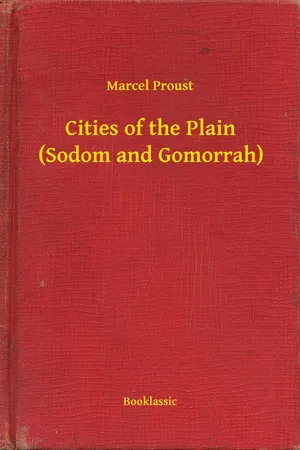
Cities of the Plain (Sodom and Gomorrah)
About this book
Information
Subtopic
Literature GeneralIndex
LiteraturePart 1
Introducing the men-women, descendants of those of the inhabitants of Sodom who were spared by the fire from heaven
La femme aura Gomorrhe et l'homme aura Sodome.Alfred de Vigny.
The reader will remember that, long before going that day (on the evening of which the Princesse de Guermantes was to give her party) to pay the Duke and Duchess the visit which I have just described, I had kept watch for their return and had made, in the course of my vigil, a discovery which, albeit concerning M. de Charlus in particular, was in itself so important that I have until now, until the moment when I could give it the prominence and treat it with the fulness that it demanded, postponed giving any account of it. I had, as I have said, left the marvellous point of vantage, so snugly contrived for me at the top of the house, commanding the broken and irregular slopes leading up to the Hôtel de Bréquigny, and gaily decorated in the Italian manner by the rose-pink campanile of the Marquis de Frécourt's stables. I had felt it to be more convenient, when I thought that the Duke and Duchess were on the point of returning, to post myself on the staircase. I regretted somewhat the abandonment of my watch-tower. But at that time of day, namely the hour immediately following luncheon, I had less cause for regret, for I should not then have seen, as in the morning, the foptmen of the Bréquigny-Tresmes household, converted by distance into minute figures in a picture, make their leisurely ascent of the abrupt precipice, feather-brush in hand, behind the large, transparent flakes of mica which stood out so charmingly upon its ruddy bastions. Failing the geologist's field of contemplation, I had at least that of the botanist, and was peering through the shutters of the staircase window at the Duchess's little tree and at the precious plant, exposed in the courtyard with that insistence with which mothers 'bring out' their marriageable offspring, and asking myself whether the unlikely insect would come, by a providential hazard, to visit the offered and neglected pistil. My curiosity emboldening me by degrees, I went down to the ground-floor window, which also stood open with its shutters ajar. I could hear distinctly, as he got ready to go out, Jupien who could not detect me behind my blind, where I stood perfectly still until the moment when I drew quickly aside in order not to be seen by M. de Charlus, who, on his way to call upon Mme. de Villeparisis, was slowly crossing the courtyard, a pursy figure, aged by the strong light, his hair visibly grey. Nothing short of an indisposition of Mme. de Villeparisis (consequent on the illness of the Marquis de Fierbois, with whom he personally was at daggers drawn) could have made M. de Charlus pay a call, perhaps for the first time in his life, at that hour of the day. For with that eccentricity of the Guermantes, who, instead of conforming to the ways of society, used to modify them to suit their own personal habits (habits not, they thought, social, and deserving in consequence the abasement before them of that thing of no value, Society—thus it was that Mme. de Marsantes had no regular 'day,' but was at home to her friends every morning between ten o'clock and noon), the Baron, reserving those hours for reading, hunting for old curiosities and so forth, paid calls only between four and six in the afternoon. At six o'clock he went to the Jockey Club, or took a stroll in the Bois. A moment later, I again recoiled, in order not to be seen by Jupien. It was nearly time for him to start for the office, from which he would return only for dinner, and not even then always during the last week, his niece and her apprentices having gone to the country to finish a dress there for a customer. Then, realising that no one could see me, I decided not to let myself be disturbed again, for fear of missing, should the miracle be fated to occur, the arrival, almost beyond the possibility of hope (across so many obstacles of distance, of adverse risks, of dangers), of the insect sent from so far as ambassador to the virgin who had so long been waiting for him to appear. I knew that this expectancy was no more passive than in the male flower, whose stamens had spontaneously curved so that the insect might more easily receive their offering; similarly the female flower that stood here, if the insect came, would coquettishly arch her styles; and, to be more effectively penetrated by him, would imperceptibly advance, like a hypocritical but ardent damsel, to meet him half-way. The laws of the vegetable kingdom are themselves governed by other laws, increasingly exalted. If the visit of an insect, that is to say, the transportation of the seed of one flower is generally necessary for the fertilisation of another, that is because autofecundation, the fertilisation of a flower by itself, would lead, like a succession of intermarriages in the same family, to degeneracy and sterility, whereas the crossing effected by the insects gives to the subsequent generations of the same species a vigour unknown to their forebears. This invigoration may, however, prove excessive, the species develop out of all proportion; then, as an anti-toxin protects us against disease, as the thyroid gland regulates our adiposity, as defeat comes to punish pride, fatigue, indulgence, and as sleep in turn depends upon fatigue, so an exceptional act of autofecundation comes at a given point to apply its turn of the screw, its pull on the curb, brings back within normal limits the flower that has exaggerated its transgression of them. My reflexions had followed a tendency which I shall describe in due course, and I had already drawn from the visible stratagems of flowers a conclusion that bore upon a whole unconscious element of literary work, when I saw M. de Charlus coming away from the Marquise. Perhaps he had learned from his elderly relative herself, or merely from a servant, the great improvement, or rather her complete recovery from what had been nothing more than a slight indisposition. At this moment, when he did not suspect that anyone was watching him, his eyelids lowered as a screen against the sun, M. de Charlus had relaxed that tension in his face, deadened that artificial vitality, which the animation of his talk and the force of his will kept in evidence there as a rule. Pale as marble, his nose stood out firmly, his fine features no longer received from an expression deliberately assumed a different meaning which altered the beauty of their modelling; nothing more now than a Guermantes, he seemed already carved in stone, he Pala-mède the Fifteenth, in their chapel at Combray. These general features of a whole family took on, however, in the face of M. de Charlus a fineness more spiritualised, above all more gentle. I regretted for his sake that he should habitually adulterate with so many acts of violence, offensive oddities, tale-bearings, with such harshness, susceptibility and arrogance, that he should conceal beneath a false brutality the amenity, the kindness which, at the moment of his emerging from Mme. de Villeparisis's, I could see displayed so innocently upon his face. Blinking his eyes in the sunlight, he seemed almost to be smiling, I found in his face seen thus in repose and, so to speak, in its natural state something so affectionate, so disarmed, that I could not help thinking how angry M. de Charlus would have been could he have known that he was being watched; for what was suggested to me by the sight of this man who was so insistent, who prided himself so upon his virility, to whom all other men seemed odiously effeminate, what he made me suddenly think of, so far had he momentarily assumed her features, expression, smile, was a woman.
I was about to change my position again, so that he should not catch sight of me; I had neither the time nor the need to do so. What did I see? Face to face, in that courtyard where certainly they had never met before (M. de Charlus coming to the Hôtel de Guermantes only in the afternoon, during the time when Jupien was at his office), the Baron, having suddenly opened wide his half-shut eyes, was studying with unusual attention the ex-tailor poised on the threshold of his shop, while the latter, fastened suddenly to the ground before M. de Charlus, taking root in it like a plant, was contemplating with a look of amazement the plump form of the middle-aged Baron. But, more astounding still, M. de Charlus's attitude having changed, Jupien's, as though in obedience to the laws of an occult art, at once brought itself into harmony with it. The Baron, who was now seeking to conceal the impression that had been made on him, and yet, in spite of his affectation of indifference, seemed unable to move away without regret, went, came, looked vaguely into the distance in the way which, he felt, most enhanced the beauty of his eyes, assumed a complacent, careless, fatuous air. Meanwhile Jupien, shedding at once the humble, honest expression which I had always associated with him, had—in perfect symmetry with the Baron—thrown up his head, given a becoming tilt to his body, placed his hand with a grotesque impertinence on his hip, stuck out his behind, posed himself with the coquetry that the orchid might have adopted on the providential arrival of the bee. I had not supposed that he could appear so repellent. But I was equally unaware that he was capable of improvising his part in this sort of dumb charade, which (albeit he found himself for the first time in the presence of M. de Charlus) seemed to have been long and carefully rehearsed; one does not arrive spontaneously at that pitch of perfection except when one meets in a foreign country a compatriot with whom an understanding then grows up of itself, both parties speaking the same language, even though they have never seen one another before.
This scene was not, however, positively comic, it was stamped with a strangeness, or if you like a naturalness, the beauty of which steadily increased. M. de Charlus might indeed assume a detached air, indifferently let his eyelids droop; every now and then he raised them, and at such moments turned on Jupien an attentive gaze. But (doubtless because he felt that such a scene could not be prolonged indefinitely in this place, whether for reasons which we shall learn later on, or possibly from that feeling of the brevity of all things which makes us determine that every blow must strike home, and renders so moving the spectacle of every kind of love), each time that M. de Charlus looked at Jupien, he took care that his glance should be accompanied by a spoken word, which made it infinitely unlike the glances we usually direct at a person whom we do or do not know; he stared at Jupien with the peculiar fixity of the person who is about to say to us: "Excuse my taking the liberty, but you have a long white thread hanging down your back," or else: "Surely I can't be mistaken, you come from Zurich too; I'm certain I must have seen you there often in the curiosity shop." Thus, every other minute, the same question seemed to be being intensely put to Jupien in the stare of M. de Charlus, like those questioning phrases of Beethoven indefinitely repeated at regular intervals, and intended—with an exaggerated lavish-ness of preparation—to introduce a new theme, a change of tone, a 'reentry.' On the other hand, the beauty of the reciprocal glances of M. de Charlus and Jupien arose precisely from the fact that they did not, for the moment at least, seem to be intended to lead to anything further. This beauty, it was the first time that I had seen the Baron and Jupien display it. In the eyes of both of them, it was the sky not of Zurich but of some Oriental city, the name of which I had not yet divined, that I saw reflected. Whatever the point might be that held M. de Charlus and the ex-tailor thus arrested, their pact seemed concluded and these superfluous glances to be but ritual preliminaries, like the parties that people give before a marriage which has been definitely 'arranged.' Nearer still to nature—and the multiplicity of these analogies is itself all the more natural in that the same man, if we examine him for a few minutes, appears in turn as a man, a man-bird or man-insect, and so forth—one would have called them a pair of birds, the male and the female, the male seeking to make advances, the female—Jupien—no longer giving any sign of response to these overtures, but regarding her new friend without surprise, with an inattentive fixity of gaze, which she doubtless felt to be more disturbing and the only effective method, once the male had taken the first steps, and had fallen back upon preening his feathers. At length Jupien's indifference seemed to suffice him no longer; from this certainty of having conquered, to making himself be pursued and desired was but the next stage, and Jupien, deciding to go off to his work, passed through the carriage gate. It was only, however, after turning his head two or three times that he escaped into the street towards which the Baron, trembling lest he should lose the trail (boldly humming a tune, not forgetting to fling a 'Good day' to the porter, who, half-tipsy himself and engaged in treating a few friends in his back kitchen, did not even hear him), hurried briskly to overtake him. At the same instant, just as M. de Charlus disappeared through the gate humming like a great bumble-bee, another, a real bee this time, came into the courtyard. For all I knew this might be the one so long awaited by the orchid, which was coming to bring it that rare pollen without which it must die a virgin. But I was distracted from following the gyrations of the insect for, a few minutes later, engaging my attention afresh, Jupien (perhaps to pick up a parcel which he did take away with him eventually and so, presumably, in the emotion aroused by the apparition of M. de Charlus, had forgotten, perhaps simply for a more natural reason) returned, followed by the Baron. The latter, deciding to cut short the preliminaries, asked the tailor for a light, but at once observed: "I ask you for a light, but I find that I have left my cigars at home." The laws of hospitality prevailed over those of coquetry. "Come inside, you shall have everything you require," said the tailor, on whose features disdain now gave place to joy. The door of the shop closed behind them and I could hear no more. I had lost sight of the bee. I did not know whether he was the insect that the orchid needed, but I had no longer any doubt, in the case of an extremely rare insect and a captive flower, of the miraculous possibility of their conjunction when M. de Charlus (this is simply a comparison of providential hazards, whatever they may be, without the slightest scientific claim to establish a relation between certain laws and what is sometimes, most ineptly, termed homosexuality), who for years past had never come to the house except at hours when Jupien was not there, by the mere accident of Mme. de Villeparisis's illness had encountered the tailor, and with him the good fortune reserved for men of the type of the Baron by one of those fellow-creatures who may indeed be, as we shall see, infinitely younger than Jupien and better looking, the man predestined to exist in order that they may have their share of sensual pleasure on this earth; the man who cares only for elderly gentlemen.
All that I have just said, however, I was not to understand until several minutes had elapsed; so much is reality encumbered by those properties of invisibility until a chance occurrence has divested it of them. Anyhow, for the moment I was greatly annoyed at not being able to hear any more of the conversation between the ex-tailor and the Baron. I then bethought myself of the vacant shop, separated from Jupien's only by a partition that was extremely slender. I had, in order to get to it, merely to go up to our flat, pass through the kitchen, go down by the service stair to the cellars, make my way through them across the breadth of the courtyard above, and on coming to the right place underground, where the joiner had, a few months ago, still been storing his timber and where Jupien intended to keep his coal, climb the flight of steps which led to the interior of the shop. Thus the whole of my journey would be made under cover, I should not be seen by anyone. This was the most prudent method. It was not the one that I adopted, but, keeping close to the walls, I made a circuit in the open air of the courtyard, trying not to let myself be seen. If I was not, I owe it more, I am sure, to chance than to my own sagacity. And for the fact that I took so imprudent a course, when the way through the cellar was so safe, I can see three possible reasons, assuming that I had any reason at all. First of all, my impatience. Secondly, perhaps, a dim memory of the scene at Montjouvain, when I stood concealed outside Mlle. Vinteuil's window. Certainly, the affairs of this sort of which I have been a spectator have always been presented in a setting of the most imprudent and least probable character, as if such revelations were to be the reward of an action full of risk, though in part clandestine. Lastly, I hardly dare, so childish does it appear, to confess the third reason, which was, I am quite sure, unconsciously decisive. Since, in order to follow—and see controverted—the military principles enunciated by Saint-Loup, I had followed in close detail the course of the Boer war, I had been led on from that to read again old accounts of explorations, narratives of travel. These stories had excited me, and I applied them to the events of my daily life to stimulate my courage. When attacks of illness had compelled me to remain for several days and nights on end not only without sleep but without lying down, without tasting food or drink, at the moment when my pain and exhaustion became so intense that I felt that I should never escape from them, I would think of some traveller cast on the beach, poisoned by noxious herbs, shivering with fever in clothes drenched by the salt water, who nevertheless in a day or two felt stronger, rose and went blindly upon his way, in search of possible inhabitants who might, when he came to them, prove cannibals. His example acted on me as a tonic, restored my hope, and I felt ashamed of my momentary discouragement. Thinking of the Boers who, with British armies facing them, were not afraid to expose themselves at the moment when they had to cross, in order to reach a covered position, a tract of open country: "It would be a fine thing," I thought to myself, "if I were to shew less courage when the theatre of operations is simply the human heart, and when the only steel that I, who engaged in more than one duel without fear at the time of the Dreyfus case, have to fear is that of the eyes of the neighbours who have other things to do besides looking into the courtyard,"
But when I was inside the shop, taking care not to let any plank in the floor make the slightest creak, as I found that the least sound in Jupien's shop could be heard from the other, I thought to myself how rash Jupien and M. de Charlus had been, and how wonderfully fortune had favoured them.
I did not dare move. The Guermantes groom, taking advantage no doubt of his master's absence, had, as it happened, transferred to the shop in which I now stood a ladder which hitherto had been kept in the coach-house, and if I had climbed this I could have opened the ventilator above and heard as well as if I had been in Jupien's shop itself. But I was afraid of making a noise. Besides, it was unnecessary. I had not even cause to regret my not having arrived in the shop until several minutes had elapsed. For from what I heard at first in Jupien's shop, which was only a series of inarticulate sounds, I imagine that few words had been exchanged. It is true that these sounds were so violent that, if one set had not always been taken up an octave higher by a parallel plaint, I might have thought that one person was strangling another within a few feet of me, and that subsequently the murderer and his resuscitated victim were taking a bath to wash away the traces of the crime. I concluded from this later on that there is another thing as vociferous as pain, namely pleasure, especially when there is added to it—failing the fear of an eventual parturition, which could not be present in this case, despite the hardly convincing example in the Golden Legend—an immediate afterthought of cleanliness. Finally, after about half an hour (during which time I had climbed on tip-toe up my ladder so as to peep through the ventilator which I did not open), a conversation began. Jupien refused with insistence the money that M. de Charlus was pressing upon him.
"Why do you have your chin shaved like that," he inquired of the Baron in a cajoling tone. "It's so becoming, a nice beard." "Ugh! It's disgusting," the Baron replied. Meanwhile he still lingered upon the threshold and plied Jupien with questions about the neighbourhood. "You don't know anything about the man who sells chestnuts at the corner, not the one on the left, he's a horror, but the other way, a great, dark fellow? And the chemist opposite, he has a charming cyclist who delivers his parcels." These questions must have ruffled Jupien, for, drawing himself up with the scorn of a great courtesan who has been forsaken, he replied: "I can see you are completely heartless." Uttered in a pained, frigid, affected tone, this reproach must have made its sting felt by M. de Charlus, who, to counteract the bad impression made by his curiosity, addressed to Jupien, in too low a tone for me to be able to make out his words, a request the granting of which would doubtless necessitate their prolonging-their sojourn in the shop, and which moved the tailor sufficiently to make-him forget his annoyance, for he studied the Baron's face, plump and flushed beneath his grey hair, with the supremely blissful air of a person whose self-esteem has just been profoundly flattered, and, deciding to grant M. de Charlus the favour that he had just asked of him, after various remarks lacking in refinement such as: "Aren't you naughty!" said to the Baron with a smiling, emotional, superior and grateful air: "All right, you big baby, come along!"
"If I hark back to the question of the tram conductor," M. de Charlus went on imperturbably, "it is because, apart from anything else, he might offer me some entertainment on my homeward journey. For it falls to my lot, now and then, like the Caliph who used to roam the streets of Bagdad in the guise of a common merchant, to condescend to follow some curious little person whose profile may have taken my fancy." I made at this point the same observation that I had made on Bergotte. If he should ever have to plead before a bench, he would employ not the sentences calculated to convince his judges, but such Bergottesque sentences as his peculiar literary temperament suggested to him and made him find pleasure in using. Similarly M. de Charlus, in conversing with the tailor, made use of the same language that he would have used to fashionable people of his own set, even exaggerating its eccentricities, whether because the shyness which he was striving to overcome drove him to an excess of pride or, by preventing him from mastering himself (for we are always less at our ease in the company of some one who is not of our station), forced him to unveil, to lay bare his true nature, which was, in fact, arrogant and a trifle mad, as Mme. de Guermantes had remarked. "So as not to lose the trail," he went on, "I spring like a little usher, like a young and good-looking doctor, into the same car as the little person herself, of whom we speak in the feminine gender only so as to conform with the rules of grammar (as we say, in speaking of a Prince, 'Is His Highness enjoying her usual health'). If she changes her car, I take, with possibly the germs of the plague, that incredible thing called a 'transfer,' a number, and one which, albeit it is presented to me, is not always number one! I change 'carriages' in this way as many as three or four times, I end up sometimes at eleven o'clock at night at the Orleans station and have to come home. Still, if it were only the Orleans station! Once, I must tell you, not having managed to get into conversation sooner, I went all the way to Orleans itself, in one of those frightful compartments where one has, to rest one's eyes upon, between triangles of what is known as 'string-work,' photographs of the principal architectural features of the line. There was only one vacant seat; I had in front of me, as an historic edifice, a 'view' of the Cathedral of Orleans, quite the ugliest in France, and as tiring a thing to have to stare at in that way against my will as if somebody had forced me to focus its towers in the lens of one of those optical penholders which give one ophthalmia. I got out of the train at Les Aubrais together with my young person, for whom alas his family (when I had imagined him to possess every defect except that of having a family) were waiting on the platform! My sole consolation, as I waited for a train to take me back to Paris, was the house of Diane de Poitiers. She may indeed have charmed one of my royal ancestors, I should have preferred a more living beauty. That is why, as an antidote to the boredom of returning home by myself, I should rather like to make friends with a sleeping-car attendant or the conductor of an omnibus. Now, don't be shocked," the Baron wound up, "it is all a question of class. With what you call 'young gentlemen,' for instance, I feel no desire actually to have them, but I am never satisfied until I have touched them, I don't mean physically, but touched a responsive chord. As soon as, instead of leaving my letters unanswered, a young man starts writing to me incessantly, when he is morally at my disposal, I grow calm again, or at least I should grow calm were I not immediately caught by the attraction of another. Rather curious, ain't it?—Speaking of 'young gentlemen,' those that come to the house here, do you know any of them?" "No, baby. Oh, yes, I do, a dark one, very tall, with an eye-. glass, who keeps smiling and turning r...
Table of contents
- Title
- Part 1
- Part 2
Trusted by 375,005 students
Access to over 1.5 million titles for a fair monthly price.
Study more efficiently using our study tools.
Frequently asked questions
Yes, you can cancel anytime from the Subscription tab in your account settings on the Perlego website. Your subscription will stay active until the end of your current billing period. Learn how to cancel your subscription
No, books cannot be downloaded as external files, such as PDFs, for use outside of Perlego. However, you can download books within the Perlego app for offline reading on mobile or tablet. Learn how to download books offline
Perlego offers two plans: Essential and Complete
- Essential is ideal for learners and professionals who enjoy exploring a wide range of subjects. Access the Essential Library with 800,000+ trusted titles and best-sellers across business, personal growth, and the humanities. Includes unlimited reading time and Standard Read Aloud voice.
- Complete: Perfect for advanced learners and researchers needing full, unrestricted access. Unlock 1.5M+ books across hundreds of subjects, including academic and specialized titles. The Complete Plan also includes advanced features like Premium Read Aloud and Research Assistant.
We are an online textbook subscription service, where you can get access to an entire online library for less than the price of a single book per month. With over 1.5 million books across 990+ topics, we’ve got you covered! Learn about our mission
Look out for the read-aloud symbol on your next book to see if you can listen to it. The read-aloud tool reads text aloud for you, highlighting the text as it is being read. You can pause it, speed it up and slow it down. Learn more about Read Aloud
Yes! You can use the Perlego app on both iOS and Android devices to read anytime, anywhere — even offline. Perfect for commutes or when you’re on the go.
Please note we cannot support devices running on iOS 13 and Android 7 or earlier. Learn more about using the app
Please note we cannot support devices running on iOS 13 and Android 7 or earlier. Learn more about using the app
Yes, you can access Cities of the Plain (Sodom and Gomorrah) by Marcel Proust in PDF and/or ePUB format, as well as other popular books in Literature & Literature General. We have over 1.5 million books available in our catalogue for you to explore.