At last - the first comprehensive and practical guide to the work breakdown structure (WBS) in 45 years! This book offers vital new perspectives on how to apply the WBS to today's different types of projects that produce products, services or results. You'll learn how to use WBS throughout the project lifecycle to plan, control and communicate. Your new insights into the WBS principles, plus checklists and proven action steps, will improve the planning of new projects and help you launch projects more efficiently and effectively.
This introductory chapter provides information on the work breakdown structure (WBS), the background of the concept, and its place in the project management process.
THE PROJECT PROBLEM AND SOLUTION
Starting a new project is like starting to write a book—you have an idea of what you want to do, but are not sure how to start. Many writers, like many project planners and managers, find that outlining is frequently the most effective way to start writing.1
An outline is both a method for organizing material and a plan for the book itself. There are many ways to outline a book, especially one based on research. In general, it is necessary to plan the research or data gathering, and decide what will be discussed in each chapter and the appendices. In addition, it is necessary to take into account drafting chapters, getting critical reviews from other experts, and the actual steps involved in reviewing proofs and publishing the document. A sample outline is included in the form of a WBS in Chapter 5.
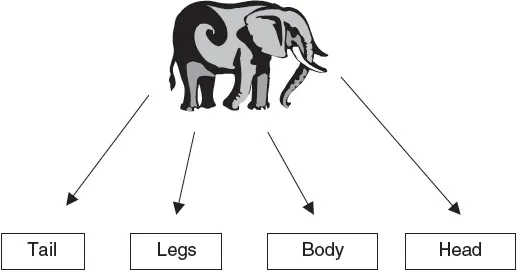
A frequently used analogy is the old question: “How do you eat an elephant?” The answer, of course, is: “One bite at a time.” So the first step in preparing an outline is to start defining and categorizing the “bites.” The bites are important because that is where the useful work is accomplished. For a project, brainstorming can help define the “bites” or activities from the bottom up or a process of “decomposition” can be used starting from the top, and subdividing the project (or the entire elephant) into major sections and working down as shown in Figure 1-1. In either approach, the objective is to develop a structure of the work that needs to be done for the project.
It is obvious that the parts of the elephant can be broken down (or subdivided) further. For example, the head is made up of a face, ears, tusks, and trunk; the four legs can be individually identified; body parts identified, and the tail and tuft separated. A WBS for a project follows the same concept. The WBS is an outline of the work; it is not the work itself. The work is the sum of many activities that make up the project.
FIGURE 1-1 Elephant Breakdown Structure
A WBS may start either as an informal list of activities or in a very structured way, depending on the project and the constraints, and it can end wherever the planner wants it to. The goal is to have a useful framework to help define and organize the work and then to get started doing it.
In developing an outline for a book, for example, some things happen almost automatically, growing out of the discipline of the process. First, boundaries need to be imposed on the book’s contents. Preparing an outline forces the author to define the topics, parts, sections, and chapters. The same thing happens when the project’s WBS is developed. Assumptions and constraints are often considered without focusing on them directly.
Developing the WBS is a four-step process:
1. Specifying the project objectives and focusing on the products, services, or results to be provided to the customer
2. Identifying specifically the products, services, or results (deliverables or end items) to be provided to the customer
3. Identifying other work areas in the project to make sure that 100 percent of the work is covered and to identify areas that cut across the deliverables, represent intermediate outputs, or complement the deliverables.
4. Subdividing each of the items in steps 2 and 3 into successive, logical subcategories until the complexity and dollar value of the elements become manageable units for planning and control purposes (work packages).
KEY DEFINITIONS
Most of the project management terms used frequently in this book are in common usage in the project management field. The following definitions are included in the Glossary of the Project Management Institute’s A Guide to the Project Management Book of Knowledge, known as the PMBOK®Guide.2
Activity: An element of work performed during the course of a project that includes a verb in its descriptor signifying action. An activity normally has an expected duration, expected cost, and expected resource requirements. Activities are often subdivided into tasks.3
Deliverable: Any measurable, tangible, verifiable outcome, result, or item that must be produced to complete a project or part of a project. Often used more narrowly in reference to an external deliverable, which is a deliverable that is subject to approval by the project sponsor or customer.
End Item: A general term that represents the hardware, services, equipment, facilities, data, etc., that are deliverable to the customer or that constitute a commitment on the part of the project manager to the customer.
Organizational Breakdown Structure (OBS): A depiction of the project organization arranged so as to relate work packages to organizational units.
Program: A group of related projects managed in a coordinated way. Programs usually include an element of ongoing work.
Project: A temporary endeavor undertaken to create a unique product, service, or result.
Responsibility Assignment Matrix (RAM): A structure that relates the project organization structure to the WBS to help ensure that each element of the project scope of work is assigned to a responsible individual.
Subproject: A smaller portion of the overall project according to the PMBOK®Guide. Usually, a subproject is a WBS element that can be managed as a semi-independent element of the project and is the responsibility of one person or organization.
Task: A generic term for work that is not included in the WBS, but potentially could be a further decomposition of work by the individuals responsible for that work. Also used to describe the lowest level of effort on a project.
WBS Dictionary: A document that describes the work performed in each WBS element.
WBS Element: An entry in the WBS that can be at any level and is described by a noun or noun and adjective.
Work Breakdown Structure (WBS): A deliverable-oriented grouping of project elements that organizes and defines the total work scope of the project. Each descending level represents an increasingly detailed definition of the project work.
Work Package: Th...
Table of contents
Cover
Title Page
Copyright
About the Author
Dedication
Table of Contents
Foreword
Preface
CHAPTER 1 Introduction to the Work Breakdown Structure
CHAPTER 2 Work Breakdown Structure Fundamentals
CHAPTER 3 Lifecycle Planning: Programs and Phases
CHAPTER 4 The WBS in Project Operations
CHAPTER 5 WBS Examples and Descriptions
CHAPTER 6 WBS Principles, Steps, and Checklist
Bibliography
Index
Trusted by 375,005 students
Access to over 1.5 million titles for a fair monthly price.
Study more efficiently using our study tools.
Frequently asked questions
Yes, you can cancel anytime from the Subscription tab in your account settings on the Perlego website. Your subscription will stay active until the end of your current billing period. Learn how to cancel your subscription
No, books cannot be downloaded as external files, such as PDFs, for use outside of Perlego. However, you can download books within the Perlego app for offline reading on mobile or tablet. Learn how to download books offline
Perlego offers two plans: Essential and Complete
Essential is ideal for learners and professionals who enjoy exploring a wide range of subjects. Access the Essential Library with 800,000+ trusted titles and best-sellers across business, personal growth, and the humanities. Includes unlimited reading time and Standard Read Aloud voice.
Complete: Perfect for advanced learners and researchers needing full, unrestricted access. Unlock 1.5M+ books across hundreds of subjects, including academic and specialized titles. The Complete Plan also includes advanced features like Premium Read Aloud and Research Assistant.
Both plans are available with monthly, semester, or annual billing cycles.
We are an online textbook subscription service, where you can get access to an entire online library for less than the price of a single book per month. With over 1.5 million books across 990+ topics, we’ve got you covered! Learn about our mission
Look out for the read-aloud symbol on your next book to see if you can listen to it. The read-aloud tool reads text aloud for you, highlighting the text as it is being read. You can pause it, speed it up and slow it down. Learn more about Read Aloud
Yes! You can use the Perlego app on both iOS and Android devices to read anytime, anywhere — even offline. Perfect for commutes or when you’re on the go. Please note we cannot support devices running on iOS 13 and Android 7 or earlier. Learn more about using the app
Yes, you can access Effective Work Breakdown Structures by Gregory T. Haugan PhD, PMP in PDF and/or ePUB format, as well as other popular books in Business & Business General. We have over 1.5 million books available in our catalogue for you to explore.