The Complete Project Manager: Integrating People, Organizational, and Technical Skills is the practical guide that addresses the “soft” project management skills that are so essential to successful project, program, and portfolio management.Through a storytelling approach, the authors explain the necessary skills—and how to use them—to create an environment that supports project success. They demonstrate both the “why” and the “how” of creatively applying soft project management skills in the areas of leadership, conflict resolution, negotiations, change management, and more. This guide has an accompanying workbook, The Complete Project Manager's Toolkit, sold separately.
eBook - ePub
The Complete Project Manager
- 314 pages
- English
- ePUB (mobile friendly)
- Available on iOS & Android
eBook - ePub
The Complete Project Manager
About this book
Information
Chapter

1
LEADERSHIP AND
MANAGEMENT SKILLS
Leadership is not about creating followers only. It’s about developing and creating new leaders. I feel good when I’m able to create a leadership spirit in my team.
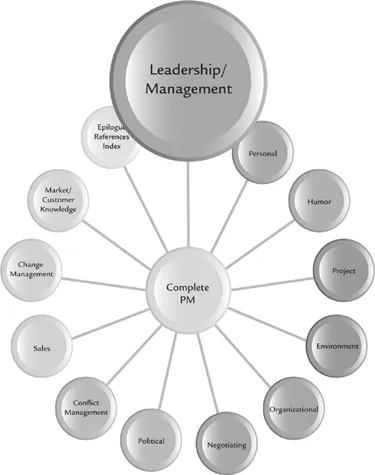
In this chapter, we cover leadership and management skills—those vital visionary and “can do” competencies so necessary for people in a position to influence colleagues, team members, upper managers, clients, and others. The complete project manager possesses charisma, teachability, respect for self and others, qualities of leadership, and courage, as well as lead-by-example, delegation, listening, and relationship-building skills. He or she has to interact with people and achieve results.
LEADING VERSUS MANAGING
We start by highlighting, in Table 1-1, the activities performed when leading or managing a team. Many debates ensue around differences between leadership and management. Our position throughout this book and in our seminars is that both are necessary. Project managers tend to view their jobs as managing. We believe complete project managers also need to be leading.
TABLE 1-1: Leading versus Managing a Project Team
| Leading a Team | Managing a Team |
| Setting a Direction: Creating a vision of the project, with implications for the roles and contributions of team members | Planning and Budgeting: Developing a plan for the project, including objectives, critical path, milestones, and resources needed |
| Aligning People: Seeking commitment by communicating and interpreting the vision together and translating the roles and potential contributions into expectations for team members | Organizing and Staffing: Determining the tasks, roles, and responsibilities required for the project and assembling individuals with appropriate knowledge, skills, and experience |
| Influencing and Inspiring: Encouraging and assisting individuals to actively participate by establishing open and positive relationships; by appealing to their needs, values, and goals; and by involving, entrusting, recognizing, and supporting them | Controlling and Problem Solving: Monitoring and evaluating the progress of the team through observation, meetings, and reports and taking action to correct deviations from the project plan |
In some cultures, people do only what has been defined as their responsibility. Consider the following joke:
Long, long ago, a soldier was shot in the leg in battle and suffered from constant pain. An officer in the troop sent for a surgeon versed in external medicine to treat the soldier’s wound.
The surgeon came to have a look, then said, “This is easy!” He cut off the arrow shaft at the leg with a big pair of scissors and immediately asked for fees for the surgical operation.
“Anyone can do that,” the soldier cried. “The arrowhead is still in my leg! Why haven’t you taken it out?”
“My surgical operation is finished,” said the doctor. “The arrowhead in your leg should be removed by a physician who practices internal medicine.”
Project team members may likewise view their roles very narrowly. Professional project managers usually know what their responsibilities are, but in our experience, there have been many occasions in which the project manager needs to take action beyond the norm in order to get activities done. We recommend that project managers stay flexible and adaptable. In some cultures, the project manager needs to lead by example and wear different hats, especially when people are blocked by perceived limitations in their job descriptions.
WHAT IS PROJECT SUCCESS?
The typical goal for leaders and managers is to achieve project success. An exercise I (Englund) do in the classroom is to ask everyone to take a high-level view of project success and identify the thread that runs through all key factors that determine success and failure. The answer I am looking for is that these factors are all about people. People do matter. Projects typically do not fail or succeed because of technical factors or because we cannot get electrons traveling faster than the speed of light; they fail or succeed depending on how well people work together. When we lose sight of the importance of people issues, such as clarity of purpose, effective and efficient communications, and management support, then we are doomed to struggle. Engaged people find ways to work through all problems. Our challenge as leaders is to create environments for people to do their best work.
There are a bountiful harvest of definitions of project success (and just as many explanations for project failure). Meeting the triple constraints is just a starting point. Sometimes you can be right on scope, schedule, and resources and still fail to be successful, perhaps because the market changed, or a competitor outdid you, or a client changed its mind. You could also miss on all constraints but still have a successful project in the long term. It is important to get all requirements specified as accurately as possible; it is also important to be flexible since needs and conditions change over time or as more becomes known about the project as it progresses.
Please allow us to suggest an overarching criterion for project success: check with key stakeholders and ask them for their definitions of success. Pin them down to one key definition each. You may get some surprising replies like, “Don’t embarrass me.” “Keep out of the newspaper.” “Just get something finished.” You may even get conflicting responses. Integrate the replies and work to fulfill the stakeholders’ needs. Having this dialogue early in project life cycles provides clear marching orders—and forewarning about what is important to key stakeholders.
Having established that success or failure is all about people, our goal now is to learn how to be better leaders and managers of people, not just projects.
START BY LEADING YOURSELF
Have you ever worked with people who did not lead themselves well? Worse, have you ever worked for people in leadership positions who could not lead themselves? We have, and in those situations, we felt very bad, unsupported, and very disappointed.
These people are like the crow in a fable that goes like this: A crow was sitting in a tree, doing nothing all day. A small rabbit saw the crow and asked him, “Can I also sit like you and do nothing all day long?” “Sure,” answered the crow, “why not?” So the rabbit sat on the ground below the crow, following his example. All of a sudden a fox appeared, pounced on the rabbit, and ate him.
The tongue-in-cheek moral of the story is that if you are going to sit around doing nothing all day, you had better be sitting very high up. But if you are down where the action is, you cannot afford to be sitting around doing nothing. The key to leading yourself well is to learn self-management. We have observed that many people put too much emphasis on decision-making and too little on decision managing. As a result, they lack focus, discipline, intentionality, and purpose.
Successful people make right decisions early and manage those decisions daily. Some people think that self-leadership is about making good decisions every day, when the reality is that we need to make a few critical decisions in major areas of life and then manage those decisions day to day.
Here is a classic example. Have you ever made a New Year’s resolution to exercise? You probably already believe that exercise is important. Making a decision to do it is not hard, but managing that decision and following through is much more difficult. Let us say, for example, that you sign up for a health club membership the first week of January. When you sign on, you are excited. But the first time you show up at the gym, there is a mob of people. There are so many cars that police are directing traffic. You drive around for fifteen minutes and finally find a parking place four blocks away. But that is okay; you are there for exercise anyway, so you walk to the gym.
Then when you get inside the building, you even have to wait to get into the locker room to change. But you think that is okay. You want to get into shape. This is going to be great. You think that until you finally get dressed and discover all of the exercise machines are being used. Once again you have to wait. Finally, you get on a machine. It is not the one you really wanted, but you take it and you exercise for twenty minutes. When you see the line for the shower, you decide to skip it, take your clothes, and just change at home.
On your way out, you see the manager of the club, and you decide to complain about the crowds. She says, “Do not worry about it. Come back in three weeks, and you can have the closest parking place and your choice of machines. Because by then, 98 percent of the people who signed up will have dropped out!”
It is one thing to decide to exercise. It is another to actually follow through with it. As everyone else drops out, you have to decide whether you will quit like everyone else or you will stick with it. And that takes self-management.
Nothing will make a better impression on your leader than your ability to manage yourself. If your leader must continually expend energy managing you, then you will be perceived as someone who drains time and energy. If you manage yourself well, however, your leader will see you as someone who maximizes opportunities and leverages personal strengths. That will make you someone your leader turns to when the heat is on. I (Englund) had a colleague who seemed to constantly irritate our manager. I made it a point to always help the manager and be easy to work with. In turn, that manager took good care of me.
The question is: what does a leader need to self-manage? To gain credibility with your leader and others, focus on taking care of business as follows:
- Manage your emotions. People driving in a state of heightened emotions are 144 percent more likely to have auto accidents. The same study evidently found that one out of five victims of fatal accidents had been in a quarrel with another person in the six hours preceding the accident.It is important for everybody to manage their emotions. Nobody likes to spend time around a person who behaves like an emotional time bomb that may go off at any moment. But it is especially critical for leaders to control their emotions because whatever they do affects many other people. Good leaders know when to display emotions and when to delay doing so. Sometimes they show them so that their people can feel what they are feeling. It stirs them up. Is that manipulative? We do not think so, as long as the leaders are doing it for the good of the team and not for their own gain. Because leaders see more and ahead of others, they often experience the emotions first. By letting your team know what you are feeling, you are helping them to see what you are seeing.
- Manage your time. Time management issues are especially tough for people in the middle. Leaders at the top can delegate. Workers at the bottom often punch a time clock. They get paid an hourly wage, and they do what they can while they are on the clock. Leaders in the middle, meanwhile, feel the stress and tension of being pulled in both directions. They are encouraged, and are often expected, to put in long hours to get work done.
- Manage your priorities. In some companies, project managers have no choice but to juggle various responsibilities, but the old proverb is true: if you chase two rabbits, both will escape.So what is a leader in the middle to do? Since you are not the top leader, you do not have control over your list of responsibilities or your schedule. A way to move up from the middle is to gradually shift from generalist to specialist, from someone who does many things well to someone who focuses on a few things she does exceptionally well. Often, the secret to making the shift is discipline. In Good to Great, Jim Collins (2001) writes, “Most of us lead busy, but undisciplined lives. We have ever-expanding ‘to do’ lists, trying to build momentum by doing, doing, doing and doing more. And it rarely works. Those who build the good-to-great companies, however, made as much use of ‘stop doing’ lists as the ‘to do’ lists. They displayed a remarkable amount of discipline to unplug all sorts of extraneous junk.”
- Manage your energy. Some people have to ration their energy so that they do not run out. Up until a few years ago, that was not me (Bucero). When people asked me how I got so much done, my answer was always, “High energy, low IQ.” From the time I was a kid, I was always on the go. I was six years old before I realized my name was not “Settle Down.”Now that I am older, I do have to pay attention to my energy level. Here is one of my strategies for managing my energy. When I look at my calendar every morning, I ask myself, “What is the main event?” That is the one thing to which I cannot afford to give anything less than my best. That one thing can be for my family, my employees, a friend, my publisher, the sponsor of a speaking engagement, or my writing time. I always make sure I have the energy to do it with focus and excellence.
- Manage your thinking. The greatest enemy of good thinking is busyness. And middle leaders are usually the busiest people in an organization. If you find that the pace of life is too demanding for you to stop and think during your workday, then get into the habit of jotting down the three or four things that need good mental processing or planning that you cannot stop to think about. Then carve out some time later when you can give those items some good think-time.
ARE YOU DELEGATING PROPERLY?
Although a project manager cannot delegate everything in a project, delegating can make a complete project manager’s life easier. But many are hesitant to pass on responsibilities. For example, many organizations have a low project management maturity level, and management’s focus is on project results, not on project control.
Most project managers do not have enough authority and so they also perform a technical role along with their project management role. Many of them have been promoted from technical positions to project management positions. As individual contributors, they were not accustomed to delegating work to others; they did their technical tasks and just followed the project plan. Now, as project managers, they do not feel comfortable delegating because they are not confident in the people on their team, and nobody has explained to them why and how to do it. Here are some reasons people share with us why they do not dele...
Table of contents
- Cover
- Title Page
- Copyright
- ABOUT THE AUTHORS
- Dedication
- CONTENTS
- Preface
- Introduction
- Chapter 1: Leadership and Management Skills
- Chapter 2: The Role of Humor and Fun
- Chapter 3: Personal Skills
- Chapter 4: Project Management Skills
- Chapter 5: Environment Skills
- Chapter 6: Organization Skills
- Chapter 7: Negotiating Skills
- Chapter 8: Political Skills
- Chapter 9: Conflict Management Skills
- Chapter 10: Sales Skills
- Chapter 11: Change Management Skills
- Chapter 12: Market and Customer Knowledge
- Epilogue
- References and Resources
- Index
Trusted by 375,005 students
Access to over 1.5 million titles for a fair monthly price.
Study more efficiently using our study tools.
Frequently asked questions
Yes, you can cancel anytime from the Subscription tab in your account settings on the Perlego website. Your subscription will stay active until the end of your current billing period. Learn how to cancel your subscription
No, books cannot be downloaded as external files, such as PDFs, for use outside of Perlego. However, you can download books within the Perlego app for offline reading on mobile or tablet. Learn how to download books offline
Perlego offers two plans: Essential and Complete
- Essential is ideal for learners and professionals who enjoy exploring a wide range of subjects. Access the Essential Library with 800,000+ trusted titles and best-sellers across business, personal growth, and the humanities. Includes unlimited reading time and Standard Read Aloud voice.
- Complete: Perfect for advanced learners and researchers needing full, unrestricted access. Unlock 1.5M+ books across hundreds of subjects, including academic and specialized titles. The Complete Plan also includes advanced features like Premium Read Aloud and Research Assistant.
We are an online textbook subscription service, where you can get access to an entire online library for less than the price of a single book per month. With over 1.5 million books across 990+ topics, we’ve got you covered! Learn about our mission
Look out for the read-aloud symbol on your next book to see if you can listen to it. The read-aloud tool reads text aloud for you, highlighting the text as it is being read. You can pause it, speed it up and slow it down. Learn more about Read Aloud
Yes! You can use the Perlego app on both iOS and Android devices to read anytime, anywhere — even offline. Perfect for commutes or when you’re on the go.
Please note we cannot support devices running on iOS 13 and Android 7 or earlier. Learn more about using the app
Please note we cannot support devices running on iOS 13 and Android 7 or earlier. Learn more about using the app
Yes, you can access The Complete Project Manager by Randall Englund MBA, BSEE, NPDP, CBM, Alfonso Bucero CSE, MSc, PMP in PDF and/or ePUB format, as well as other popular books in Business & Management. We have over 1.5 million books available in our catalogue for you to explore.